I have this Future Shape in my head and in my heart, that I’ve long meant to share, but haven’t quite known how. I met Asya, and we got into a good conversation, and so now seems as good a time as any to talk about it. She helped me flesh this post out with more detail and deeper dives.
I don’t think there’s one solution when it comes to what economics style we should have, or what governance should look like. Like I drafted way back when, a “mixed mode system” is where it’s at instead.
Decision making
Distributed systems are good at last-mile logistics, nuance, and fast decision making. They are not good at doing simple things at scale. So for actual implementation and innovation, I think distributed networks are where it’s at.
Hierarchical systems are good at making simple decisions at scale. So good for North Star guidance and things you want to take a socialist approach with. That might include assurance of human-rights-shaped things like
- Freedom of movement – no one can tell anyone else where they can and cannot go (perhaps there are some caveats here around individual’s homes)
- Guaranteed access to sustenance, shelter, health (and a shared sense of collective responsibility where it would be completely unfathomable to encounter someone without and not be compelled to do something about it) Maybe this principle is just collective accountability to collective well being
- Being in balance with ecological intelligence (a concept I really started plugged into from A Half Built Garden and a later conversation with the BKC Phil-tech group)
- Civic responsibility & participation/contribution (more on this one in another comment
What each of these actually looks like is then determined at the local level, but accountable to the wider level.
I think the problem and scale at hand should be what determines what sort of decision making is happening. We’re also seeing this shift with things like Talk To The City where the nuance can be gathered and processed at scale in a way that impacts everyone in the network. I’m quite hopeful about this, although the transition is going to suck. I really like what Liz Barry has talked to me about lotteries for representation (hey, this also happened in the Red Mars trilogy!). As Asya said in a comment, “I also like the concept of citizen councils/assemblies. randomized, representative, and mandatory civic service (jury duty) where all of us see it as our obligation and privilege to serve our communities and make decisions. Service lasts a fixed amount of time, no elections, no lifetime appointments & an education system that prepares us to participate.”
People already belong to multiple groups that operate in different ways, and can hold different rulesets in our heads and adhere in our actions. I think these constraints lead to creativity.
Economics
While I’ve grown up in a “capitalist” country, I’ve also had some limited experience in a socialist setup. Kenya and Tanzania were on opposite sides of the Iron Curtain, and I’ve seen the impact in both countries on how people think about each other and their responsibilities to one another. Here’s where I’m at here:
- Socialism is great for things that everyone should have access to (I’d argue health care, education, housing, food), but is terrible at creativity and innovation. This also has historically led to issues with distribution, which is easier to solve with technology but still requires gumption and a great deal of infrastructure.
- Capitalism is great for pushing the needle on what’s possible, but inhibits broad distribution without centralizing wealth. So, how to still get those innovations without reinforcing inequality?
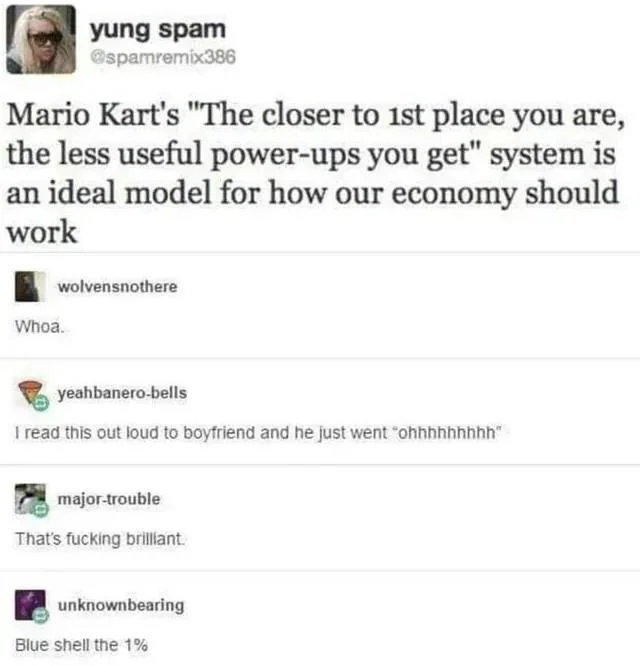
My proposal here is to have universal access to basic resources (not income, that’ll just deal with inflation), with some currency available to earn/use if you’re the type of person who wants to play with extra stuff. Any innovation that has a certain percent of the population adopt it or is integral for a certain period of time becomes socialized as an assumed resource, but creators are welcome to make money off it until that point. I, too, would love a population of intrinsically motivated people who would just do neat stuff as soon as basic needs are covered, but all my time in organizing and managing people says that’s just not going to work, and so we do still need a market here.
That’s it
The devils are of course in the details, but I think that’s the extent of how this could be set up.
Let’s talk with each other to suss out some of those details.