In talking to someone I would rather see as both infallible and immortal about going under the knife, I lightened the situation by telling them they could be altered within several deviations of themselves and still be tolerable. Bantering with SJ around what are organs even for, if you don’t need entire parts of them, lead us somehow to my drawing this image.
This is about 3 times too long, and definitely too waxing-poetic to be my statement of objective for grad school applications. But I’m proud of having written it, and wanted to share.
Back in 2006, I was discovering my first ever capital-F Future. A class at Indiana University called Religion, Ethics, and the Environment took a couple weeks to explore transhumanism. As a superhero-apathetic comics nerd, I had known about weird futures, but had never quite understood that I could have a role in building them. Suddenly, here was a route to building a better world, rather than failing into another stopgap of less-wrong. I was set on a path of not only understanding, but intentionally building a world in which our constructed technologies meant making it easier to be a Good Person connected to other Good People.
A year later, having completed a Bachelor’s in Sociology and an honors thesis, I landed on my feet in Seattle. I was ready to go to one of the law schools I’d been accepted to, around the overly specific topic of the meeting of organic and digital in prosthetics. Who would own the data going through your cochlear implant? Could you opt into a more dexterous mechanical hand if you still had a healthy biological one? Continuing on with the transhumanist discussion groups I had been organizing and moderating in Bloomington, Indiana, a new community of Future-thinkers began to form in Seattle, from all sorts of backgrounds and disciplines. Upon discovering the Electronic Frontier Foundation, I suddenly had the freedom to build those strange Futures alongside the likes of those in the discussion group, those I would have dedicated my life to defend.
But in building those strange Futures in hackerspaces, -camps, and -conferences, I started to be unable to ignore a concerning trend: these were event and physical spaces for those already self-aware- and resource-enabled-enough to participate. Where were those who were less advantaged? The appalling narrative of “they’re just not trying hard enough” made me reconsider the groups I had come to call family. The lack of historical awareness in the entire community was in myself only mitigated by an acceptance that the world was full of things I had not yet learned. Focusing on spawning our future family, I turned attention to establishing Jigsaw Renaissance in 2009, one of the first makerspaces.
Makerspaces are schools of the future, intergenerational and transdiciplinary project-focused communities. They are extroverted versions of necessarily-introverted hackerspaces. I spent another two years focused not only on Jigsaw, but also on Space Federation, a way to link together spaces, to share non profit status, tax processing, zoning negotiation, etcetera in the same way we geographically shared milling machines. We were more frightened of papercuts than of laser cutters, and making do in the existing world while building a new one was no small task. Again, we intentionally built the Future we wished to see. But this time, the arc matched that of my (arguably onging) goth and cyberpunk days. The idea was so good and accessible that everyone wanted a piece of it, at least for a moment. We fought internally about who we were and what was worth negotiating. The clear paths to legibility which would make rent easy to pay also made us less of what we were. We had been a new Future, but slowly changed instead into blocks filling gaps in understood structures. Shop class returned to high school, but what made makerspaces what they were (and some still are) – the wide open space of possibility and innovation – instead stifled in the inorganic and proscribed state that also made your insurance agent know what box to tick.
As this happened, before it was a clear pattern, I had also started building Geeks Without Bounds. The same primordial ooze of possibility and energy in hacker- and makerspaces was also in digital humanitarian and disaster response space. They made things, but they also made them with purpose, many focused on not leaving populations affected by horrible situations dependent upon the aid sent to them. This was it for me – all of the starry eyes, coupled with an ability to get hands dirty, and the clear intention based on historical awareness of including all parties in the process. I still travel the globe helping people from San Francisco, to Port-au-Prince, to DC, to Nairobi, to Berlin understand just how much they have to learn from each other. Unsurprisingly, the formal sectors in this space care to learn from the informal and disruptive – but many of us on the informal side have gone through the co-option cycle at least once, and are wary of how to interact. In part due to this, no one benefits from the experience and ability of the other.
The same tensions from hacker- and makerspaces exist here, manifest most clearly in hackathons. Born from hacker-spaces and -cons, adopted by open source and commercial endeavors, now taken up by entrepreneurship initiatives and my own response and social good space, these events have the promise of actual revolutionary innovation in the same shallow breath as being mere publicity stunts. Digital response groups struggle with, I kid you not, nearly the *exact* same issues that hacker and makerspaces have as they gain traction. This is most clearly an issue of how to standardize and transmit history in an agressively informal space. I simply cannot stand by and watch these trends happen again, especially not in such a promising endeavor. With the clear understanding and credibility a Master’s degree would provide, this is a trend that can go less wrong this time with the right sort of guidance, and even better in the future. We can have that capital-F future, but it’s not just about building another technological advancement.
At first we spoke of a gleaming future, but didn’t know how to build it. Then, we could build things, but didn’t understand to what purpose. Now, snuggled (or forced?) down into this niche, any lesson learned is necessary to extrapolate by setting it up to be translated and universal. This is not a universal-design approach, this is a self-examining and correcting social script. First, we reach the people building things with purpose and awareness, to make their lives and their interactions building that Future easier. From there, we will mentor those building things, but lacking awareness. Then we can move to those who wish to build but also need context. These are social constructs which can be built with the same intent as our well-designed technologies and transmitted via workshops and comics. More than a possibilty, though – this is an imperative.
These trends are so clear cut as to be glaring. And the solution is not more technology, it is stronger social fabric through intentional building. If the distributed, adaptive, aware systems we build truly are to make humanity better off, humanity itself must also be tended to.
In the same way I used to shake my cyberpunk fist at my steampunk friends, the issue is this: to act upon, rather than bemoan an incomprehensible system does not mean recreating steam engines so you can see where the gearing is warped, it means learning how to solder. In this moment, we cannot blame socioeconomic differences, atrocities, and low adoption rates on failing computer technology, we must start to look instead at understanding human connections in the new digital age, and constructing that with even more intent than with which we lay out a new circuit board design.
We went on safari in the national park, waking up so so early and adventuring first around parts of Nairobi to find Andy, new cohort in action and humored outrage. Backroads and hanging out of the car window asking for directions, every interaction a moment of pleasantry and shared experience. Francis, exhausted from funeral travel the day before indulging our awkward questions and changing plans, finally looking less emotionally exhausted after a chicken lunch.
A giraffe rather immediately looming on the left, blended with the forest, perturbed to be interrupted but not worried about us. The immediate dispersal of any remnants of jadedness I might have felt about being outside, and joy in seeing a creature move in unconstrained strides. Later seeing young giraffes fighting, I hope in play, but likely not. Spotting the “Kenya Express” of warthogs nestled down in the distance, called as such because they run from wherever they are to whatever their next stop is. I might like them a lot, given that.
Stopping into the animal orphanage, Andy and I excited about animal conditioning and release back into the national park, our wilted demeanor as it dawned on us both that the area is essentially a zoo. At some point, lingering behind the guides for this area and our expedition, I referenced the Calvin and Hobbes cartoon I had been thinking about, and he laughed that quiet desperate laugh shared by so many people with a certain level of awareness and care. We took our weary selves to iHub, and immediately met up with Kevin, an amazing human being and fantastic guide for further adventure, of course also connected via Sasha.
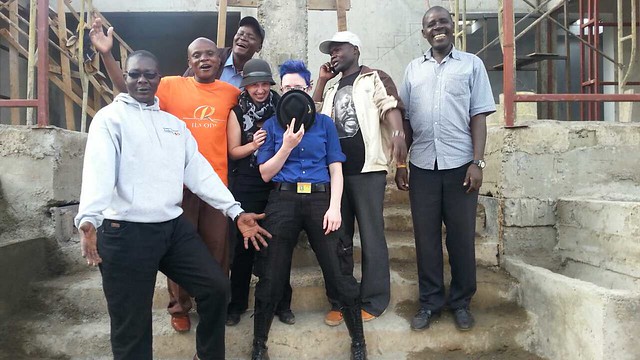
We took the matatu to Kibera, instead of a taxi, walking after we arrived to the area, exploring the new permanent building being built at the outskirts. It will hold toilets, and offices, and a meeting space. The solid walls are a rarity here – especially the doors – and a welcome shift from the compounds we’ve been on for the past week. Bankslave is around the corner of the building, laying down the priming layer for a mural he’s working on with other folk, expressing hygiene as empowerment. They’ve run into a problem – a small swimming pool, or rather, ditch, in the way of the scaffolding they’ve set up. We work with them on problem solving before wandering deeper into the slum.
We walk for a bit, and then pause, waiting for some folk to join us. Nearby, children crowd, staring, whispering and laughing. When I turn around, they point at my head. I remove my hat, they shout “blue!” One asks “are you a boy?” “Nope.” “Why are you dressed that way?” “Because I look good.” They nod. One notices tattoos peeking out – I went for the dress shirt but not bow tie and vest – and I discretely show the top of the ink. They chatter and gather around. I hand out dum-dums, and they run away.
Before we head down the next road with our growing cohort, the difference between “politically dangerous” and “physically dangerous” is explained. The folk working on Human Needs Project take us through the slums, insisting we take pictures, showing us local artisans, subtly and simultaneously protecting and showcasing us and their home to/from each other. They have born a hole so deep that it brings clean water. They have set up a way to collect it, and the surrounding building will hold laundry, and toilets, and offices for local initiatives. They will have wifi and computers. It is too expensive, and too daunting, to go see the innovation centers of Nairobi, so they’re bringing a center to Kibera. We speak of education, and of shared joy, and of politics.
I’ve seen, this week, what it is to be surrounded by people who give freely of whatever they have, without question or obligation. What it is for someone to know what actions must be taken to see the community of which you are a part be better off. There is an unassuming but persister baseline of giving in Nairobi. Any overt transaction is heavily negotiated, but giving is freely done.
The stressful process of the Nairobi airport, seeing Brenson and Josh and Oliver from State Department again, what are the chances (passed them also on safari), and hugging and wishing each other safe travels. Two more security checkpoints after that one, the first having separated Lindsay and myself rather abruptly. And now I sit on the first leg of a very long journey, obviously but not comically demonstrating the opening and using of our food packets and seat configurations. The gent in the seat next to me carries an International Organization for Migration packet, and studies from the sides of his eyes.
I’m ready to be in another home, and feeling heart-warmed and -torn for finding yet another one. Three homes in as many weeks, Boston> Nairobi> Seattle> Boston.
Blog entries will follow about being in Nairobi. But right now, I’m sitting in Arabica on Capital Hill in Seattle, lovingly crafted cappuccino in hand. Patrick Watson plays on well-placed speakers. Everyone wrapped in layers of natural and earth tones, typing, sharing space, and air. Branches cast shadows on skulled wall paper, and I am happy and at peace. I love it here. So many homes, and somehow always home sick.
The last month has been really stressful. None of my people have died, though, and I’m not left destitute, so it’s not as bad as it might have been. Perspective and all that.
Boston gets communal shipping containers to Burning Man, given the drive there is more daunting than going from San Francisco, so many folk ship things and then fly. This gets packed up and sent out about a month before the Burn, so folk with early arrival also have their things. A friend I was camping with was in another country, so I was handling some of his logistics as well as my own. The ship-out day was the Sunday of CatCon. It was stressful, but it got done, with many hugs and love to Ethan and Jess.
Packing for that was complicated in that I was also packing to move, and hosting three amazing people for CatCon. I also then needed to parse out some clothes for my return to Cambridge on the 2nd as my boxes would be in my old place (with people I didn’t know) until the 5th. I would then move into the new place, have 2 days to unpack my boxes and pack for 2 weeks in England. It had been 3 days, but I booked a train ticket down to NY to spend time with a friend. My request for strange platitudes on the trusting expedition into the world was met with this:
The universe is vast. You are also vast. So is an ant. There are different sizes of infinity.
— Night Vale podcast (@NightValeRadio) August 17, 2013
Burning Man was fulfilling, but stressful, as per usual. I burned my self that couldn’t learn to be good enough at Temple.
I did not get time to decompress afterwards. The flight back from Reno to Boston through Salt Lake City was overbooked, and they offered flight credit, to put me up, and to do my laundry if I waited until the next day to fly. I agreed. I got back to Boston and got some work done. Then I visited my old home, stacking boxes on the porch to be transported to the new, a chest cold settling in.
Upon arrival, I found the vines on the outside of the house had grown INTO my room, cracking a window. The wall paper was peeling. It was not a state into which I could unpack. I started peeling wall paper and moving boxes into the basement, while a persistent beeping went on outside my windows for a half hour. “Geeze, neglectful neighbors,” I thought. Then, the fire department showed up. Seems the previous tenants had thrown out a bunch of stuff, including the smoke detectors, and left the trashbags along the sides and back of the house. The fireman came into the house to check for detectors. There were definitely not as many as there needed to be. Nor a carbon monoxide detector. Because of the trash, the fire inspector had to be called. And the health department. They recommended I not even unpack, as they might have to close the house if it wasn’t up to code. The landlord came and promised to get some things done on a timeline. My traveling buddy had a death in the family, so I’d be going to New York alone, but that was just as well, given the hosting situation. I packed for two weeks in England out of moving boxes, and left for New York, high on cold meds. Accordingly, I left my favorite jacket on the train.
The flight to Birmingham, England, was a haze of meds. As a facilitator, being stressed from a move and sick set a poor mood for the event. As I felt better, and as the attendees gained understanding of the initiative, we got traction and got some epic things done. More on the GWOBlog in a few days. I left for London feeling accomplished. London and I do not get on well, but Ella and Laurie and Arthur were there, so lots of work and good socializing got done. We pulled off an OpenITP Technoactivism Third Monday meetup which went pretty well, though I spent about 5 hours that day on transit, some of it lost, much of it just slow. The next day I headed to Nottingham for FOSS4G’s MapHack, where I was meant to help define and guide the group. Instead, I spent the day having a panic attack in a friend’s hotel room.
The morning after that I woke up at 5a to train from Nottingham to Birmingham to catch my flights from there to Amsterdam to Minneapolis to San Jose, where I was meant to get to Santa Cruz to learn from Monica, who has also agreed to mentor me in facilitation. Lodging awaited me, but the shuttle that late would have taken 3 hours and a couple hundred dollars (making it equivalent to a taxi). Exhausted, finally recovering from sick but not from anxiety, not knowing what I was returning to in Boston, I finally balked. I bailed on something I was very much looking forward to in the short and long term, caught a bus to Caltrain, and went to San Francisco. The self that couldn’t learn to be good enough would have gone, and been broken, and been broken further. Instead, I took care of myself. I decompressed for a few days, boots up on the coffee table, with people whose faces I like, and my wifey, and good food and fine wine. I returned to Boston to strip wall paper, and ride my motorcycle, and settle into my new space and roles. I’m TA for a Codesign Studio at the Media Lab. I’m getting ready to take the GREs. My walls are a pleasant slate color, and my art is prepped to hang.
German German Spackle Party
When people ask how I’ve been, or why I look so tired, I can only respond with “it’s been a month.” No one close to me died. I wasn’t left destitute. But I am incredibly aware of how my own privilege in being able to recover from a bad month with relative ease, and only a slight beating to my soul. I’m equally aware of how smoothly most of the things in my life go – regardless of how difficult or dangerous the situation I’m in might be, having the confidence to laugh and assume it will work out is deeply rooted in a safe childhood and continued strong social ties. While not everyone got the former, I can help to provide the latter. (Is it too cheesy to say that you can, too?)
Many years ago, when I was in undergrad, a layover in Minneapolis for a flight from Indianapolis to Kalispell turned from 2 hours into 36 hours. This was upsetting not only for the obvious reasons, but also because I was meant to be hiking in the Rocky Mountains with my family. But, alone time is always a welcome respite, and I was excited for a whole day to explore a new city! This was in the time before smartphones were ubiquitous, and while my trusty Palm (still heartbroken that these no longer happen) would let me draw on pictures and send email, it was not the yelp-toting, google-mapping device of Today. Out of preference, history, and necessity, I was reliant upon local knowledge to while away the hours.
The airport attendee, the cabbie, the hotel desk clerk, and the restaurant server all told me to go to the same place: The Mall of America. While skeptical, my sample size was as large as I could muster given my resources, and so I set forth. And it is indeed an experience. Over 500 stores. 40 million visitors a year. Aquarium in the basement and a roller coaster on site. And when I saw the Mall of America souvenir shop in the Mall of America, my brain kind of died a little.
And then I found the LEGO store. My first LEGO store. And all the blocks were perfectly sorted into separate bins, and there were giant LEGO dinosaurs, and the employees looked like ex-engineers who were either the luckiest or the most degraded to be wearing the LEGO apron. And then. Then I saw the most amazing shirt I’ve ever seen in my life. It was the astronaut LEGO torso. And sure, it was a kid’s size, but I was running and lifting a lot at the time, so I was fairly svelte. I looked at it, and I looked at myself. I hailed one of the mustached employees.
“I’d like to try that on. Think it’ll work?”
He eyed me over. “It says ‘6+’ (meaning age) You’re more on the plus side of that, but sure, it could work.”
“Have a changing room?” I asked.
He looked around the glass-brick semblance of store walls. “It’s a LEGO store.”
“Right.”
I pulled my soul-mate shirt on over my tank top. It fit – but was pushing it, my belly button attempting an awkward Peeping Tom lurk from the bottom, my retina-distroying haunches indecently exposed over the low-rise pants so prevalent Back In The Day. Sadly, the glory of the shirt and I were not meant to be. The saddest of faces. I would have to go distract myself from my grief by vindictively laughing at the fish in the aquarium, my third time through that day. I’m terrified of fish, and eating and viewing them is the highest form of victory for me.
Then I tried to take the glorious shirt off. I have some fairly hefty shoulders as it is, but I’m also prone to absurd muscle mass when instigated, and as I say, I was in the practice of light lifting at the time. The nylon panels of the front and back did not stretch. And the elastic bands at the sides were at their limits. I blushed fiercely as I tried, first solo, and then with the disgruntled engineer, to move the beautiful article of clothing past my mass.
Eventually, we won out. Hung the shirt back on its hanger, stretched and warped. We contemplated it together.
I’m totally willing to pay for that.
Meh.
Want to grab a drink, now that you’ve gotten me out of my shirt? I think there’s a bar on the third floor.
No, but thanks.
And that’s the story of the day I was at the Mall of America.
I’m sitting on a repurposed fishing boat, which is now an art, music, and hacker venue. Last night I toured the guts of it, slipping between shoulder-high engines, the air smelling of diesel and slick oil. Doors hiding computer terminals, and audio mixing setups, and soldering stations, and a lathe so large they must have built the ship around it. Blo letting me onto the bridge, where the only piece of new equipment is the mandated ship locator and broadcaster. The crew asks for your preferred language and then your name when you enter the tiny mess hall, a window cracked for the hand-rolled cigarettes. I now have just enough German to nearly state that for my language, but am still too self conscious, so instead I listen to theirs.
View from my room on Stubnitz
It’s the first quiet time I’ve had in a week, the last being a six hour moto ride through the English countryside. Sheep perched on stone walls, eyeing us as we went by, hugging curves and throttle. Between then and now have been hours of hard work, rockstars of response tech tools building and conversing, finding overlaps and launch points. Between that and the ship were also bombs in Boston, staying up late into the night funneling the energies of people seeking information, freeing up brain cycles to respond rather than question.
And today was Camden Market, strange back alleys and food smells. Wandering aimlessly with no purpose, simply to see and examine, ask and listen. The papers held by passengers on the London Underground all have Boston on their front pages. Half the emails in my inbox are the same, the vast myriad of my social (fingers in) pie (charts) exhibiting ripples. I find a shop that sells mediocre doner and examine horse statues. Tomorrow is Krakow, after the flight to Warsaw and the 3 hour express train. The distraction and calm are perfect in coping with the vast ocean between me and anyone I could be hugging, which is the most I could be doing right now anyway.
Tonight I’ll sit on my tiny bench on Stubnitz, with my too-quickly-ending book, and listen to sounds of an empty banking hub from out my window. The disco balls will hang deep in the ship, refracting light inside the hull; and I’ll daydream about sailing away with them, with spotty wifi and floors to scrub, to write about what I haven’t yet researched.
First, let’s get the initial argument out of the way. Sexism exists. It definitely exists in tech communities. There are long-standing scientific studies on it, whole departments of colleges based around it, and the next person who thinks we’re past it (not “doesn’t want to talk about it,” but thinks it doesn’t exist)2 is being taken out back to be flogged as a fundamentalist3. Here’s a handy timeline. This entry deals mostly with women and sexism. You all should know by now that “women” is but one word used to refer to an area of a matrix, but I feel like using my wordiness on other topics today. Know that I’m focusing on one facet of an entire intertwingled object of marginalized populations4.
Everyone grows up with social scripts, unless they are raised in a box with no interaction with anything (no way IRB is letting you do that one!). The cadence of your voice to your posture to how you indicate interest are all influenced by social scripts. These scripts abstractly guide how we interact with one another – we are cued from past interaction, seen or participated with. This is part of why it is difficult to get women to speak at conferences – because they don’t see the value of their words, because the bulk of interaction has pointed at that5. Individuals from the projects won’t take a promotion because authority is seen as negative, and they don’t want to have authority over their peers. And because these roles continue to be filled by not-that-demographic, that-demographic never sees that it’s possible for them to do it. Women specifically are also socialized into letting people down easy and into making space and providing support for other people and the group over themselves (which is great when it’s reciprocated!). So, a society that objectifies women also sets the expectation that they will be objectified. We tend to grow into the expectations set on us6.
When women talk about being cat-called on the street pretty constantly, and the response it “I don’t see that” from her male peers, that is because they don’t. It doesn’t happen (as much, or at all) when they are with her7. And they don’t know how to be aware of it when it does happen around them (and are often participating in it). As someone in the penumbral8 space of gender norms, let me queersplain something to you. I don’t get catcalled much, because the way I walk and interact with people is pretty head-on. I am not scared to get in fights, to make eye contact, and to call people on things (most of the time). My upbringing is to thank for this. My parents consciously reduced the amount of exposure I had to mainstream social scripts through television and magazines. They made sure I felt comfortable in my own skin. My self-possession is a learned behavior9, and one that I am privileged to have obtained early on. But because I apparently also have hips, harassments still happen to those around me. I see it on a regular basis, and have to constantly decide if it is worth engaging in conflict.
Persistent, low grade harassment is so invisible until seen in aggregate, that when someone does snap, it’s seen as out of proportion. We have the ideas of straws and camels backs, and practice of drip water torture for a reason. Small things add up. When asked to laugh with you about the absurdity of the situation, and that “dongle” is indeed a funny word, maybe the laughter will be a beautiful moment of shared understanding. But when it’s not about the abhorrence at the system itself, such comments are instead just another straw. It can’t be taken lightly because it’s one of many. The individual voicing that comment is responsible for being a part of that load, when in fact they should be actively lightening it. The people who share that load with you get to joke with you about how utterly ridiculous it is that you can’t be using your strength to carry other things. It would be easier to just roll with it, but that also continues a culture that makes such comments ok. It is harder to fight.
Which gets us very smoothly into this whole Pycon thing, and how Adria is a very public figure.
When you are a highly visible person, you are expected to adhere more closely to the outlines of social scripts. For privileged populations, that means being MORE of what indicates success – demanding, manic, callous. If you are from a marginalized population, it still means fitting MORE closely to those expectations within that demographic. We call them archetypes for a reason. Individuals from those populations, rare already in roles associated with success, are demure and muted so as not to tip a boat they already feel shaky in10. At the same time, people of privilege are socialized to retain their privilege. Two to tango and all that. Because of all this, I feel a public response to a systemic issue occasionally trumps individualized response11.
The thing about this specific situation is that the same startup culture which claims Safe Space To Fail for tech doesn’t provide the same support and space for learning social lessons. Social lessons which are hard, but somehow the technical community has persuaded themselves and the rest of the world they are exempt from learning. That inability to care for our own, let alone others, is killing us and keeping our brightest from finding home.
The reason this debate is so visible is because it shows the tension between what we think is the case (why some will think this is dead-horse beating) and what is (many people’s daily existence). It shows the tension between where tech and social affect each other. And perhaps most tangibly, it shows the tension between the ideals of our society and our shitty labor laws. No one should have been fired over this, though we should still be having discourse. Hate to say it, but the same patriarchy12 that makes all this shit a part of everyday experience for so many is also what upholds the idea that your employer knows best and you have no desire nor ability to stand up for yourself and each other.
The response here is not more in-fighting and drama (which are not even true responses). The action here is to realize where the flaws are and to band together, to have nuancedconversation. We need unions. We need to support marginalized groups while not infantalizing them by taking control of their own ability to stand for themselves. It’s hard work. No one said it would be smooth, but brilliant people are used to sticking to what comes easily.
1. (Can it be a wizard hat? You bet your fingers it can be)
2. This is like saying racism is done in the US because we have a black president. Your desire to move forward blank-slate does nothing to the actual starting point of a vast majority of the population. Lack of acknowledgement of history is what is preventing many potential allies from doing anything except perpetuate the current state. Handy Infograph.
3. It’s the equivalent of someone saying “I don’t believe in webpages” and you saying “but you’re reading one right now” and them saying “silly coder, you really should look around you.” If they actually decided to figure out what you were talking about, you might sit and explain it to them, open up conversations, give them a book. Here’s my favorite starting place for feminism: Said the Pot to the Kettle: Feminism for Anarchist Men.
4. Which is what meant by references to “minority,” we mean “represented in the minority” – a language misstep that I do not intend to keep making. This misunderstanding of “minority” as “population minority” is similar to cracks implying scientific “theory” is a wild guess.
5. I challenge you to observe a room of people and tally how often people are checking their phones when a man is talking versus when a woman is talking. Audiences indulge in distraction far more when a woman is speaking, and not because of subject matter knowledge nor presentation style. Imagine how that effects your self-assurance when doing public speaking. See if you catch yourself checking your own phone more often in different cases.
6. Whole other entry in the works about halo effect and expectations vesus desire. But I didn’t want to overload you right now.
7. If your response to this is just always having a male companion, you are an event-addressing, non-systems fuck.
8. (insert favorite word into a ranty post +10 points)
9. Just as yours, or lack thereof, is learned.
10. I keep my blue hair, let me tattoos show, don’t hide my sexuality not only because it’s me, but because it also sets the tone for future people. It is a conscious choice, and one that sometimes detriments my ability to make professional progress. My subcultural markers are opt-in. My sex and sexuality are not. My desire to have all of them show is something I choose at personal cost for societal gain.
11. Only addressing these things individually is like playing whack-a-mole.
12. Look how far I made it in this entry without using the word! Look look look!
Sometimes I wonder if writing about a family member or friend who has recently died is sort of like telling someone about your dreams – fascinating and useful to you, but completely without the same meaning from context for them. This entry is a celebration of someone who aged with incredibly good humor, and who has been a steady thread in my life. This is what it is to have deep roots spread wide.
Grandma Irene Murphy died yesterday. She’s been ready to go for years, but some subset of her eleven children weren’t. Which means she hung on, being revived when she slipped too far, living in the same house she had for 30 years, with a rotation of those children and their spouses taking shifts to care for her. We moved her bed down into the same room Mammy (her own mother, who was married to Pappy, and whose actual names I will never remember) had lived out her final days some twenty years previous, with notably less joy than Grandma. It was the third house Irene had taken the kids to, after the farm, the farm being after the house on Spear Street.
The house on Spear Street is now my Uncle Bill’s. Decades earlier, they had left it for the farm when my Grandmother had packed all the kids in the house out to it, fleeing her abusive husband Charlie. My grandfather Charlie, who taught me that assholes can be assholes to anyone, not just to their own kids, and not always behind closed doors. Charlie who used to sit at the kitchen table drinking Budweiser and smoking while basketball blared on the living room TV, taking up all the space in the house he could. Charlie who used to “take his kids out for the day,” leaving them to play in the car while he sat in the bar and drank. Charlie who could also be genuinely gentle in the strangest of moments, making it easy to forget. Charlie, whose children not only fought to protect each other and their mother from, but also their own children.
It wasn’t until I was in college that I learned about these aspects of my grandfather, of the deep reasons behind the strange giddiness Irene’s children experienced upon his death. This amazing woman, their mother, my grandmother, was finally free to play and make space for herself in more than passing moments. I had always assumed the move to the farm, and later the move to their final house had been of choice or necessity, not of flight. Their last house, where they both lived out their lives, was two away from Peggy, proximity to family some sort of safety, at least a place for the kids to escape to. The house separating Peggy and Irene was later purchased by my parents, where they still live, and where I grew up, the house undergoing slow remodels around me as my own body and brain changed. But always, always, grandma next door. A door that was never locked, and a motorized easy chair, and saccharine pinwheel cookies, and electronic poker games.
Nine of their eleven adult children live in my home town, scattered in a radius around her home. The tenth lives beyond city limits, and the final is in California, buying grandma’s house from afar so she had income and so it would stay in the family. All the children’s kids live within a few hours’ drive, and Mary’s four children live in the state, and Theresa’s fourteen children have scattered across the country but stayed away from the coasts. In short, it was incredibly difficult to throw a party as a teenager. But grandma would sometimes look at me with this glint in her eye, and her laugh sounded like getting away with it.
She loved murder mysteries. We used to watch Columbo together – there was no TV in my parents’ house, but I was allowed an hour of television over at grandma’s on rare occasion. She was convinced John Edwards was legit, and that angels watched over us. She made curtains before her hands got bad, and would let me sketch child thought-scapes with chalk on scrap fabric, and examine how her sewing machines worked, and hunt for dropped pins with magnets. She liked my blue hair, and objectified my boyfriends, and missed my mohawk (but was glad I had grown it out). She told me I needed to give her a motorcycle ride, and if I wasn’t willing to take her, it wasn’t safe enough for me, either. She chose Baltimore when my parents offered to take her anywhere at all in the world. She laughed at herself when she had no idea what was going on, and she didn’t mind at all that she had heard the joke before but forgotten the punchline. As she slipped deeper into dementia, she cracked jokes that no one else got, that no one else had context for, and she still laughed like she was getting away with it. She aged with incredible good grace and humor. And when her children had finally gotten to see a mother they had only seen glimpses of while growing up, when they were at last ready to let her go, she gratefully and quietly died.
I just got off a plane to Indiana for the wake. A wake where so many Irish-Catholic family members will attend we simply call people a generation older “aunt” or “uncle,” anyone younger “niece” or “nephew,” and anyone your own age “cousin.” My Uncle Mike (not even a full year younger than my father) will point out the faint four-poke scar he claims is from my grandmother stabbing him with a fork when he wouldn’t shut up at the dinner table. (Mike who also once told my cousin RD that a lion had bitten his leg, rather than explain Vietnam and mines and what it is to have a toe tag replaced by a purple heart, so that’s the sort of trustworthy he is.) Her great-great-grandkids will still be in diapers, unless my sense of time is completely off. We’ll bring out albums and stories and track mud into the home for which we exhausted the local framing store in a vain attempt to keep up with the propagation of this family. The hodgepodge collection of folding chairs will be brought from every nearby house, nearly enough but why not pick up another mismatched set. Everyone will bring a casserole, spilling off the kitchen table and onto the nearby counters. Someone will turn on the TV, and someone else will mute it. Aunt Suzy will wonder why I insist on wearing a tie, and an endless line of nieces and nephews will insist on airplane and piggy-back rides. We will play with blocks and marbles and race matchbox cars. (And I, for the first time in years, will not hide myself away in front of the recently-emerged fireplace in my parents’ home with glass of Bailey’s, furious with myself for anxieties.)
As the night wears on, and the children go home, we’ll drink cheap beer and reminisce about a woman who brought so much joy despite everything in her path. We’ll remember sitting in our shared yards as night fell, lightning bugs flashing and the smell of a recent rain. We’ll remember how she protected as best she could with the beliefs she had. How she left Charlie’s presence but never his side. How she made what was never enough food or money or hours sustain so many. How each of her children coped with that upbringing. How some, my father included, got themselves out – and how that meant leaving others behind. The ties of family, and of love, and of dreams, and of responsibilities. What it is to protect your family from your family, and see those patterns repeat. What love is, no matter what, even if you don’t want it. Love without the need to understand. Love that sometimes lacks care, and the kind of love that combats that. In the morning, we’ll shine our shoes and go to church for her, albeit less begrudgingly and a little bit more hungover, one last time.
In short, it will be business as usual. Celebration of life, celebration of death, and the ever overwhelming presence of family.
The day I arrived in Port-au-Prince was a whirlwind, joyful and strange and a bit overwhelming, soothed by stints of reading, and coding, and a nap. Adaptation is something all humans tend to be incredible at, myself being no exception (and possibly programmed to be even more so). Learning new social cues is fascinating rather than daunting, my main concern being not to fixate too long on any one person, lest they be put off by my stares.
That night, Emilie and I walked down the hill to a new restaurant/bar, recently opened. My own friendliness matched by one of the owners, Em asking if we already knew each other, given our laughing and kissing on cheeks (no hugging here), comrades in awareness and intent. He wants the area to be the Castro of Port-au-Prince, helping others to open shops and bars nearby, seeing the cultural shift rather than the competition. I feel the beginnings of something big – possibly struggle and tragedy, but more hopefully the expansion of the safe space we experience in their courtyard out into the streets. The weather had cooled, and the open floor plan with beautifully graffiti’d walls reminded me of Berlin. Brazilian pop played, and we capped our beers and talked for long hours. The same kind switch to English, accented by French and Creole here rather than German, so that I might participate.
Lit by oil lanterns, I feel the sort of quiet happiness you only get from stolen moments, the knowledge that you have participated in safe space when which is rare outside your bubble. But too often we long to use these spaces as sanctuaries of permanence, rather than celebration. Mecca is where we go to understand the world we strive for on a daily basis, to remind us to look up and see, rather than feel like we taking incrementally smaller steps, like some role in a philosophical mathematical proof. To be only around like-minded people is easy and wonderful, we can dive deeply into our shared interests and create esoteric structures of understanding. But those structures are fragile, not shored up by webs of links to other aspects of the world. And it is selfish to hoard those understandings, to not challenge ourselves and other people. As I recently read on the twitters, “design like you’re right, listen like you’re wrong.”
And yesterday, I found myself amongst a group of hackers who gave up their weekends to fly continents away. They learned to interact at a different pace, waiting for translations. They learned just as much as the students and call center staff who came to talk. A day spent in a hot room, wind drifting through, my own tie and vest and dress shirt too much. My eventually exposed shoulders disrespectful but for my own profuse apologies and broken english allowances. One founder saying “the heat is a violence against you,” me not knowing possibly how to respond.
A sudden rush to get out the gate before the street is repaired, who knows where the means to do so came from. Despite our attempt to collect our equipment and pack into bags and into the truck, we are left watching as 7 Haitian men spread a small hill of asphalt via wheelbarrows and shovels. Rather than hover, we walk up the steep hill to drink beer from a shop made out of plywood, held together by a nail gun, and hand painted in more of this language I fail to grasp. The sun sets over the ocean, reminding us that we’re on a tropical island. Well, that and the mosquitos. We finally see some cars come up from the road we came from, and we head back to our Van of Privilege.
On the way to dinner we stop in a gas station supermarket to change money and get local rum. Again, children giggle at my hair (and the now showing tattoos) and stern adults walk them away. The numbers etched on my skin having an extra layer of indiscerability here. The harsh florescence and my own exhaustion make this a less welcoming place. Blocks away, our dinner includes goat, and taro root, and a very polite cat who holds the chair at the head of the table. The cat’s body language renders understandable, though I’ve struggled at times to understand the social cues here. I’ve realized how much of my interaction is based on wit, and compassion, and a deep understanding and care of what people expect and can handle. Here, I have none of the same leeway (because I have not built it, because I do not understand). It is atrociously good for me.
We return back to the hotel. Expats around tables, snow-marked (not pixelated) Alan Rickman and Bruce Willis on same small screen which showed Se7en the night before. We talk about making safe space for people in taking leadership roles (or at the very least being heard) who might not otherwise, and what it is to learn new things, and what tomorrow looks like.
This morning, I forgot to think about if I was being proper or not, and joked about my stick figures, and heard about cocreation. We played Bear-Ninja-Cowboy in the courtyard, and everyone laughed and cheered. Today they have a lot of work ahead of them – not the kind of work you plow through on your own, but the kind where you ensure the people around you are on the same page. Today is about building consensus, buy-in, and understanding. I am excited.