V&TC summit summary

Huge hearts to Galit for so much help on this doc, and to Matt Stempeck and Heather Leson for their heavy input.

On October 10th, a small group of Volunteer and Technical Community leaders and academics focused on crisis and humanitarian response gathered at the Woodrow Wilson Center in Washington, DC. The V&TC summit was scheduled to occur just before the annual International Conference of Crisis Mappers (ICCM) beginning the following day. The session provided an opportunity to establish and strengthen face-to-face relationships, open channels of communication to be built upon at ICCM and extend beyond the framework of the event.

The event was conceived and subsequently organized by Willow Brugh (Geeks without Bounds) and Pascal Schuback (Crisis Commons). The location for the summit was generously offered up by Lea Shanley and David Rejeski, both directors within the Science and Technology Innovation Program at the Wilson Center, in support of V&TC efforts.

A number of active community members from a range of backgrounds and affiliation were able to attend the summit on the painfully short notice we were able to provide, forming a dynamic group of individuals. The full-day session yielded a better understanding of challenges the broader V&TC network faces in responding to humanitarian needs and communicating amongst each other and with more traditional organizations. Ideas for improving upon volunteer response and organization were outlined, as well as a followup plan of action to provide continuation and solidify development.

Below is a summation of what was discussed, and how we hope you’ll comment and contribute.
Continue reading

Random Hacks at ICCM

The Random Hacks of Kindness at International Conference of Crisis Mappers took place this past weekend  (October 13 – 14, 2012) at George Washington University in Washington, DC. Humanitarian hackathons are specialized in that the hacks proposed are brought by subject matter experts who fully understand the needs and impact of a tool built out during the event. While not all events curate their challenges, we did at this one, with the esteemed team comprised of The Doctor, Robbie Mackay, Jen Ziemke, Heather Leson, Kate Chapman and Willow Bl00. They examined each of the 16 proposed challenges for usefulness, if it could be accomplished over the weekend, technical specs and feasibility, as well as strong use case. Our 40 participants piled into our tiny room to work on the 7 of selected challenges. 5 presented on Sunday afternoon.

Many thanks to our sponsors AT&T Developer Program and John Carroll University. Thanks to you, we had essential coffee, delicious food, candy and steady internet tubes. We were also able to award prizes to each of the teams.

Image by our very own Dymaxion

James with Amnesty International worked on Challenge #8  : Geographic Web Data Curation Tool with Nico from InSTEDD. This collaboration made me happy for two main reasons – one was that they were able to address James’s challenge with an existing tool. The second reason is that James, who came with little coding experience, took the weekend to learn about RIff and apply it to his problem space. There is a distinct issue in the digital humanitarian community of “Wasn’t Built Here” which adds to the already massive cognitive load of the responders.Extending an existing tool means we can keep using what works while making it better.

Clay and Jorge (Challenge #13: Mapping United Nations Security Council Resolutions) implemented MapBox by porting in UN Policies and geocoding them to the areas they were based around, matching a geospatial and temporal interface to search the resolutions issued by the United Nations Security Council. A quick way to see where the UN had been focusing, along with an easy pull on the referenced documents, this creates another way for people to search and catalog.

The Taarifa team linked up to a group in England to create the hardware trigger for a data snapshot from just about any input, along with the API call which would link up to that snapshot. A continuing hack from H4D2 (and other hackathons), we were pleased as punch to see this group working hard to see their platform for civic reporting push forward and build out their contributing community.

A subtle but powerful glue was created by Josh Snider while working on Challenge 15: Extracting info into SMS reports. A user could send in a text which would port directly into a wiki and geocode. If formatted incorrectly, a text is returned to the person asking them to reformat. The potential of messaging format issues could assist in the accuracy of content collected to so support digital humanitarians in processing massive amounts of incoming texts into maps.

Best overall hack went to the Humanitarian Markup Language (HXL) team, a challenge brought to the table by UN OCHA’s CJ Hendrix. It furthered the capabilities of this platform by doing creating an easy way to interact with maps, with special care payed to the visualization and interface – be still my linux-loving-mac-using heart. It eases the process of grabbing maps, uploading maps, and plugging them into what you need.Huge thanks again to our sponsors, and to the ICCM team Jen and Patrick for organizing the event our hackathon went hand-in-hand with. A special sparkle kittens to Heather Leson of Ushahidi for co-organizing and facilitating the event. I’ll match my blue hair to your pink hair anytime.

RHOK and ICCM share common goals of uniting the brightest minds for sprints of collaboration. This was the first time that RHOK occurred at ICCM. It was amazing to have guest subject matter experts join the hackathon to share their expertise with the talented developers and challenge owners. This is a huge opportunity to keep the momentum. A number of the challenges will continue on to RHOK Global in December. Willow and Heather will work with the folks to mentor their efforts. As well, based on the success of ICCM RHOK, we recommend that ICCM in Nairobi also have a simultaneous RHOK.
Specing out Challenges

Hackathons are a great way to move a project forward with new minds on the challenge and a big push over a few days, but it takes some skill to get what you need out of that push. The first step to getting the solutions you need is to make sure that your challenges are well written and well spec’d out. GWOB and AT&T are sponsoring a session to review some challenges and help you make sure that yours will work the way you want. We’ll review your specifications and explain exactly how they might play out at an upcoming hackathon.

Want to have your challenge reviewed in the session? Submit your challenge at this form by October 23rd, 2012. Include as full a specification as possible, including wireframes. You will also need to be on the call – you can register here.

If you need some help thinking through your specification, take a look at some of the challenges that have already been started on our Get Involved page. Have questions? Post a comment on the Get Involved page or this entry. We’ll keep an eye on good questions to ask people when submitting challenges for better future engagement.

Want to help review other people’s specs? Join us for our virtual unconference and working party via Google Hangout on Friday October 26th at 10:30am West Coast time (I’ll add people in by the email address they used to register, so make sure they sync!). We need people who do work flow, UX, backend, front end, telephony, etc. If our group is large enough, we can break out into separate challenges. Sign up here.

Once we have the reviewed and improved spec’s, we’ll bring them to AT&T hackathons and attaching a prize to each one. You’ll also be able to post your specifications to Random Hacks of Kindness for inclusion in RHoK’s semi-annual international simultaneous hackathon events attended by hundreds of developers, designers and subject matter experts worldwide.

Gender-Based Violence hackathon in Port-au-Prince

Originally posted at Digital-Democracy’s website.

Apply to join Digital Democracy for a Hackathon in Port-au-Prince, Haiti from November 8-12, 2012.  We are inviting American and Haitian developers & designers to address these questions and support the inspiring work of Haitian women’s organization KOFAVIV. For over 8 years, KOFAVIV has provided critical, life-saving services to survivors of rape & gender-based violence.

With generous support from Abundance Foundation and partners ESIH (Ecole Supérieure d’Infotronique d’Haïti) & Willow Brugh of Geeks Without Bounds, the Hackathon is focused on developing tools to help scale the impact of our current systems in two areas, resulting in three outputs that will dramatically improve the work of our partners.

1) EXPANDING THE CALL CENTER TO NATIONAL SERVICE
Last fall, Dd & local partner KOFAVIV launched Haiti’s first Emergency Response Hotline for Gender Based Violence (GBV). In May, 2012, the hotline transitioned to 24 hour service and currently provides women survivors of violence free access to information on services for medical, legal and psychosocial care in Port-au-Prince. In order for the Call Center to serve national clients, operators need easy access to a map of resources outside of the Port-au-Prince area.

Hackathon goal:
•  Build a web platform to map/aggregate information on service providers throughout the country. Skills in SMS, GIS, and Drupal are especially useful.

2) BETTER VISUALIZING DATA
Since 2010, Dd has worked with local partners to develop a cloud-based database to digitize information on incidents of violence. The system currently includes 50+ points of data on over 900 reports of rape and domestic violence in Haiti between 2010 and 2012. KOFAVIV is seeking to improve their ability to use data to advocate for increased security for Haitian women & girls.

Hackathon goal:
•  Develop live data visualization to generate visual monthly reports on cases received by local partners. Skills in Drupal, design, dynamic code, especially useful.
•  Identify new trends in existing data and develop creative ways to visualize data for advocacy and outreach. Skills in design, big data, and community engagement especially useful.

Join us!

If you or someone you know has skills in the following and would be interested in participating, please submit an application here (bit.ly/PaPhack) by October 9, 2012. Specifically, we’re looking for participants skilled in:

  • Drupal
  • Front end design
  • Graphic design
  • Dynamic code
  • Dataviz
  • Big data
  • Mapping / GIS

Participation includes Hackathon, travel, lodging, food and transport in country. All logistics taken care of by Digital Democracy. Estimated total travel and accomodation per participant is $5,000 with some scholarships available. For more information, about attending as a participant email Emilie Reiser – ereiser(at)digital-democracy(dot)org.

Become a Sponsor!

Help make the Hackathon possible. We are looking for premier sponsors as well as scholarship sponsors to help bring the right participants to the Hackathon. To discuss potential sponsorship, contact Emily Jacobi – ejacobi(at)digital-democracy(dot)org.

RELIEF summary part II

Co-authored post from Ella and Willow

Yesterday, you read about Civil Air Patrol and the basis of RELIEF. We continue that conversation today into security and the complexities of mismatched cultural backgrounds.

On the security side, Rogue Genius’s George Chamales and Geeks Without Bounds’s Eleanor Saitta spoke with RELIEF attendees about their systems. While the military and agencies like the State Department have experience with security in other arenas, recognition of the importance of security in humanitarian assistance and disaster response situations is an ongoing process. Security often isn’t intuitive, even for development groups with mature products. Beyond that, the landscape is often changing rapidly, as evidenced by the current state of mobile security. Just like in all areas of security however, outcomes are what matter, more than any theoretical state of security.

One of the most concrete security outcomes of the event, from George, was the creation of a test install virtual machine image of many of the open source tools in the humanitarian space, which can now be distributed to security testers. This will allow testers to quickly jump in and find potential vulnerabilities without needing to learn how the tools are installed and configured, reducing the overhead associated with pro-bono testing. Efforts like this one will feed into the larger project of professionalizing the VTC community’s approach to security-centric peer review and testing.

In addition to the longer-term work on the community process, Eleanor and George both had a number of specific conversations with different teams present at the event about the security of their tools. Some of this was skill-sharing and some of it resulted in actionable guidance for both the product development teams and the operational field groups. Apart from the technical concerns, understanding the cultural difference between how government organizations think about security and how the more Internet-centric security community thinks about it was productive for all parties.

It’s no accident that the cultures of different communities keep coming up here. One of the most valuable parts of the RELIEF experience for GWOB was learning the culture and the language of the government attendees. This is a wildly different crowd than the sort of people Geeks Without Bounds usually associates with and supports. While it was great fun to try to persuade someone from DHS to let us take a picture of a #HOPE9 Hopeland Security patch next to the real patch on their shirt (“of course we won’t get your face in the photo”), that’s not an approach that a lot of folks will be comfortable with.

Learning how to speak each other’s languages doesn’t mean that the cultural mismatch will magically go away – GWOB’s decentralized, bottom-up approaches are still going unnerve someone coming from a culture that expects strict hierarchical oversight. However, it does mean that they’ll at least understand what’s going on. On our side, we’ll have more of a clue of what their alphabet soup means and where we can find room to act and cooperate. One of the big open questions for the humanitarian world is what happens when these two cultures work together. Does one eventually override the other, or do we both come to an accommodation where we can both be productive and our ethics and their orders can live with each other?

Figuring this out is vital to the future of humanitarian response. Whole systems approaches are critical in the face of more frequent and larger disasters with increasingly complex infrastructure, and this includes both the scope of the response and its form. We need tools and structures that break down the silos that response groups can fall into. More than that, we need to let people cooperate directly — to encourage true decentralized response, where all of the resources on the ground can be brought into play. We can’t afford to rely on solutions that don’t allow people to self-rescue when that’s possible, and we must bring in affected populations with deep local knowledge as peers in our efforts. On the other hand, at least for major disasters within the US, the DoD will be providing the majority of heavy lift and logistics response capability. We all have to live and play together.

RELIEF was a small but important step in this direction.

RELIEF summary part I

Co-authored post from Ella and Willow

This week, Willow Brugh and Eleanor Saitta represented Geeks Without Bounds at RELIEF at Camp Roberts in California, an event that’s a long way from our usual beat. A “Joint-Interagency Field Experimentation”, most of the people at RELIEF are from US military humanitarian response groups or agencies like FEMA or the State Department that do significant response work, or private sector groups experimenting with technology solutions for these groups. The event gives vendors a chance to see what their technology can do in the field and to experiment with how it works together informally, and it gives the responders a chance to try the tools out or see how it could meet their specific needs. It’s by no means all commercial, though — open source and VTC-centric groups also attend, but they’re generally groups that have mature, field-deployed solutions.

For a group like GWOB, the importance of an event like RELIEF lies in seeing potential routes in the lifecycles of our projects. At RELIEF, we got to spend time with a number of organizations that might be partners, customers, or peers when a project is deployed. On the vendor and VTC side, we got to see what successful projects in this space look like in an experimental setting. The sharing went both ways, too — for the commercial vendors and government agencies, GWOB was a chance to remember the roles that the ordinary folks have when they deploy and to start a more open dialog with the rest of the world.

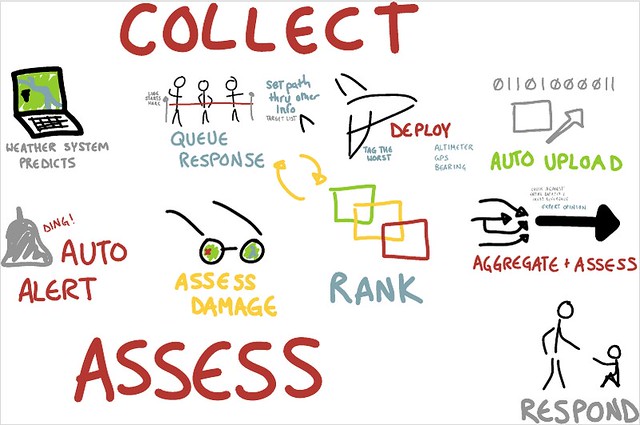
A great example of this was the Civil Air Patrol ad-hoc session. CAP is the official civilian auxiliary organization of the Air Force. It operates as a volunteer organization similar to the Boy Scouts, and also has strong ties to FEMA. They operate a network of private light planes around the US. CAP gets the first aerial imagery after a disaster, allowing the incoming responders to know where their efforts would be best focused. Currently, it’s time consuming to figure out the spot on a map that corresponds to an image and to assess damage. The planes have GPS, but the GPS is for where the camera is, and unlike custom survey aircraft, they can’t take pictures straight down and don’t record camera angle.

We talked about changing the way deployment happens – pulling from things like Geo Commons and other social media platforms to help the commander set routes for the pilots. We started scheming how to standardize the way the camera is mounted, held, or tracked to make geocoding the image easier. Our working group also laid the foundation for automating image uploading and sending those images to be crowd-sourced for damage detection. We’ll talk more about it as it moves along, but it’s a big deal that these organizations are opening up to interacting (and even requesting assistance) from digital humanitarians and volunteer technical communities. Part of why groups like GWOB are valuable to RELIEF is bringing ad-hoc and community development to experienced groups, highlighting the best of both worlds.

Tomorrow, an entry on security and cultural legibility will follow this entry as its second part.

Breaking Down Silos

Interoperability is a *huge* issue in emergency management, humanitarian response, ..actually, in an awful lot of things. My hometown in rural Indiana didn’t even have a way for the fire department to speak to the police department, it was all done via 911 operators switching lines. Add on the issues of county lines, security clearance, multiple device platforms, and a long history of mishmashing protocols to make whatever exists works, and you have the current state of affairs.

Today at RELIEF I spoke to two groups that give me great hope for these issues being addressed. The first is MutualLink, which addresses the “ability” to speak to each other, and the second is VirtualAgility, which addresses a shared view of a developing situation.

MutualLink is already live in places like California, New Jersey, and Afghanistan. Deploying its router and black boxes mean taking in communications in whatever format it comes to a central stream. The important thing is beyond the cross-platform usability, though – it’s also about crossing city, county, state, and even country lines. Your responders are no longer seeing a forest fire disappear at the border, but are continuing to be in direct contact with the entire response group.

VirtualAgility addresses those people who can now talk to each other being able to “work” together as well. At its core a planning and task management system, but ultra adaptable, trackable, and sharable. It seems so simple, but it’s a really difficult challenge to support shared decision-making – how does someone in one secured silo let someone they’re working with in another secured silo know what’s the current status of a joint project? This is an incredible dynamic dashboard, and already adopted by some very large org, meaning it’s not redundant across existing models, but replacing them.

This is the infrastructure that everything else can run on.

HOPE and Awesummit

Spent the last three weeks away from Seattle – about a week on Playa, a week in NYC, a week in Boston. Was constantly surrounded by people I respect immensely and with whom I can’t wait to have continued interactions.

HOPE was incredible. I gave a talk with Diggz on Geeks Without Bounds. I sat on a panel about DARPA funding education and hackerspace programs. No chairs were thrown. It was pretty bitchin’. Saw the Byzantium project, and drank mate, and sipped whiskey with the No Starch Press folk. Went out for beers with an eclectic group of hackers and artists, talked about the future we were building, the holes that still exist, and how we might be less wrong.

I was blown away by the gender ratios (still not close to half, but far better, especially with the speaker line-up), and that the vibe was a bit less awkward and certainly less sexually charged than most of the other events I’ve been to. And the level of respect with which people approached each other in calling out inaccuracies, misrepresentations, and differences of opinion was phenomenal.

Exploried an old power plant with Borgatti. Nearly got caught. Knelt in the dark, breathing quietly, covered in brick dust and mud, and waited for people to pass by. Played Cards Against Humanity with some of my favorite humanitarians. Spent time with my Sunday Boyfriend and met his new cat. Made my way to Boston. Played in the park in bare feet, with a flask of whiskey, in the torrential downpour of heat finally breaking. Sat on a sea wall and ate breakfast, loosing track of time and wading back, coffee in hand and boots over my shoulder.

Went to the #awesummit, saw what opt-in taxes might look like. People who understand they are a part of a larger whole – giving their excess to things which don’t just entertain them, but also enhance the rest of their community.

It was *so cool* to sit in a room with people whose shred ideologies are so meta we often lacked the language and pattern recognition to pin it down. That we couldn’t say all the projects we supported were even the same sort. That the trustees were not all of a similar demographic, background, what have you. Not even our giving patterns were the same. Only one thing was shared – the word “awesome,” and the aspect of sharing, of facing outwards. To have a group of people that varied come together to talk about what we *were*, if anything, and what that *meant*, if we were something or if we weren’t. It was wonderful. There were a few moments of tension, mostly around the idea of trademark. It reminded me a lot of the conversations in hackerspaces. What do we all share, when we are so fiercely grass roots? What does it mean to share a vision but not a praxis? What is the value of making ourselves legible to the rest of society, or is that something we should actively avoid?

And my drawings ended up on the MIT Civic Media blog, which is kind of amazing.

All that was topped off by a dinosaur-themed party with cookie checks and cake. Saw massive ink pipes and the three-story press at the Boston Globe, bifurcated paper and quixotic diagrams. A private tour with a new friend through back doors and stalled robots and stressed editors. Taking the green line back to my dear college friend’s home, walking the last mile slightly buzzed, T-Rex balloon bouncing, happy.

Continued conversations around what comes Next, what are we building, how are we helping each other. I continue to be in constant awe of the amazing folk around me, humbled that they invite me into their community and projects. And to return to Seattle, to smiles and mangos and all of the hackathon planning ever.

Hacking Humanitarian Technology Before the Bad Guys Do

From George, about the RELIEF efforts Diggz and I speak about at times:

Event:  JIFX-RELIEF Field Exploration
Location:  Camp Roberts, CA
Dates:  August 22-23, 2012

In the last 18 months there have been a steady increase in attacks by
hostile groups against citizens and response organizations utilizing
communications and Internet technologies.  Those attacks include
custom malware targeting activists in Syria, harassment and
infiltration of civil rights monitoring groups in Egypt, and the
murder of citizen reporters in Mexico.

The JIFX-RELIEF Field Explorations are acknowledged to be the premier
venue for creating interoperable civil-military systems for
Humanitarian Assistance / Disaster Response (HA/DR) operations.  This
year’s RELIEF experiments will bring together members of the security
community to evaluate the security strengths and weaknesses of several
technologies that are being deployed in hostile environments.

Participants from the security community will have the opportunity to:
* Support the development of lifesaving emergency and humanitarian technologies
* Meet a variety of groups working in the humanitarian and government
technology space
* Interact with other members of the public and private security community

The security evaluations will take part over two separate days and
security experts are invited to take part in one or both:

August 15th:  Tour of the different experiments taking place and
discussions with the owners and operators of those technologies to
provide the security expert’s view of the strengths and weaknesses of
the technology.

August 16th:  Penetration testing of a set of those technologies as
they are being deployed to simulate attacks they will face when
fielded in hostile environments.

The attached document contains more information on the experiments
that will be taking place and the organizations involved.  If you are
interested in taking part in the security assessment on one or both
days please RSVP to george@roguegenius.com by August 1st.

Thank you for your time and interest in supporting the development of
secure technologies for use in crisis and disaster response
operations.

george