September happenings

August 28-31 : Burning Man : DPW Camp
September 1st : High School Reunion : Indiana
September 7th : Journey to the End of the Night : Seattle

The city spreads out before you. Rushing from point to point, lit by the slow strobe of fluorescent buses and dark streets. Stumbling into situations for a stranger’s signature. Fleeing unknown pursuers, breathing hard, admiring the landscape and the multitude of worlds hidden in it.

For one night, drop your relations, your work and leisure activities, and all your usual motives for movement and action, and let yourself be drawn by the attractions of the chase and the encounters you find there.

September 8th : CyborgCamp : Seattle

CyborgCamp is an unconference about the future of the relationship between humans and technology. We’ll discuss topics such as social media, design, code, inventions, web 2.0, twitter, the future of communication, cyborg technology, anthropology, psychology, and philosophy.

September 14-15 : Education hackathon : Dallas, TX
September 21-23 : H4D2 hackathon : Birmingham, England

Aston University and the University of Warwick are happy to announce the Hackathon for Disaster Response, a 2-day event to bring together software developers and emergency management experts to hack out solutions to disaster-related problems. We will focus specifically on data available via social media, and on structured data (open data, linked data) available from a variety of sources. This event is sponsored as part of the Disaster 2.0 project

September 29 : CrisisCamp Ireland : Galway

First half of October I’ll be on the East Coast bouncing between DC, Boston, and NYC.

Please come out and participate!

Sea Change

So, there was this whole series of cultural shifts around hacker and maker spaces from about 2005 to now1. In America, people were realizing that they could work together. Then that they could pool resources and form spaces. Then that other spaces existed. Now, how we can link spaces together and how to help make more. Next will be what to turn them into. I vote schools. More on that another time.

A similar thing is happening with hackathon / app contest / civic engagement culture right now. Hackathons have been around for a long time, but more recently there have been a greater quantity in rapid succession. Another knee. Why? Tools are more accessible, people want to create something useful, but also because it’s a powerful motivator to be in something so engaging as OpenGov. Again, at first, it was “hey, other people are doing this?” Then “I want to do that!” and now, most of the discussions at OpenGovWest11 was about how to do it better. How do we make the things that hobby-ists are building sustainable, robust, and most of all – impactful2.

There are a few ideas. Beyond just the excitement of continued work, and post-geographical ideals of traveling to where the awesome is, we can also encourage people to maintain, improve, and build upon what already exists instead of just creating the new. It’s like maker ethics of Fix What You’ve Got brought to the hacker ethic of I Will Build It Better. So… how do we encourage a culture of maintenence while continuing to uphold a culture of innovation?

 
Hard question, but we have a few ideas.
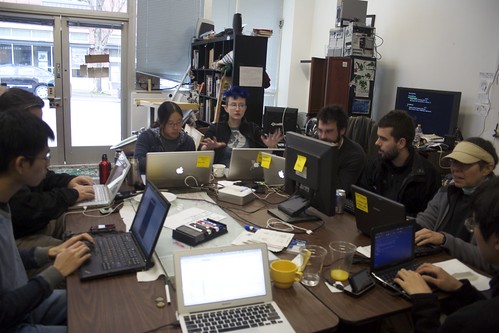
Things like GameSave are a start with a format of long-running competition with an intense work weekend and the goal of the program being funding for full development.
This has also been done with things like the X Prize and other such things, but rarely quite so grassroots.

We can also start to look at progress between two phases made during a hackathon style competition instead of just how far from the startline someone is.
I think we should also give awards based on adaptation of or improvement on existing tools, or just the research time needed to discover that you don’t actually need the thing you were going to build.
Continued incentives and interest in further building of tools

We have to maintain and encourage the long term agility and mythos of our ideals to continue this sea change instead of just being co-opted and burning out. We can’t just use the scientific method in testing and building the tools we use because that almost guarantees failure.

1. Well of course it’s always been a cultural change. Outside the norm. Etc etc. I’m talking here about the knee of the curve, mostly sparked by the 2007 Chaos Computer Camp.
2. Yes that’s a word shut up

of hacks and thons

Random Hacks of Kindness was the first weekend of December, OpenDoor Hack-A-Thon this past weekend. Many amazing things were built, and we’ll be continuing endeavors on both counts. What I’m going to talk about now though is not the code or the implementation, but the social dynamics and what we can Do Better for hackathons.

The thons that I have participated with have, as a default, been intimidating. I hope this is not everyone’s experience, but it certainly is mine. I have limited coding experience, and a time-crunch competition is no time to show up and say “but I can learn!” I often offer to keep track of online communications, do research, layout order-of-use and menus and the like, and brew coffee. On occasion, while someone is waiting for code to compile or someone else to finish a contingency task, they’ll teach me about what they’ve written. I learn a lot and have a great time.

image by @aaronpk

There is a continuing problem of “the n00b and the clue-by-four”. This is happens when someone shows up with some combination of the following two features : arriving late1 and/or having extremely limited ability2. It is an issue I have yet to see addressed well. Incorporating a better way of guiding efforts of the thons would be beneficial to all participants, n00bs or l33t. So, in talking with James and Jordan and Strand, we’ve been thinking about the following solutions:

  • basic document (link to what the event is about, communication channels, documents created for event
  • IRC bots (check-in times, auto-answer basic questions, DM those joining the room with above doc, send log of IRC discussion
  • gamification (points towards what people should be working on, time allotments for each stage, etc)

So… I’m super excited to start the hackathons at Jigsaw third weekends in 2011. What would you do? What sorts of guidance do you need when participating in a group event where the details evolve as everyone works together, and few people know each other? We’re intending on having classes the Wednesday before, so people feel a bit more capable in their skills, or create a new skillset.

1. Problems and their potential solutions are discussed either before the hackathon or during its first breaths. Courses chosen are based on the skillsets of available people – to include a step which involves skills no one present has based on the hope that someone will walk through the door hours into the event with just that skill would be silly. This means arriving early is essential, ESPECIALLY if you haven’t been participating in the existing dialoge.
2. As stated before, time-crunch competitions are no time to pester people to teach you things, and promising you can deliver something you don’t have the skills for can be detrimental to everyone. Come, hang out, learn more, but temper your ambitions with your abilities.