
Summary
Willow goes into great length, with charts, about how the job hunt went with a focus on keeping track, experiments in approach, and what actually worked this time.
So I’ve just signed to start in mid-December as the manager of the AppSec team at a well-known platform. I’m REALLY excited for this for many reasons I’ll get into after I’ve actually started and it feels real. I’m really excited to be able to talk about this part of my life again.
I’ll do a separate post about how I structured my consulting because that’s it own fun setup, but I wanted to take a moment here to talk about how grueling the job hunt is right now and to offer some scaffolding, because being intentional about things is how I stay sane when in a chaotic situation.
This is long because I have a lot to say on keeping track, experiments in approach, and what actually worked this time.
Resources mentioned in here:
- Job hunt tracking spreadsheet
- Sankey HTML file and associated page/image
- Financial burn-down spreadsheet
Keeping track
Applications
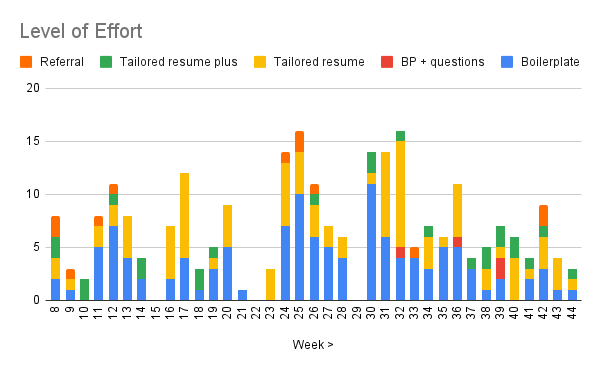
In order to be able to look at the AMOUNT of work I was doing by applying, to make filing unemployment insurance more convenient, and to track results of things, I had a spreadsheet of what I was applying to. Headers: date applied, company, position, link, type, level of effort expended, stage I got to, state of application (live, rejected, ghosted), last update, and days between.
I thought to start tracking “via” (LinkedIn, Welcome to the Jungle, Indeed, Slack, mailing list, recruiter, friend) too late but this would have been useful.
I have applied to 265 jobs since February, and have spent about 170 hours on this hunt.
Results of applications
A spreadsheet is great, but it isn’t very good at telling a story. So I made a Sankey Diagram to determine how my approach was paying off and to see the massive amount of work. I originally posted about this on LinkedIn (gotta get those engagement numbers up!), but here’s the updated one (full interactive one here).
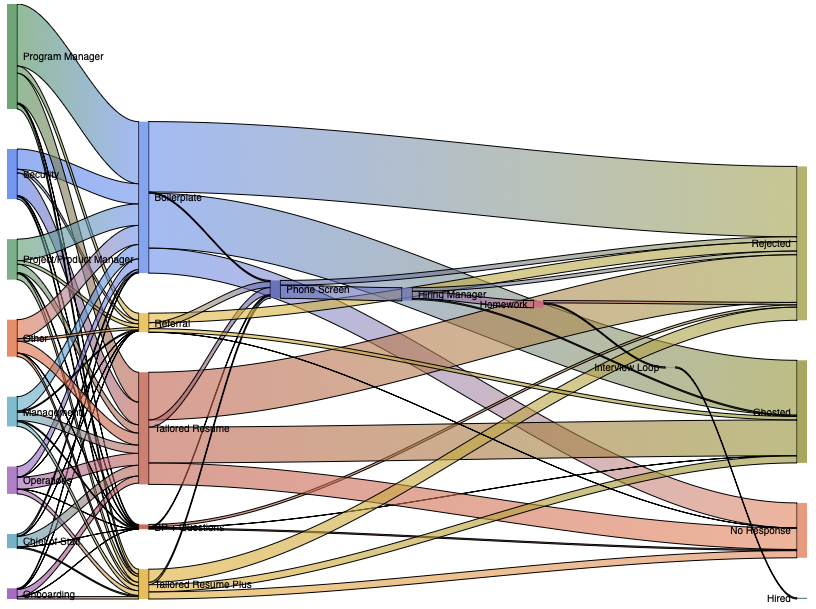
The main takeaway I got from this was about the level of effort I was putting into things. Just “spraying and praying” (sending a boilerplate resume in response to a job description (JD) led to a 1% hit rate, and that’s rounding up. Tailoring the resume to respond to the JD got me 7%, and adding a cover letter or answering form questions bumped up to 9%. Having a referral had a drastic impact of 45% moving to a phone screen.
Financial burn-down
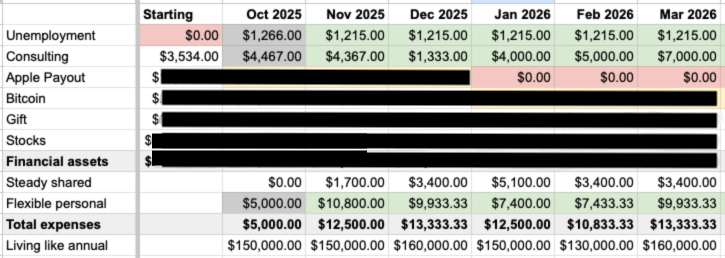
I also wanted to have some peace of mind about how fast I was burning through my reserves. I’m beyond lucky here — Apple gave me a good payout (plus my accrued things), I found 0.02 Bitcoin from when I was buying tacos with them in 2017, and I have some savings beyond my 401k because I am intentional about finances since even before starting to make more predictable money.
I had rows for each income source (consulting, unemployment) and for each pot of money in the order I’d draw them down (Apple payout, Bitcoin, gift, stocks, 401k) in. I had another section for expenses (steady shared expenses like mortgage and a separate row for flexible spending). There were some formulas to calculate based on quality of life anticipated for the month, what accounts I was drawing from, etc; and then conditional formatting about when something reached $0 and when a source was being pulled from. I would then update with actual amounts spent and brought in at the end of each month to keep things fresh.
Experiments in approach
I had a gut instinct even before I did the Sankey Diagram about needing to do more work than just a boilerplate resume to get in at places. Each of these was marked on my job hunt spreadsheet as a stand-alone row about the tweak in approach so I could analyze any impacts each change was having.
Researching companies
How much research is good to put into a company in order to align a resume with them?
- For the screening stage, ends up it matters more (at least in my case) to keyword match the job description than to values match the company.
- However, when I had a referral and I knew a human would probably look at my resume, I would definitely at least check out the values page before redoing my resume.
- Before having a phone screen, I would review the job description again and know which points to speak to, with stories from my past. I had at least two questions about the company itself.
- Before speaking to the hiring manager, I would come up with theories about the organizational structure of the company based on what was online.
- Before doing homework I would research what sorts of projects the company was prone to doing, and pick a project from my past that aligned well with their existing work.
- Before final round interviews I would read a lot more about the company’s approach to the problem space the JD was positioned in.
LLMs
At first I tried LLMs for keyword matching, but the tone was SO wrong from how I usually write that it felt artificial. Then I remembered that I have content on this blog since 2003 (hell yeah Live Journal import!), all of which match my tone. So I asked the LLM to read my blog, store boilerplate resumes for each of the job types I was going for, and to keyword match a specific resume (or combo of resumes) to a JD while maintaining my tone. It worked wonders!
Always still check for accuracy, because hallucinations sure do happen. The things I would have been claiming to have done if I hadn’t checked! I spent time with each suggested set of changes to be sure they were accurate and in my tone. I also added a disclaimer at the bottom of my resume about how I use LLMs. When a particular JD would ask to not use LLMs, I would respect that.
Mock interviews
I am SO SO grateful to Tilde, Mark, Baron, Lara, and Keaton for doing mock interviews with me; and to Eric and Munish for helping me shape my pitch overall. This helped me hone my storytelling, understand where I was oversharing, and think through the problems I would likely be facing in a role (which means good questions for panel!), all of which built my confidence and poise. Cannot recommend highly enough.
What actually worked (for me)
Doing some therapy
I was oversharing a lot in interviews — I want to be sure that people know what they’re getting into with me, and there’s a big rhetoric at a lot of places I’d care to work about “bringing your whole self to work.” Being neurospicy, I took these to heart and asked very difficult questions in interviews and highlighted a lot of mistakes I’ve made in the past (along with what I learned from them). When taking this approach, I always felt like I had overplayed my hand after interviews, and data shows I was advancing at a lesser rate when doing this.
I worked with a friend who is learning somatic therapy and motivational interviewing, and they helped me reground myself in my goals and matching up to a company’s goals. As we said in the session, I “don’t need to be showing my whole ass.” I gained confidence in this as an act of being appropriate rather than being out of integrity with myself.
Series that was successful
The series that was successful had to do with being introduced to a discipline-specific Slack, engaging to get a feel for the community, and watching their jobs area. When an interesting gig came up with someone I respected based on how he interacted in the community, I adapted my resume as above to the JD and reached out to him in DM to ask if he thought I would be a good candidate. “great resume btw. just fantastic representation of identity and style” was the feedback, so I applied for real and let him know. I then did research as described above, and mock interviews for each stage of the process as I progressed. I have about 12 pages’ worth of hand-written notes in a 6×8 notebook from the arc with this one company.
Staying sane while looking
Tracking definitely helped me feel more sane while doing all of this work that just… disappears into the ether. Half the resumes I submitted never got any answer at all, not even a clear rejection.
Staying on top of my other obligations helped me a great deal. I can keep my room tidy, I can do my parts of house maintenance. I still used my calendar to block time and activities pretty religiously. And I can still knock out an excellent sci-fi book in my down time.
Finding meaning other ways while looking
I’m a midwestern gurl (gender neutral) at heart, and I still struggle with all the baggage that comes with, especially overlaps with the Protestant Work Ethic and the agreements we had made at home about the roles we were in. If I’m not employed, do I really count as human? I know the answer in theory, but my soul sings another song.
Reconnecting with friends (hey, free afternoons!), organizing in my neighborhood, and investing in my consultancy helped me feel like I was adding value despite not making a steady income. I also got to spend a lot more quality time with my spouse and kiddo, which I will forever be grateful for. What a treat.