Social Accountability

Most of the projects I work on involve me holding myself accountable. I don’t have a boss to fire me, just the possibility of losing gigs and support. I don’t have relationships with people that require certain actions from me. The side projects I tend to take on take place over a long period of time and involve many parties.

Checking in regularly with a number of people I trust, but am not accountable to or for, helps me stay on track with (and realistic about) my workload. Especially related to side projects.

Not Your Usual Checkin

These are people you are not directly accountable to. They are people to whom you strive towards being socially accountable. This mainly boils down to working with people you desire the respect of, but are friendly enough with to fail in front of. No part of your livelihood should depend upon your honesty (obviously, I hope this would be the case in any job, but the dream is not yet the reality).

Tom sez: The Table is Round : There is no project manager. Rather, participants ask one another about their projects. “So Tom, how is ‘Writing a cover letter’ going?”

Fin sez: I really like the informal and casual tone we keep.

Have a Regular Call Time

You might tweak this regular call time to later in the day or that week occasionally, and let people know if you won’t make it or need to reschedule. Some weeks everyone will miss together. Just keep going. Assume it will happen the next week at the regular time. If people consistently miss, ask them if they mean to make it. Remove them from the workflow if they can’t commit on at least a semi-regular basis, welcoming them back if they are able to prioritize it again.

Have a Place to Meet that Doesn’t Rely on Any One Person

Charlie set us up with a persistent Unhangout. No invites, no person flaking preventing an easy join, just. showing up at the regular time. The code to set up such a thing exists here. It can be a little intense for someone to install and run on their own, so if you’d like to use the hosted service for a permalink, do so here.

Update: we now use a permalink at meet.jit.si

Choose a Platform

We use Trello. Generalizable enough to make sense for various projects, public, low barrier to entry. Especially useful with its API so some of us plug into our more finely detailed project management software.

We use the following Columns:

  • “Backlog” for things that may or may not happen.
  • “ToDo” for things yet to be worked on, or that have stalled out.
  • “Doing” for things that are in progress & are being actively worked on.
  • Update: we now also have “Blocked” for things which are out of our hands in how to move forward.
  • “Done” is the high-five column, which gets emptied every check-in.

We also assign tasks to ourselves, so everyone can have an overview of what others are doing – and thus can take over “moderation” of the call.

You’ll slowly start to notice that some things you meant to do just… aren’t being done. Put them on a back burner. After awhile, either admit they’re not going to get done, or restructure them to be approachable and actionable.

Generalities, Not Atomized

All of our participants have personal task management on various platforms. This is about what we’re generally needing to get done, not the granular aspects. We each have our own systems for those more specific aspects (I use OmniFocus on my desktop, tho thinking of switching off, and TeamBox for GWOB).

This has been super useful for me in staying on task, delivering on long-term projects, and in feeling connected to a group of people even when my work isn’t. Hope you find it useful, too!

How I Got Here (the unused Statement of Objective)

This is about 3 times too long, and definitely too waxing-poetic to be my statement of objective for grad school applications. But I’m proud of having written it, and wanted to share.

Back in 2006, I was discovering my first ever capital-F Future. A class at Indiana University called Religion, Ethics, and the Environment took a couple weeks to explore transhumanism. As a superhero-apathetic comics nerd, I had known about weird futures, but had never quite understood that I could have a role in building them. Suddenly, here was a route to building a better world, rather than failing into another stopgap of less-wrong. I was set on a path of not only understanding, but intentionally building a world in which our constructed technologies meant making it easier to be a Good Person connected to other Good People.

A year later, having completed a Bachelor’s in Sociology and an honors thesis, I landed on my feet in Seattle. I was ready to go to one of the law schools I’d been accepted to, around the overly specific topic of the meeting of organic and digital in prosthetics. Who would own the data going through your cochlear implant? Could you opt into a more dexterous mechanical hand if you still had a healthy biological one? Continuing on with the transhumanist discussion groups I had been organizing and moderating in Bloomington, Indiana, a new community of Future-thinkers began to form in Seattle, from all sorts of backgrounds and disciplines. Upon discovering the Electronic Frontier Foundation, I suddenly had the freedom to build those strange Futures alongside the likes of those in the discussion group, those I would have dedicated my life to defend.

But in building those strange Futures in hackerspaces, -camps, and -conferences, I started to be unable to ignore a concerning trend: these were event and physical spaces for those already self-aware- and resource-enabled-enough to participate. Where were those who were less advantaged? The appalling narrative of “they’re just not trying hard enough” made me reconsider the groups I had come to call family. The lack of historical awareness in the entire community was in myself only mitigated by an acceptance that the world was full of things I had not yet learned. Focusing on spawning our future family, I turned attention to establishing Jigsaw Renaissance in 2009, one of the first makerspaces.

Makerspaces are schools of the future, intergenerational and transdiciplinary project-focused communities. They are extroverted versions of necessarily-introverted hackerspaces. I spent another two years focused not only on Jigsaw, but also on Space Federation, a way to link together spaces, to share non profit status, tax processing, zoning negotiation, etcetera in the same way we geographically shared milling machines. We were more frightened of papercuts than of laser cutters, and making do in the existing world while building a new one was no small task. Again, we intentionally built the Future we wished to see. But this time, the arc matched that of my (arguably onging) goth and cyberpunk days. The idea was so good and accessible that everyone wanted a piece of it, at least for a moment. We fought internally about who we were and what was worth negotiating. The clear paths to legibility which would make rent easy to pay also made us less of what we were. We had been a new Future, but slowly changed instead into blocks filling gaps in understood structures. Shop class returned to high school, but what made  makerspaces what they were (and some still are) – the wide open space of possibility and innovation – instead stifled in the inorganic and proscribed state that also made your insurance agent know what box to tick.

As this happened, before it was a clear pattern, I had also started building Geeks Without Bounds. The same primordial ooze of possibility and energy in hacker- and makerspaces was also in digital humanitarian and disaster response space. They made things, but they also made them with purpose, many focused on not leaving populations affected by horrible situations dependent upon the aid sent to them. This was it for me – all of the starry eyes, coupled with an ability to get hands dirty, and the clear intention based on historical awareness of including all parties in the process. I still travel the globe helping people from San Francisco, to Port-au-Prince, to DC, to Nairobi, to Berlin understand just how much they have to learn from each other. Unsurprisingly, the formal sectors in this space care to learn from the informal and disruptive – but many of us on the informal side have gone through the co-option cycle at least once, and are wary of how to interact. In part due to this, no one benefits from the experience and ability of the other.

The same tensions from hacker- and makerspaces exist here, manifest most clearly in hackathons. Born from hacker-spaces and -cons, adopted by open source and commercial endeavors, now taken up by entrepreneurship initiatives and my own response and social good space, these events have the promise of actual revolutionary innovation in the same shallow breath as being mere publicity stunts. Digital response groups struggle with, I kid you not, nearly the *exact* same issues that hacker and makerspaces have as they gain traction. This is most clearly an issue of how to standardize and transmit history in an agressively informal space. I simply cannot stand by and watch these trends happen again, especially not in such a promising endeavor. With the clear understanding and credibility a Master’s degree would provide, this is a trend that can go less wrong this time with the right sort of guidance, and even better in the future. We can have that capital-F future, but it’s not just about building another technological advancement.

At first we spoke of a gleaming future, but didn’t know how to build it. Then, we could build things, but didn’t understand to what purpose. Now, snuggled (or forced?) down into this niche, any lesson learned is necessary to extrapolate by setting it up to be translated and universal. This is not a universal-design approach, this is a self-examining and correcting social script. First, we reach the people building things with purpose and awareness, to make their lives and their interactions building that Future easier. From there, we will mentor those building things, but lacking awareness. Then we can move to those who wish to build but also need context. These are social constructs which can be built with the same intent as our well-designed technologies and transmitted via workshops and comics. More than a possibilty, though – this is an imperative.

These trends are so clear cut as to be glaring. And the solution is not more technology, it is stronger social fabric through intentional building. If the distributed, adaptive, aware systems we build truly are to make humanity better off, humanity itself must also be tended to.

In the same way I used to shake my cyberpunk fist at my steampunk friends, the issue is this: to act upon, rather than bemoan an incomprehensible system does not mean recreating steam engines so you can see where the gearing is warped, it means learning how to solder. In this moment, we cannot blame socioeconomic differences, atrocities, and low adoption rates on failing computer technology, we must start to look instead at understanding human connections in the new digital age, and constructing that with even more intent than with which we lay out a new circuit board design.

Creating (New) Collaborative Spaces

There’s this ongoing sense of frustration from the adaptive, iterative, inclusive informal side of disaster response with the formal side. While we often focus on how to get members of a population not accustomed to collaboration to feel empowered to speak and act, and that is a core component of any work I do, that’s not what this entry is about. In the same way that I think many people don’t engage in their environments when conflict is a possible component, I think the lack of collaborative and codesign approach in the formal sector is simply a lack of exposure and understanding.

Come with me / and we’ll be / in a land of pure collaboration – sung to the tune of Willy Wonka’s “Pure Imagination

The thing to understand is that after Kindergarten, most people have been discouraged from being collaborative. While it comes easily in our youth, when we haven’t built up the skills (social and technical) to operate from that source, it can be difficult. When creating codesign space with members of a formal or traditional organization, they come with the mentality that experts are the best (and perhaps only) people equipped to know how to assess and respond to a challenge. In this mentality, only academics have time to think, only corporations have access to resources, and only people who have been in the field for decades can see patterns. Often, because of the constructs around being an expert or specialist, people considered as such have had difficulty finding cohorts. In fact, you’re often actively discouraged away from it – anyone who shares your field is a competitor for limited resources. Any remotely collaborative activity is done asynchronously and piecemeal, cobbled together later by yet another specialist. This backdrop should indicate the importance of providing safe and guiding space for learning collaborative methods to those coming from traditional sectors. Here’s how I’ve done collaborative space-making in the past.

First, we must understand the codesign methods we aim to use by making it safe and inviting to work collaboratively, and ways to ask questions and with the expectation of listening. We call this “holding space,” through facilitation methods of encouraging inclusivity like paying attention to equal speaking time and accessbility of language. Within this space, we set a North Star, the purpose of the group. Frame all conversations and problem solving trajectories by that North Star.

With the Field Innovation Team (FIT) for FEMA’s Hurricane Sandy response, our North Star was “helping members of the affected population.” This might seem obvious, but formal organizations have been set up to help the official response organizations – Office of Emergency Management, or Red Cross, or the local police department. This has happened in the past because of scaling issues of knowledge and delivery abilities. Any situational knowledge was based upon limited aerial imagery (difficult and expensive), people who were in the area but are now able to report by being in an office (stale information), and past experience (misaligned patterns).

With things like crowd mapping, a higher resolution of situational awareness is possible. People on the ground can tell you where they are and what they see. With this ability comes a new responsibility, to deliver response at a similar resolution. This setup also includes an ability to directly interact with members of the affected population, so it’s important to refocus our efforts on our end users.

Any time any question came up, or any difficulties got in our way, we reminded ourselves about our main objective. From this, we immediately saw many paths to achieving the objective such as education, housing, heat, and connectivity. Through skill and connection discovery, we determined what the best focuses were, based on the team members present. We were already collaborating – by focusing on a main objective, and outlining various ways of achieving that objective, people start to consider how they can offer ways of getting there. Too often, we delineate our jobs and then figure out what we can do – which would have limited our creativity by leaps and bounds.

This is when it’s important to have a slew of collaborative tools in your back pocket. What will kick up this new track of collaboration with productivity? Just as importantly, what will be so easy to use that your newly-fledged collaborators won’t trip over install processes or learning curves, losing this precious momentum towards beautiful new worlds? I really like etherpad, hackpad, or google docs as a starting point for this: nearly everyone uses a word processor, and it’s immediately evident as to what is going on. Suddenly, there is a shared view! The common problem of resolving differences across multiple word documents has disappeared in this setting! Reports begin to write themselves out of meeting notes! Butterflies and bluejays are frolicking in the sky. Be wary that during this part of the process, it is important to both make sure people understand what is going on, while also not becoming their administrator. Help people put their own information into the platform, don’t do it for them when they stumble. Other great platforms are trello, basecamp, and loomio for near-immediate recognition of usefulness. People will sometimes stumble in the transition – simply take their recent update on the old method (email, anyone?) and continue the discussion on the new collaborative platform.

Once that objective is set, everything else is just problem solving. Things which would have kept us waiting to act instead became new opportunities to try things out.

Back in New York, the Joint Forces Office wouldn’t allow the FIT team in, because not all of us were federal employees, a few of us were foreign, and some of us were *cough* activists */cough*. Instead of twiddling our thumbs, we instead worked from the apartment of a friend-of-mine. They had better (and more open) internet, far superior coffee, and great serendipity liklihood. While working from there, we linked the OccupySandy volunteering map into the Google Crisis Map and (unofficially) chatted with UNICEF about what options we hadn’t yet looked at for resources. The neutral space allowed us to accomplish far more than we would have in the official offices. It also meant that as we tried out collaborative tools, firewalls didn’t get in our way. When we were later welcomed into the official offices for their first-ever design jam (with Frog Design!), the indignation about Basecamp and hackpad not loading was so great that the FEMA firewalls are now on different settings!

Remember that people are delicate. What most people in the formal sector have been missing for a long time is the ability to SPEAK and to ACT, just on a different vector than those in historically marginalized populations. We are asking all parties in the codesign process to be active and engaged. In distributed and collaborative spaces, this is something we excel in. It is therefore our responsibility to show all newcomers how awesome it can be. Stand with them to make more space. Sometimes as manifest in blanket forts.

Nairobi (2/2)

We went on safari in the national park, waking up so so early and adventuring first around parts of Nairobi to find Andy, new cohort in action and humored outrage. Backroads and hanging out of the car window asking for directions, every interaction a moment of pleasantry and shared experience. Francis, exhausted from funeral travel the day before indulging our awkward questions and changing plans, finally looking less emotionally exhausted after a chicken lunch.

giraffesA giraffe rather immediately looming on the left, blended with the forest, perturbed to be interrupted but not worried about us. The immediate dispersal of any remnants of jadedness I might have felt about being outside, and joy in seeing a creature move in unconstrained strides. Later seeing young giraffes fighting, I hope in play, but likely not. Spotting the “Kenya Express” of warthogs nestled down in the distance, called as such because they run from wherever they are to whatever their next stop is. I might like them a lot, given that.

Stopping into the animal orphanage, Andy and I excited about animal conditioning and release back into the national park, our wilted demeanor as it dawned on us both that the area is essentially a zoo. At some point, lingering behind the guides for this area and our expedition, I referenced the Calvin and Hobbes cartoon I had been thinking about, and he laughed that quiet desperate laugh shared by so many people with a certain level of awareness and care. We took our weary selves to iHub, and immediately met up with Kevin, an amazing human being and fantastic guide for further adventure, of course also connected via Sasha.

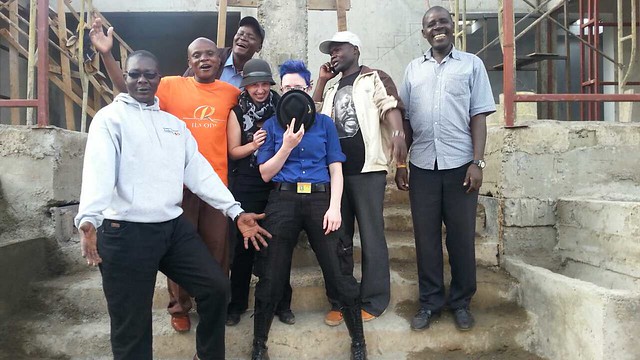
We took the matatu to Kibera, instead of a taxi, walking after we arrived to the area, exploring the new permanent building being built at the outskirts. It will hold toilets, and offices, and a meeting space. The solid walls are a rarity here – especially the doors – and a welcome shift from the compounds we’ve been on for the past week. Bankslave is around the corner of the building, laying down the priming layer for a mural he’s working on with other folk, expressing hygiene as empowerment. They’ve run into a problem – a small swimming pool, or rather, ditch, in the way of the scaffolding they’ve set up. We work with them on problem solving before wandering deeper into the slum.

KiberaWe walk for a bit, and then pause, waiting for some folk to join us. Nearby, children crowd, staring, whispering and laughing. When I turn around, they point at my head. I remove my hat, they shout “blue!” One asks “are you a boy?” “Nope.” “Why are you dressed that way?” “Because I look good.” They nod. One notices tattoos peeking out – I went for the dress shirt but not bow tie and vest – and I discretely show the top of the ink. They chatter and gather around. I hand out dum-dums, and they run away.

Before we head down the next road with our growing cohort, the difference between “politically dangerous” and “physically dangerous” is explained. The folk working on Human Needs Project take us through the slums, insisting we take pictures, showing us local artisans, subtly and simultaneously protecting and showcasing us and their home to/from each other. They have born a hole so deep that it brings clean water. They have set up a way to collect it, and the surrounding building will hold laundry, and toilets, and offices for local initiatives. They will have wifi and computers. It is too expensive, and too daunting, to go see the innovation centers of Nairobi, so they’re bringing a center to Kibera. We speak of education, and of shared joy, and of politics.

I’ve seen, this week, what it is to be surrounded by people who give freely of whatever they have, without question or obligation. What it is for someone to know what actions must be taken to see the community of which you are a part be better off. There is an unassuming but persister baseline of giving in Nairobi. Any overt transaction is heavily negotiated, but giving is freely done.

The stressful process of the Nairobi airport, seeing Brenson and Josh and Oliver from State Department again, what are the chances (passed them also on safari), and hugging and wishing each other safe travels. Two more security checkpoints after that one, the first having separated Lindsay and myself rather abruptly. And now I sit on the first leg of a very long journey, obviously but not comically demonstrating the opening and using of our food packets and seat configurations. The gent in the seat next to me carries an International Organization for Migration packet, and studies from the sides of his eyes.

I’m ready to be in another home, and feeling heart-warmed and -torn for finding yet another one. Three homes in as many weeks, Boston> Nairobi> Seattle> Boston.

Nairobi (1/2)

I’ve just been to Nairobi for my first time, Kenya for my first time, Africa for my first time. The 3 days before the trip, I stressed about travel in a way I haven’t for at least a year, pacing and unpacking and repacking my bag. Ethan sitting me down to frankly say “your equals are in Nairobi, and if you fail to see that, it is on you. They could be doing the work they do anywhere, and they choose to do it there. Don’t stress. It will be incredible. I’m so excited you’re going.” SJ asking me in my anxiety what I had packed, me saying the same things as always, him insisting I include small things for my pockets. I looked at him blankly. I only have the essentials on me, always. “Get candy,” he says, “something they won’t have there. Dum-dums are great.”

18ish hours of flying later, I found a pink-haired Lindsay outside the ad hoc airport (the other one burned down), our presentation already garnering surprised but approving response. We caught up in the back of the taxi, new smells and tree shapes and stories from the driver. A long ride later, we happened upon new friends Steven (Mercy Corps) and Per (Standby Task Force) and Amean (International Organization for Migration), soon not only being good tobacco and booze friends upon arrival to our hotel, but also cohorts in response and making the world suck less.

We spent the next 3 days at the UN Compound for the International Conference of Crisis Mappers. Which was beautiful, but still a compound. The only chance we had to be outside the short walk there in the morning, the way back being a taxi ride in the dark. I had another amazing chance to draw things, and we had a chance to call ourselves out, which I think we failed to do. At long last, someone dedicated to security held a session – Gillo from Tactical Tech. 3 people showed up, and two were Lindsay and myself. I am deeply upset with this group of people I otherwise have so much respect for.

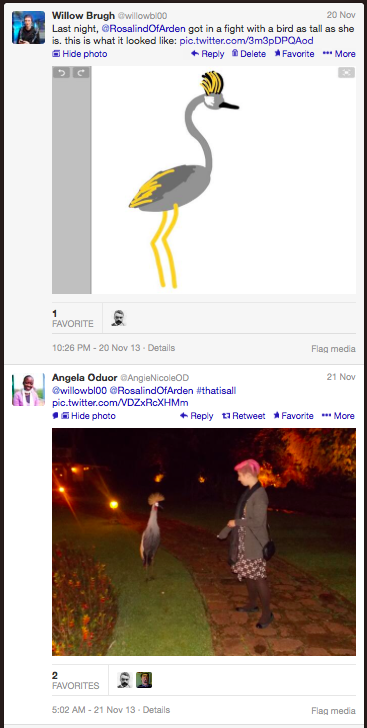
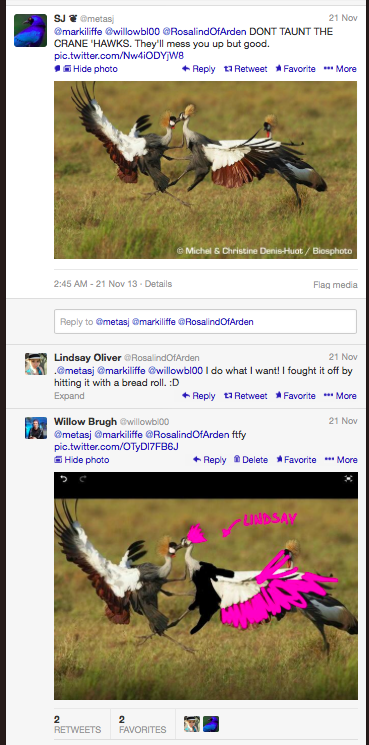
bird1 bird2But we are taken care of in physical security, escaping to nearby dinner and drinks via shared buses. Shaddrock’s toast to those who work within the system (himself included), the swimming upstream and constant trials. And to the volunteers, who truly are changing things. We all laughed, and drank, and ate. We all made a point of talking to new people, Lindsay apparently taking that to mean making new bird friends, and encountering a bird as tall as she is. In attempting to feed it some bread, she then threw said bread roll at it when it threatened her. We drew a profile of it for the internets, Mark, SJ, Lindsay and myself escalating on Twitter across timezones.

Running away early the last day, no longer able to handle the compound, to vibrant Pawa254. Sitting on the roof, chatting to members of a band about the sort of music they make, and cracking jokes about creatures, Lindsay doing startlingly close interpretive dance for a Beta Fish. Seeing Bankslave’s work and plans, the celebration of Toilet Day. Sitting back downstairs at the table, drinking beer and chatting about crypto while we wait to be ready for the taxi.

The experience of just having to wait, and of slowly dying inside because time is one of the few ways I know of to clearly indicate care. Having to accept that the pace that our hosts moved at was the pace everyone else moved at, feeling indignant on their behalf was patronizing to them and stressful only for me.

The astounding, unexpected hosting of Sasha, who booked us amazing and kind drivers, and things to do, and suggested the perfect people to meet without blinking an eye. As Lindsay and I reunited with her at the iHub on our last day, Lindsay suggested she’s like the US Ambassador, but we ended up agreeing she’s much more Internet Ambassador.

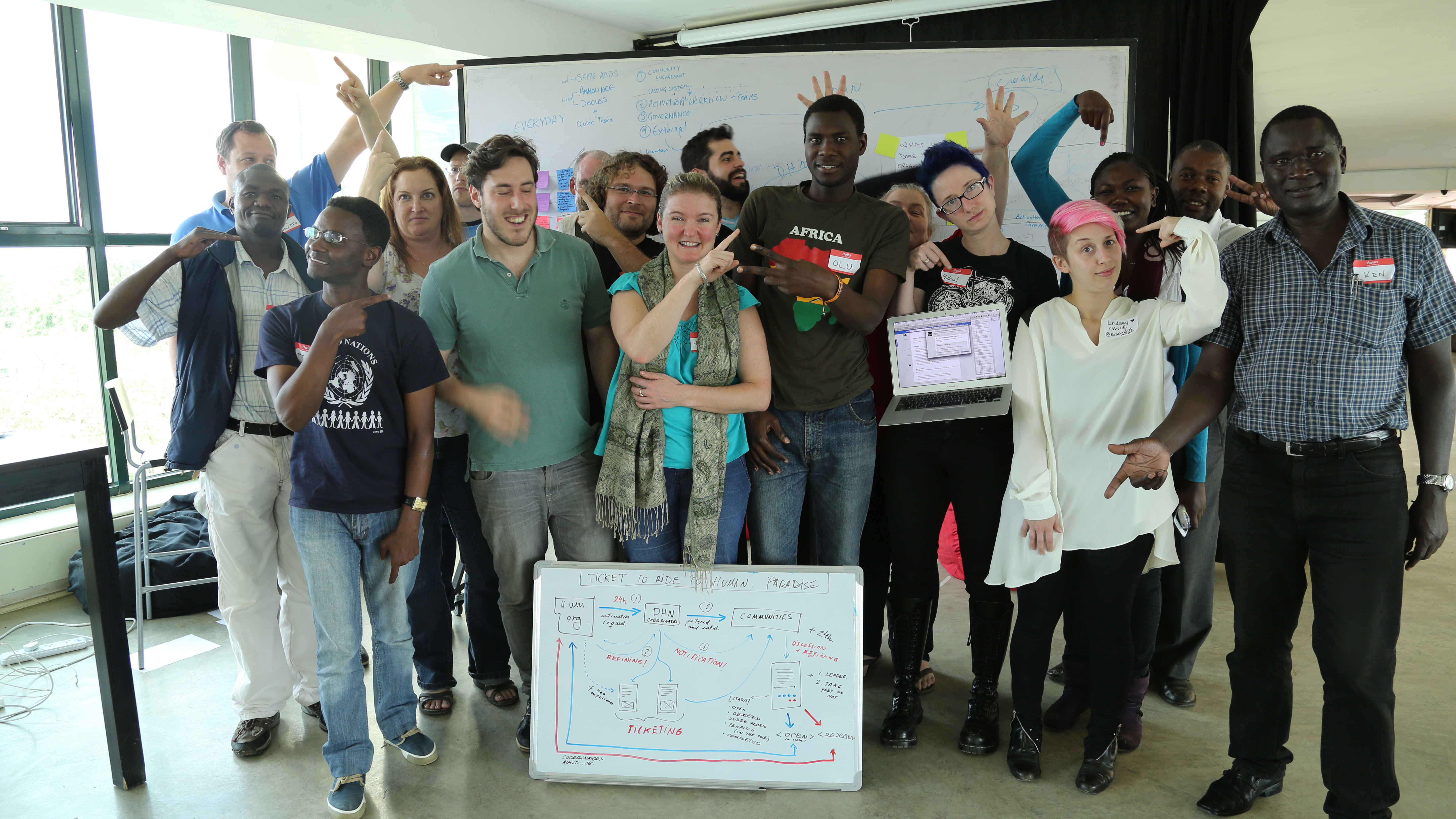
The Digital Humanitarian Network Summit in the beautiful 88MPH, an utterly unmarked coworking space somewhere along Ngong Road, just like everything else. The security guards at the gate of the center shrugging when we asked them what the area was called, and how we could get other people to it. Everyone excited for a chance to get to know each other deeper, and to get work done, and to address hard problems. Jus holding space not only for her own self, and organizations, but also for the internet. And initiating a totally amazing way of considering the Network, and how we can be an actual Network, and not just a group of organizations which can be called upon by the same point of contact. And local folk showing up, and making their voices heard, and telling us what we need to do to be useful to groups they represent. They came into a foreign environment, and thrived.DHN_2_of_2

And beer, and dancing, and live music at the end of the second day. A foie burger and surprise 2-for-1 beers, immediately shared. The locals giving us long looks while we belted out the songs, got the dance floor going, talked louder than we probably needed to. Rejoicing to be done with compounds and enforced productivity. 5 days straight of conference, finally done, accomplished and exhausted.

Lindsay as a fantastic traveling partner, always on top of logistics, enthusiastic, and willing to try new things. Dragging me away from keyboard and closed curtains onto safari, us both being excited enough to continue on to Kibera later that day.

College To Careers

I had the joy of visiting my hometown of Logansport, Indiana recently. In fact, I’m still sitting at the kitchen table, under skylights. Might have just finished dancing like a muppet with my father to adamant piano music. I came primarily to see my parents, but also to see how my aunt is settling into Grandma’s old house, and how the forrest of magical privilege1 is growing. My mother also asked me to speak to the Rotary club. Which is amazing. As you may know, I see service, especially to one’s less-well-off origins, as an important component of maintaining the social fabric.

Which of course meant I couldn’t just talk to Rotary. I also reached out to the high school principal. Could I come and speak to some classes? Some perusal of the high school schedule later, I had some classes picked out. I’d present to the Advanced Placement Speech Class and all of the 8th graders at one of the two middle schools.

First, I landed from Ireland via Chicago2, hugged my parents, took my melatonin, and passed out. I woke in the morning, nervous but excited to head to the high school. I remembered the route from my house, driving my mother’s car like ye olde days.

I sometimes have these dreams where I’m back in high school, and I’m running late. Never naked, I suppose because I don’t care, but often late. Well. That actually happened. I arrived into the parking lot, a full 20 minutes before the class started, to an email that said “Hope you’re ok, sad to miss you in class.” Dear timezones. Dear, dear timezones. Drat.

Rotary was another matter. We ate, I caught up with friends’ parents, I talked about technology and collaboration and disaster response. The response was “we’re still not quite sure what you do, but we’re impressed!” Sigh. I must get better at this! I rewrote the presentation, laid it out differently, and prepared myself for the next day, with 6 rounds of 8th graders in a class called College to Careers.

Then, I took questions. Any question. One class was stuck on “hacking,” one on “celebrities,” but nearly all the questions were good ones. Once it became clear that I mean “any question,” more interesting ones started coming. “Why is your hair blue?” – because it’s supposed to be. “Why do you wear a tie?” – because it looks good. “What’s the worst place you’ve ever been?” – looking for invisible populations in Far Rockaway that we knew would freeze to death because they were scared to be seen. “What’s your favorite color?” – grey. “50 Shades of Grey?” – terrible fanfic of a terrible book. “Twilight?” – yup. *Gasp*

Each class had its own flavor. A blind kid was incredibly adept at translating into “kid speak.” Another, pink hair and poised nature, wanted to know where I went shopping. Two kids and I riffed about motorcycles, and how they were terrifically dangerous and here’s my scar but of course I still have one, but wait until you know how to sit still before you think about getting one yourself. And the instructor was incredibly gracious about me essentially telling kids who had signed up to a class for clear purpose and direction that I was still winging it (and loving it).

It was a great opportunity, and I’m glad to have a better understanding of what I do. Maybe other people will now, too. At least 120 kids out there are thinking that “hack” might not be a bad word.

1. My parents have taken to buying lots on their block that tend to be held by negligent landlords, tearing down the house, and planting trees. While this is a rather strange form of gentrification, as you can still easily get a house in any area of my hometown for under $30,000, I don’t feel so bad about it.
2. The first flight Diggz and I have ever been on together in 3 years of traveling!

Value-Based Design

Bex and I put together a Value-Based Design workshop for the Codesign Studio at MIT Media Lab. Originally posted on the Codesign site (and then to the Civic blog and Bex’s blog). Here’s how we did it:

link to the hackpad version of this post

When you are designing a project for social justice, where do you start?

In this workshop, we practice value-based design, a method that helps us to design for large scale social impact and to relate this directly to how we plan and implement projects. We envision the impacts we’d like to contribute to in the world and the values we bring with us into our work as the first steps in this design process. As individuals, this method helps us to express our connection to our projects on a personal level and to prevent burnout as we are able to identify work that resonates with our values and to set aside work that doesn’t. As a team, this method helps us to identify shared values and to make design decisions based on our shared vision instead of personal preferences.

At the last Codesign Studio, Bex and Willow took the class through an hour-long workshop to identify our individual values and to design our projects and approach around shared values.

This workshop is inspired by Monica Sharma’s work in transformational leadership for large scale system shift. In this article, she describes the framework of the methods she shares for this kind of work. Connecting with our personal values and designing based on values is a key component. [Sharma, Monica. “Contemporary Leaders of Courage and Compassion: Competencies and Inner Capacities.” Kosmos Summer 2012.]

Individual Values


Purpose
Uncovering our core values gives us better understanding of our own purpose and desire in the world. Doing this exercise with teammates is a great way to connect to each other’s inspiration.

Process
(3 min) Select one person in the room to work these questions with:

Share something you’ve worked on that you had some role in designing.

Ask the following questions:

  • What did you envision as success for that project? Often people will dissemble, and say it wasn’t a success. People will also commonly talk about the activities of the project, things they did, instead of what the vision was of the project. So:
  • Ask them to imagine that it WAS a success. What is happening in the world then? How are people living? What is the quality of life?
  • Drill to one word. That’s the value you were working from. The value you represent. The word should not be an action or process (manifestation, collaboration, interaction, etc), but what people feel like if they can act or work in that way (joy, justice, inclusion, health, etc).

(12 min) Now, break into pairs. If there are project teams in the room, ask people to work with someone in the same team and ask each other the questions above.

(at 6 min) Remind people to switch

Reportback
Have each person say their value when you reconvene. If you can, write these somewhere that will be visible for your team as you continue to work together.

Value-Based Design


Purpose
Designing a project with the larger purpose in mind helps to think big and understand that your actions connect to your visions of social justice. It also helps your team to recognize shared values, a great starting place for connecting when you have to make difficult design decisions.

Overview (5 minutes)
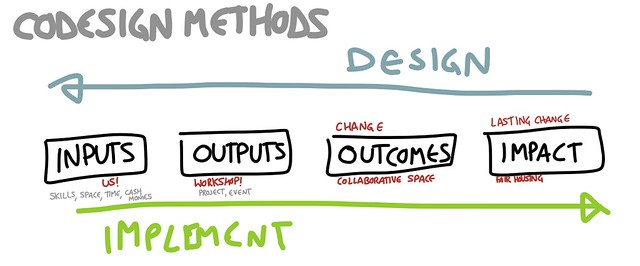
In this method, we design with our teams first by developing shared understanding of the impacts we want to see as a result of the work we do together. These will be large-scale and will likely relate to values we identified in the Individual Values exercise. In this exercise, Impacts, longterm sustained state change.

Because we can’t implement impacts directly, we continue to design our work into pieces of work that we can implement. We divide these pieces into three categories: Inputs, Outputs, and Outcomes.

Process
Share the above graphic.

Go through an example, here is an example of how we might have used this methodology in developing Codesign:

Ask what desired impacts of Codesign are:

  • Impacts – sustained state change. – What do you think the intended impacts of codesign as a method are? Empowered and equal engagement.

Ask what some inputs, outputs and outcomes are of Codesign:

  • Outputs – collaborative workshops
  • Inputs – YOU! Partners, us, this room, MOUs, etc
  • Outcomes – A change, but requires continued effort to maintain – Such as social relationships, people try it and don’t keep it up

We tend to fill these three categories with information in a nonlinear way — recognizing an Output may surface desired Outcomes and Inputs. Broadly, we design right to left and implement left to right.

Project Design (25 min)
Now practice the value-based design methodology with project with your team. If you are at an early stage in your work together and you haven’t yet identified or selected a project you will work on, you can begin by taking the various partner’s organizational values into consideration. Broadly, what are the impacts that your team’s members envision?

Before completing the exercise, have each group fill in at least 2 points under each section.

Wrap It Up
Reportback (15 min)
Ask people to share their process. Try using the Green/Yellow/Red method and ask each group to share one Green – a thing that was easy or clear; Yellow – one thing that was challenging or that they learned something from; and Red – something that was difficult or a block.

If the teams went to different parts of the room, have everyone tour around. Document the work of each group.

CatCon

CatCon happened last weekend. An unconference for systems thinkers from varied disciplines, it was an experiment in format as well as in topic. The invite list was small, and it was not publicized outside of that group. Invitees were encouraged to invite another 1-3 people, but a very small percentage of the attendees were new to me. The Media Lab provided the 6th floor for a relatively small fee (custodial and set-up services), and attendees chipped in for food.

Of course I second guess how it went. Of course I over analyze what could have gone better. But the one thing that someone said during closing appreciations made me think that maybe we’re on the right track:

This is the only time I’ve seen the web of trust work.

Unionizing the Revolution / Web of Trust

We read about inspiring things that people are up to fairly often. But rarely do we know the folk behind it, nor do we see how what we do can bolster them (and visa versa). If we’re going to “win,” as I think we should, we should be supporting each other. We should have each other’s backs, and we should call each other (lovingly) on bullshit. We should have focus on what we do, but we should know who else is on our team. The problems the humans on this planet face are huge and complex, and so our responses to them must be as well. This event was an experiment in that.

Structure

We took the first day to get to know one another, lots of ice breakers and running around. We asked questions of each other, and tried to get a feel for what the weekend would be like. Some hadn’t been to an unconference before, and I haven’t been lead on facilitating one before. But everyone was patient and good natured, and we made it through. The sessions for Saturday were curated, based on a conversation I had with Gunner (who has agreed to mentor me in facilitation, zomg!). The arc went over the course of the day from big picture, to meta endeavors, into focused projects, into designing projects. Tracks tended to be in education, interpersonal, economics, security, and co-ops. The goal was to get to know what everyone was working on, and share brain juices. Sunday was dedicated to work, to getting started on linking projects together.

Code of Conduct

So much of this event was about attendees getting to know one another. We needed conflict, and love, and trust. So we had a Code of Conduct. I kind of love writing these. Here’s one of my favorite parts:

Human being are sexual organisms, just like anything else. Harassment happens where there is a lack of consent. At Catalytic, that extends to enthusiastic consent. Act like adults.

Stages of Attendees’ Projects

One thing which was difficult was having such a wide range of expertise in the room. This was further complicated by having many different stages of projects. At most events, you share a common language of discipline with other attendees. Here, we had to learn what people were saying as well as where they were at. From a conversation with Ella Saitta, most boiled down into the following four groups:

  • Full-steam-ahead: I have a few questions that the expertise in the room can help answer, but really not up for shifting what they’re up to nor taking on new tasks.
  • Looking to scale: Project is plugging along, but could use some tweaks or some links.
  • Planning stages: I think my project looks a certain way, but need feedback, advice, assistance.
  • Open to signing on: I am super awesome! I have skills, but don’t currently have a project. How is yours?

What’s Next?

So next is figuring out if it should be done again. The rest of it is solidly in the hands of the attendees – disseminating notes and figuring out what (if anything) to publish for public review and feedback. But I’m considering if it’s worthwhile to do again, and will base that mainly on the feedback of the attendees. Also talked to Tim Maly about different formats, based mostly off of the Toronto Theater unconference. A bit more structured. Excited to try them out.

Diversity, Nepotism, Inclusion, and Quality Control

The thing is, if this happens again, of how to do the invite list. My own wariness of nepotism and ego have been rebutted throughout the past few days with conversations in good faith because “I knew the person I was talking to was awesome and kind because Willow had invited them.” But most of the people I know are fairly well-off white dudes (whom I adore), and that’s not a revolution I want. So, I’m thinking about how to handle that. Suggestions are requested. The last thing that this world needs is another echo chamber. Well, it needs other things far less, but this is pretty present in all of those issues.

Growing a Community

One thing I think about is, if this takes off and grows into a Thing, is how to maintain accountability in a growing group of people. Nothing drastic went wrong at CatCon (except for when we ran out of coffee), and those failure points are when you see how strong your community and its standards are. I worry about the first time accountability has to be maintained. But I also trust in the links being made to withstand and facilitate that.

InterTwinkles

Yesterday held many gems, and one of my favorites was seeing Charlie defend his dissertation (he would prefer it be called “defenestration“). He’s built an incredible tool called InterTwinkles, an online tool for non-hierarchical, consensus-oriented decision making.

Non-hierarchical, participatory, consensus-based decision making has seen an explosion in popularity in recent years. The traditional techniques of formal consensus, however, are limited to face-to-face meetings, which can limit organizations’ capacity due to their time and cost. InterTwinkles is a set of integrated but composable online tools designed to assist small and medium-sized groups in engaging in formal group decision making processes online. In this thesis, Charlie DeTar presents a thorough investigation of the ethical and practical motivations for consensus decision making, and relates these to concerns of control and autonomy in the design of online systems. He describes the participatory and iterative design process for building an online platform for consensus, with particular attention to the practical constraints of real-world groups with mixed technical aptitude. He presents the results of a three month field trial with six cooperative groups in the Boston area, and evaluates the results through the lens of adaptive structuration theory, with particular attention on the fit between the ethical motivations and performance outcomes.

It also generated one of the better #vizthink outputs I think I’ve done in awhile. A big part of being able to do that is based all of the wonderful conversations Charlie and I have shared over the past few months. He’s always been generous with his time and his brains.

Keep an eye out for his future work, try out InterTwinkles in your housing co-op or other affinity-based consensus group. While I (and the rest of the Media Lab) will miss Charlie dearly, Montana calls him to new adventures (and to his awesome partner!).