Things to Care About

GWOB’s IndieGoGo

Geeks Without Bounds, the thing I’ve given my life to over the past 3 years, has launched a fundraiser to hire a fundraiser. It’s all in the video, but it basically boils down to this: the internet was supposed to be the great equalizer, but it isn’t. People with technical skillsets need a way to help other people. We bridge that gap. Go help us grow. There are only a couple days left to contribute in this way.

Moonlet

All over the place, the internet is showing itself as what it is – not only owned by private interests, but also tracked. We’re building a prototype template of group-held servers for people who don’t know how to run their own servers. Email, Calendar to start, all sorts of other goodies as it builds. Join in the first round to help us build the future we were supposed to have, and to keep your data.. yours.

Moonlet will be a small scale personal cloud services collective. Our goal is to pool together about 20-40 peoples’ resources to pay for the hosting and sysadmin time necessary to replace most or all of the cloud services we use with ones we can trust.

Our goals are:

  • To offer cloud-replacement services at a reasonable price to members
  • Security and privacy are primary priorities
  • Ensure a useable and well-integrated solution that replicates the hassle-free convenience of the better existing cloud services
  • Document the process clearly so other people can replicate the experience

NASA’s Asteroid Grand Challenge

Some mornings, I wake up and watch the NASA/Sagan YouTube series. It gives me hope and peace to remember what humanity is capable of. All the shit we do to each other, rather than focusing our efforts of banding together to overcome the natural obstacles around us, is trumped when Us/Them mentality replaces the “Them” of other people with the “Them” of the unknown. NASA represents that. They’re also a manifestation of a gov org trying to do it right – massively pooled resources to conduct collaborative exploration turned atrociously bureaucratic. They’ve started releasing datasets, opening up their processes, engaging the public, etc. And now they have a grand challenge around finding asteroids. I’ll probably post more on this one later, but check it out now.

Italy

This is the first time I’ve been overseas that isn’t for work. I’m here with my parents, and my sister, and my brother and his wife. Right now, there’s someone playing piano in the inner square of Perugia, the capital of Umbria, and I can hear them from the hotel window four flights up. We’ve played Taboo, and gone swimming, and each waxed esoteric about the things we care about (My father: Indiana Law; my mother: the world’s largest incinerator they’re trying to put in our 20k populated hometown; my sister: fitness in food and in action; my sister-in-law: care for the elderly; my brother: wine and law).

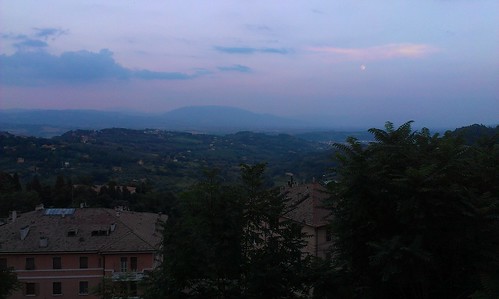
The week we spent in the Umbrian countryside had this view. There, we played Taboo and went on adventures, traipsing through alleyways older than the start of the colonization of what has become known as my country.

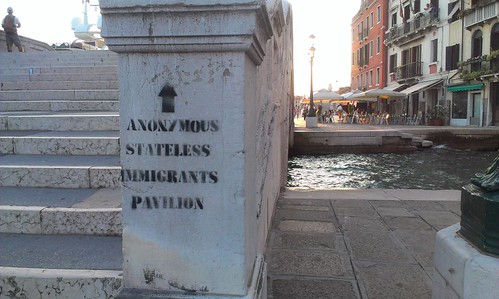
We took a day to drive our tiny car to a Grappa tasting (Jacopo himself came out to say hello, tease my brother that he needed his bike tattoo to remind him how to get home, and my numbers because I must forget how to count), the stills cold but beautiful, the cellars pungent and cool. We continued on to Venice for a full 24 hours, canals and tourists and heat. A new favorite statue and the persistent graffiti of unaddressed unrest.

Seeing SJ online and playing cat-and-mouse with details of the statue, finding history and story threads from across the Atlantic. Community and structured knowledge winning out over algorithms.

Upon our return, coming to Perugia, our Garmins butchering the 7-word street names, the absurdity of robotic cadence winning out over the frustration of navigating streets not built for cars. Learning a city with walls like the rings of a tree, built up for the growing population and its needs, neon pizza signs on doorways built centuries ago, praxis winning out over awe of persistence. And the hours-long dinner as the sun set and we made our way through the wine list, talking about life and intent and memories.

Today, wandering streets and churches and walls. Cracks in painted ceilings blending seamlessly with the streaks in marble walls. A shaft of sunlight blessing the shoulders of an unaware tourist consulting a map before moving on. The fake shutters of camera phones and the true ring of a belled phone in the back. Statues and paintings fight, and bless, and seek. Seek seek seek some sign of god, whose house they are in, and in whose name they have been painted and chipped away at. The holy always never quite touching the not yet holy. Candles and sunlight and incandescent bulbs and flickering-quarter-to-light-votive-bulbs. The soft muttering of tourists in half a dozrn languages and beliefs.

IMAG0095-1And then this, which had us laughing to tears. Saint Whoa-Now. Saint Hold-on-Just-a-Minute. Saint I-didn’t-get-enough-sleep-last-night-and-really-can’t-handle-this-right-now.

Becoming Structured

Feeding off the Pixels and Paintbrushes blog entry. Interested in that transition space between the analog and the digital. It’s funny, liminal has long been my favorite word, rivaled only recently by penumbral. More and more, I get to look at and live in that space. But now I see it more as the space of transition, not just as space between/at the edge.

So this thing happens, where we have formal structures, and the informal takes up the space between. As in the previous entry, each of these has its purpose and strengths and weaknesses.

This drawing based off a conversation with Galit, a cohort and roommate.

This drawing based off a conversation with Galit, a cohort and roommate.

As a reference, let’s take the limited work I’ve done with Occupy Relief efforts. I act as human API – if you need something from a formalized organization, including them getting out of the way, let me know. Then there are posts like this one, which is totally legit. But it puts me in a strange place of saying “I stand with you politically, but if you want this taken care of logistically, then let’s do that.” Something that keeps me in the relief space is how stark a relief differences are thrown into1. The choices that have to be made, and what is considered important when, and what cultural artifacts are created by those choices. A big part of how adaptable and powerful Occupy is, is based upon their NOT being defined nor legible. More and more I wonder how to make groups like FEMA legible to Occupy, rather than the other way round.

Reading Seeing Like A State, if you can’t tell. So very good. And then, I got to see Douglas Rushkoff speak about his new book, Present Shock. I think a HUGE part of these ideas overlap.

He equated the quest for the upper right quadrant in Capitalism with the Singularity as an example of existing world views being applied to new ways of considering the future. Rushkoff also brought up the feminist media theory of storylines and plots of male vs female orgasm – one is a single escalation and then easy bell curve down. The other being complex, multi-apex, etc. The only way we’ve known for things to be predictable is with the storyline we could track – the male orgasm model2.

Now we have the ability to see, track, understand the complexity of “actual” life3 through big data4 in a way that understands as it emerges, rather than forces adherence to a predictable, and thereby incomplete, model. And instead we are applying the same two-dimensional, simplistic pattern to it, and cutting off the long tails of a bell curve we’ve forced everything into. We’re bringing the legal system of documents and MAYBE spreadsheets to a database and RDF world5. We are not allowing ourselves the nuance of the paintbrush, digitized through the use of high-density pixels. We’re making ourselves bland and bucketed instead. A low-res snapshot of culture, of which the mere act of capturing makes us fulfill it more closely. Through quantified self and things like Prism, we’re stealing our own souls, at least as things are set up now6.

And this is why I’m doing the research I am. I’m tired of us lugging our unexamined baggage into the future we’re building. In the past, institutions were where knowledge was stored. Now it’s stored in us, in a sharable and duplicatable way. Seeing Rushkoff was inspiring, because he noted that yes, it’s difficult to exist in the crevices, but it’s also totally worthwhile. Video and audio are up already on the Berkman site.


It’s the trying to fit new things into old methods. We have to be willing to embrace some unpredictability in order for the lives of others to be more predictable to themselves. Crowds becoming “less predictable” to an outside view, but they’re becoming more self-determining. Let go of the reins and let it guide itself. Isn’t that the point of having power? To push it outwards?
—–

1. See why penumbral is a favorite word?
2. Sidenote that I just tried to find links to the academic background on this, but guess how useful the internet is for THAT.
3. Or at least a closer approximation than we’ve had in the past.
4. Which would be the crowning, and crowing, triumph of Sociology.
5. And the database model isn’t The Best, it’s just “better” than what we’ve had before, in that it’s more self-defining and adaptable.
6. Damn kids get off my keyboard.

Pixels and Paintbrushes

This is a more half-baked entry than most, but I feel it’s as far as I can push it right now without additional reading or feedback. Please do comment to share thoughts, or send me emails.

One describes a tale best by telling the tale. You see? The way one describes a story, to oneself or to the world, is by telling the story. It is a balancing act and it is a dream. The more accurate the map, the more it resembles the territory. The most accurate map possible would be the territory, and thus would be perfectly accurate and perfectly useless. The tale is the map that is the territory. – Neil Gaiman, American Gods

The balance between the formal and the informal is a constant. The formal being the structures, agreements, legible interactions of people trying to exact control and predictability out of their world. It is the tallying of food on a ship to ration for a voyage gone awry, it is the systematizing of forestry to produce a known quantity of wood, it is the manual of building types by address on the secret shelves of a fire truck. The informal is the learning to fish, the grazing of sheep on a multigrowth forest, the running in to do what you can when the books don’t have a reference for the fire you’re looking at.

For generations, we have optimized for outputs rather than for adaptability. We have chosen for formal over the informal, in the belief it was the only way for us to survive. We have made our systems predictable with the factors we were aware of, but we did not see enough. This has made us fragile.

We have optimized our objectives and approaches for the removal of cognitive and emotional barriers, allowing ourselves to produce at scale and have use impact via torque. Slower moving, but persistent and consistent. This allows us to produce and plan, a necessary approach for growing populations. The current (and hopefully continuing) trend of glorifying innovation is a response to this. It is about difference and barriers forcing examination and collaboration. That brings out creativity and the ability to adapt. This is quick, but not patient, and rarely replicable. It is the wibbly bits around the edges, the water that flows between the scaffolding.

I have started comparing these aspects to the level of detail we can get out of digitization approaching and surpassing what the human brain can process. The beauty of analog, and of those wibbly bits, is that this is where the smoothness of sound comes in, the ease of a brush stroke. The deep quality and enjoyable nature of an LP, as opposed to the lossy MP3 of the same song. But digitizing means we can replicate, send, readily share that song, and as our processing power increases, we are able to approximate real life more and more.

This has entirely to do with how much detail is available for you at each level of zoom, and what your ability to perceive those differences is. As I talked to Kav about this blog entry yesterday, slowly sunburning on a walk through New Orleans streets, he pointed out that one theory of chaos is it as order complex beyond the ability to process.

Pixels and paintbrushes. Our desire to plan and optimize has interrupted our ability to create and adapt. There is a tension here which could be used to better each component, rather than have them at odds. We now have the ability to see and use more complexity, but we are bringing the mindset of optimization through simplification to it. Big DataTM shouldn’t just be about what falls within allowable standard deviations, it’s about acknowledgement and examination of the tails; and more importantly, the complexity of interaction. We now have the ability to have a large quantity of qualitative data. And that is amazing.

If each of us is a set of pixels in an image, or we produce the pixels which make up a digital self, at some point you get high resolution by sharing more, but it’s still in the abstraction of viewing the whole picture that people get a sense of who you are. Strangely, because we are each sharing things with metadata, we are also able to get abstraction divorced from the individual, and rather across the topic (EverydayCarry being a great example of this). These pixels, if we each are keeping our heads down for fear of how we are treated in the future, lead to one bland picture when you step back from the individual into the zoom setting of society. Civic Media blog

That thing about the map becoming more and more accurate, and that making it too bulky to be useful in any way is now negated by filters. And filters which inform each layer about context. We now CAN have the map as the territory.

There are remainder thoughts here about how this self-documentation now means explicit selectiveness in the enforcement of law. And how the process of making the illegible (those woobly, informal bits) legible is what monocultures a system. But this is already wordy, and I am hungry. Maybe another time.

The Ethics of Ethical Review

My lit review is coming to an end. My beautiful, ingest knowledge constantly, lit review. I’ve read more books1 in the past two months than in the last two years combined. Having space to sit and read is an amazing thing. The most spoiled, as it were. But the time of ingesting existing information is coming to a close, and the time to start interviews is approaching. And that means ethical review of my process.

The Institutional Review Board exists for good reason. We’ve done some awful shit to each other in the name of science. IRB is there to be sure human subjects are treated with dignity and in a safe manner. It is also required by many institutions to embark upon research, to get funding, and to be published. IRB has a section on its form to indicate institutional affiliation – a section which, if left blank, doesn’t allow you to submit the form. Both academic institutions and the IRB are predicated by the other.

This set up makes it nigh impossible to do “legitimate” research involving humans in the academic context2. I find this morally reproachable. I think anyone should have the opportunity to do research, so long as they do so ethically3. So what’s a robot to do?

I’m looking at having an Informal Review Board, comprised of respected folk around the area of my research, to still assess and push back on the ethics of my study. The questions around IRB are good ones – potential harm to participants, benefits, complications, etc. I would still structure around those, and publish my responses to those questions to the internet and to participants. The people on the board would be putting their own names behind the work I’m doing, which adds in a layer of accountability of me to them, and them to the world.

If I were only to go this route, the costs would be that I wouldn’t have my research explicitly tied to Center for Civic Media at MIT’s Media Lab, tho I as an individual would be. I wouldn’t be able to publish via MIT’s press. The research wouldn’t show up in academic journals. IE, it wouldn’t have the easy notoriety boost up of academic affiliation with such a respected institution. My access to get funding would also be drastically reduced.

The cost of success of the Informal approach gaining legitimacy (regardless of how the research is taken), is informal review becoming a thing which can be done. And what if someone puts people in harm’s way because their board wasn’t as rigorous as an institution which can be held accountable via traditional means? IE, someone doing research on a vulnerable population accidentally pushes personally identifying information out with their results. How would that person be held accountable?

The cost of not taking this approach is being complicit in an institutional system which locks out citizens from the process of research and contribution. And I think that is worse than the other potential costs. But I have to see what the folk who would be on my Informal Review Board say. I’m still looking for someone who is willing to push back on me, constructively but aggressively, who is also willing to be on such a board.

The balance to be had, and thanks to Mako for talking through this with me, is to do both at the same time. This would lay the path for the institutionally unaffiliated while also making use of a solid resource of COUHES (MIT’s IRB), addressing my deepest concern. To mitigate the potential harms of this approach gaining traction in worrisome ways, I’ll be working with the engine room to examine the process itself. And the issues of not having access to institutional credibility and funding will be alleviated by taking the formal route as well. Sure, it’s more work, but I think it’s worth it. I’ll publish my responses and process here in fairly short order.

1a. Book List:

  • Thinking in Systems – to gain a shared language with systems thinkers
  • The Fifth Discipline – to expand on that language, gain antedotes
  • Protocol (How Control Exists After Decentralization) – about new social structures and expectations
  • Revolutions in Reverse – what winning looks like, group creation and unification
  • Take Back the Land – internal conflict and societal skewing
  • The Future of the Internet and How to Stop It – costs and benefits of generative systems 
  • Poor People’s Movements – costs and benefits of scaling up

1b. Theses

2. Sure, you can work with a non-academic research lab, but even that is based upon affiliation with a formal organization, with its own expectations.

3. “Ethically” of course being a contextual term, but still one worth striving towards while also examining on a regular basis.

Social Packets

The recent move to Cambridge has cut down drastically on my travel time, meaning that I now flux more strongly from being “at home” to being “at speed” (previous to the move, I simply stayed at a steady 8.5mph average for life, or about a flight a week). The way I’ve best found to describe the accompanying modes of communication is TCP versus UDP. From Wikipedia:

Browsers use it when they connect to servers on the World Wide Web sites, and it is used to accurately deliver email and transfer files from one location to another. Applications that do not require the reliability of a TCP connection may instead use the connectionless User Datagram Protocol (UDP), which emphasizes low-overhead operation and reduced latency rather than error checking and delivery validation. (Emphasis added)

TCP

What I mean is this: TCP is a lot of checking in and ensuring that the receiver is ready to get a packet and that they got the same packet you sent. This is what it is to be “at home.” There is a continual back-and-forth with a set group of people, lots of checking in and building. UDP, on the other hand, is what “at speed” feels like – lots of broadcast, but not a whole lot of making sure the message lands, nor what to build with it. Whole lot more being pushed out, but very little (if any) assurance of message being heard.

To put it another way, when bouncing around the world (as lovely at it is), there is no closed loop back to me letting me know that what I am doing matters. It is sending packets into the breech, shouting into the abyss. There are constant new introductions, and not a whole lot of processing. And shifting from that to the TCP of home is a non-zero effort. Suddenly, it is expected not only to adapt action to context, but to know how to receive the packets which define context. It is absolutely worthwhile, but it does take awareness and effort.

Now let’s extrapolate this to social expectations and what sociologists call the Halo Effect, which is a way of looking at cognitive bias. When we have all these packets going back and forth, we have an easier time processing if we have some filters in place. We can expect that our dear friend so-and-so will often talk about a shared interest. We also know they have our best interests at heart. To take every packet as a unique instance gives us very dense information, but also requires a lot of processing power (which means those power cycles are being allocated to that, rather than other things).

When filters set in place for optimizing exchanges are incorrect, packets get dropped. Sometimes, the social situation crashes from too many packets being dropped. It becomes possible to only be heard by sending packets which are recognizable based on existing filters. Which, in turn, makes those filters seem correct. No need to examine those filters if they seem to be correct and working. Extra credit if you want to talk about filters and addressing tables picked up from the other people in your network, and how that can be detrimental or useful.

Project-Based Collaborations / Collusions

In starting research with Center for Civic Media, I get to sit and read for hours a day. Go to conferences which seem interesting. Attend talks of people I’ve read the work of. It is absurd. I still don’t like the institution of academia, but that’s because everyone should have access to such resources, not because I don’t like (and appreciate) the opportunities. My research is on how organizations with distributed power scale. In this area of study, decentralization or distributed power in an group is referred to as “flat.” “Decentralized” as a stand-alone term usually means how resources are distributed, rather than power structures. Read more about that on Charlie DeTar’s great post.

This means I’ve been reading rather a lot around how activist groups change over time based on how they interact with the rest of the world, each other, and themselves. Most recently, I finished Revolutions in Reverse, a collection of David Graeber essays. A standard sequence which became clear to me is the following:

  • Individual groups work towards their objective from their perspective, build up some sort of core and maybe a following.
  • Occasionally, something massive comes up, and some of these groups band together. While they have different perspectives, they share an objective for a short period of time. Basically, alliterative alignment-based alliance.
  • After the shared objective is achieved, the thrill of victory makes groups want to continue to work together. Other shared objectives are sought, but alliances crumble due to the different perspectives which made the larger grouping so robust in its diversity.
  • Individual participants become disenchanted because of these dramas and depart from the larger grouping at the least, and often their orginial core group as well.

Essentially, people set aside basic debates while a pressing objective is at hand. In facilitation work, instigating projects is a great way to get people over their social anxieties and political differences in order to create bonds which later might surplant those issues. As my friend Slim once said on the twitters, “sweat is a far more honest social lubricant.” The issue is when those collusions are expected to last longer than is actually reasonable.

What I have been wondering is this: Why don’t we just shake hands after the larger objective has been achieved, and go on our merry ways? To me, this is far more sustainable culturally. Personally, one of the things which I love most about meeting people doing good work completely unrelated to my own is that there are so many things wrong in the world, in such intertwined and complex ways, if we were all working on the same aspect, no impact would be made. I don’t want to continue being joined forces, because I want to know you have my back in the larger scheme of things. Talk about the breakup before you start dating (or the “Founder’s Prenup“) – adults should be able to act like adults, even when they go their separate ways. Then you have the ability to work together on big things in the future, instead of still being butthurt about something that happened in the past.

I see this approach as similar to the move to portfolio-based employment from one long career employment. People associate with you for a discrete project based on what you’ve done in the past, which then gets added to your portfolio. Why not the same for social structures and political movements? We gather around a project, celebrate it when it’s done, and move on. Sometimes we end up working consistently with the same set of people because it makes a lot of sense, but it’s not the starting assumption. In my wariness, I don’t believe this will solve large problems, only allow us to fail for better reasons. Does anyone have any examples around this, of it working or not working, or at least being tried?

Potentially related: Temporary Autonomous Zones

Queersplain

Donning my angry feminist hat.1

First, let’s get the initial argument out of the way. Sexism exists. It definitely exists in tech communities. There are long-standing scientific studies on it, whole departments of colleges based around it, and the next person who thinks we’re past it (not “doesn’t want to talk about it,” but thinks it doesn’t exist)2 is being taken out back to be flogged as a fundamentalist3. Here’s a handy timeline. This entry deals mostly with women and sexism. You all should know by now that “women” is but one word used to refer to an area of a matrix, but I feel like using my wordiness on other topics today. Know that I’m focusing on one facet of an entire intertwingled object of marginalized populations4.

Everyone grows up with social scripts, unless they are raised in a box with no interaction with anything (no way IRB is letting you do that one!). The cadence of your voice to your posture to how you indicate interest are all influenced by social scripts. These scripts abstractly guide how we interact with one another – we are cued from past interaction, seen or participated with. This is part of why it is difficult to get women to speak at conferences – because they don’t see the value of their words, because the bulk of interaction has pointed at that5. Individuals from the projects won’t take a promotion because authority is seen as negative, and they don’t want to have authority over their peers. And because these roles continue to be filled by not-that-demographic, that-demographic never sees that it’s possible for them to do it. Women specifically are also socialized into letting people down easy and into making space and providing support for other people and the group over themselves (which is great when it’s reciprocated!). So, a society that objectifies women also sets the expectation that they will be objectified. We tend to grow into the expectations set on us6.

When women talk about being cat-called on the street pretty constantly, and the response it “I don’t see that” from her male peers, that is because they don’t. It doesn’t happen (as much, or at all) when they are with her7. And they don’t know how to be aware of it when it does happen around them (and are often participating in it). As someone in the penumbral8 space of gender norms, let me queersplain something to you. I don’t get catcalled much, because the way I walk and interact with people is pretty head-on. I am not scared to get in fights, to make eye contact, and to call people on things (most of the time). My upbringing is to thank for this. My parents consciously reduced the amount of exposure I had to mainstream social scripts through television and magazines. They made sure I felt comfortable in my own skin. My self-possession is a learned behavior9, and one that I am privileged to have obtained early on. But because I apparently also have hips, harassments still happen to those around me. I see it on a regular basis, and have to constantly decide if it is worth engaging in conflict.

Persistent, low grade harassment is so invisible until seen in aggregate, that when someone does snap, it’s seen as out of proportion. We have the ideas of straws and camels backs, and practice of drip water torture for a reason. Small things add up. When asked to laugh with you about the absurdity of the situation, and that “dongle” is indeed a funny word, maybe the laughter will be a beautiful moment of shared understanding. But when it’s not about the abhorrence at the system itself, such comments are instead just another straw. It can’t be taken lightly because it’s one of many. The individual voicing that comment is responsible for being a part of that load, when in fact they should be actively lightening it. The people who share that load with you get to joke with you about how utterly ridiculous it is that you can’t be using your strength to carry other things. It would be easier to just roll with it, but that also continues a culture that makes such comments ok. It is harder to fight.

Which gets us very smoothly into this whole Pycon thing, and how Adria is a very public figure.

When you are a highly visible person, you are expected to adhere more closely to the outlines of social scripts. For privileged populations, that means being MORE of what indicates success – demanding, manic, callous. If you are from a marginalized population, it still means fitting MORE closely to those expectations within that demographic. We call them archetypes for a reason. Individuals from those populations, rare already in roles associated with success, are demure and muted so as not to tip a boat they already feel shaky in10. At the same time, people of privilege are socialized to retain their privilege. Two to tango and all that. Because of all this, I feel a public response to a systemic issue occasionally trumps individualized response11.

The thing about this specific situation is that the same startup culture which claims Safe Space To Fail for tech doesn’t provide the same support and space for learning social lessons. Social lessons which are hard, but somehow the technical community has persuaded themselves and the rest of the world they are exempt from learning. That inability to care for our own, let alone others, is killing us and keeping our brightest from finding home.

The reason this debate is so visible is because it shows the tension between what we think is the case (why some will think this is dead-horse beating) and what is (many people’s daily existence). It shows the tension between where tech and social affect each other. And perhaps most tangibly, it shows the tension between the ideals of our society and our shitty labor laws. No one should have been fired over this, though we should still be having discourse. Hate to say it, but the same patriarchy12 that makes all this shit a part of everyday experience for so many is also what upholds the idea that your employer knows best and you have no desire nor ability to stand up for yourself and each other.

The response here is not more in-fighting and drama (which are not even true responses). The action here is to realize where the flaws are and to band together, to have nuanced conversation. We need unions. We need to support marginalized groups while not infantalizing them by taking control of their own ability to stand for themselves. It’s hard work. No one said it would be smooth, but brilliant people are used to sticking to what comes easily.


1. (Can it be a wizard hat? You bet your fingers it can be)
2. This is like saying racism is done in the US because we have a black president. Your desire to move forward blank-slate does nothing to the actual starting point of a vast majority of the population. Lack of acknowledgement of history is what is preventing many potential allies from doing anything except perpetuate the current state. Handy Infograph.
3. It’s the equivalent of someone saying “I don’t believe in webpages” and you saying “but you’re reading one right now” and them saying “silly coder, you really should look around you.” If they actually decided to figure out what you were talking about, you might sit and explain it to them, open up conversations, give them a book. Here’s my favorite starting place for feminism: Said the Pot to the Kettle: Feminism for Anarchist Men.
4. Which is what meant by references to “minority,” we mean “represented in the minority” – a language misstep that I do not intend to keep making. This misunderstanding of “minority” as “population minority” is similar to cracks implying scientific “theory” is a wild guess.
5. I challenge you to observe a room of people and tally how often people are checking their phones when a man is talking versus when a woman is talking. Audiences indulge in distraction far more when a woman is speaking, and not because of subject matter knowledge nor presentation style. Imagine how that effects your self-assurance when doing public speaking. See if you catch yourself checking your own phone more often in different cases.
6. Whole other entry in the works about halo effect and expectations vesus desire. But I didn’t want to overload you right now.
7. If your response to this is just always having a male companion, you are an event-addressing, non-systems fuck.
8. (insert favorite word into a ranty post +10 points)
9. Just as yours, or lack thereof, is learned.
10. I keep my blue hair, let me tattoos show, don’t hide my sexuality not only because it’s me, but because it also sets the tone for future people. It is a conscious choice, and one that sometimes detriments my ability to make professional progress. My subcultural markers are opt-in. My sex and sexuality are not. My desire to have all of them show is something I choose at personal cost for societal gain.
11. Only addressing these things individually is like playing whack-a-mole.
12. Look how far I made it in this entry without using the word! Look look look!

Expectations

There’s something about the fantastic Saving The Hackathon blog post on TokBox, that gets to the crux of the cognitive dissonance around hackathons. People expect the next technological tool or application that will change the world to come out of these. Sometimes they do, but rarely. (Insert side-rant about the expectation of perfectly-formed tools, objects, or people appearing from anywhere; as specifically articulated in my comments to this blog post). As I’m sure we’ve talked about before, I deeply believe that technologies only amplify human intent. I have yet to see anything that contradicts this. When it comes to disaster and humanitarian response hackathons, they get a lot of press. But what is the tangible output? What expectations can we set for ourselves and attendees?

So far as tools which can immediately be deployed in the field, not much. Not to say it doesn’t happen at all, but it is rare. The amount of forethought and digging which must happen to find the specific pain point which tech can help ease or automate is not something the affected population or the responders really have time to deal with while they are also doing response. Even when something appropriate is built, you have to worry about dissemination, training, and failure modes. Thus why the most useful things come out of things like Random Hacks of Kindness and CrisisCamps are awareness building and warm fuzzy feelings.

Yes, both warm fuzzies and awareness are legitimate, useful things. Too often, as technologists, we are separated from our world. We spend time behind screens, acutely aware of crises and issues but detached from the response and ownership of those situations. Civic media is an exceptional example of how technology has helped to close that detachment rather than deepen it. I see the same reclamation of involvement at the heart of the maker movement also at the heart of digital humanitarian work. No, this is not something we can leave up to some organization that we don’t know about, that isn’t accountable to us, and that doesn’t have mechanisms for listening to the very people it claims to serve. This is something we must do ourselves, calling upon the institutional knowledge and resources of those large organizations as needed. The things we create, which work, including processes, need to be codified. Sometimes into consensual hierarchies, sometimes into bureaucracy (both of which can be useful, as painful as that might seem). These assumptions of interaction allow us to operate at the next higher level, just as a language allows us to converse more easily, and a shared word set (for a discipline, say) allows us to have even more specific and deep conversation.

rhythmic tapping will solve everything!

rhythmic tapping solves everything

And on the institutionalized side of another false dichotomy, the awareness and warm fuzzies remove the mysticism of tech. People in traditional sectors all too often see applications and networks as some ruby slippers, easily deployed and perfectly aligned if you just knew the right phrase. And the same fear that goes along with a belief in such power, the misunderstanding of a very real (but also not ultimate) power. It’s not just developers who think the thing they build will be the next big thing – it’s also the people in response-based orgs not knowing that they need one section of a workflow automated, not a geotagged photo sharing platform (we already have those).

So response hackathons are a great place for the amplification of human intent and desire to assist the rest of humanity. That’s great. Now – how do you make those intentions deployable? IE, now that you’ve had the cancer walk, who’s doing the research and implementation? That’s a smaller group of people, who are willing to take the risk of plunging into work that doesn’t pay like the rest of the software world. That’s a small group of people who are willing to suffer the heart break and soul crushing that seeing the horrors of the world can cause, in order to see your tiny steps (maybe) make way against that. That’s an even smaller group of people who also understand how to support and care for themselves while they do that work, to find sustained income (sometimes from the people you are wanting to help most – which is still a cognitively sticky bucket for me), so they can keep going. And the fight isn’t just to make things better, it’s also about how that exists in the current world, with policy and with culture.

Response hackathons absolutely have a place in this system of engagement. But it’s one part. Without the continuation programs like Geeks Without Bounds and SocialCoding4Good, we all just pat ourselves on the back and go home. We start to wonder if it’s even worth going to the next one. But accomplishment takes hard work, and sometimes working on the fiddly bits. And that means deep learning and conversations with the user. That means advance work, and continued work. Which I believe you can do. Don’t just create in response to things going pear-shaped. Build things to better understand them. Create to make the world better. Make with purpose. The disasters and obstacles we face in the near future are unpredictably complicated and massive. We have no way to train for them. But we also have massive untapped resources in the sharing of our brains and hearts, brought out when we create, and share, and build.

It is with all this in mind that I am excited about how Geeks Without Bounds is starting to look at how we will interact with OpenHatch, in an effort to contribute to (and learn from) the open source community. It is with all this in mind that I am excited about DataWind, and AppsToEmpower, and shipping low-cost tablets into developing area pre-loaded with useful tools. It is with these things in mind that I am excited about the continuation of EveryoneHacks, and how it creates space for new creators.

The Informal Side of Sandy Response

So, apparently I was at the White House today – my first time, as I never went on any of those tours as a kid. In a series about the FEMA Think Tank, this was the first to happen there, and somehow they decided inviting me was a good idea. Sure, I know inviting the rest of the field time is a good move. But this satire-punk kid? Oof.

The whole thing was streamed as a phone call (that, and other notes, will be available at http://www.fema.gov/fema-think-tank within a week or two. The chat was live-tweeted as well via the hashtag #femathinktank – some interesting stuff there.

img by Scotty! Thanks for indulging Galit and myself.

img by Scotty! Thanks for indulging Galit and myself.

After the mics were off, we did a round-table on connecting the formal to the informal – honest discussion about some tough ideas on moving forward. I was asked to be one of the four people to lead us out. Here’s a summation of what I was getting at:

We’re talking about connecting the formal and informal. Somewhat obviously, I’m from the informal

Individual voice (sometimes represented through social media) is important in response because it gives high resolution and granularity to our understanding of what is going on. Instead of dropping in one massive block of resources, we can figure out where tiny bits go. How communities can help themselves and help each other. In short, mutual aid. This is couple with wanting to respond at the pace our technology has made us accustomed to.

I look at this a bit like the record industry in the age of the internet. FEMA right now can become kickstarter or some other platform on which people can connect directly, and have a way of interacting and supporting each other. Through providing those connections, you can bring your institutional knowledge and directive of assistance to bear on interaction. Or you can be like the record industry and become not only obsolete but also unliked. (I like you all.)

How do we create space for innovation in tech and in policy while allowing paths for systematizing? The things that work can’t just be ad hoc all the time. Challenges are bigger than we can plan or train for – have to give people space and support to figure it out on their own.

The tools exist, as we’ve shown, and we can make more. What is needed is an assumption and platform for us working together.

Be transparent about what you do, how to be in touch. It’s already chaotic, help make it less so. The populations we aim to help can be included in that knowledge. We need your bigger abilities and institutional knowledge. We as individuals also have to learn to support you as our government. So many of these things happen out of directed conversations and open minds.

Ialsomaybetookapictureofatinyoccupytentwhileinthewhitehouse. And slid down the railings. ([x] World Bank [x] White House [ ] NASA). I wonder if they’ll ever let me back.