
Scavenger Hunt Radio Etiquette Game

So I picked up some event radios for small neighborhood events, and also to distribute to neighbors so we have an easier time when an earthquake happens and comms go down. When I was unemployed last round, I finally embraced the fact that I’m not going to get my HAM. Yes, I know it’s “so easy,” yes I know it’s “so useful.” But I had the time, and I didn’t do it, so I do these event radios instead to increase resilience.

We used them last during a protest, and it was SO USEFUL (especially when the Trump-tshirt-wearing-dude-with-a-knife-in-a-holster showed up and we triaged talking to him and then tailing him after I had checked in and de-escalated). So, we love these things.

But my crew are so very bad new at radio etiquette. It’s a mess, because we don’t talk to each other very often on them. Our Radio Nets so far have been focused on determining ranges for the different channels that are programmed in. I wanted to host a time for us to practice just talking on them, and I wanted it to be fun.

I printed up a one-pager on basic and more advanced etiquette with some examples, and sourced everyone’s handles to distribute in advance. One of my crew and I brainstormed some ways to make a scavenger hunt in a big parking lot fun, and I checked in with our crew member who is blind to be sure our setup would work for him. Here’s what we did.

Hide your things

It’s a scavenger hunt. Hide your things within and area that’s walkable. This will also mean it will be within easy radio range. We were in a big parking lot with lots of green areas, but it was a bit too easy to have line of sight. Better to have nooks and crannies. We hid 11 objects for 9 people on 3 teams to find over the course of an hour.

The task

The thing to do is for each team to find an object and then not pick it up. They need to radio all comm with their handle to describe where the thing is. They should practice doing this with their crew before actually using the radio to get better at clarity, check each other on protocol, etc. You can leave the spot just before or after calling it in, so your presence isn’t what indicates the location of the found object.

Then another team or person tries to find it based on that instruction. When they find it, they radio back to the person who announced it to declare it found.

Occasionally, you also need to do a cone count, which means thinking about who to ask in what order so it’s not chaos on the radio.

Our experience

We had a ton of fun! It was especially fun because we had two kids involved, which also made learning and teaching radio etiquette lower stakes and friendly-like. Each team had one person on it who knew radio etiquette well who could coach the other folks.

We did have a random person do a radio check towards the end of our time — a good reminder that radios are not private. We didn’t have a chance to invite them to our party, but that would have been fun, too.

Next time

The time and setup was about right. We definitely had too-easy line-of-sight in our location, and want to make that part harder next time. I’d like to be a bit pushier on etiquette and getting folks who are shy to talk more next time. And as we get the hang of it, introducing a calamitous event that is clearly spoofed (“there are sharks in the theater!”) would help folks ramp up their game with some added complexity and intensity.

August Joy : Finalizing the Disaster Zine!

Back when I was mildly pregnant in 2021, I figured I would need something to work on while I was on parental leave. While I’ve transitioned my career (and am currently looking for work again), I never really reached resolution about all I had learned in crisis response that hadn’t yet been applied across the field. It’s arguably part of why I left — the field had stagnated and wasn’t adapting to new technologies and practices, and one can only bash their head against that wall for so long. But I knew I had things to teach, and that there are still folks who wanted to learn about it. So I decided to use whatever time I had to put together some guidance, to wrap things up. Did I want to finish the mixed-mode system paper I’d worked on back in my academic days? No, that would be too cumbersome to get published now that I don’t have any affiliations.

Continue reading

Approaches to Conflict

We’re already seeing people being disappeared. I think we’ll see more of that, and people fighting back, and a possible escalation of violence between civilian factions, and between civilians and the government. I think things will get kinetic soon. I think it’s important to be deliberate in how we approach the incoming conflict, to not be swept up in it. So I’ve been having conversations with friends and neighbors about what this might look like, and how we want to approach things. This blog post is inspired by those conversations, but I’m not going to name everyone here because that would be bad opsec. These are friends with direct experience with conflict, and/or are deeply researched about it.

So first, to set the tone, there are already groups saying we’re lined up for a genocide against trans folks in the US. People who know how these things go say we’re headed there. We need to be aware of this and fight it, not “wait it out.” It will only get better if we make it better. So this is a post not about theoreticals, this is a post about how I’m approaching something that seems certain at this point. Friends say we’ll probably look like Columbia, and suggest Lederach as a person to read, although I haven’t yet.

I’m balancing two views here, both from people I have direct contact with, and both of which are born of deep experience. One is about how some communities decide to opt out of conflict despite it happening all around them, and the other is about being willing to be in conflict with bullies scaring the bullies away in post-disaster zones. From that, I’ve decided my goal is to not be in conflict, and to be ready to defend myself if that approach doesn’t work. And I know you can’t prepare for peace and war at the same time, but also I’m not setting strategy for a country. The Quakers would disagree with this approach, and point out that nonviolence does not mean passivity, and that putting violence on the table tends to optimize for violence and limit approaches to responding to violence. Regardless of how you choose to engage, hold close to the fact that violence isn’t the norm, and we should work to return to a peaceful baseline. Be loud about violence being abnormal and not acceptable. If you go a nonviolent route, make it clear that fighting, if it’s going to happen, happens outside of your space. The people being violent can do it in their own spaces. 

Most of the ways communities have approached opting out of conflict had to do with being connected with their neighbors and always welcoming more people in (if they adhere to the nonviolence). That’s harder after eviction culture and being hyper individualistic — I will forever beat the drum of bringing unknown neighbors baked goods to try to get to know them. Maybe go talk to your local security forces about how they’re thinking about the incoming conflict and what they see their role as — some have already started making statements about never working with ICE. Further afield, having such far-flung communities means having early warning systems for where the violence WILL start, so stay in touch with those loved ones who live in other places and talk about what the local happenings are. 

When Marshall, author of Opting Out of War, came to talk to a small group of us about his research, he told us about the differences between Sarajevo and Tolisa in Bosnia, and how Sarajevo buttoned down in neighborhoods and fell into local violence, and Tolisa united and welcomed others and avoided much of the violence. An impromptu peace demonstration in Sarajevo was fired upon, killing some protestors, and the movement fell apart and so did the city. Marshall focused on holding a broad circle, anticipation, communication, and relationships with security forces to help stave off conflict. In his book, he also talks about throwing a good party as part of the trends in communities that opt out of conflict. 

In that conversation, we also talked about how we need to only persuade a few percentage points of the population to oust Trump. But that means talking to people who might not be aligned with you politically, and what that might look like. I’d recommend the Better Conflict Bulletin for thinking on how to approach those conversations. I’ve started making bets with people online — define thresholds and timelines and check back it. It forces people to acknowledge risks to their world view, a clear story, and a bid for connection. Offering to build bridges can also be seen as traitorous by either end of the spectrum, and that’s problematic to avoiding armed conflict. 

I’ll still be going to the range with neighbors because shooting is meditative and fun, and because I won’t tolerate people bringing violence to my neighborhood. But I will do so while putting 90% more time and effort into nonviolent approaches, and hoping desperately that path is the one I’m allowed to take.

How are y’all thinking about these things?

Additional reading from Marshall:

  • Erica Chenoweth and Maria Stephan, Why Civil Resistance Works
  • Chenoweth, Civil Resistance: What Everyone Needs to Know
  • William Ury, The Third Side
    • He describes 10 roles for people to play in reducing conflict. It’s an interesting way to think about tapping into people’s strengths and finding the gaps in your organization or your work.
  • Gene Sharp, From Dictatorship to Democracy
  • Sharp, 198 Methods of Nonviolent Action
  • Peter Ackerman, Strategic Nonviolent Conflict
    • Sharp and Ackerman’s organization: The Albert Einstein Institution (https://www.aeinstein.org/). Gene Sharp was instrumental in moving the ideas of nonviolence into secular language from religious. Here in 2025, he’s probably more intellectually influential than King or Gandhi.
  • Srdja Popovic, Blueprint for a Revolution
    • Popovic’s organization: CANVAS (Centre for Applied Nonviolent Action and Strategies) (https://canvasopedia.org/). The publications page has good resources that are also, dare I say it, fun. 
  • Martin Luther King, Jr, Letter From a Birmingham Jail
    • In my opinion, one of the finest strategy documents ever written.

Sniff test and teaming up with the formal sector

This is a draft for the zine, worked on with John Crowley. Reminder that we have a kickstarter up for not-quite-a-month still.

Determining if they’re collaborative

The vast majority of people in the formal sector when I was doing crisis response in 2010-2018 actually wanted to help the frontline population, and had a deep breadth of education and experience in doing so. One of the things about the formal sector is that they’re NOT starting from square one for each crisis. They are also stymied by bureaucracies. Those same bureaucracies also hold them accountable. It’s a mixed bag. 

Under Trump, they’ll be changing a lot. See more in the Trends article. This piece is to get a rough sniff test on whether or not someone in the formal sector is trustworthy and whether or not they can actually effect change to assist your efforts. 

  • You’ll want to be aware that most folks in the field come from a social work background, and most folks in the command center come from a command and control background. This doesn’t exclude either set from being worth collaborating with, but it will influence their approaches.
  • They should be focused on listening and responding, not telling you want to do or just listening without saying anything. 
  • You will spot them speaking to people of different backgrounds at the same time – you’ll see them facilitating a discussion between someone deployed via the military and someone whose house just got blown down. 
  • When you embark upon conversation, they’re focused on the actual problem and how to deliver support whether or not you collaborate, rather than getting territorial. 

If they’re worth collaborating with

Once you figure out someone CAN be collaborated with, you’ll want to determine if they have enough sway in their org to actually get some things done with you. Start small and work your way up. 

  • If they know who to ask and when their next checkpoint with that person is, they are probably effective. 
  • If they can deliver on concrete things (including preventing an interruption to your work), it’s a good sign. 
  • If they’re just hanging out to be seen or to gather intel, ask them to move on, assertively if need be. 
  • If they over promise and then hype up their role in what’s happening, you’re probably dealing with a problematic person and you should cut ties ASAP, even if they can nominally deliver.

The actual collaboration mechanisms

  • Have multiple people behind one role title and group email/phone number to coordinate with the formal sector. Do not give out a single person’s point of contact or it will be unsustainable for them.
  • They cannot come join you on discord or wherever because of IT rules of what can and can’t be installed on their devices, so you’ll need to find a way to talk to each other. 
  • One-on-one conversations are more likely to get traction for actual collaboration. 
  • They may also invite you to their meetings as information sharing, but it’s not the time or place to try to course correct how they operate. 
  • If you end up sharing their space with them (you’re invited to their phone calls or meetings), expect things to flow very differently from what you’ve seen in your own community and try to follow their lead.

What to collaborate on after they pass the sniff test

  • Ask what usually goes wrong or what complications you’re about to face.
  • Tell them about pain points to elicit feedback.
  • If you need to talk about risks you’re taking or rules you’re breaking, have answers ready about how you’re mitigating those risks.
  • If you need a large number of “simple” things like blankets, you can usually arrange a pickup point from them to then bring to your distro center to get out into your community.
  • If you have a solid distro system going, offer it as a way to do last mile logistics for their supplies. You may need to integrate with their reporting system, but it may be worth it. They won’t have logistics, access, or intelligence (PII) to do last mile.

Threat modeling for disasters

Environmental hazards

Investigate what sorts of hazards are likely to occur in your region by using available tools. If you can’t trust the tools, talk to people who have been around for a long time about what is likely to happen and how to prepare. Discuss it with neighbors. 

  • First, find broad strokes. I’m in the Bay Area, so I look up earthquake hazards at a large level to see where one might occur near me.
  • Narrow down to your region. I look up liquefaction zones because that’s what matters in an earthquake.
  • We also have wild fires in California, so I find the state’s hazard website, which tells me which areas are protected how against fires and other hazards.
  • Floods can happen just about anywhere. Here’s the current way to look up your flooding risk.

There are often environmental justice organizations in each region as well, who will have different maps that include super fund sites you’ll need to be wary of if you can no longer trust that government one. During 2017 we worked with Public Lab to find and combine maps of issues.

Political hazards

Depending on the political climate where you’re at, you may face some challenges to your response organizing work.

  • Disinformation – people may try to skew information people are getting in order to further their own political ends. Be aware of who you can trust, and read the pages in here about understanding and combatting disinformation.
  • Cops – bullies with power may tell you that you can’t do some of the things you’re doing. Know your rights in your area, and record interactions. And shut the fuck up. Have your local legal team’s number written down and/or ideally memorized.
  • Wanna be cops – bullies with guns and a sense of power may come by and try to interrupt what you’re doing. Have a sense of what risks you’re willing to take, and stand your ground whenever possible. Have a crew of folks who are willing to show up against these folks, and have them be on an on call rotation. 

Community hazards

Hopefully you already have a sense of who is in your neighborhood. If you don’t, start knocking on doors with cookies. 

  • Narcissists – who is going to show up and look for power in order to look good? They’ll drive things in a way that doesn’t help the community but has their name all over it and looks good for a moment in the news. Not willing to share power or take critical feedback. Should be removed from power and ignored as early as possible. Grey rock that shit. 
  • Spontaneous unaffiliated volunteers – people who show up and disrupt your work in order to “help.” Figuring out who is useful and who is going to get in the way is vital. More in that article

Community resources

Map your neighborhood for resources folks are willing to provide. I did this by showing up to community events with a form for folks to fill out with what they were willing to provide, posting on community forums, and hosting disaster-themed get togethers for folks who were interested.

  • Power – who has generators or solar with batteries
  • Water – who has water stored in their house, and is likely to fill up a bathtub
  • Food – who keeps a backstop of food at their house and is willing to share
  • Medical capabilities – who can help with medical issues
  • AED – anyone who keeps an AED in their location
  • Disaster experience – those who are trained and/or experienced in disaster response
  • Block captains – folks who are willing to check in on each other in a crisis

Kickstarting like it’s 2009

So all those blog posts I’ve been making about informal disaster response? Yeah, it’s growing into a full-on zine. Drew and I have enough put together that we can publish something in the first quarter of the new year, but we’d like to make it even bigger and better. So we’re doing a kickstarter like it’s 2009 again or something.

I’m hoping to pay some folks what they’re worth to do a full-on website, some extra graphics for the zine, and finish up some great articles. It can end up shipping as the mostly-Willow-show, but that doesn’t feel good or right. I’ve run through my 5k personal budget of what to spend on generating this, but people keep getting excited for what it could be. So this Kickstarter is to see if there’s enough heat there to expand the scope. Throw in and share if you think it’s a nice idea. Otherwise, no worries. We can still ship with what we’ve got.

Documentation in disaster response

There’s so much going on! Surely slowing down to write about it isn’t worth the time and effort. But it is! Promise.

Use it for learning, use it for community

  • Lightening your onboarding lift – if you write down how something works, it means someone can onboard themselves while you focus on more complex things. Bonus if each person updates the documentation to help the next person do even better based on what they learn.
  • Passing on knowledge – we shouldn’t have to keep reinventing the wheel for crisis response. What did you learn, and can you teach it forward? Occupy Sandy folks helped those organizing about the tornadoes the following year.
  • Solidifying what you know – do you really understand something until you’ve written it down and someone else has done a review of it?
  • Helps with fundraising and countering misinformation. You’ll have a written log of what happened, when, that can be used as reference in the future.

Celebrate your documentarians! It’s fairly thankless work that helps the whole organization keep going smoothly.

Continue reading

Flying drones in disaster zones

This post is from Rakesh and Pascal of Crisis Commons, who know WAY more about drones than I ever will. I tweaked a bit for flow and readability. They’ll be hosting a conversation soon amongst folks who are sharing airspace to figure out how to be good neighbors to each other – hit us up if you’d like to be a part of that at connect@crisiscommons.org and my first name at this blog’s domain. That conversation will apply to Milton as well as Helene. 

On Thursday, the FAA reported 30 “near misses” of crewed flights in the Helene disaster area in one 24 hour period. 

TL;DR for operating aircraft <400ft

  • Uncoordinated shared airspace, and its near misses, bring crewed aircraft delivering aid or performing rescues to the ground for the safety of the crew. Crewed aircraft ALWAYS takes precedence over drones both for human safety and for response needs.
  • Drone pilots are always legally responsible for understanding any relevant restrictions and airspace authorizations necessary.
  • Local authority doesn’t have ownership of the skies. A police officer cannot (usually) tell you not to fly. The FAA coordinates the sky, and you should follow their guidance as best you can for the safety of all.
  • Here’s how the FAA would like you to be operating in disaster zones. (H/T to jdg for finding this link)

It is not your god given right as an American to crash into a helicopter.

Continue reading

Dealing with Money in disaster response

Co-written with Devin Balkind. Much love to Drew Hornbein, Seamus Brugh, and Mark Ferlatte for their input on this piece. 

At some point, if you are visible enough, people will want to give your group money to do what you’re doing in responding to the crisis. 

Ideally, you will have been tracking who is putting money into the response so you can later pay them back if outside donations start coming in. Have a spreadsheet somewhere that folks can see (but not necessarily edit – see “data security”).

Some quick models that might work for you

If you want to be able to take tax deductible donations quickly, you can partner with a 501c3 in something called fiscal sponsorship where they take the donation and then pass it through to you after taking a small amount as administrative overhead (I’ve seen 10% most often). Some bureaucracy and you have to partner with an org that is values-aligned. You’ll want to take a look at a Memorandum of Understanding (MOU) to see how these partnerships are set up.

If you want to move fast and are expecting small amounts of donations, and don’t care about tax deductible donations, you can just open up a business bank account as a sole proprietor. There will be confusing tax implications later, someone in your group who has been an independent contractor will have insights. If you want more folks on the account it can get more complicated by needing to form a business or nonprofit (see below for when you have more time), but a local bank or credit union will want to help you figure it out. 

Framing conversations about dealing with money

Money often starts coming in AFTER you’ve already figured out what you’re doing and why. But people will start to see what you’re doing after you’ve been doing it, and want to support you in doing so. This means some of the tenor of your work will already be shifting as funds start coming in. You’ll be shifting from the response phase (getting people off of roofs and from under rubble) and into the recovery phase (getting people food and medicine, gutting houses, setting up warming shelters; longer term rebuilding housing, reestablishing businesses).

Continue reading

Self and Community Care in Crisis

With love to Kate Falkenhart for her additional kind contributions and course corrections to this post.

We’ve all heard about self care at this point, and probably even have our own routines. However, when crisis strikes, it can be tempting to throw out your adaptive routines in favor of all the pressing work that surrounds you. When this is the case, we must both model the behavior ourselves as well as instigating strong guidelines across the community, lest people burn out and hurt themselves (or others). 

I struggled to do this for myself and those around me during digital response campaigns earlier in the 2010s, saw better success as more coordinators came online and came up to speed around 2015, and saw the best example yet during Occupy Sandy response in 2012.

Bringing joy

Take time and space to notice the things that bring you joy, make you pause to pay attention, shake your preconceived notions, or inspire those around you? Laughter and joy are important things to experience during a crisis, even though it may feel inappropriate at the time. This is something we can give to one another: time to stop and experience.

Embed assumptions into everything else

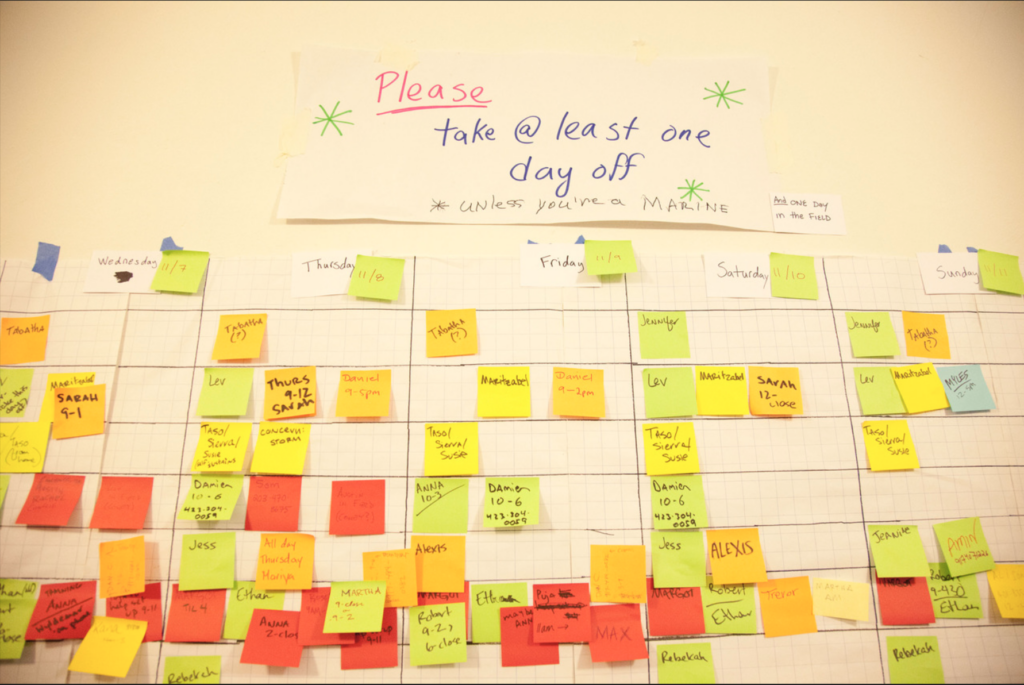
Everyone is always jumping from topic to topic as priorities change during a response. As systems fall into place, people start making notes in their “space” – whether physical space (as pictured above), in onboarding docs, or as reminders present in digital communication. Self-care guidelines should be included in this, along with an explicit expectation that people support each other if someone is struggling to follow community care guidelines. They may already be facing internal shame for not modeling the behavior.

For example, rotation of duties is an excellent way to build resilience of responsibility in your community and to strengthen the overall system by knowledge sharing. Taking at least one day off a week is a necessary additional example. Both come at a cost – a maximum of 5 days in one’s speciality – but the overall benefit to the system is well worth it.

Lead by obeying

You cannot go all out indefinitely and your body, relationships, and work will suffer if you try to. If someone (including you) is unwilling to take care of themselves, there is likely either a codependent need to be valued that needs self reflection, or they may be more interested in being seen as heroic than in actually being effective or modeling care for others, and that should be avoided. Life will continue after the crisis, and you have to have things worth going back to, that hopefully you’ve been able to enjoy and maintain in the meantime.

Pushing power outwards

Look for people invested in the cultural context of the group you’re working in. They will foster the emotional safety that will allow you to take informed risks. Look for people who make space for others, and ask them to lead. Quiet, competent leaders are often overlooked in favor of those who are brasher. However, the quiet, competent people can also be the most skilled at delivering on group goals while also uplifting the group. 

Those folks can be quiet, though! And quiet people sometimes like quiet spaces. Having a “sacred” quiet space to go amongst the chaos of response can help people recenter themselves and find balance. It’s a good place to practice gratitude and pause to be strategic rather than reactionary.

Support your leaders, IE if a quiet, competent leader is also a single parent, find a way to get them child care support while they coordinate your group. Additionally, it is a full time job to support the frontline workers. Those support roles ALSO need support and can succumb to burnout.