
Dar part 2

People don’t lean out of vehicles to ask for directions here, as they did in Nairobi. The security guards, when they exist, lounge in chairs and ask questions rather than standing, mostly silent, with automatic weapons. But like Nairobi, meetings can start (and end) hours late due to traffic, to tardy risers, to rain that causes traffic, to conversations running long, to torn-up infrastructure (that causes traffic), to slow service for your lunch meeting. Tardiness is sometimes used as a sort of posturing card to play – whether or not someone gives you a meeting, and how prompt they are, as sorts of indicators of status.

Everything we’ve done here has required status strutting in order to gain speed. Those plates I told you about? Only people with yellow plates get pulled at traffic stops, because they won’t be diplomats, or military, or donors, or government. If you get stopped, it’s easier for everyone if you just hand the officer money rather than pay the huge fine for driving illegally. Which most are. And because we don’t want to slow down our project, nearly every introduction is “and this is Willow, from MIT.” Which is great and all1, but as someone who prefers to be affiliated with institutions for access to incredible brains and the space to consider at length, rather than constructed legitimacy, it makes me feel like I’d be prettier if I just smiled2.

Those same posturings and rerouting the system means there’s a fear of transparency here. Entire systems here are built up around being opaque. People across all walks of life ignore the floods for fear of being blamed for what happened, being put out of a job. This means any transition into transparency will require safe space. No “we’re coming after you” attitude, but a “we have been operating to the best of our abilities within the structure we have. Now that the structure is changing, we get to change as well!” But it seems enough people into open data and transparency have done it with a vindictive streak that everyone balks these days, and it’s a slow, gentle process.

Two and a half days into an 8 day trip, we’d chatted with NGOs, World Bank3 employees, the Ministry of Water, UNHCR, and no people who actually live the experience this technology would change. And as much as I trust all of those people (and my hosts) to know what the status of their work is, I needed to go see things. Establish ground truth. Everyone gets caught up in paperwork, rhetoric, image, and email, and so seeing it for oneself is always imperative. Mark, an amazing guide and cohort as always, got us out to Tandale a full day early for the sake of my patience and sanity.

On the way there, Msilikale leaned forward to ask the bajaj driver to drive like he does, not like we’re tourists. The roads had washed out from the recent floods, full of pot holes and rubble to negotiate and lurch over. Tandale is a slum in Dar es Salaam, and is a place to live, just like anywhere else. We walk with a man who has lived there, him taking us past houses with water lines up to our mid-thigh, insides still covered in silt, to the river running by the open defication area (ODA here). Kids run by with make-shift toys, and young women peep out to ogle my hair (or Mark’s size)4. As we stand by a washed-out bridge, our guide explains context.

The river divides two areas, one has most of the markets and the other is mostly houses. There’s no grid system (it’s an informal settlement), and so paths are highly reliant upon available bridges, and new structures are based on those paths. IE, functionally ad hoc labyrinthine. And when the floods came, the bridge washed out, and there are still people learning about that and figuring out new routes home. No one is responsible for the bridge – the government won’t come fix it, and the man who built it and had lived nearby died awhile back. No one takes responsibility, either.
It’s not just the bridge getting washed out – it’s the height at which the water rose, and that the ODA is not much higher than the river on a regular basis anyway, and it’s certainly lower than the water marks. So all the trash and bodily functions and such from the ODA get caught up in the river, which means it gets clogged up (as do the drains in the area), which means standing water, which means more mosquitos, and mosquitos are bad news bears. That’s besides all the things in the ODA also flooding into the houses with the rest of the river water.
Flooded or not, the water from the river (and the wells around it) is used to wash, cook, and sometimes drink. This is only for people who can’t afford the water out of the water points – which can be salt or fresh. For half price, you can get jugs of salt water to wash with, and sometimes for cooking. For full price, you can get fresh water. The water is delivered out of water points – giant containers, raised up off the ground, from which people purchase water. These are privately owned, though installed and supplied by the government, and few enough are stocked and working at any given point that there are queues for the resource.
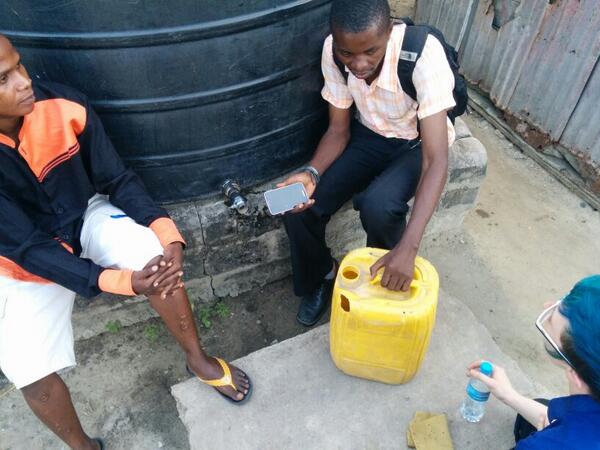
I ask questions. How do people know that one is broken? I wonder about where knowledge of what is going on would be hosted and shared. Is there a town center where things are posted, or is it all word of mouth? No center, just neighbors telling neighbors. No bulletin board system. I saw a vanishingly small number of feature phones while we were out. Only government and donor officials and contractors smart phones. Which, to me, makes me wonder how to get maps built of the water system back to the people in the area5. And given the level of corruption in the country, that data being only accessible to groups already in power is fraught with peril. Mark, aware to not ask questions about anything that won’t have a guaranteed resource response, waves me off asking more specific questions of how points break, and how to track response, what would next challenges and steps be, etc6.

Night threatening and malaria mosquitos7 lazing about, we walk back towards the main road. At a bodaboda station, we negotiate with the fliers. I feel like I’m choosing who to be auctioned off to, having to dismiss the enthusiastic and be wary of the most aloof. Msilikale shoos off the most invasive, and I’m glad of a native Swahili speaker friend and a friend who’s 6’6”. That negotiated, we take a rather epic dive-bomb through traffic route home8, avoiding jams and vehicles traversing the median to gain a clearer route. Only one or two of the passing bike riders make kissy faces and eyebrows at me. Mosquitos die on my visor, and mud splashes on my boots.

And I stare at the bathtub in the hotel room, and think about not finishing my dinner when I was young and knowing most parents referred to starving children in Africa. But the issue then, and with this, is in supply chains and politics around them.

1. Waves MIT flag.
2. Institutional objectification. Which is at least different from institutionalized -isms.
3. Yes, of course I wore my “/capitalism” pin, why do you ask?
4. Please forgive my tense-shifting.
5. A core ethic when obtaining data. See also this blog entry.
6. DEMAND EQUITABLE ETC9
7. Dhengi for day, malaria for night.
8. Sorry, mom.
9. Inside joke.
A Week of User Rights and the Tools to Support

What a crazy week. This has mostly been typed on a plane back to Boston, where I get to be for a few days before heading to DC and then home to visit. When I landed to SF a week ago, I had plans to see friends, to lounge a bit, to enjoy a city I love so much. Instead, and just as happily, it was a whirlwind of jam-packed braining and action around user rights and the methods and tools to support those rights.

Countersurveillance DiscoTechs

With the Codesign Studio I TA with the Media Lab, a series of Discovery Technology (DiscoTech) Workshops were put on. The ones in Bangalore, Ramallah, Mexico City, Boston, and San Francisco were all inspiring. You can see more about the projects, art, and progress over on our hackpad. Some examples were stories from Venezuelan activists, face painting to deter facial recognition (so hard!), long-time surveillance on poor communities in America, and spoofing DNA.

And seriously. Take a few minutes to go through the partner pages for this. Need a bit of morning outrage? Think everything’s going pretty ok in the world? Nope!

UI/UX for Crypto Tools Hackathon

The second usability hackathon with OpenITP went incredibly well, and repped as the San Francisco DiscoTech as well as its own thing.

It was utterly luxurious to work on large team of people. Ciprian had logistics covered, solidly. Gus knew the projects inside and out. Bex had notes and tone in beautiful competence. Anytime I would think “oh, we should..” it was already in progress. All I had to do was herd the kittens, which was absurdly fun.

RightsCon

It was really nice to completely surrounded by the people I usually see when we all jam into the one or two sessions at any tech or policy event which involve both. But that overlap was the whole conference, so we were able to dive in much deeper, see more nuance, and see next steps. I learned about funder motives, and the initiatives which backed tech in atrocity prevention/detection/accountability, and about many many tools used to amplify the voices of marginalized people. I drew a lot, and I hugged even more.

VizNotes

Full set on bl00viz.

Typed Notes!

I typed notes for two interactive sessions for sake of formatting. One was a review of the the UI/UX hackathon the weekend before, the other was stories from the field and suggestions for how to be better trainers. Those can be found over on the Civic blog.

Responsible Data Forum

Thursday I trekked out to Oakland to participate in Engine Room‘s Responsible Data Forum, as hosted by the inspirational Aspiration Tech. Again, I was spoiled by being surrounded by an impressively diverse set of people interested in the same fulcrum of concern and change. We skeletoned out plans for checklists before collecting data, and workflows that include project death, and illustrated how data moves through a company. We talked hosting and coercion resistant design and informed consent. We also talked about context-based privacy in disasters. I’m looking forward to seeing what comes of the day.

Open Badges for Crisis Response

Just before the Dublin Hacks event, I found myself in London for Mozfest, the yearly conference for Mozilla. I was there to wander and schmooze, but then I met Jess Klein (now listed on our Who-Is page!). She was working on HackLabs in disaster areas, based on her experience during Hurricane Sandy. What would be needed in any kit (software of space-wise) deployed in times of disaster? It’s a good question asked by many intelligent people who encounter disaster. Because of GWOB’s exposure to so many such people and groups, it’s also a question we know is huge, and one that we create parts and pieces of constantly. Through deep conversation over a couple hours, we dug down deeper: what is a missing component our crew was especially well equipped to deal with at Mozfest?

The Emergency Hacklab team discussed just this question. What we came up with was this: a way for residents in an affected area to indicate someone has helped them. This helps deal with the disconnect between responders and the good work they aim to do.

In times of crisis, there is a desperate need to open up emergency/disaster response data. Communities rush to aid and collaborate both online and in person. There is a convergence of new technology, open source methodologies and grassroots activism. The Emergency Hack Lab tackled the question of how to credential, task and thank volunteers. The UN OCHA offices released an open data set of disaster badges. In a fast paced sprint, our team hacked and built proto-workflow for the UN OCHA Noun Project sets (official process) to the Mozilla Open Badges program. More details from Jessica Klein, Creative Lead, Mozilla Open Badges.

Things we’re super excited about:
This wasn’t about reinventing the wheel, it was about doing something innovative with existing pieces. We pulled from the UNOCHA Noun Project page. We are building a badging triage system that can function on top of existing grassroots and relief technology such as the Participatory Aid Marktplace and Frontline SMS using Mozilla Open Badges.

What’s next:

  • Code the SMS system prototype that is detailed in the userflow here:

  • Partnering with existing grassroots and relief orgs to make sure what we build can sit on top of their technology
  • User test the utility of the UNOCHA badges as we have hacked them out here: https://etherpad.mozilla.org/emergency-badges
  • Join us for the OpenBadges call about this Jan 29 – details here

Do we have a plan for deploying this? Testing it?

  • We are looking for volunteers to join our usertesting cohort.
  • We are working with the Hive Learning Network to usertest and paper prototype
  • People all over the world have expressed interest in this including Global Minimum who have offered to work with us to user test once we have a prototype

Learn more at: https://wiki.mozilla.org/Emergencyhacklab and http://jessicaklein.blogspot.co.uk/2013/11/community-aid-badging.html

If you are interested in working on this project – please let us know:

Introducing the Participatory Aid Marketplace

My cohort Matt Stempeck at the Center for Civic Media at MIT’s Media Lab recently finished his graduate thesis on participatory aid. We were also on a panel together at the MIT-Knight Civic Media Conference. Here’s a blog he posted on the Civic Blog about his work – it’s reposted here with his permission.

Unlike my thesis readers, who may or may not have made it through all 244 pages, you get to experience the condensed version. The full PDF is here, if you’re into reading and citations.

Participatory Aid

People are using information and communication technologies (like the internet) to help each other in times of crisis (natural or man-made). This trend is the evolution of a concept known as “mutual aid”, introduced by Russian polymath Peter Kropotkin in 1902 in his argument that our natural sociable inclinations towards cooperation and mutual support are underserved by capitalism’s exclusive focus on the self-interested individual. My own reaction is to the bureaucracy’s underserving of informal and public-led solutions.

The practice of mutual aid has been greatly accelerated and extended by the internet’s global reach. I introduce the term “participatory aid” to describe the new reality where people all over the planet can participate in providing aid in various forms to their fellow humans. In many of these cases, that aid is mediated at least partially by technology, rather than exclusively by formal aid groups.

Formal aid groups like the UN and Red Cross are facing disintermediation not entirely unlike we’ve seen in the music, travel, and news industries. Members of the public are increasingly turning towards direct sources in crises rather than large, bureaucratic intermediaries. Information is increasingly likely to originate from people on the ground in those places rather than news companies, and there is a rich and growing number of ways to help, as well.

You are more than your bank account

The advent of broadcast media brought with it new responsibilities to empathize with people experiencing disaster all over the world. For most of the 20th century, the public was invited to demonstrate their sympathy via financial donations to formal aid organizations, who would, in turn, help those in need (think telethons). This broadcast model of aid works well for martialing large numbers of donors, IF a crisis is deemed significant enough to broadcast it to the audience. Many crises do not reach this threshold, and therefore do not receive the public or private relief support that often follows broadcast attention.

People are using the internet to help in creative ways in times of crisis. There are pros and cons to this development, to be celebrated and mitigated. Briefly, the pool of people who can help in some way is now orders of magnitude larger than it was previously, and the value of those peoples’ contributions is no longer limited to the financial value of their bank accounts. People have consistently proven capable of creative solutions and able to respond to a wider range of human needs than formal needs assessment methodologies accommodate.

On the flip side, not every way to help online is as effective as providing additional funding to professional crisis responders. There is already a graveyard of hackathon projects that never truly helped anyone (especially those with no connection or feedback loop from anyone in the field). The expansion of the range of crisis responders can lead to fragmentation of resources and duplication of efforts, although anyone managing the thousands of traditional NGOs that descended upon Haiti following the earthquake there will tell you that the same problem exists offline. It is my hope that open data standards and improved coordination between projects can mitigate some of these issues.

case-library-categories

How to Help Using Tech

One of the more celebrated methods of recent years is the practice of crisismapping. Following a disaster, crowdsourced mapping platforms like Ushahidi are populated with geocoded data by globally distributed online volunteers like Volunteer Standby Taskforce. The teams collect, translate, verify, analyze, and plot data points to improve the situational awareness (the “what’s going on where”) of formal emergency managers and organizations.

Of course, participatory aid is not limited to producing crisis maps to benefit formal aid organizations, and I argue we shouldn’t limit our understanding of the space to this one early example. Countless professions have shifted to support the digitization of labor, so many of our jobs can (and are) conducted online (pro bono networks like Taproot Foundation and Catchafire are important inspirations to consider). Over time, technology has continued to expand the range of actions an individual can accomplish from anywhere in the world.

A Case Library of New Ways to Help

To support this argument, I collected a case library of nearly one hundred ways members of the public can help communities in crisis (as well as the formal aid organizations working on behalf of these communities). I still need to convert the full case library from Word to HTML, but you can get a sense of it here.

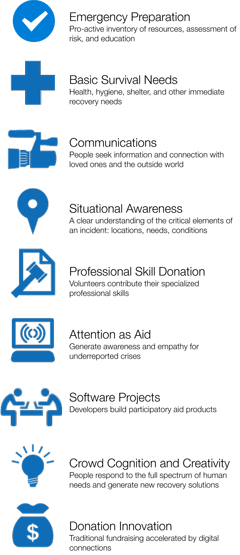
I spent a lot of time thinking about the many ways people can help using technology, and abstracted from these many cases 9 general categories to organize the library. They are to your left.

Framework

From the many examples in the case library, I abstracted a framework to help define and think about participatory aid projects:

framework

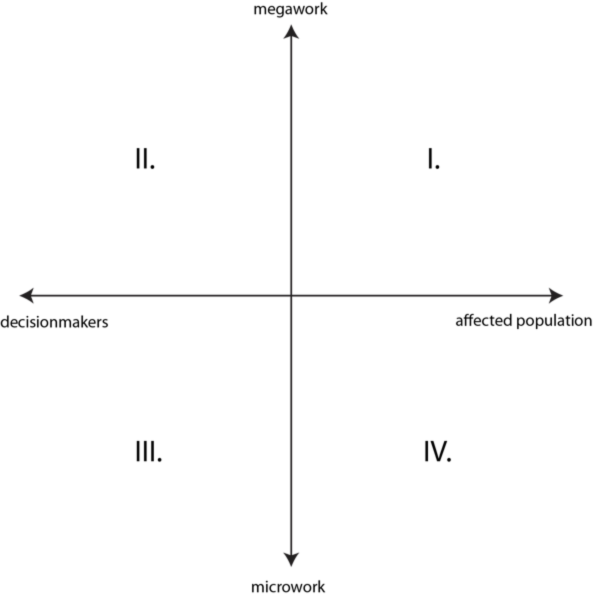
Participatory aid can consist of projects that help existing formal aid groups (like a crisis map created at the request of such an institution) or projects that seek to help the affected population directly (like the Sandy Coworking Map, which listed donations of commercial real estate by and for the people of New York). This is a spectrum, because there are many projects which seek to help the affected population as well as the professionals mediating their aid.

Likewise, there is a spectrum between microwork, which often gets called ‘crowdsourcing’, and far less discrete tasks, like designing an entirely new software project or launching an entirely new public initiative like Occupy Sandy. In my research, I noticed that even some of those in the participatory aid space a limited view of its possibilities, and consider crowdsourced microwork at the behest of existing state actors (quadrant IV) to be the ideal application of technological innovation in crisis response. This is an exciting area, but there’s equally great work being done elsewhere. We can create and execute much deeper, more complicated solutions than helping sort thousands of tweets to extract actionable information. (See Ethan Zuckerman’s discussion of thick vs. thin engagement, which I borrow).

Participatory Aid Marketplace

Because I’m at the Media Lab, I was charged with building a piece of technology in addition to producing the written thesis. After conducting interviews with a wide range of leaders in the participatory aid space (and reading a crazy wide range of documents), it emerged that coordination of efforts was a major and unsolved need. Volunteers are interested in what they can do to help, and prefer to use their professional skills if volunteering (versus making a donation). Leaders of semi-formal volunteer organizations like those that make up the Digital Humanitarians Networkseek common check-in forms to easily alert one another (and the world) to their deployments. The individuals within formal aid organizations (like UN-OCHA) who are working to better integrate participatory aid with formal aid also stand to benefit from improved coordination and aggregation of participatory aid projects.

So, with a team of MIT undergrads (Patrick Marx, Eann Tuann, and Yi-shiuan Tung), I co-designed and built a website to aggregate participatory aid projects. The goals of the site are:

  • to index active participatory aid projects by crisis to provide an overview of public response
  • to match skilled volunteers with projects seeking their help
  • to host the case library of previous examples of peer aid, tagged by the needs they addressed, in the hopes of inspiring future projects
  • to do all of this in as user-friendly, open, and distributable ways as possible (including early support for a couple of emerging aid data standards)

Participatory Aid Marketplace
A design mockup of the functional Drupal site

The site provides administrators of participatory aid projects with a simple form to list their project. This form populates the active project views as well as the case library, and links projects to common crisis needs and general buckets of volunteer skills. It can also automatically distribute the content to existing coordination fora like Google Groups or RSS readers.

Volunteers can participate in the site with full-fledged profiles, skills<->project matching, and specific LinkedIn skills importing. The more likely use case consists of short, anonymous visits to quickly identify meaningful ways to help in the crises people care about.

The skills selection and importing prototype

The skills selection and importing prototype

Future Work

There’s a lot more in the full thesis, but essentially, we’ve worked with some of the most innovative groups in crisis response to build a functional prototype that would only require some design work and loving iterations to be of real utility. I’m looking into various ways to finish development and implement the site (not to mention identify a good organizational / network home). Get in touch with me if you’d like to talk about the platform, or this space in general.

THANKS

Thanks for reading this.

Also, while I’ve worked for years to use the web to organize people to create change in the world, my background isn’t in humanitarian aid or crisis response. My ability to rapidly understand this space and consume massive amounts of information (written and social) was directly correlated with the kindness and enthusiasm of people like Willow Brugh, Luis Capelo, Natalie Chang, all of my interview subjects, all of the kind survey respondents, and of course my readers, Ethan ZuckermanJoi Ito, and Patrick Meier. My colleagues, the staff and fellow grad students of the Center for Civic Media, shared their intellectual firepower at every turn.

Becoming Structured

Feeding off the Pixels and Paintbrushes blog entry. Interested in that transition space between the analog and the digital. It’s funny, liminal has long been my favorite word, rivaled only recently by penumbral. More and more, I get to look at and live in that space. But now I see it more as the space of transition, not just as space between/at the edge.

So this thing happens, where we have formal structures, and the informal takes up the space between. As in the previous entry, each of these has its purpose and strengths and weaknesses.

This drawing based off a conversation with Galit, a cohort and roommate.

This drawing based off a conversation with Galit, a cohort and roommate.

As a reference, let’s take the limited work I’ve done with Occupy Relief efforts. I act as human API – if you need something from a formalized organization, including them getting out of the way, let me know. Then there are posts like this one, which is totally legit. But it puts me in a strange place of saying “I stand with you politically, but if you want this taken care of logistically, then let’s do that.” Something that keeps me in the relief space is how stark a relief differences are thrown into1. The choices that have to be made, and what is considered important when, and what cultural artifacts are created by those choices. A big part of how adaptable and powerful Occupy is, is based upon their NOT being defined nor legible. More and more I wonder how to make groups like FEMA legible to Occupy, rather than the other way round.

Reading Seeing Like A State, if you can’t tell. So very good. And then, I got to see Douglas Rushkoff speak about his new book, Present Shock. I think a HUGE part of these ideas overlap.

He equated the quest for the upper right quadrant in Capitalism with the Singularity as an example of existing world views being applied to new ways of considering the future. Rushkoff also brought up the feminist media theory of storylines and plots of male vs female orgasm – one is a single escalation and then easy bell curve down. The other being complex, multi-apex, etc. The only way we’ve known for things to be predictable is with the storyline we could track – the male orgasm model2.

Now we have the ability to see, track, understand the complexity of “actual” life3 through big data4 in a way that understands as it emerges, rather than forces adherence to a predictable, and thereby incomplete, model. And instead we are applying the same two-dimensional, simplistic pattern to it, and cutting off the long tails of a bell curve we’ve forced everything into. We’re bringing the legal system of documents and MAYBE spreadsheets to a database and RDF world5. We are not allowing ourselves the nuance of the paintbrush, digitized through the use of high-density pixels. We’re making ourselves bland and bucketed instead. A low-res snapshot of culture, of which the mere act of capturing makes us fulfill it more closely. Through quantified self and things like Prism, we’re stealing our own souls, at least as things are set up now6.

And this is why I’m doing the research I am. I’m tired of us lugging our unexamined baggage into the future we’re building. In the past, institutions were where knowledge was stored. Now it’s stored in us, in a sharable and duplicatable way. Seeing Rushkoff was inspiring, because he noted that yes, it’s difficult to exist in the crevices, but it’s also totally worthwhile. Video and audio are up already on the Berkman site.


It’s the trying to fit new things into old methods. We have to be willing to embrace some unpredictability in order for the lives of others to be more predictable to themselves. Crowds becoming “less predictable” to an outside view, but they’re becoming more self-determining. Let go of the reins and let it guide itself. Isn’t that the point of having power? To push it outwards?
—–

1. See why penumbral is a favorite word?
2. Sidenote that I just tried to find links to the academic background on this, but guess how useful the internet is for THAT.
3. Or at least a closer approximation than we’ve had in the past.
4. Which would be the crowning, and crowing, triumph of Sociology.
5. And the database model isn’t The Best, it’s just “better” than what we’ve had before, in that it’s more self-defining and adaptable.
6. Damn kids get off my keyboard.

Expectations

There’s something about the fantastic Saving The Hackathon blog post on TokBox, that gets to the crux of the cognitive dissonance around hackathons. People expect the next technological tool or application that will change the world to come out of these. Sometimes they do, but rarely. (Insert side-rant about the expectation of perfectly-formed tools, objects, or people appearing from anywhere; as specifically articulated in my comments to this blog post). As I’m sure we’ve talked about before, I deeply believe that technologies only amplify human intent. I have yet to see anything that contradicts this. When it comes to disaster and humanitarian response hackathons, they get a lot of press. But what is the tangible output? What expectations can we set for ourselves and attendees?

So far as tools which can immediately be deployed in the field, not much. Not to say it doesn’t happen at all, but it is rare. The amount of forethought and digging which must happen to find the specific pain point which tech can help ease or automate is not something the affected population or the responders really have time to deal with while they are also doing response. Even when something appropriate is built, you have to worry about dissemination, training, and failure modes. Thus why the most useful things come out of things like Random Hacks of Kindness and CrisisCamps are awareness building and warm fuzzy feelings.

Yes, both warm fuzzies and awareness are legitimate, useful things. Too often, as technologists, we are separated from our world. We spend time behind screens, acutely aware of crises and issues but detached from the response and ownership of those situations. Civic media is an exceptional example of how technology has helped to close that detachment rather than deepen it. I see the same reclamation of involvement at the heart of the maker movement also at the heart of digital humanitarian work. No, this is not something we can leave up to some organization that we don’t know about, that isn’t accountable to us, and that doesn’t have mechanisms for listening to the very people it claims to serve. This is something we must do ourselves, calling upon the institutional knowledge and resources of those large organizations as needed. The things we create, which work, including processes, need to be codified. Sometimes into consensual hierarchies, sometimes into bureaucracy (both of which can be useful, as painful as that might seem). These assumptions of interaction allow us to operate at the next higher level, just as a language allows us to converse more easily, and a shared word set (for a discipline, say) allows us to have even more specific and deep conversation.

rhythmic tapping will solve everything!

rhythmic tapping solves everything

And on the institutionalized side of another false dichotomy, the awareness and warm fuzzies remove the mysticism of tech. People in traditional sectors all too often see applications and networks as some ruby slippers, easily deployed and perfectly aligned if you just knew the right phrase. And the same fear that goes along with a belief in such power, the misunderstanding of a very real (but also not ultimate) power. It’s not just developers who think the thing they build will be the next big thing – it’s also the people in response-based orgs not knowing that they need one section of a workflow automated, not a geotagged photo sharing platform (we already have those).

So response hackathons are a great place for the amplification of human intent and desire to assist the rest of humanity. That’s great. Now – how do you make those intentions deployable? IE, now that you’ve had the cancer walk, who’s doing the research and implementation? That’s a smaller group of people, who are willing to take the risk of plunging into work that doesn’t pay like the rest of the software world. That’s a small group of people who are willing to suffer the heart break and soul crushing that seeing the horrors of the world can cause, in order to see your tiny steps (maybe) make way against that. That’s an even smaller group of people who also understand how to support and care for themselves while they do that work, to find sustained income (sometimes from the people you are wanting to help most – which is still a cognitively sticky bucket for me), so they can keep going. And the fight isn’t just to make things better, it’s also about how that exists in the current world, with policy and with culture.

Response hackathons absolutely have a place in this system of engagement. But it’s one part. Without the continuation programs like Geeks Without Bounds and SocialCoding4Good, we all just pat ourselves on the back and go home. We start to wonder if it’s even worth going to the next one. But accomplishment takes hard work, and sometimes working on the fiddly bits. And that means deep learning and conversations with the user. That means advance work, and continued work. Which I believe you can do. Don’t just create in response to things going pear-shaped. Build things to better understand them. Create to make the world better. Make with purpose. The disasters and obstacles we face in the near future are unpredictably complicated and massive. We have no way to train for them. But we also have massive untapped resources in the sharing of our brains and hearts, brought out when we create, and share, and build.

It is with all this in mind that I am excited about how Geeks Without Bounds is starting to look at how we will interact with OpenHatch, in an effort to contribute to (and learn from) the open source community. It is with all this in mind that I am excited about DataWind, and AppsToEmpower, and shipping low-cost tablets into developing area pre-loaded with useful tools. It is with these things in mind that I am excited about the continuation of EveryoneHacks, and how it creates space for new creators.

Port-au-Prince

Landed in Port-au-Prince a few hours ago. Have had a nap, and a salad, and a tour of where we’ll hold the hackathon. I waited for Marco, our driver (green car), by the hotel’s road, prolonged looks from passers-by and giggles from children. Marco assures me it’s because my hair is so different, not because I am stumbling blatantly in any social way.

I’m here for a gender-based-violence hackathon put on by Digital Democracy – Schuyler linked us up. The call center which Kovaviv has going for victims of gender-based violence, to get them medical and psychosocial and legal help, is in need of some scaling and shoring up. (We’ll be using #HaitiHack for the event.) We’ve called together an international team and a local team to get the work done, housed out of a university with a charming leader obsessed with perrier. I drank coffee out of a tiny cup while we explored the space we’ll have access to, and ran into some folk from NetHope – the social singularities continue even here.

Everything is bright, and covered in hand-painted advertisements, and it is hot. High ceilings and open windows allow heat to pass through, vast empty rooms cooler than the crowded outside. I feel unhappy but grateful for the luxuries of the hotel they have put me up in – A/C (should I want it), hot water (should I want it), and wifi (definitely want that). There is teasing about my wilted demeanor in the heat, and I tell them about Seattle and the overcast and how people wear all greys and blacks and drink a lot of coffee. The traffic is chaotic but predictable, reminding me of driving in New York, but more so. Taps on the horn for communication, not anger. People walk and ride with assurance tempered with awareness.

Flocks of children recently released from schools, far enough from origin to have their uniforms mix together, some bands still holding strong. We talk about how a school uniform means if a student is found but the parents can’t for the moment, the school is a place to return to for safety and waiting. Marco is incredibly patient with me while I try to ask how attendance is determined – based on the ability to pay, not location. Cognitive leaps I barely get away with among native English speakers will not do here.

Guards with shotguns watch soccer alongside students, everyone piled into the cafeteria, ignoring the vista to cheer their team. It seems all the infrastructure (not just architectural, but also social, and network, etc) are either under repair or being built afresh. I wonder if this leads to a predictability which can be assumed, or means nothing is so stable as to built upon (hearts, dreams, and mortar). I imagine I will be in awe either way.

In a few hours, we’ll go to a restaurant-bar quietly owned by the same folk behind an LGBT advocacy group here. While not a “gay bar” (the backlash here would still be too great and violent), it is a safe space and a welcome meeting place. My utter lack in the language and many of the social cues prevent me from interacting much beyond planned meetings, but those few are with people who express mild curiosity and quick smiles. Tomorrow the rest of the crew arrives, but today I’m still trying to get some kegs picked up in San Francisco and my belongings shipped from Seattle to Boston. It is an interesting world.