Civic tech and digital response

Originally posted on the Aspiration blog

We are preparing for the Humanitarian Technology Festival on June 4th and 5th in Cambridge, Mass. This participatory event is for field practitioners, media makers and storytellers, technology developers, information security practitioners, members of affected populations, researchers, and everyone in between. We are hoping for a strong contingent of civic tech and civic media folk as well, for reasons we hope this post will make clear.

Humanitarian and disaster response deals with exceptional situations. But whether through historical happenstance or through poor design, response also tends to be short-sighted and deeply siloed. As crises are by definition beyond the capacity of “the norm” (existing infrastructure like governments), responders are often military or nongovernment organizations (NGOs). We deploy into places we do not fully understand the histories of, where we are not well connected with pre-existing efforts, and when we leave we often take our data and gained understanding with us. We too often make poor choices which deeply affect the future lives of a frontline community because “it is better than doing nothing.” I generally find the whole thing paternalistic and incremental when we should instead be focusing on systemic interventions to long-term issues of inequity by working with local populations to increase their capacity. A combination of coping with exceptional circumstances in a way which actively works with, depends on, and returns to pre-existing efforts is what I see in the overlap of civics and response.

Where one ends and the other begins

Civic tech is technology which enables engagement or participation of the public for stronger development, enhancing citizen communications, improving government infrastructure, and generally improving the public good. Civic media is any form of communication that strengthens the social bonds within a community or creates a strong sense of civic engagement among its residents. Then civic media and tech are deeply linked with digital disaster and humanitarian response. All are about how people work with each other and with institutions, each is about more intentional infrastructure, and each is about having an empowered public supported by institutions and a global public. The excellent book Building Resilience gives a precise overview of the strength of social capital and community ties as the leading indicator to a region’s ability to cope with shocks and stressors, regardless of access to other resources. We anticipate the scenario we will be playing through at the event will get at these social ties as well as laying a baseline of understanding for those new to response.

From that background theory, the practice looks like responders working with already established civic infrastructure in order to bolster those networks of trust, to benefit from that knowledge, and to have a place to return created data and delivered resources into for post-response sustainability. But where do humanitarian aid/development, civic engagement, and disaster response transition into one another?

Civics and humanitarian aid

Digital humanitarian response could be seen as civics in places where there is not yet established technical, physical, or possibly even political infrastructure to bolster or route around. In this case, considering how the civic tools you are building apply to other locations is a useful theoretical framework. Perhaps more importantly — how could tools built elsewhere apply here? (Spoiler alert: Kenya and Tanzania have had mobile money for a looooong time, and we are only just starting to get it in the States — we have plenty to learn from other places.) Improving infrastructure is more and more grounded on baseline data, which can be collected for development purposes or as a means of civic engagement. When the creation of baseline data is happening for civic reasons, it indicates those social ties are being formed around local political empowerment, versus (the still worthwhile) baseline creation by intervening groups like UN OCHA for the sole purpose of response. Our goal in response is to only be around for as long as we are needed, but civics is about investing in a longer-term view.

Civics and disaster response

While humanitarian aid is (in part) about the creation or improvement of long-term infrastructure, disaster response is about existing infrastructure being disrupted, and not even in the questionable type of disruption from Silicon Valley, but in the sense of “nothing is working the way we planned because the power and internet we have come to rely on are down and I can’t find my child.” In these circumstances, building tools which allow for (or even encourage!) off-the-grid communication or storage-until-able-to-update matter. As in, tools which would also work in low connectivity areas like humanitarian deployments are often better suited for crisis response than other everyday-use tools. We will be thinking about how to perform such coordination at HumTechFest, too.

An aside here seems necessary, to point out that the chaos of response is in this disconnection from the infrastructures on which we depend. The chaos is not in the form of people. People are amazing, often even more so in a crisis. While most of the field of Disaster Sociology points this out, a shorter (and easy) read is A Paradise Built in Hell.

The square you start from matters

While we can talk all day about the technology we use in our everyday lives and in times of crisis, the purpose of that technology is to help us connect with one another, to help us have safer and happier (and I would argue more dignified and coequal) lives. Social connections bolstered by mediating technology is how communities help themselves. Take Civic Hall‘s Noel Hidalgo, and his Coworking Map during Sandy response. It is from those spaces so many of the preexisting civic tech was reapplied to the new crisis circumstance, and that people found each other in order to address their unique concerns. The strong civic ties allowed for a more robust response. The same is true of the success of Occupy Sandy, grown from the ties created during Occupy Wall Street, and for the listening centers in West Africa which became essential for information distribution during the Ebola outbreak. Caring about sharing data in advance means you can more readily ask for external help… and then hold those responding accountable because there is a baseline.

Deepening the connection

We would love to explore this overlap further, and be more intentional in things like data hand-off and collaboration between existing community-based groups like Public Labs and Open Referral and NYC Prepared, official response organizations like FEMA and local Offices of Emergency Mangement, emergent response groups like Occupy Sandy and Boulder Relief, and back to those long-term civic groups. We would love to think about how those communication patterns might look, and what resources we can create to expedite the process. We have a lot to learn from groups like Humanitarian OpenStreetMap Team and Kathmandu Living Labs. As Heather Leson said in this blog post on Civicus,

How can maps and citizen-generated data empower civil society organisations to bring about change in their local community? In some parts of the world, existing physical layer maps are inaccurate and outdated. Imagine walking around your neighbourhood – do you know the names of all the streets, or where the nearest school or hospital is? With this kind of data, people are in a better position to plan futures for their communities. OSM enables each of these data items to be downloaded freely, making it a valuable civil society resource.

Projects like Promise TrackerTaarifa, and the Riffle provide that strong baseline data which can also be useful in times of crisis, as well as the surrounding communities of practice. How excellent would it be to have all the capacity needed to respond already in any given location?! So rad. Because then it is not a crisis. When we frame response on strong civic engagement rather than a traditional perspective of short-term interventions, we are acting in a more efficacious and coequal way. We are acting in solidarity.

Join us in building this new world

We hope you will join us to be a part of this responsible lifecycle on June 4th and 5th in Cambridge, Mass at the Humanitarian Technology Festival. If you want to carpool up from NYC, we are happy to help with gas. If you are on the West Coast, we would love to see you at the June 16th Digital Responder Meet Up in San Francisco. And if you are remote to both those places, we have an ongoing mailing list and semi-regular call-ins you can join.

Deep thanks to the Aspiration teamHeather LesonMatt Stempeck, and Ethan Zuckerman for helping make this piece exist.

Drafting an introductory handbook for Digital Response

Originally posted on the Aspiration blog

We’re getting ready for the Humanitarian Technology Festival in Cambridge, Mass June 4th and 5th. We’ve already talked about our potential sessions (let us know if you have more ideas!), how civic tech and media are related to response, and the scenario/game we are going to play. Another opportunity presented by having so many diverse folk in a room is that of creating an introductory handbook for digital responders. We will benefit especially from having folk present who haven’t been through a response deployment before.

A surge of interest and attention

Humanitarian and disaster response sees large influxes of attention and funding during high-stress situations, the navigation of which creates one more factor for those already doing logistics. These sudden influxes are called “surges,” and the sudden but disproportionate shifts in what is possible with those increases is called “surge capacity.” Digital response sees an even larger influx of attention, as it’s easier to log in to a readily handy device to sort data than it is to fly to an affected region. But while much of traditional response has some history in coping with and utilizing surges through protocols and expectations of how volunteers should (and shouldn’t) engage in the field, the digital space lacks that onboarding infrastructure and expectation setting. What if we had a communally-held introductory guide/handbook to send the wonderful new people invested in helping out digitally when things get additionally chaotic through people’s good will? The next layer to add to this is how we can be better prepared to contribute both digitally and locally to disaster risk management. Imagine that digital contributors collaborated in parallel and, even, inside local and global organizations to help make a difference.

The beauty of seeing ourselves as global citizens

But what is digital response? The excellent Heather Leson has already said it far better than I ever could in this WeForum piece:

Seeking a way to “do something,” more and more people are answering the call to action on social media after each emergency. Digital responders or “digital humanitarians“ immediately log on when news breaks about a natural disaster or human-created catastrophe. Individuals and teams “activate” based on skill sets of volunteer and technical communities (VTCs). These digital responders use their time and technical skills, as well as their personal networks in an attempt to help mitigate information overload for formal humanitarian aid in the field. The terms often used to define these contributors in the humanitarian space are remote help, citizen engagement, citizen response, localized community, civil society and global civic technology. Some participants are new to online humanitarian response, but have found a topic or location that drives their passion to get involved.

This surge of action by participants is often just as chaotic as the actual physical emergency response. People are compelled to work, at a dizzying pace, by the fact that many parties involved in first response require valid, urgent and usable data. Focused on the needs of the citizens in affected areas, informal and formal networks collaborate and sometimes collide in an effort to make sense of and identify needs or stories from this user-generated content. With a combination of will and skill, they create updated maps, datasets, information products, and even communities (both online and offline). The global growth of these activities is based on access to information, connectivity and language skills as well as digital literacy levels. These groups are making efforts to become more inclusive while respecting local language, culture and knowledge. The mantra of most digital responders is “support” not “supplant” local citizens, humanitarians and emergency responders.

The complication of churn

As a coordinator across these groups, with their new members, and for unaffiliated individuals coming across a response overview and wanting to jump in, much of my time is dedicated to helping to onboard newcomers, matching their skills to the ongoing and chaotic efforts of a whole slew of response groups. There are data standards, politics, and various communication channels, and the whole thing is extraordinarily difficult to self-navigate. While self-assigning one day might happen with something like the Participatory Aid Marketplace (please someone build this), we’re not there yet. In the meantime and in open source fashion, having an introductory guide would go a tremendous way towards helping everyone involved. Newcomers do want support in getting their bearings, and we could codify what we’re up to, rather than spending valuable time in urgent situations on something which is able to be systematized. Of course we want to be supportive and human and present for new folk, but we also need to be able to focus when at all possible. Heather did some basic needs framing here for her talk at Understanding Risk which can be perused here.

Join us on making a way forward

Join at HumTechFestto work on on just that — an externalized handbook, which can then branch that into smaller pieces on a bonus day following the event. We need to know what your newbie questions are, what your jaded “I’m tired of onboarding and wish you knew the following things…” are. Heather already started on a Table of Contents, and we welcome your thoughts on what could be consolidated, added, or prioritized.

Can’t make it to Cambridge? Come to our West Coast meetup on June 16th in SF! Can’t make it to either, or want to join the ongoing conversation? Check out our mailing list!

Communicating and coordinating without the internet at HumTechFest

Originally posted on the Aspiration blog

We are preparing for the Humanitarian Technology Festival on June 4th and 5th in Cambridge, Mass. During our initial discussions, we connected with Heather (Text on Techs), Nathan (Guardian and Wind Farm), Jamila (Palante Technology Cooperative and SciFi Action & Apocalypse Preparedness Queer Club), Damien (FemmeTech and the same SciFi Action Club), and Mikel (MapBox). Our hope is to discover and bring together those working on the core challenges of digital humanitarian response in effective, interesting, and playful ways.

During humanitarian and disaster response, taking care with people while in the midst of chaos is the name of the game. Core challenges to delivering goods and services are coordination and communication. Instead of market-created scarcity, people have to decide how to send what limited materials have been delivered on a narrow runway out over damaged roads and with limited gas. It’s also about knowing where those limited goods should be going. Many might theorize about how to get what is called “situational awareness” (knowing who needs what and where in a chaotic situation) in order to deliver resources accurately, but being in the chaos is different. Because (thankfully) only a few of us have experienced that chaos and need ourselves, it can be difficult to build appropriate tools and workflows for response. But if we’re going to work on just that while at the Humanitarian Technology Festival, we need to be sure we’re grounded in at least a proximity of reality. A big chunk of our first day will be comprised of playful workshops.

Who needs what, where… and getting it to them

First, let’s talk about coordination. Affected populations and responders have to deal with scarcity. Rather than having the option of picking up what someone needs from a store or website, we must instead find those materials on site from people we already know (or are willing to get to know). It’s fun to think about this like a recipe: finding individual components and interacting with others to combine those components into what you all need to survive. Maybe one person has a generator, and another person has gallons of water, and a third has a backyard farm. People in crisis don’t all actually go rogue (sorry, Mad Max), but tend to join together to help one another out, those in our example would make soup together. Pre-existing networks of trust make this easier, but issues of scarcity and access still arise which require people-interfacing and problem-solving skills. It’s hard to know what these circumstances are like until you’re in them. Or until you pretend you’re in them.

The SciFi Action & Apocalypse Preparedness Queer Club has devised a live-action role playing game for just that – problem solving through the self-imposed limitations of games. They ran one of these games one day in NYC this past year, and we’re thrilled to be working with them on this project and to have access to their gaming framework to help HumTechFest attendees have a safe but proximal experience to a response situation. 

Hello? Is anyone there?

Secondly, let’s talk about connectivity. When we are connected, we can communicate about what we need and what we have, and we can coordinate with each other about matching those haves and needs. When the communications infrastructure (the internet and/or cell phone data) we’ve come to rely on so heavily goes down (or was never there to begin with, as in some austere areas), issues of timing (sometimes called “gaps”) emerge—a request for food in one region might be addressed through other means by the time the message reaches its target audience, or perhaps diapers become even more necessary than soup as the soup delivery starts on its path to the point of stated need. If communication infrastructure is up, the delivery person can be called to come back or to reroute to a place that needs their payload more.

If the centralized data pipes go down in these times, what are ways folk work around them?

Some excellent initiatives exist based on addressing the challenge of connectivity without an internet backbone, like Commotion Wireless and Project Byzantium, as well as many proprietary services. But these often rely on either long-term embeddedness with a community (like how the community Commotion Network in Redhook mattered during Superstorm Sandy response [PDF]) or rapid (read: expensive) setup through official channels which is also often proprietary and only for state-sanctioned response groups. We have ongoing political struggles with corporations like Comcast about the ability to set up community mesh networks and local internet service providers, and it’s worth continuing to build better tech and to push on that issue from many angles. (Those include our work on right to access as with our work with the Media Democracy Fund, as a political issue as with the Electronic Frontier Foundation, or as an issue of public health and safety in disaster times). However, we arguably have everything we already need right in our pockets.  Wind Farm is incredibly useful for this context. Instead of a network being static (you’re not prone to moving your internet modem around the office), it assumes people have tiny storage and sufficient connectivity options in their pockets via their phones, and will be near each other as well as moving between synchronizing points. Based on this, we should be able to propagate communication and therefore coordinate with each other even when the backbone is down. Hirdonelle’s Listening Centers with Bluetooth file transfer is an example of what these networks might look like in practice. And when it comes to updating and using maps, OpenStreetMap’s new Portable OSM might come in handy.

Join us

We’ll be stitching all this together to create a safe but proximal way for HumTechFest participants to base conversations in a shared experience. We will be doing a workshop at HumTechFest to playfully discover how we would communicate and coordinate while facing scarcity and an internet blackout of sorts.

Register for HumTechFest June 4th and 5th in Cambridge, Mass.

Politics and Death

This was co-written with Fin

When Mihi died, we had some problems beyond just the holes in our chests and the salt in our eyes. 0) He was part of many communities – the medical community, the hacker community, the data journalism community, and many more. We wanted to create a site where these communities could come together, which was complicated as we are 1) activists of one flavor or another, and so most of us aren’t on facebook, 2) facebook memorial pages squick us the fuck out anyway1 2, and 3) there aren’t other accessible options out there for collaborative memorial pages3. Continue reading

Planning better disaster response with the Climate Centre

Originally posted on the Aspiration blog

The Red Cross Red Crescent Climate Centre is an interesting organization, tasked with advising all the different Red Cross and Red Crescent groups, whether country- or topic-based, to understand and reduce the impacts of climate change and extreme weather events on vulnerable people. Some of this has to do with understanding long-term trends and shifts, some of it with training about how climate works, and some in specialized support and resources. I’ve gotten a chance to work with them in the past, both before my time with Aspiration, as well as with Aspiration. Together we recently published an animation explaining something called Forecast-Based Financing, which we’re excited to share with you!

Climate science, like most sciences, is often communicated poorly and is therefore less than fun to learn, let alone act upon. The Climate Centre crew doesn’t just focus on what they communicate, but also how it’s communicated. They’re also exceptional in bringing trainees into a space of active engagement around climate-based issues. They primarily do so through games (which are all also presented in easy-to-use formats, under creative commons, be still my Commons-based heart). Many of these have been developed through working with those affected by and/or responding to extreme events. Participants are asked to describe the systems in which they interact — the delays, costs, resources, and goals of their community or organization. These descriptors become an easy-to-communicate set of game rules. The randomness of success is externalized for discussion — two people making the exact same choice might end up in very different places simply because one person rolled a 6 (a flood), and another rolled a 4 (a healthy amount of rain). The associated feelings of self-righteousness about “right” and “wrong” choices can then be explored safely. Additionally, after playing through and understanding the game, participants are asked if they would make any changes to the rule set — which must then be expressed concisely and agreed upon by everyone. Iterations of the game are then played with those rule changes. Did it help out the entire system? If so, what would it take to actually enact that rule change?

One such game is called Paying for Predictions. From their website, “the humanitarian movement under-utilizes climate forecasts for a number of reasons, some of which include:

  • These forecasts are not always disseminated to the appropriate decision makers in the movement.
  • Red Cross Red Crescent employees often do not understand the forecasts.
  • If the forecasts are understood, employees are often unclear on what types of action could be taken in preparation for a potential disaster.
  • Employees fear “acting in vain”, ie: taking disaster preparedness measures when a disaster does not manifest itself.
  • Funding is often not available until after the disaster has already occurred.
  • Playing this game is one step towards helping publicize the potential value of these forecasts, and helps break down some of these barriers to their effective use.”

By playing this game across the engagement spectrum from frontline communities to official responders to funders of programs, a change of rules was suggested on every front, now called Forecast Based Financing. This rule change means instead of always reacting to extreme events after they happen, funding should be made available based on forecasts, which allow us to take more precise action in advance of a likely extreme event. This would diminish both suffering and costs, while also increasing organizational effectiveness. This proposed rule change in the game is now being implemented by funders, communities, and responders alike!

In order to further express this idea, I worked with the Climate Centre team to produce this animation:

Forecast-based financing: an animation from Climate Centre on Vimeo.

What do you think? How would focusing on lower-cost but slightly-less-assured choices change your organization’s work flow?

Humanitarian TechFest 2016 East Coast Sessions

This originally appeared on the Aspiration blog

The Humanitarian Technology Festival session list will be co-developed with participants, facilitators, and partners in the time leading up and during the Festival.

The agenda will be designed and facilitated using Aspiration’s unique participatory model, in an environment where powerpoint slides are discouraged and dialog and collaboration drive the learning.

Sessions likely to be on the agenda include…

Data Flows: These interactive sessions will explore existing data flows and gaps in response as it is now:

  • What data is useful?
  • Is responsible data in disaster and humanitarian response different from any other circumstance?
  • Open data standards
  • Data lifecycles across the disaster cycle
  • Overwhelming data

Cross-Sector Collaboration: There are many local groups not related to response which already know a region, its people, and its needs — how do they communicate with response-specific organizations?:

  • Frontline situational awareness, institutional resources
  • How to know what might be beyond your capacity
  • How to know who to ask for assistance
  • How to hold responders accountable

Privacy, security and data: These sessions will explore the risks and responsibilities incurred when using technology in disaster and humanitarian response, along with ways to maximize control of information and technology destiny:

  • When–and When Not–to Trust “The Cloud” with Your Data
  • Managing Your Universe of Organizational Data
  • Securing Your Online Accounts
  • Managing Constituent Data: The Dream vs. The Reality

Social Justice in Response: while the primary focus of the event will be tech and tech strategy, we’ll also take time to learn about and reflect on how we can continue and amplify our social and environmental justice purposes, even while things are urgent

  • Listening to frontline populations in priority setting
  • Using response as a way to advocate for other ongoing efforts

Participant-Led Sessions: More than half of the agenda will be built by participants before and during the event, covering topics, tools, themes and issues proposed by those present.

Learning by Making: Hands-on workshops for sharing essential technology skills, with sessions including:

  • Humanitarian OpenStreetMap Tasker, with participants learning the interface for contributing to maps around humanitarian issues
  • Mapping the Digital Response Ecosystem, to create a shared view of data and people flows
  • More, more more! Tell us what other hands-on tech skills you would like to learn, and we’ll try to find facilitators to get you there.

Tell us what should be on the agenda and how we can make this event more relevant and valuable for you!

Join Us!

We strongly encourage you to join in the fun at this unique and interactive gathering!

Register

We welcome questions, inquiries, suggestions and requests.

notre dam de la garde

Yesterday I walked to the top of a hill to see the Notre Dam de la Garde, and was sad that it was just as Catholic as any other cathedral, and even more filled with tourists. I had somehow hoped for a pile of tiny boat models, superstitiously left over decades in hopes of protection. As I couldn’t discover hidden pockets of trust and hope made manifest, my favorite part was sliding down the railings back down the hill.

The week has been dedicated to Global Voices Exchange, a project to create a digital advocacy campaign guide by and for women of the global south. 20 of us gathered to question, scaffold, and draft the guide. I was honored to facilitate in my role at Aspiration, and as a friend of the Global Voices community. It was amazing to remember that about 2 years ago, I had facilitated the GV strategy meeting, and it was the first intensive time collaborating as mentee to Aspiration. It was incredible to see the progression of my skills (still so far to go!), the continued trust put in me by GV, and also how significantly working with Aspiration has influenced me. Continue reading

Civics in an age of mistrust and decentralization

Originally published on Medium with NECSI

For the January salon at NECSIEthan Zuckerman and Erhardt Graeff led a discussion and workshop on civics in a distributed society. Both are at the Center for Civic Media at the MIT Media Lab, Ethan as director and Erhardt as a PhD researcher. We explored how people with influence/power/money try to create change in the world, how those affected by those changes view and respond to those attempts and changes, and also what we would do as people of influence/power/money.

Many thanks to Ethan and Erhardt for their valuable time and attention as well as images used in this blog entry, and to Erhardt especially for designing such a great workshop, and for suggesting edits to the blog itself. Y’all are pretty great. ❤ – w

Many people want to change the world.

Leverage through money or power

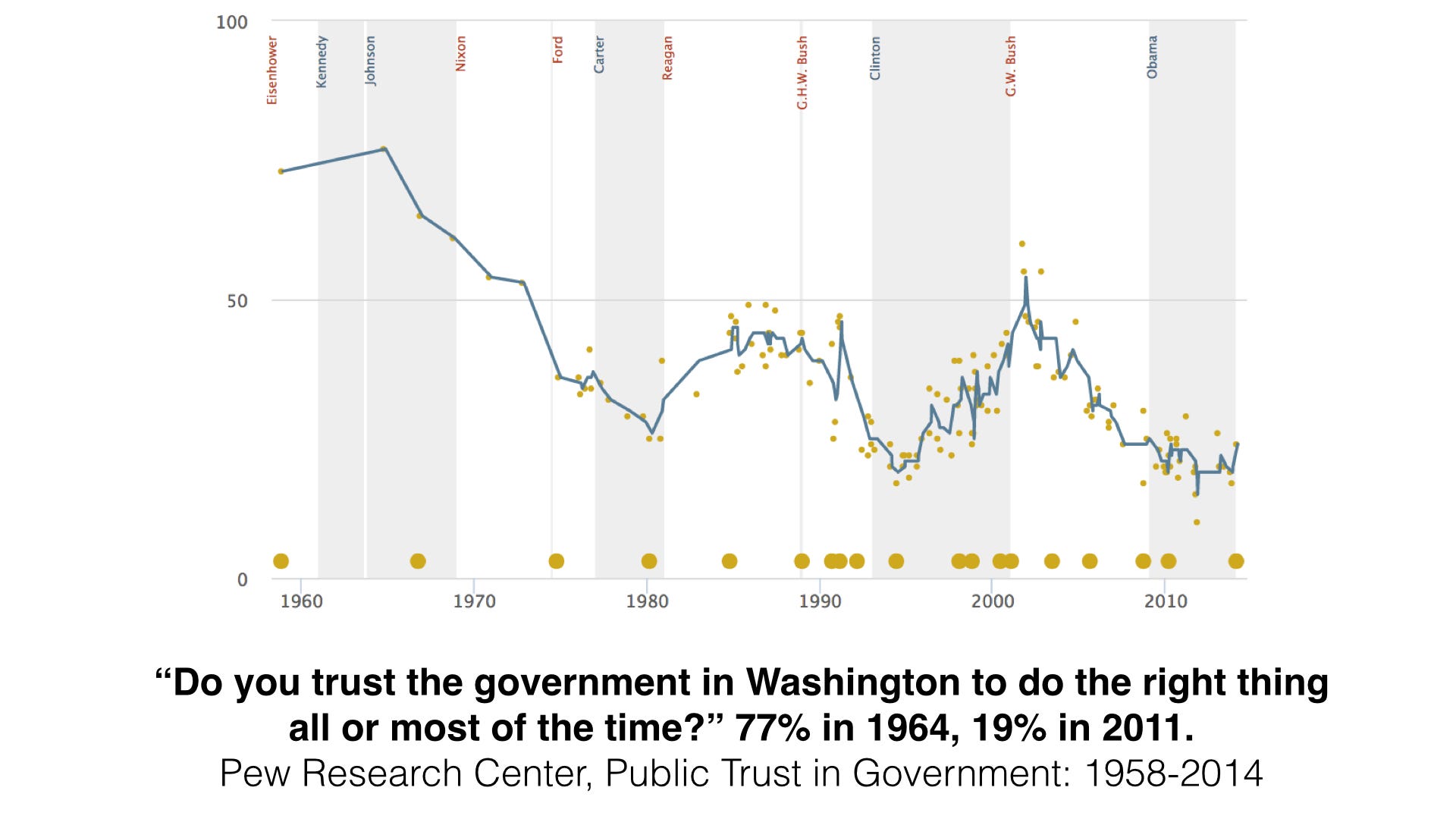
Democracy as it tends to be generally practiced is the act of selecting people for positions of power, and then pressuring them through petitions, protests, and letters. Ethan remarks that this is a remarkably impoverished view. We also interact with governance and our social systems based on what we buy (and don’t buy), where we live, how we speak. However, today our trust is low, and not just in government, but in institutions as well; and not just in the US, but all over the world (see Figure 1). (note: The origins of distrust may be traced to the high complexity of society that makes centralized decision making ineffective.) Many of us would like to change the systems we live in to improve the world. What strategies are available to make such change?

Figure 1

Among those who are trying to make changes are individuals and foundations with large amounts of wealth who strive to act in ways that will improve the world according to their perspectives and understanding. What strategies do they use to exert influence? How successful are they at achieving their objectives? Examples ranging from the Koch brothers to George Soros provide some insight. They might invest in think tanks, in market-based interventions, in campaigns to affect public opinion to place pressure on courts and elected officials.

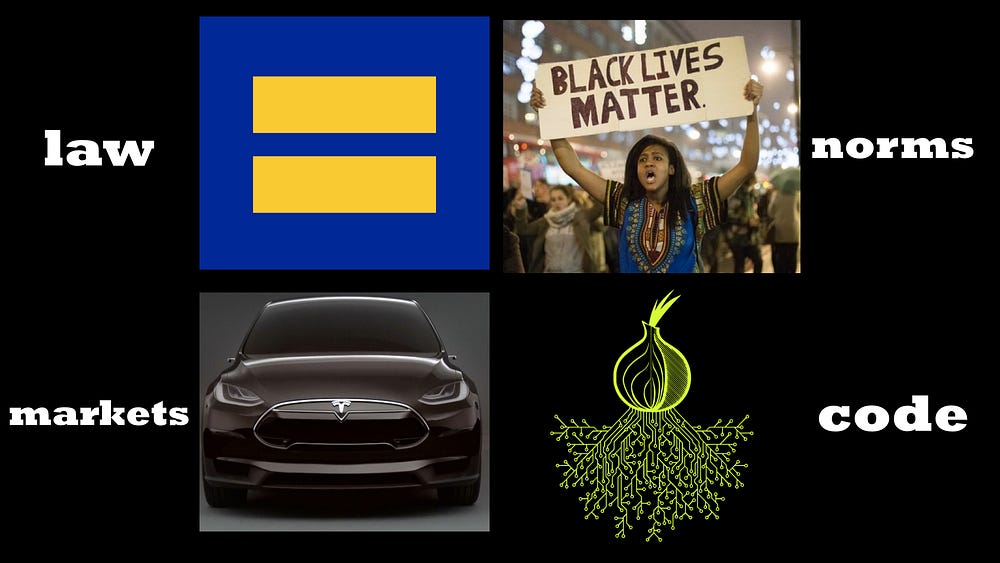
Regardless of whether an individual came to have influence through an electoral process or through access to wealth, Lawrence Lessig provides a framework in his book Code and Other Laws of Cyberspace on which most (if not all) change is attempted.

Four fulcrums

  • Laws are explicitly stated codes of behavior, created and enforced through governance systems.
  • Norms are often implicit social expectations, enforced through social pressure and assumptions of media and other communications.
  • Markets shape behavior by making some actions more or less expensive financially or time.
  • Architecture/Code are the frameworks that surround us and must be adhered to because we act within them. Today many of these frameworks are technological which might be called: the tyranny of the database, or how interfaces demand obedience.

How do you know if what you’re doing is working?

The enforcement of laws can be tracked. Market costs can be quantified. The use of an architecture implies success of its constraints (though choices of what architecture to use, and innovators, hackers and other reappropriators, provide freedom). Ethan and Erhardt primarily focus on changing norms. These are also arguably the most difficult to characterize and to discover if a hoped-for-change is occurring, as norms are often implicit, rather than explicit, and are distributed across the statements of individuals, groups and media sources.

At the Center for Civic Media, they think about norms and the attention economy, and one way of seeing shifts in norms in this view is by tracking how the media talks about a topic. They use a tool called Media Cloud for gathering media sources, creating visualizations, and comparing the words used to talk about topics of discourse. For instance, Erhardt analyzed the dynamics of the media conversation around Trayvon Martin through the roles of broadcast and participatory social media.

In short, creating change is hard, even if you’ve got money and/or power.

Here’s the video from our salon

More on the topic of civics in a distributed society from Ethan’s post about his keynote at Syracuse University’s Humanities annual symposium on Insurrectionist Civics in the Age of Mistrust (highly recommended, and most of the images on this blog comes from the associated slide deck).

How would YOU create change?

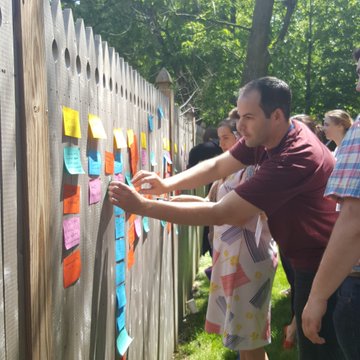
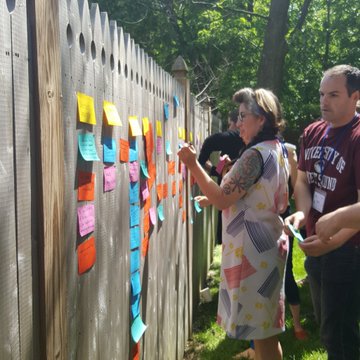
With this framing, this question was posited to the salon attendees. Erhardt facilitated an interactive workshop: “So let’s say you have 10 million dollars. What would you do, about climate change? Fund think tanks and organizations? Fund advocacy groups / passing laws? Fund research? Create tech to do things we can’t otherwise do?” The room divided into 4 groups, and then picked one of Lessig’s four means of interventions and brainstormed ideas.

What would you focus on doing, and how would you know if it was working?

Architecture/Code: Attach sensors to cars, trucks, and environments focused on transportation-based discharges of greenhouse gases. The emissions sensors could provide immediate feedback to drivers and city officials when emissions go to high and trigger sanctions.

Markets: Invest in a startup that offered green logistics/delivery services such as bicycles that would compete with truck-based last-mile services such as UPS and FedEx. Gain market share not just by comparative cost but also by being better for the environment.

Norms: Incorporate data about individuals’ carbon emission from how they live into their online social profiles so that their is an opportunity for social sanctions and desire for self-improvement is publicly viewable.

Law: Create policy that forced power suppliers to develop more resilient grids from renewable energy sources. The data would be monitored by the government for compliance.

We were also joined on Twitter:https://medium.com/media/636d0bf5ea05901a2a4a1b980c23e010https://medium.com/media/d9363c613a23182d898f47ff90bcf6d1

Summary

To shift the world, even with massive funding and assumed power, is difficult. All of the interventions discussed at the salon were at a speculative pilot/demo level. To know you’re succeeding through an intervention is also difficult. There was a realization that those who have money and power are often not wildly successful at changing the world because of the difficulty of understanding how constructive change can be achieved. Perhaps a few “why don’t you just…” phrases were put to rest. At the same time, as individual citizens, we saw how much of a role we have to play in societal shifts — perhaps more effectively in our distributed and connected networks.

“The exercise of designing a method for evaluating your campaign’s success often forces you to rethink and get more specific about your original intervention idea. When you need to turn your target and goals into dependent and independent variables to study and then worry about the timeline for change — it really complicates your view of how to make change. And I would say each of the groups felt this.

There was also a clear bias amongst participants toward norms-based change even though they were addressing legal fixes, market forces, or technical architectures. We all want to think that people will know what behavior is the right behavior once they have enough information. The fact that such a process takes many years and many interventions and runs up against cognitive biases where information counter to your position can leave people stronger in their problematic ways, is what makes norms-based change so hard. The goal of making sure that everyone in the workshop had a chance to think about laws, markets, and code as well helps concretize the need for many different approaches: carrots and sticks in various guises needed for a movement to make its mark. And $10mil is not a lot of money to start with.” – Erhardt

Civics in an age of mistrust and decentralization

I regularly coordinate a salon over at the New England Complex Systems Institute. For the January salon at NECSIEthan and Erhardt led a discussion and workshop on civics in a distributed society. We explored how people with influence/power/money try to create change in the world, how those affected by those changes view and respond to those attempts and changes, and also what we would do as people of influence/power/money.

Many thanks to Ethan and Erhardt for their valuable time and attention as well as images used in this blog entry, and to Erhardt especially for designing such a great workshop, and for suggesting edits to the blog itself. Y’all are pretty great. ❤ – w

Many people want to change the world.

Leverage through money or power

Democracy as it tends to be generally practiced is the act of selecting people for positions of power, and then pressuring them through petitions, protests, and letters. Ethan remarks that this is a remarkably impoverished view. We also interact with governance and our social systems based on what we buy (and don’t buy), where we live, how we speak. However, today our trust is low, and not just in government, but in institutions as well; and not just in the US, but all over the world (see Figure 1). (note: The origins of distrust may be traced to the high complexity of society that makes centralized decision making ineffective.) Many of us would like to change the systems we live in to improve the world. What strategies are available to make such change?

Figure 1  

Among those who are trying to make changes are individuals and foundations with large amounts of wealth who strive to act in ways that will improve the world according to their perspectives and understanding. What strategies do they use to exert influence? How successful are they at achieving their objectives? Examples ranging from the Koch brothers to George Soros provide some insight. They might invest in think tanks, in market-based interventions, in campaigns to affect public opinion to place pressure on courts and elected officials.

Regardless of whether an individual came to have influence through an electoral process or through access to wealth, Lawrence Lessig provides a framework in his book Code and Other Laws of Cyberspace on which most (if not all) change is attempted.

Four fulcrums

  • Laws are explicitly stated codes of behavior, created and enforced through governance systems.
  • Norms are often implicit social expectations, enforced through social pressure and assumptions of media and other communications.
  • Markets shape behavior by making some actions more or less expensive financially or time.
  • Architecture/Code are the frameworks that surround us and must be adhered to because we act within them. Today many of these frameworks are technological which might be called: the tyranny of the database, or how interfaces demand obedience.

How do you know if what you’re doing is working?

The enforcement of laws can be tracked. Market costs can be quantified. The use of an architecture implies success of its constraints (though choices of what architecture to use, and innovators, hackers and other reappropriators, provide freedom). Ethan and Erhardt primarily focus on changing norms. These are also arguably the most difficult to characterize and to discover if a hoped-for-change is occurring, as norms are often implicit, rather than explicit, and are distributed across the statements of individuals, groups and media sources. 

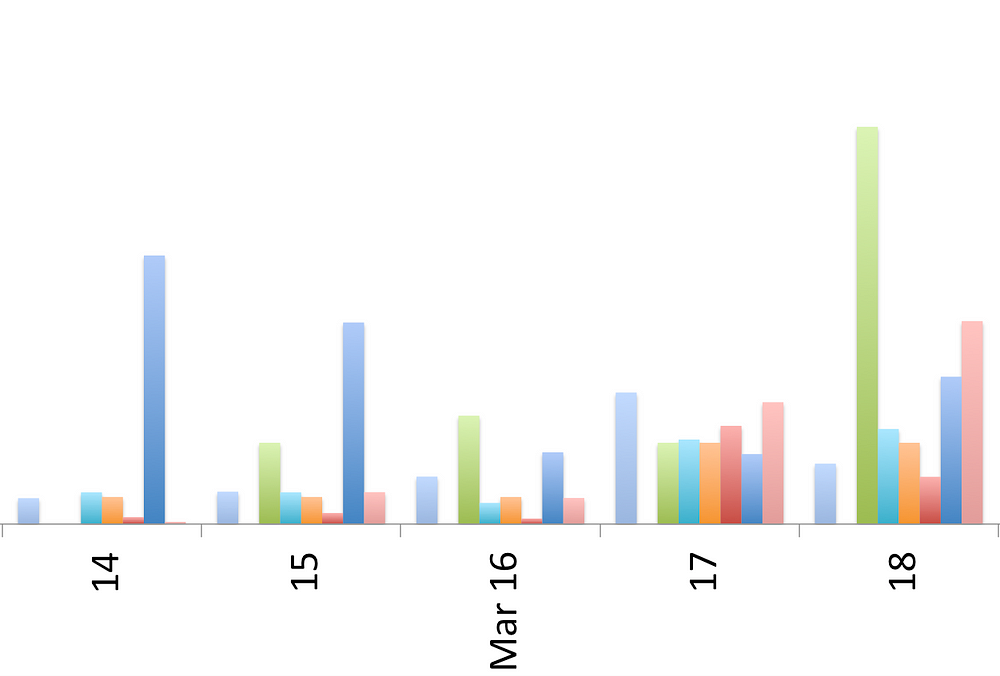
At the Center for Civic Media, they think about norms and the attention economy, and one way of seeing shifts in norms in this view is by tracking how the media talks about a topic. They use a tool called Media Cloud for gathering media sources, creating visualizations, and comparing the words used to talk about topics of discourse. For instance, Erhardt analyzed the dynamics of the media conversation around Trayvon Martin through the roles of broadcast and participatory social media.

In short, creating change is hard, even if you’ve got money and/or power.

Here’s the video from our salon:

More on the topic of civics in a distributed society from Ethan’s post about his keynote at Syracuse University’s Humanities annual symposium on Insurrectionist Civics in the Age of Mistrust (highly recommended, and most of the images on this blog comes from the associated slide deck).

How would YOU create change?

With this framing, this question was posited to the salon attendees. Erhardt facilitated an interactive workshop: “So let’s say you have 10 million dollars. What would you do, about climate change? Fund think tanks and organizations? Fund advocacy groups / passing laws? Fund research? Create tech to do things we can’t otherwise do?” The room divided into 4 groups, and then picked one of Lessig’s four means of interventions and brainstormed ideas.

What would you focus on doing, and how would you know if it was working?

Architecture/Code: Attach sensors to cars, trucks, and environments focused on transportation-based discharges of greenhouse gases. The emissions sensors could provide immediate feedback to drivers and city officials when emissions go to high and trigger sanctions.

Markets: Invest in a startup that offered green logistics/delivery services such as bicycles that would compete with truck-based last-mile services such as UPS and FedEx. Gain market share not just by comparative cost but also by being better for the environment.

Norms: Incorporate data about individuals’ carbon emission from how they live into their online social profiles so that their is an opportunity for social sanctions and desire for self-improvement is publicly viewable.

Law: Create policy that forced power suppliers to develop more resilient grids from renewable energy sources. The data would be monitored by the government for compliance.

We were also joined on Twitter:

@willowbl00 @NECSI I think the Great African Tree Wall is a good start; ban Urban commutes by automobile on penalty of stoning; nuke plants.

— Kevin Foobar (@fu9ar) January 13, 2016

@willowbl00 @NECSI Investments in https://t.co/gNtzicIT9q 2.Battery tech 3.Ending animal agriculture (bigger than transportation) — Ben Rupert (@Meowdip) January 14, 2016

To shift the world, even with massive funding and assumed power, is difficult. All of the interventions discussed at the salon were at a speculative pilot/demo level. To know you’re succeeding through an intervention is also difficult. There was a realization that those who have money and power are often not wildly successful at changing the world because of the difficulty of understanding how constructive change can be achieved. Perhaps a few “why don’t you just…” phrases were put to rest. At the same time, as individual citizens, we saw how much of a role we have to play in societal shifts — perhaps more effectively in our distributed and connected networks.

“The exercise of designing a method for evaluating your campaign’s success often forces you to rethink and get more specific about your original intervention idea. When you need to turn your target and goals into dependent and independent variables to study and then worry about the timeline for change — it really complicates your view of how to make change. And I would say each of the groups felt this.

There was also a clear bias amongst participants toward norms-based change even though they were addressing legal fixes, market forces, or technical architectures. We all want to think that people will know what behavior is the right behavior once they have enough information. The fact that such a process takes many years and many interventions and runs up against cognitive biases where information counter to your position can leave people stronger in their problematic ways, is what makes norms-based change so hard. The goal of making sure that everyone in the workshop had a chance to think about laws, markets, and code as well helps concretize the need for many different approaches: carrots and sticks in various guises needed for a movement to make its mark. And $10mil is not a lot of money to start with.” – Erhardt

Dialling Up Resilience

Originally posted on the Aspiration blog

At the end of April I was in Nairobi doing several things related to digital humanitarian response. One of these was a program called Dialling Up Resilience (yes, with two Ls in “Dialling,” because it was a British-centred team), which looks at local indicators of resilience. This blog entry explores why subjectivity is important in measurement, and how technology can help us parse through subjective information and combine it with objective datasets.

Scarcity

It’s possible to exacerbate or alleviate existing inequalities when designing and implementing response programs. As climate change alters the world around us, the people who have been historically marginalized often become even more so as those in power see scarcity encroaching on their livelihoods. When programs distribute resources without taking care with those previously in power, we also see backlashes and resource grabs. But the ability to hold people accountable in new ways through things like social media and community mapping are coupled with an awareness and effort towards the long bend towards justice means there are groups of people seeking new ways to better allocate resources to those most affected by those inequalities. Often, the groups working in this space are also in a post-scarcity mentality — that, when we work together wisely, we can do a whole lot more with a whole lot less. These are folk who think we can reach zero poverty and zero emissions (within a generation). These are the folk who see joy in the world, and possibility in these difficult situations we’ve backed ourselves into.

Resource Allocation

The resource allocation and accountability necessary for transitory steps towards a world that can survive and even thrive won’t happen in a vacuum. The formal and informal organizations of this space alike have entire supply chains, ways of listening (and to whom), and self-reflexive mechanisms to consider. In these are embedded corruption, paternalism, and colonialism. But also in these are embedded individuals who have been Fighting The Good Fight for decades, and have added useful checks, amplifiers, and questions into infrastructure. It’s into this environment we step when we do response work. It is, at its core, like any other environment — it has History.

It’s in this context that Dialling Up Resilience is such a good program. This project supports the need to adapt to climate issues while putting frontline communities at its core, and does so in a way which can be useful in historically convoluted contexts. 

Metrics

When various organizations — be they international or local, government mandated or radical, formal or informal — wish to change a circumstance, having metrics can help show if success is being approximated. Hopefully, those metrics can also hint at where and how we’re failing. To adapt to climate change and other issues, we need to be able to see how initiatives are doing over time. We can then better allocate resources or attention. The way this is done now is primarily through “objective” measurements such as education level and income. These don’t work for everyone, whether because they are pastoralists or anti-capitalists (or both). In the same way that some schools shift away from standardized testing into more subjective ways to measure learning, Dialling Up Resilience re-focuses the evaluation of success more locally. This is how the frontline community is at the core — they’re determining what makes them resilient, as well as how they feel they’re doing in relationship to those self-defined indicators.

These metrics are then visible to the community (often we’re our own calvary, afterall), and the aggregate is visible to organizations acting in the area. What are needs they may have missed? Is a program having the desired impact? Because of the flow we set up, the information is even fast enough to potentially be for rapid response, with people in a region indicating a flood-related need then triggering alerts for response organizations to deploy those materials in time.

Working with Existing Communities and Initiatives

We worked with a few different groups directly working in Kenya, including the National Drought Management Authority (and their Ending Drought Emergencies program) and UNDP on their existing surveying initiatives and Climate Change, Agriculture and Food Security, as well as extending those survey abilities with international groups like GeoPoll (SMS), Taweza (call center), and Kobo (household) to assess how communities establish and track their own resilience. While we didn’t get the second round of funding, we hope in future to also work more directly with communities using tools like Promise Tracker and Landscape (a digitized version of Dividers & Connectors) to better expose a community’s data back to themselves, and to subsequently be able to have more agency over their own improvement as well as accountability.

What’s also exciting is that our means and our ends matched. I was again in Nairobi for a stakeholder workshop with not only the project partners, but also with the organizations which would eventually make use of the data. We conducted community workshops to test our basic assumptions and methods against reality, as well as to be sure community voice was at the core of each component we consider. We threw a lot out… and added some amazing new things in. We hoped to break down the gatekeeper dynamic of accessing communities in the Horn of Africa, and we wanted to be coextensive with existing programs (rather than supplanting them). It’s feminist and it’s development and I’m kind of super thrilled that we got to try this idea out, even if we don’t get to do it in earnest (yet). We’ll keep looking for opportunities to carry the idea forward, and the design principles will remain at the core of what we do. You can read more about the proposal and stakeholder workshop here, including that side comment about feminism around page 7.