How can humanitarian response be decentralized?

Originally posted on the Aspiration blog

For a long time, it wasn’t possible to include everyone’s voice in planning or decision-making without impossibly large amounts of time. There was no way to listen, at scale. So aggregation and centralization became common, especially in times of urgency, even with the troubles these tend to cause.

But now, with the technologies we have, we can *listen*, in high resolution and in high fidelity. But technology isn’t a silver bullet. We also need the political will and the personal values to make that happen. With Aspiration’s new Digital Humanitarian Response program, we get to support some of the rad people willing and able to make these movements happen. In May, we hosted the Humanitarian Technology Festival at MIT. The Digital Response Wiki provides resources and notes, and here are some top-level highlights from the event:

Disaster and humanitarian issues don’t happen in a vacuum

Notes from the Humanitarian Technology Festival

Groups like Public Lab help lay the groundwork (both socially and technically) for fast-cycle disasters, via their ongoing interaction with communities around environmental justice. This also provides scaffolding for handing off responsibilities after an extreme event. Kathmandu Living Labs, a group committed to mapping the infrastructure of their geography, is an excellent case study in this. When the Nepal earthquake hit, they were able to jump into action quickly due to pre-existing Open Street Map communities, workflows, data infrastructure, and (most importantly) social ties. Kathmandu was then capable of making use of (and maintaining) the updated data after the fact. Simply by being (and being allowed to be) active in affected communities on a day-to-day basis, organizations can support communities in becoming more resilient to disasters.

That said, preparing for extreme events before they happen can help mitigate the severity of impact on people lives. We explored the idea of games to make what might be considered dull more fun. No need to start from scratch (though that can be stimulating as well!). Climate Centre makes such games, and publishes them openly over on their website.

We already have much of what we need

One of our spectrogram statements was, “We already have all of the technology we need.” While we were divided in our responses, we acknowledged that the ability of groups of people to make do with what they have in disaster is astounding. And our preferences apply here technically as well as ethically. Distributed, federated systems both for technology and for communities/governance are more resilient than centralized systems (as well as addressing human rights in general). There are a few of these rad systems being built, NYC Prepared being one of my favorites.

Data and consent are deeply linked

Data use with populations that are vulnerable (based on their history, their current circumstances, or both) is still a big question, but not one we need to face on our own. OpenGov, Missing Persons, and other transparency-related initiatives have figured an awful lot of that out, and we should take note. Additionally, while consent is different in high-stress situations than in long-term advocacy campaigns, it should still be a strong consideration in any plan or intervention.

We looked at the Framework for Consent Policies which came out of a Responsible Data Forum in Budapest, and suggested advocating for a “notify this set of people in case of emergency” embedded into social platforms, similar to Networked Mortality or ICE contacts in some phones. This way, people would be consenting and determining who would be their contacting associates in case of disaster (unlike what Facebook recently did). Consent is a component of accountability, both of which highlight how frontline communities might be the architects of their own rescue.

Accountability is just as important in precarious situations as it is in everyday life, if not more so

Accountability is sorely lacking in humanitarian aid and disaster response. Fantastic organizations exist to track where spending is going, but money is often considered misspent. Frameworks exist for deploying aid in ways which alleviate, rather than exacerbate, conflict and tensions. However, these frameworks and mechanisms are still sometimes insufficient, as even well intended groups remain in regions for decades while populations become reliant on them, rather than becoming self sufficient.

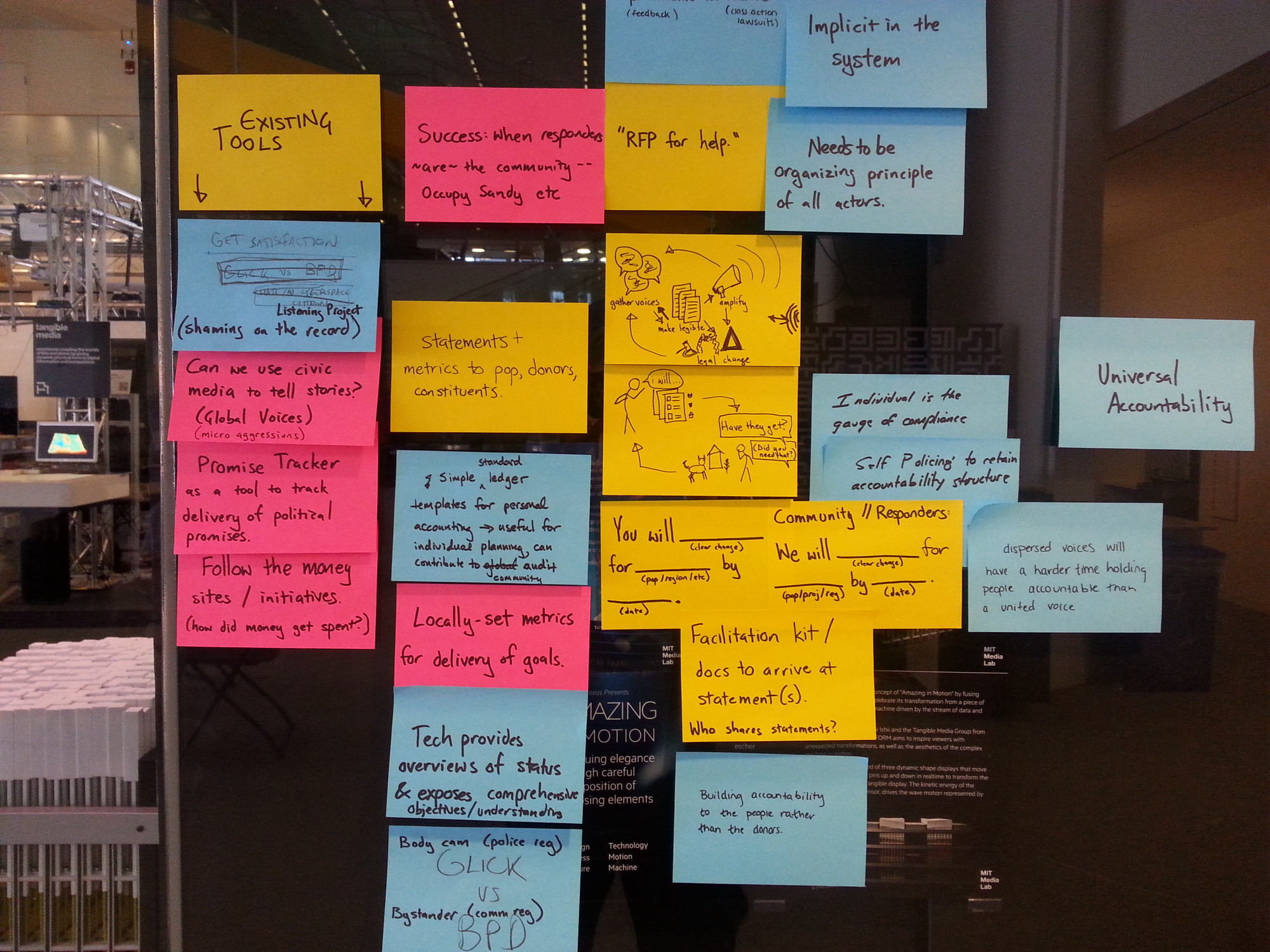
Rather than come up with an external group to hold response groups accountable, we figured the frontline community could state whether or not initiatives are working, and those reports could be sent directly to the response organizations, their donors, and relevant constituents. This factors in strongly to the Dialling Up Resilience initiative grant of which Aspiration is a part (Yes, it’s spelled with 2 L’s. They’re Brits). More on that soon.

You can find more thorough notes from Humanitarian Technology Festival on (you guessed it) our wiki. Reach out to us if you have any questions about this ongoing work. Contact us here: humtechfest@aspirationtech.org / @willlowbl00

Forays in creating a healthier online ecosystem

Originally posted on the Aspiration blog

Weaponized Social is an emerging program that seeks to support a healthier online ecosystem. Since our last gathering in New York, we’ve been to Nairobi on May 2nd, hosted WeapSoc SF in our office home in San Francisco, and facilitated a highly relevant event, the International Workshop on Misogyny and the Internet in MY home base of Cambridge, MA. We’ve continued to build out the Weaponized Social Wiki with notes from conversations, projects, and possibilities.

Weaponized Social in Nairobi

In Nairobi at AkiraChix, we further refined the checklist for making safe space and started two projects: FaceOff and Trolling the Trolls. FaceOff provides space for highly visible people to interact in a nuanced way, posting back to short-form spaces, so as to ask their constituents to be better balanced. This is a response to the very real occurrences of politicians calling their online followers to take action (sometimes violent) in offline space. Trolling the Trolls seeks to use language patterns from sock puppet accounts to find those accounts sooner, and respond to them before they have a negative impact on the speech of marginalized individuals online. Yvonne, who suggested this, also introduced me to ZeroTrollerance which was then represented by Peng! Collective.

San Francisco’s attendees on May 16th and 17th at the SF Nonprofit Tech Center were highly influenced by the book Thinking, Fast and Slow, which explores the two systems we have for thinking: one which is based on intuition (and assumption) and on which we most often depend, and one which is based in logic and analysis which comes with a cost to use.

Often, when in difficult exchanges online, we default into the intuitive to protect ourselves. This prevents us from reaching any different understanding of an encounter than what we came to it with. To cope with this, we devised the Introspection Bot, to help you break from whatever mental rut you’re in and consider the wider picture. We also developed the idea of redirecting dog piles of outrage into actual long-term efforts to address systemic problems. We performed some heavy lifting around dissecting what aspects of sociality go into platforms, including privacy control and friend count, which we offered to the Center for Civic Media’s Uncomfortable Networks.

One major difference in perspective between these two events was that freedom of expression is so enthusiastically valued in both the American and internet freedom circles I run in, but in Kenya, just as in other places, concern over hate speech inciting violence is very real. This tension is difficult to navigate both in everyday life and in the microcosm of a session. This is one reason why I was so thrilled when Aspiration was asked to facilitate the Berkman Center’s International Workshop on Internet and Society (IWoMI). Here, there was an international crowd committed to understanding and preventing misogyny (a bit more specific than Weaponized Social events, but focus can be a good thing!) online and off.

We made explicit space for, though still struggled to ingrain, non-Western perspectives in our conversations, including with one conversation about reporting abuse on platforms. A number of memorable things took place:

I continue to be honored and thrilled at the vast amount of brain power and heart the powerhouses of human beings involved in this movement are extending to solve these problems. To have such an international, intergenerational, and human-rights-supportive group set on making the internet a healthy place gives me hope we might even make it happen.

Digital humanitarian response: Meanwhile, in Nairobi…

Originally posted on the Aspiration blog

I was in Nairobi, Kenya, at the end of April participating in various happenings across humanitarian response spaces. From interactive gameplay to resiliency indicators, here’s how we focused attention on frontline communities through digital means.

Facilitating gameplay to model for resource allocation

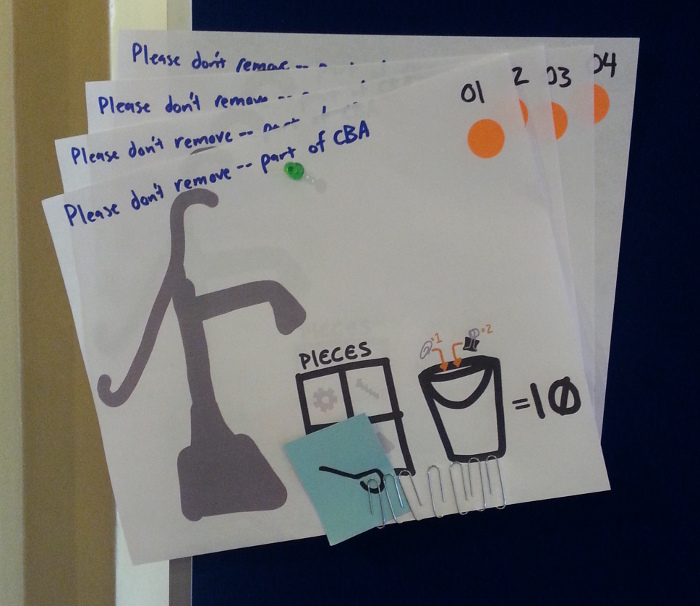
Game materials to indicate water points

I attended the 9th International Conference on Community-Based Adaptation (CBA9) with the Red Cross/Red Crescent Climate Centre in Nairobi on April 24-30. I was there to facilitate a game which simulated the citizen reporting of water resource status and distribution in an area to better inform allocation.

The game stems from Taarifa, a free software project that has been widely deployed to collect, visualize, and map infrastructure information. The Climate Centre is well known (and appreciated) for their distillations of complex climate, environmental, and social systems into fun-to-play games, which are available on their website.

Often, these games start simply, and then complexity is layered on as each set of rules is understood by the participants. There are additional challenges when designing a “pervasive game” like this one, which is a game that extends play out into the wider physical world. All the details needed to be written on one piece of paper and accessible across languages, and players need to be able to join at any point, and without a facilitation start-session. Phew. We did our best, and you can view our materials here.

Day one was focused on re-creating the system as it is now – everyone had to find the rest of their community, their malfunctioning water points, and engineers. Some would know the problems in space and time, but others had the tools to solve them when and where needed. How to link problem and solution? Communication was intermittent, if it happened at all. Information sharing was consistently one step behind of the facts.

On day two, we introduced the ability to SMS update and query, thus enabling a faster and more efficient match between broken pumps and the engineers who could bring tools and parts to help communities have safe water. People now only needed to find each other to make exchanges, and they were able to document and share in real time where water points were and what the status was.

How’d it go? It was confusing… just like life. There was slow uptake… just like life. Only one group used the technical assist (i.e., SMS)… just like life.

This game showed what we think we already know— that having a solid technical tool doesn’t mean anyone is going to use it. But as community-based adaptation practitioners, we often need to (re)learn what we kind-of know, and ask some tough questions, such as ‘why are available solutions not being fully embraced by those who can allegedly benefit from them?’

In Tanzania, the Taarifa team had a chance to both chat with end users about what their hopes and concerns were, as well as work with local software developers to localize the interface. That activity alone increases buy-in, as well as increasing appropriateness.

This game created a space for conference participants to see the same lack of uptake in their own behavior that pervades climate and development work, rather than it being an externalized problem space to grapple with during program design and implementation. It highlighted our collective need to better tap into the social systems around digital solutions, and rethink how to enable genuine embracing by those who can benefit from them. The Climate Centre will be taking the game forward into Zambia, where climate change and infrastructure are already under intense scrutiny.

Supporting community-driven indicators of resiliency

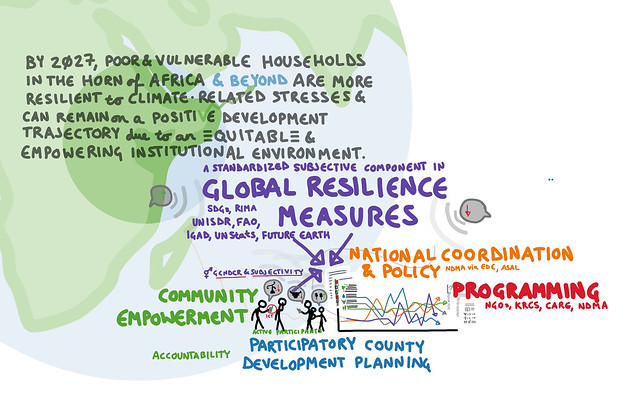
We are taking part in an initiative to build locally-driven strategies for resilience to extreme events such as drought. Our focus within the “Global Resilience Challenge” is on local indicators, or measurements, of resilience.

“You get what you measure,” as systems thinker Donella Meadows once said. When we talk about indicators of resilience, things like gross domestic products, income, and education come to mind. But that doesn’t work for everyone in all places. Actually, we often find that “more” (higher GDP, more trade, etc) is a dangerous synonym to describe “better” when we are trying to evaluate resiliencey.

In response, a few groups have worked on measuring other things, such as the happiness index. Similarly, what matters in resilience is that frontline communities are the ones describing what their own environments look like, what is important to pay attention to, and laying boundaries in how to interact. If communities have the ability to determine their own indicators and carry out subjective measurements within open data frameworks, large-scale understanding can also happen across communities.

What do we even mean by subjective? My favorite “subjectivity” delineation occurs around “framed” and “open-ended.” For example, we could set out a frame of the top five things we think are related to resilience, and then ask community members en masse how they rate their own standing on those things. Or we can ask people what they think is important to their own resilience. Both are subjective indicators.

To make this project happen, we are collaborating with the Overseas Development InstituteNational Drought Management Agency (Kenya)GeoPollDataPop (Harvard Humanitarian Initiative and MIT Media Lab), CGIAR Research Program on Climate Change, Agriculture and Food Security, and the Center for Civic Media. We’re reading a lot, talking to community partners, and beginning to ramp up various ways of both examining what questions we should be asking as well as how we’ll ask (SMS surveys, household surveys, call centers, other). We’ll try some of these things out and meet again in June or July.

Closing out at Geeks Without Bounds

One of my favorite parts of being a part of an organization has come again: the off boarding. Many might be anxious about such a time, but I see it as the glorious moment of truth where you trust that what you have helped to nurture and build is bigger than you are.

Geeks Without Bounds has always striven to be an organization where Lindsay, Lisha, and myself came together as equals to perform the visioning, pragmatism, and yes – adminis-trivia of creating and maintaining a non profit. I’m thrilled to trust the organization to grow and change in their capable hands in ways I would never have thought. This is a good thing – if I had been able to predict where they go, the results would be flat, and without scaling ability. Together, they’ll focus on building GWOB into a 501(c)(3) focused on education and hackathons, with a continuing commitment to seeing projects through the first phases of creation and launch, from good idea to actual deployment.

I’m headed off to two new hats: community leadership strategist with Aspiration, whom I’ve had a huge organizational crush on for a couple years now. There, I’ll be seeing what of Aspiration’s highly interactive event stylings transfer into the digital disaster and humanitarian response space, continuing to explore the effects of social justice on networks via events like Weaponized Social, and documenting methodologies for use across languages and cultures. The other hat is as a professor of practice at Brown, teaching a class on digital communities.

I look forward to working with you in the future, either as partners or allies!

-Willow Bl00

Reporting Back from Weaponized Social in NYC

Originally posted on the Aspiration blog

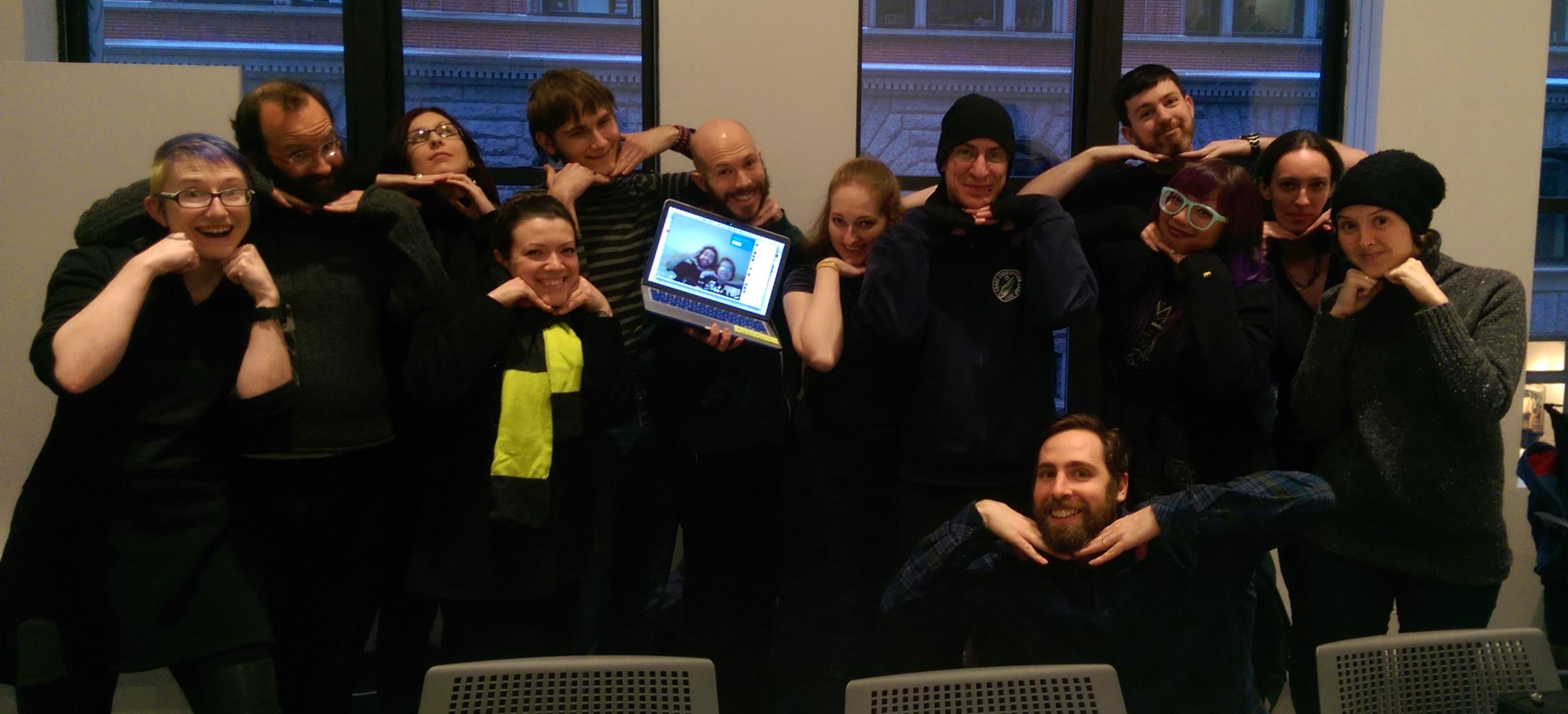
A group of fifteen participants gathered in New York City on February 13 and 14 to discuss the idea of Weaponized Social: the notion that social harms resulting from digital interactions can become dangerously amplified online by the network effect. We discussed what might be done to rethink the ‘social scripts’ that trigger conflict, and how to mediate conflicts as they arise in digital spaces (visit this post to learn more about “social scripts”).

At the event, we recognized that while online interactions can enact harmful consequences, this is a tractable problem; we are in a position to make changes to social scripts in our parts of the world and corners of the web. We understood that many of the things we love most about the internet (e.g., the ability to ambiently connect with long-time friends, to interact (and fall in love with!) strangers, and to vocalize your causes) are also what can make it seem like a dangerous place, where we may be susceptible to harassment or having private information leaked by known or unknown entities.

Weaponized Social NYC

We took the first half of day one to co-create an agenda and to participate in an idea spectrogram in order to challenge assumptions of agreement and convey the diversity of world views in the room. We then dedicated the second half of the day to the common threads across the various issues we were working in. One such shared belief was that rather than creating one-size-fits-all content (e.g., a single deescalation guidebook), we should instead embrace many versions of the same idea being present, for various levels of knowledge, language, and learning styles (think of things like “Drawing for Scientists“).

We also considered how the ways people connect to one another influences their interactions. Calling this session “structures,” it included graph and network visualizations coming into beautifully-illustrated play. We then explored ways of forming and maintaining healthy communities, creating general guidelines to create safe space within defined communities, and to recover if a community has become unsafe.

On the second day, we discussed the more tangible aspects of online scripts, such as:

  • nonviolent communication
  • historical trolling (i.e., trolling pre-online harassment)
  • recovering from unintentional mistakes (yours or someone else’s)
  • nonverbal communication online
  • constructing bridges between disagreeing people
  • solidarity in nebulous groups (what is it to have someone’s back when you’re not technically in a community together? What about if it is an open chat room anyone can join?)

Throughout these discussions, we recognized that echo chambers are to be avoided, but that safe space is also needed for reconciliation, adaptation, and learning. Assuming that a perfectly safe space is also one in which freedom to act is incredibly constrained, we now advocate creating “safe foyers” rather than blanket “safe spaces” (i.e., “Please step over here with me so we can figure out where things went wrong”).

In this model, the safe foyer being unsuccessful would mean bringing in more community members to escalate conflict resolution. We are painfully aware that many abusive people will use back room conversations to quietly continue antisocial behavior, while still seeing that back room conversations are a valuable channel of support for conflict resolution, and we look forward to further examining this tension.

There were many common threads and themes here as well. Such as:

  • Intended audience matters (see also: “Context Collapse“.)
  • Translators between world views are a valuable and necessary (and should be celebrated and rotated in order to prevent fatigue and burn-out)
  • Both historical trolling and non violent communication strive for exploration and emotional maturity for all parties involved (albeit by incredibly different methods)

In each of these, we aimed to include and support neurodiversity, such as those with autism spectrum disorders or with scrupulosity.

The question we will continue to carry forward is: How do we inspire change and self-reflection in our selves and the communities we engage with? To this end, we have a few projects started:

  • Guide for supporting activists
  • Guide in how to ask for critique in a way you can best hear it
  • Self-awareness checklist
  • Guide to wielding the privilege sword
  • Checklist for making safe space (and path-correction when things are going poorly)
  • Guide to expressing nonverbal cues in text-based space
  • Guide to using nonviolent communication among people who use differing empathic styles

These conversations required trust and comfortable space, and we were honored to be housed by the newly opened Civic Hall in NYC’s Flat Iron District. We thank Micah Sifry, a long-time Aspiration friend, who offered this newly established community space around civic tech for the Weaponized Social event. We couldn’t dream of a more appropriate space. Please do welcome them to the geographic and interest neighborhoods when you have a chance.

As we continue moving forward on these projects, we hope you’ll contact us and let us know if you’d be interested in participating in (or hosting!) a future event by contacting weaponizedsocial@aspirationtech.org

Weaponized Social: Rethinking Online Scripts

Originally posted on the Aspiration blog

In the Aspiration ethos, using tools comes second to cultivating and understanding the ecosystem where the tool would live and grow. In practice, this means creating organizational processes, positive feedback loops, conventions, etc., so that when technology is implemented, it is overlayed on existing modes of healthy and sustainable interaction. This year, we began exploring one of the broader and more nebulous ecosystems as it relates to the technology of the internet: the ‘social scripts’ that mediate online interactions.

In February in New York City, participants at the first Weaponized Social collaborated to rethink the scripts that mediate behavior and interactions online. A social script is a way of interacting which is learned and internalized. It is similar to a software script (e.g., “if X, then Y”), but it takes place in the brain and is externalized in social situations. For example, when you walk into a restaurant, a social script is enacted:

  1. A host leads you to your seat and asks what you’d like to drink.
  2. The server brings your drink order, and asks if you’re ready to order food.
  3. You say, “No, not yet.”
  4. You are given more time to explore the menu.

…and so on and so on. If the server firsts asks for a dessert order or if you want to refinance your home, confusion follows as a result of going off-script. One is not born with innate knowledge of ‘how to go to a restaruant’. The script is learned. Although persistent, social scripts are transient and always evolving.

However, social scripts for online courtesy and critique have not kept apace with the rapid evolution of online technology over the past twenty years. The harms of scripts that played out in small groups offline have become dangerously amplified via the network effect. The potential to cascade and amplify makes the harms of scripts more potent. In extreme cases, a social interaction can become weaponized, triggering a negative script that brings life-threatening consequences (think social media comments escalating to harassing death threats and forcing someone to leave their home).

Weaponized Social seeks to explore ways to diminish harmful social scripts through workshops, dialogue, and the creation of actionable and shareable content. On the other side of the coin, we have the opportunity to enforce positive social scripts. It is possible to amplify the healthy, joyful, and serendipitous aspects of online connections.

How to get involved:


Special thanks to Meredith (@maradydd) Sam (@metasj), and the Berkman Center (@berkmancenter) for help in parsing all these ideas.

Another Whirlwind Tour

The Bank booked my tickets for me (yay no financial overhead!.. but–) with an 11-hour layover at LHR. So I popped on the Heathrow Express to Paddington. I’m sitting in a Starbucks, of all places. They’re playing Morrisey. It’s pretty awful, but it’s also a holiday and everything else around here was closed. I was meant to have been back in Boston for the past week, after a long stint of travel, but things got extended by a continent, so here I am.

Cascadia.JS

I gave a keynote at Cascadia.JS, and the event and its people were absolutely wonderful. Even played some pinball with Case (oh, PS, we’re throwing a CyborgCamp at MIT in October and you should come). I was soooo stressed when I gave this talk. Not from the talk itself – this community is lovely! I even wrote about it on the Civic blog – but because of the things surrounding this entry. When I watched the video later, it’s actually pretty alright. They gave me a full 30 minutes, and I wish I had padded it with more information. C’est la vie. Huge huge hugs to Ben and Tracy and the rest of the crew. You made a rough time easier through your care.

The drawings I did for other people’s talks are all here.

Wikimania

This was my first Wikimania, and it was stunning. So so much fun. Many things to think about, frustrations in new light, conversations over cider, and even more stick figures. And! Some lovely person taught me how to upload my drawings to the commons, and so now I’ll be hosting from there instead of from Flickr. Got to spend too-short time with Laurie (who I’ll see more of in Boston! Yay!), AND found out about Yaneer’s work on networked individuals and complex systems which rings closer to true in my intuition than most anything else I’ve run across recently.

Getting to know a neighborhood in London that I actually like, with art in the alleys and a bike repair and tailoring shop with a pub and wifi while you wait that is totally hipster gentrification and I so don’t care. And a strange moment in a Bombay-style restaurant of a half-recognized face, that ends up being the brother of the heart-based Seattle ex-Partner. We hug fiercely (as is the way of his family, and mine), until his manager gets angry. We laugh and promise to catch up.

Thence to Future Perfect, through the too-early fog of morning, and a panic attack, and dear Sam handling the accompanying compulsive need to stick to The Plan, even if it did not make the most sense, with the sort of calm curiosity and fondness which is exactly what is needed in those moments, and jogging through far away airports to finally arrive at our not-even-yet-boarding gate.

Future Perfect

A short flight (slept through) and a longer ferry ride (also slept through) through the archipeligos of Sweden, and Sam and I are on the island of Grinda for Future Perfect. We’re here at the behest of one Dougald Hine, long-time mirror-world not-quite-yet-cohort, to be Temporary Faculty at the festival, and to “difficultate.” It’s a strange thing, to be encouraged to ask the hard questions, and Ella and I are a bit adrift in the new legitimacy of our usual subversive action. “Ella, I think we’ve just been made legible.” “Shit. Quick, act polite!” But there’s an awfully strong thread of Libertarianism and Profiteering From The Future, so it’s not a difficult thing to ask stir-up questions. I sit on a panel called When Women Run the World, and mock the title, and question the assumption of binary sex, and point out matrixes of power. I draw as people talk, and post the print-outs to a large board for all to see, a strange combination of digital and analogue. Another panel I’m pulled onto I advocate for inclusion and codesign on the basis of values – not everyone bites. So then, pulling from Yaneer’s work, I point out that hierarchies fail at the capacity of any individual, whereas examined networks can scale in complexity. They nod. I grit teeth.

We also meet Bembo and Troja Scenkonst and Billy Bottle and Anna and the Prince of the Festival Lucas, and see old friends Ben and Christopher and Smari. We walk through the cow and sheep pasture as a shortcut from breakfast to festival, avoiding dirty boots and communicating via body language to over protective rams. I jump into the half-salt water of the archipelagos after a long sauna stint, and we drink sweet Swedish cider, and we sing Flanders and Swann across our joined repertoires. Ed gives me access to his audio book library, and I’m high on dopamine and scifi for hours to come. Our tiny temporary faculty crew sleeps in adjacent cabins, keeping the floors swept and porches clean.

And another early flight, stomach dropping as the pre-booked taxi service couldn’t find us and didn’t speak English (and Sam doesn’t hold Swedish in his repository of languages), no Ubers showing up on the app as they had the previous night, and finally finding a taxi app that would generate our location and sent a lovely driver for us. Getting to the airport, again, in time, with an uncertainty of how to part ways from this other human-shaped being who moves at high velocities, having been caught up in each other’s orbits for a short period of time, still texting threads and punctuation past gates.

Dar

And then I went back to Dar. And I realize in writing this how worn down my travel-muscle is, exhausted to the core. Less able to appreciate the beauty of a second wrecked ship on a calm sandy beach, unable to see the trying and hurt at the core of some of the people we hear speak. I am frustrated that the workshop I have been flown here to participate in has people reading verbatim from slides, that at the core of this workshop are not the people who are the most marginalized. I am brief, and I am blunt, and I do not show the same care that I expect to be shown to everyone. I become even more blunt with those who are unkind to others, a sort of brute force function into civility, and I and others know it will not work.

But some of the workshop has us figuring out hairy problems like reducing the 16-digit identifier for water points to locally useful and uniquely identifiable phrases for the database lookup table. I listen while the People Who Decide These Things think their servers won’t have the troubles other servers have. And some sections have people talking about appropriate technology and inclusion. It is productive, though differently than I’m used to.

I exchange a quiet conversation in the front of a taxi that waited for us at a restaurant, a practice which I hate, on the long journey home. The driver having not said more than a word or two at a time at first, now sharing anger about high taxes and now visible payout. The roads are paid for by other countries, the buildings, the power grid… where are his tax dollars going? We talk about schools, and his sister, and about how he has no way to speak.

We work with the Dar Taarifa team, who are unfolding and learning to push back, hours into github and strange google searches and odd places to encourage and odder places to encourage disagreement. We pause for translations, and I try to bow out so they’ll operate at full speed in Swahili, rather than moving slower so that I might understand.

Oh, also:

One of my drawings ended up all over the place:


Morgan’s research is pretty boss, and Barton did a great job writing.

It looks like I’m going to be in Kenya in parts of October and November playing games around climate change.
This post is apparently in the memory of LJ.

Adventures in Government Grants

Over at Geeks Without Bounds, we’re working on filing some grants, including with the USG, and that involves a convoluted process of website registrations, number assignations, and security nightmares.

The site you use to register for your DUNS-number (which stands for Data Universal Number System. What I don’t event.) emailed me my password in plaintext.

The next site in this process asked for a password to act as my sig – exactly 9 LETTERS long, in plaintext. I made that password “plaintext” just for kicks. You might as well know, because it’s just hanging out there anyway. And it’s far more complicated to figure out which address they’re asking for at any point on a form than it would be to crack.

That same site called me the executor of consent, which is pretty badass, and makes me hope the USG might be starting to consider enthusiastic consent from the governed.

I was then asked to enter my CAGE. Which I did not consent to.

Screen Shot 2014-07-24 at 10.19.21 AM

Responsible Project Lifecycle

We’re thrilled to announce our first white paper, inspired by the Engine Room’s Responsible Data Forum in Oakland months ago, and with interviews with Heather, Sara, Max, and Lisha!

Responsible Humanitarian And Disaster Response Project Cycles : Embed a “kill date” on your PLATFORM. If people are using that platform, this becomes a part of the community and culture. Alternatively, create a set of stages for the platform. For example, a crisis platform could have the following stages: initial situation awareness, crisis response, early recovery, recovery, and handover. Each of these stages have different information needs and different/progressively more restrictive rules that can be applied. Stages can have expected transition dates relative to each and informed by the unique situation needs. The most important lesson to learn is that there is no easy mandate. Each event will change the needs/time required to complete tasks, and is informed by engaging and communicating with all portions of the community (mappers, in-field deployments, affected populations, etc.).

What Response Can Learn from Co-Ops

I had an amazing chat with Emily M Lippold Cheney after meeting serendipitously at a Libre Fest in Cambridge. She agreed to do a GWOBcast on the overlap of digital response and the history of cooperatives. It reminded me a bit about the Brainmeats Lisha and I did awhile ago on The Culture of Eviction.

CRISIS/VOID RESPONSE

  • ACDI-VOCA: Coops in Crisis Response Paper (.pdf): This is an international cooperative development org largely funded by USAID, so it uses a democratic model within an not-so-democratic development industry.
  • Isla Vista Community Network: This is the group that just started meeting together in an unincorporated area and, by sheer persistence and existence, started being seen as a representative body that had some authority. Recently, through the work of this network and some of its members, the community was able to save some buildings from being demolished by the County and have the turned into (much needed) community centers. The IVCN is going to be meeting and taking the lead on deciding the how/who of using the buildings.

COOPS FOR THE PEOPLE