Open Badges for Crisis Response

Just before the Dublin Hacks event, I found myself in London for Mozfest, the yearly conference for Mozilla. I was there to wander and schmooze, but then I met Jess Klein (now listed on our Who-Is page!). She was working on HackLabs in disaster areas, based on her experience during Hurricane Sandy. What would be needed in any kit (software of space-wise) deployed in times of disaster? It’s a good question asked by many intelligent people who encounter disaster. Because of GWOB’s exposure to so many such people and groups, it’s also a question we know is huge, and one that we create parts and pieces of constantly. Through deep conversation over a couple hours, we dug down deeper: what is a missing component our crew was especially well equipped to deal with at Mozfest?

The Emergency Hacklab team discussed just this question. What we came up with was this: a way for residents in an affected area to indicate someone has helped them. This helps deal with the disconnect between responders and the good work they aim to do.

In times of crisis, there is a desperate need to open up emergency/disaster response data. Communities rush to aid and collaborate both online and in person. There is a convergence of new technology, open source methodologies and grassroots activism. The Emergency Hack Lab tackled the question of how to credential, task and thank volunteers. The UN OCHA offices released an open data set of disaster badges. In a fast paced sprint, our team hacked and built proto-workflow for the UN OCHA Noun Project sets (official process) to the Mozilla Open Badges program. More details from Jessica Klein, Creative Lead, Mozilla Open Badges.

Things we’re super excited about:
This wasn’t about reinventing the wheel, it was about doing something innovative with existing pieces. We pulled from the UNOCHA Noun Project page. We are building a badging triage system that can function on top of existing grassroots and relief technology such as the Participatory Aid Marktplace and Frontline SMS using Mozilla Open Badges.

What’s next:

  • Code the SMS system prototype that is detailed in the userflow here:

  • Partnering with existing grassroots and relief orgs to make sure what we build can sit on top of their technology
  • User test the utility of the UNOCHA badges as we have hacked them out here: https://etherpad.mozilla.org/emergency-badges
  • Join us for the OpenBadges call about this Jan 29 – details here

Do we have a plan for deploying this? Testing it?

  • We are looking for volunteers to join our usertesting cohort.
  • We are working with the Hive Learning Network to usertest and paper prototype
  • People all over the world have expressed interest in this including Global Minimum who have offered to work with us to user test once we have a prototype

Learn more at: https://wiki.mozilla.org/Emergencyhacklab and http://jessicaklein.blogspot.co.uk/2013/11/community-aid-badging.html

If you are interested in working on this project – please let us know:

Encrypting Communications

Being in Berlin reminded me that I haven’t been around the hackers I know and love since my last round of gadget aquirement. A lot of conversations have been happening recently around the usability of crypto-aware tools (including an event in DC on Jan 11th that GWOB is doing with OpenITP – you should go!). What we fail to talk about are how easy many existing things are out there, and what they are. Here are some things we did:

Encrypt all the things!

Why this matters: when interacting with law enforcement, you can plead the 5th around your password, but the hardware itself can be seized, albeit sometimes for a short time. During this, they can take an image of your disk, IE, scan and copy anything on it. By encrypting your device, all they will see is adsfliu9p8aerkadfov8c79234hfgia etc instead of “ohai.”
File Vault

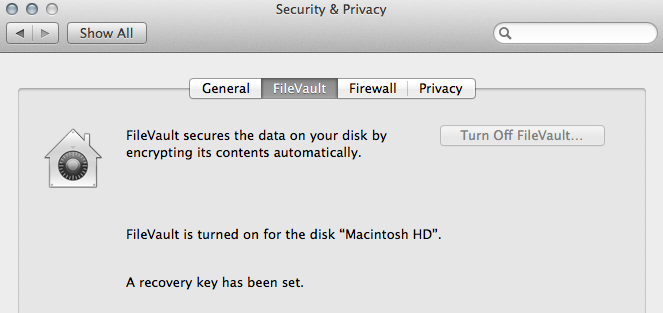
  • A Mac. It’s not as hard as you think. With a solid state drive, it takes about 45 minutes. Let it run tonight while you head to bed. For a Mac, plug it in, launch System Preferences > Security and Privacy > File Vault > Encrypt.
  • An Android. Also not difficult. Settings > Security > Encrypt Device. Again, you’ll need to leave it plugged in and have a bit of patience with it.

Password Management

Why this is important: helps you not fall into password reuse issues by allowing you to only remember one strong password, and loading in non-human-memorable passwords.
On Mac, I went for 1Password. It costs some money, but it’s hella easy to use, and I can share an encrypted file via dropbox between my multiple devices so I can still access accounts. While I’m plugging in these accounts to 1Password, I’m slowly changing all my less-secure passwords for randomized ones.

Communications

Why this is important: While we’ve achieved HTTPS in most places, within and between larger “clouds” data is not actually sent encrypted. In order for you to maintain your privacy, it’s important for anything you send to be encrypted. All of these are usable in the exact same way from a user standpoint as the things they replace. They just also encrypt the traffic. Try them out.

I already use Adium for Off The Record (OTR) and Thunderbird for Pretty Good Privacy (PGP) on my Mac. I’d use Jitsi but it crashes anytime I’ve tried. Waiting until it works. That said, I also want the messages I send on my phone to be encrypted.

  • ChatSecure : chat on phone
  • TextSecure : already installed, but worth mentioning
  • Threema : also encrypts images etc! Let me know if you’re on it, definitely needs critical mass in order to be usable. Willow is K69NNHXE
  • Orweb : Tor browser on phone
  • Orbot : Tor node on phone

<3 to all the fine folk who helped out with this : Tomate, Herr Flupke, Morgan.

Creating (New) Collaborative Spaces

There’s this ongoing sense of frustration from the adaptive, iterative, inclusive informal side of disaster response with the formal side. While we often focus on how to get members of a population not accustomed to collaboration to feel empowered to speak and act, and that is a core component of any work I do, that’s not what this entry is about. In the same way that I think many people don’t engage in their environments when conflict is a possible component, I think the lack of collaborative and codesign approach in the formal sector is simply a lack of exposure and understanding.

Come with me / and we’ll be / in a land of pure collaboration – sung to the tune of Willy Wonka’s “Pure Imagination

The thing to understand is that after Kindergarten, most people have been discouraged from being collaborative. While it comes easily in our youth, when we haven’t built up the skills (social and technical) to operate from that source, it can be difficult. When creating codesign space with members of a formal or traditional organization, they come with the mentality that experts are the best (and perhaps only) people equipped to know how to assess and respond to a challenge. In this mentality, only academics have time to think, only corporations have access to resources, and only people who have been in the field for decades can see patterns. Often, because of the constructs around being an expert or specialist, people considered as such have had difficulty finding cohorts. In fact, you’re often actively discouraged away from it – anyone who shares your field is a competitor for limited resources. Any remotely collaborative activity is done asynchronously and piecemeal, cobbled together later by yet another specialist. This backdrop should indicate the importance of providing safe and guiding space for learning collaborative methods to those coming from traditional sectors. Here’s how I’ve done collaborative space-making in the past.

First, we must understand the codesign methods we aim to use by making it safe and inviting to work collaboratively, and ways to ask questions and with the expectation of listening. We call this “holding space,” through facilitation methods of encouraging inclusivity like paying attention to equal speaking time and accessbility of language. Within this space, we set a North Star, the purpose of the group. Frame all conversations and problem solving trajectories by that North Star.

With the Field Innovation Team (FIT) for FEMA’s Hurricane Sandy response, our North Star was “helping members of the affected population.” This might seem obvious, but formal organizations have been set up to help the official response organizations – Office of Emergency Management, or Red Cross, or the local police department. This has happened in the past because of scaling issues of knowledge and delivery abilities. Any situational knowledge was based upon limited aerial imagery (difficult and expensive), people who were in the area but are now able to report by being in an office (stale information), and past experience (misaligned patterns).

With things like crowd mapping, a higher resolution of situational awareness is possible. People on the ground can tell you where they are and what they see. With this ability comes a new responsibility, to deliver response at a similar resolution. This setup also includes an ability to directly interact with members of the affected population, so it’s important to refocus our efforts on our end users.

Any time any question came up, or any difficulties got in our way, we reminded ourselves about our main objective. From this, we immediately saw many paths to achieving the objective such as education, housing, heat, and connectivity. Through skill and connection discovery, we determined what the best focuses were, based on the team members present. We were already collaborating – by focusing on a main objective, and outlining various ways of achieving that objective, people start to consider how they can offer ways of getting there. Too often, we delineate our jobs and then figure out what we can do – which would have limited our creativity by leaps and bounds.

This is when it’s important to have a slew of collaborative tools in your back pocket. What will kick up this new track of collaboration with productivity? Just as importantly, what will be so easy to use that your newly-fledged collaborators won’t trip over install processes or learning curves, losing this precious momentum towards beautiful new worlds? I really like etherpad, hackpad, or google docs as a starting point for this: nearly everyone uses a word processor, and it’s immediately evident as to what is going on. Suddenly, there is a shared view! The common problem of resolving differences across multiple word documents has disappeared in this setting! Reports begin to write themselves out of meeting notes! Butterflies and bluejays are frolicking in the sky. Be wary that during this part of the process, it is important to both make sure people understand what is going on, while also not becoming their administrator. Help people put their own information into the platform, don’t do it for them when they stumble. Other great platforms are trello, basecamp, and loomio for near-immediate recognition of usefulness. People will sometimes stumble in the transition – simply take their recent update on the old method (email, anyone?) and continue the discussion on the new collaborative platform.

Once that objective is set, everything else is just problem solving. Things which would have kept us waiting to act instead became new opportunities to try things out.

Back in New York, the Joint Forces Office wouldn’t allow the FIT team in, because not all of us were federal employees, a few of us were foreign, and some of us were *cough* activists */cough*. Instead of twiddling our thumbs, we instead worked from the apartment of a friend-of-mine. They had better (and more open) internet, far superior coffee, and great serendipity liklihood. While working from there, we linked the OccupySandy volunteering map into the Google Crisis Map and (unofficially) chatted with UNICEF about what options we hadn’t yet looked at for resources. The neutral space allowed us to accomplish far more than we would have in the official offices. It also meant that as we tried out collaborative tools, firewalls didn’t get in our way. When we were later welcomed into the official offices for their first-ever design jam (with Frog Design!), the indignation about Basecamp and hackpad not loading was so great that the FEMA firewalls are now on different settings!

Remember that people are delicate. What most people in the formal sector have been missing for a long time is the ability to SPEAK and to ACT, just on a different vector than those in historically marginalized populations. We are asking all parties in the codesign process to be active and engaged. In distributed and collaborative spaces, this is something we excel in. It is therefore our responsibility to show all newcomers how awesome it can be. Stand with them to make more space. Sometimes as manifest in blanket forts.

Nairobi (1/2)

I’ve just been to Nairobi for my first time, Kenya for my first time, Africa for my first time. The 3 days before the trip, I stressed about travel in a way I haven’t for at least a year, pacing and unpacking and repacking my bag. Ethan sitting me down to frankly say “your equals are in Nairobi, and if you fail to see that, it is on you. They could be doing the work they do anywhere, and they choose to do it there. Don’t stress. It will be incredible. I’m so excited you’re going.” SJ asking me in my anxiety what I had packed, me saying the same things as always, him insisting I include small things for my pockets. I looked at him blankly. I only have the essentials on me, always. “Get candy,” he says, “something they won’t have there. Dum-dums are great.”

18ish hours of flying later, I found a pink-haired Lindsay outside the ad hoc airport (the other one burned down), our presentation already garnering surprised but approving response. We caught up in the back of the taxi, new smells and tree shapes and stories from the driver. A long ride later, we happened upon new friends Steven (Mercy Corps) and Per (Standby Task Force) and Amean (International Organization for Migration), soon not only being good tobacco and booze friends upon arrival to our hotel, but also cohorts in response and making the world suck less.

We spent the next 3 days at the UN Compound for the International Conference of Crisis Mappers. Which was beautiful, but still a compound. The only chance we had to be outside the short walk there in the morning, the way back being a taxi ride in the dark. I had another amazing chance to draw things, and we had a chance to call ourselves out, which I think we failed to do. At long last, someone dedicated to security held a session – Gillo from Tactical Tech. 3 people showed up, and two were Lindsay and myself. I am deeply upset with this group of people I otherwise have so much respect for.

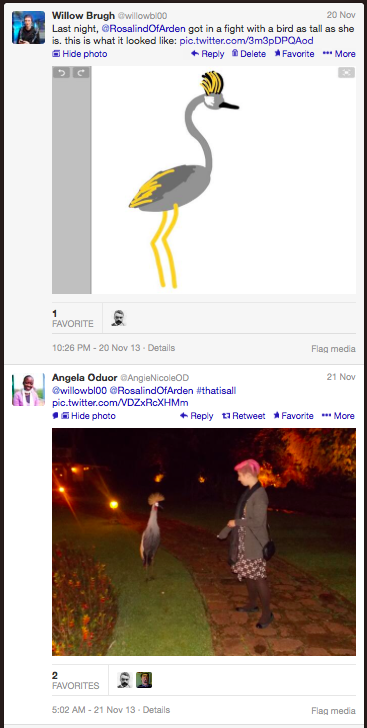
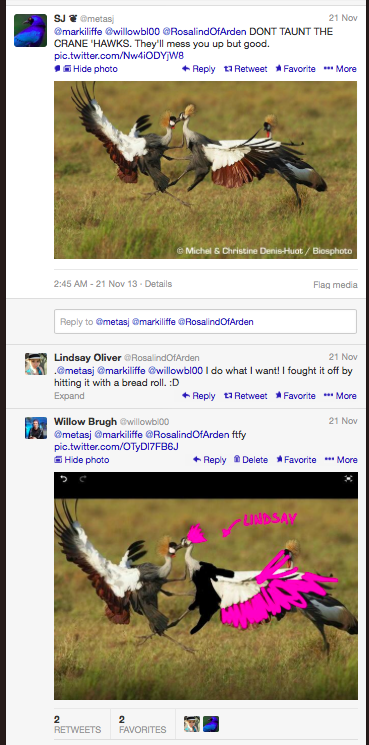
bird1 bird2But we are taken care of in physical security, escaping to nearby dinner and drinks via shared buses. Shaddrock’s toast to those who work within the system (himself included), the swimming upstream and constant trials. And to the volunteers, who truly are changing things. We all laughed, and drank, and ate. We all made a point of talking to new people, Lindsay apparently taking that to mean making new bird friends, and encountering a bird as tall as she is. In attempting to feed it some bread, she then threw said bread roll at it when it threatened her. We drew a profile of it for the internets, Mark, SJ, Lindsay and myself escalating on Twitter across timezones.

Running away early the last day, no longer able to handle the compound, to vibrant Pawa254. Sitting on the roof, chatting to members of a band about the sort of music they make, and cracking jokes about creatures, Lindsay doing startlingly close interpretive dance for a Beta Fish. Seeing Bankslave’s work and plans, the celebration of Toilet Day. Sitting back downstairs at the table, drinking beer and chatting about crypto while we wait to be ready for the taxi.

The experience of just having to wait, and of slowly dying inside because time is one of the few ways I know of to clearly indicate care. Having to accept that the pace that our hosts moved at was the pace everyone else moved at, feeling indignant on their behalf was patronizing to them and stressful only for me.

The astounding, unexpected hosting of Sasha, who booked us amazing and kind drivers, and things to do, and suggested the perfect people to meet without blinking an eye. As Lindsay and I reunited with her at the iHub on our last day, Lindsay suggested she’s like the US Ambassador, but we ended up agreeing she’s much more Internet Ambassador.

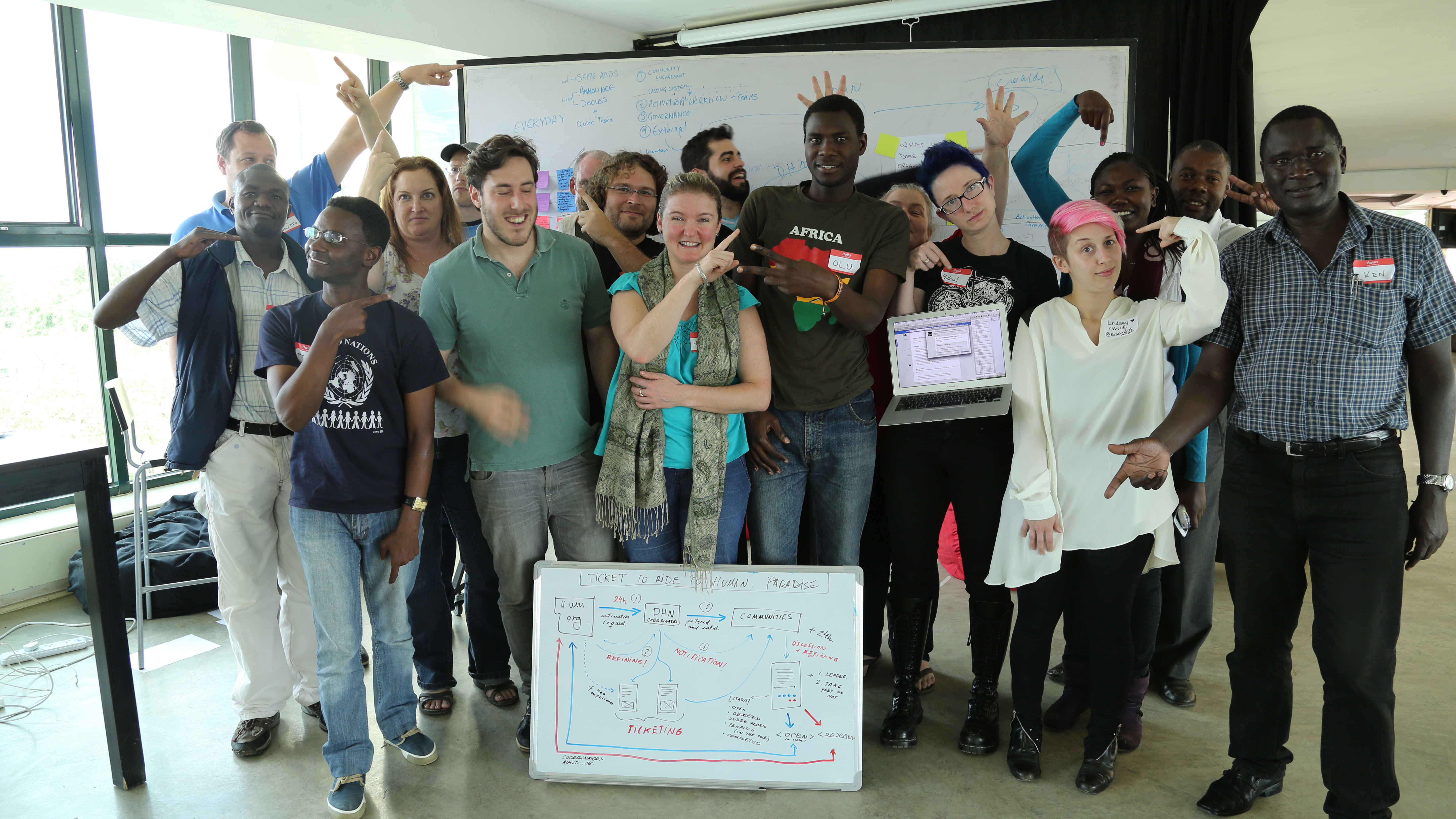
The Digital Humanitarian Network Summit in the beautiful 88MPH, an utterly unmarked coworking space somewhere along Ngong Road, just like everything else. The security guards at the gate of the center shrugging when we asked them what the area was called, and how we could get other people to it. Everyone excited for a chance to get to know each other deeper, and to get work done, and to address hard problems. Jus holding space not only for her own self, and organizations, but also for the internet. And initiating a totally amazing way of considering the Network, and how we can be an actual Network, and not just a group of organizations which can be called upon by the same point of contact. And local folk showing up, and making their voices heard, and telling us what we need to do to be useful to groups they represent. They came into a foreign environment, and thrived.DHN_2_of_2

And beer, and dancing, and live music at the end of the second day. A foie burger and surprise 2-for-1 beers, immediately shared. The locals giving us long looks while we belted out the songs, got the dance floor going, talked louder than we probably needed to. Rejoicing to be done with compounds and enforced productivity. 5 days straight of conference, finally done, accomplished and exhausted.

Lindsay as a fantastic traveling partner, always on top of logistics, enthusiastic, and willing to try new things. Dragging me away from keyboard and closed curtains onto safari, us both being excited enough to continue on to Kibera later that day.

Dublin Hacks Presentations!

We had a bunch of great projects presented at Dublin Hacks. Here are the details on their specs and focus.

Search and Rescue
S&R has the aspect of integrating smartphones with a central system, with volunteers on an open source map. They are creating an Android app to server communications. Users can search for and see where other searchers have been. The API being built has the capacity to input data via phone. The team is currently working on getting data into the formal database, but not all the paths are properly linked yet. Stay tuned for a fully mapped database soon. S&R are planning for the app to be shown to emergency managers and fire department personnel to facilitate a discussion on what can be viably accomplished in an afternoon at a four person sized team in roundtable problem solving. Additional plans include plug-and-play capabilities for myriad emergency scenarios. If the project continues, the team will test run the app on senior emergency officer’s phones. If this app is downloaded and used in other scenarios, please credit back to S&R.

Black Hole
The team ran into some challenges with their geocoding project; Not as many tweets are geocoded as was previously assumed. In terms of numbers, only 1% of tweets are geocoded. This makes extracting meaningful content and data is extremely difficult. Black Hole used Datasift to flesh out twitter data from around Ireland for the past few hours (15k geocoded tweets on the date of pull). The app also has a ton of thought put into visualizations; Colors are hashtags, and provide an easily parsed at-a-glance over a the course of the hours of data pull. Density of tweets is also viewable vuia heat map. Black Hole can also extrapolate normalization of the data trends over time, which provides insight into data black holes. The team is researching and integrating historical data with future plans to test against known events with black holes. Powermap was used in Excel to handle the data. Additional plans include world domination through selling this data, potential to Twitter for the purposes of humanitarian reporting and parsing.

Etherpad Wiki
While coordinating digital responders during disaster releif efforts, it’s difficult to figure out who is doing what and where, etc. Part of a solution to this issue is a wiki of pads, with the capability to create collections for individual disasters. The top level page is a pad hosted on one of the following platforms: hacked, mopped, etherpad, etc. The root page will be a static version of the pad content. In terms of updates, link adds inside the content spurs creation of a link tree from the collection page. When clicking edit or collaborate buttons, users are forwarded to currently up and live pads. Every few minutes, these pads are saved as static page. As a point of reference and redundancy, multiple copies of pads exist across a network, but only one is in use at a time. The future vision of the project includes distributed document storage and editing engine, with a root node page and script mirroring content from as many locations as possible.

Shelter
The Shelter team focused not on software, but on building physical resources with cheap, available materials to provide insulating protection against the elements. Using cardboard boxes and a vessel containing a human body’s worth of hot water, the team was able to simulate body temperature and heat loss by taking temperature readings at intervals. By adding a layer of tinfoil, they were able to significantly increase levels of insulation. On the ground, people will be able to take these commonly available materials to keep themselves warm. The Shelter plan depends on how many people need shelter, and the is cost based on that need. Plans for future implementation include how to waterproof materials. The team is looking into previous efforts on creating a cardboard canoe waterproof by soaking the cardboard in varnish.

Device Finder
The team is developing a tool for locating people in building collapse scenarios via device location. The premise of the project is that if the phone is working and findable, the person is also probably alive. Device Finder is working on triangulating location based on phone signal. The National Institute for Standards did tests in 2005 with radio transmitters and detected that building debris is a good blocker of RF. In order for the solution to work, the base station has to ping the device, and a WiFi network needs to be available. The device will connect to the strongest signal source, so if strong access points are nearby, phones will try to connect. The team plans to work on the project at Science Hack Day Dublin in the Spring.

Many thanks to TOG Dublin for being amazing hosts, to Tropo for supporting the event, and to Lisha for ordering us delicious food from 5 timezones away.

College To Careers

I had the joy of visiting my hometown of Logansport, Indiana recently. In fact, I’m still sitting at the kitchen table, under skylights. Might have just finished dancing like a muppet with my father to adamant piano music. I came primarily to see my parents, but also to see how my aunt is settling into Grandma’s old house, and how the forrest of magical privilege1 is growing. My mother also asked me to speak to the Rotary club. Which is amazing. As you may know, I see service, especially to one’s less-well-off origins, as an important component of maintaining the social fabric.

Which of course meant I couldn’t just talk to Rotary. I also reached out to the high school principal. Could I come and speak to some classes? Some perusal of the high school schedule later, I had some classes picked out. I’d present to the Advanced Placement Speech Class and all of the 8th graders at one of the two middle schools.

First, I landed from Ireland via Chicago2, hugged my parents, took my melatonin, and passed out. I woke in the morning, nervous but excited to head to the high school. I remembered the route from my house, driving my mother’s car like ye olde days.

I sometimes have these dreams where I’m back in high school, and I’m running late. Never naked, I suppose because I don’t care, but often late. Well. That actually happened. I arrived into the parking lot, a full 20 minutes before the class started, to an email that said “Hope you’re ok, sad to miss you in class.” Dear timezones. Dear, dear timezones. Drat.

Rotary was another matter. We ate, I caught up with friends’ parents, I talked about technology and collaboration and disaster response. The response was “we’re still not quite sure what you do, but we’re impressed!” Sigh. I must get better at this! I rewrote the presentation, laid it out differently, and prepared myself for the next day, with 6 rounds of 8th graders in a class called College to Careers.

Then, I took questions. Any question. One class was stuck on “hacking,” one on “celebrities,” but nearly all the questions were good ones. Once it became clear that I mean “any question,” more interesting ones started coming. “Why is your hair blue?” – because it’s supposed to be. “Why do you wear a tie?” – because it looks good. “What’s the worst place you’ve ever been?” – looking for invisible populations in Far Rockaway that we knew would freeze to death because they were scared to be seen. “What’s your favorite color?” – grey. “50 Shades of Grey?” – terrible fanfic of a terrible book. “Twilight?” – yup. *Gasp*

Each class had its own flavor. A blind kid was incredibly adept at translating into “kid speak.” Another, pink hair and poised nature, wanted to know where I went shopping. Two kids and I riffed about motorcycles, and how they were terrifically dangerous and here’s my scar but of course I still have one, but wait until you know how to sit still before you think about getting one yourself. And the instructor was incredibly gracious about me essentially telling kids who had signed up to a class for clear purpose and direction that I was still winging it (and loving it).

It was a great opportunity, and I’m glad to have a better understanding of what I do. Maybe other people will now, too. At least 120 kids out there are thinking that “hack” might not be a bad word.

1. My parents have taken to buying lots on their block that tend to be held by negligent landlords, tearing down the house, and planting trees. While this is a rather strange form of gentrification, as you can still easily get a house in any area of my hometown for under $30,000, I don’t feel so bad about it.
2. The first flight Diggz and I have ever been on together in 3 years of traveling!

Three Year Anniversary GWOBcast

As of October 10th, Geeks Without Bounds is no longer in our Terrible Twos! As we move into our third year of humanitarian technology work, we’d like to thank our generous program sponsors who have helped us develop both as a company and as contributors in the humanitarian field.

Tropo Logo

Tropo and Splunk, we would not exist if not for you. You make sure our rent is paid, our brains are full, and new opportunities are constantly coming our way. We love you ever so much.

…and of course, our friends and family (who we’re sure are quite sick of hearing us talk about our glorious jobs all the time). Your support is invaluable, your feedback appreciated, and your love returned many times over.

Without any further ado, our birthday GWOBcast! Enjoy. We’re off to play with noisemakers and wear party hats.

Open Humanitarian Code Sprint Overview

OHI purpose

The Open Humanitarian Initiative strives to revolutionize how information is shared in humanitarian response by engaging nongovernmental organizations, academic institutions, private sector technology companies, donors and governments in a shared vision that advocates for open data.
Code sprint
To enact this purpose, OHI hosted a code sprint to bring together individuals from a variety of mapping, data, decision-making, and networking expertise. The attendees explored how their existing work could overlap and support one another’s efforts, and what new things they could build together. We had two locations – Washington, DC area and Birmingham, England. The DC event was hosted by ESRI at their Vienna, Virginia location. The England event happened in conjunction with Maptember and Aston University’s H4D2 program.

The Teams

Briar : The Briar project is building secure communication tools to enable journalists, activists and civil society groups to communicate safely without fear of government interference. Our open source mobile and desktop apps will provide a secure, easy-to-use alternative to email, blogs and message boards, where users can exchange private messages with their contacts, create their own blogs and message boards, and subscribe to blogs and boards their contacts have shared.

ESRI inspires and enables people to positively impact the future through a deeper, geographic understanding of the changing world around them.

George Washington University : Department of Engineering Management & Systems Engineering and Institute for Crisis, Disaster, and Risk Management.

MapAction : MapAction’s service is unique. It’s the only non-governmental organisation (NGO) with a capacity to deploy a fully trained and equipped humanitarian mapping and information management team anywhere in the world, often within just hours.

Sahana: The Sahana platform is a versatile open source toolkit for building custom humanitarian solutions. It is used by Disaster Management agencies ariound the globe and supported by a 501s non-profit foundation.

Taarifa : The Taarifa Platform is a resilient open source application for helping cities or groups of people fix their plumbing and do similar infrastructure management tasks — like a github for the real world. It allows people to collect, share, and visualise their own stories and problems using various mediums, like SMS, web forms, email or Twitter.

Ushahidi : We are a non-profit tech company that specializes in developing free and open source software for information collection, visualization and interactive mapping. We build tools for democratizing information, increasing transparency and lowering the barriers for individuals to share their stories. We’re a disruptive organization that is willing to take risks in the pursuit of changing the traditional way that information flows.

The Outputs

MapAction working on automating things
Karen got some Java questions answered
Sahana built out a Who What Where tool for the Syria scenario

Joined Efforts

  • Karen’s expertise lent to prioritization things and big picture
  • Dr. Gralla and Brandon Greenberg provided a better understanding of the system of humanitarian response, as well as informed the group on decision making processes.
  • MapAction and Ushahidi were able to share data structures such that Ushahidi deployments will involve the exceptional categorizations MapAction has come up with. This means easier use of Ushahidi by their far-flung participatory mapping community as well as easier data sharing between MapAction and Ushahidi. This is awesome because MapAction is usually based on official data sources, which are limited though verifiable, and Ushahidi gives a more bottom-up, adaptive understanding of a situation. With their powers combined, a more holistic view of an incident should be formed.
  • Taarifa, tho lightweight enough for developing areas, is still reliant upon a department to receive and respond to incoming reports. By visioning what a distributed instance, built on top of Briar, would look like, we were able to see a city with citizens capable of addressing many of the issues outside the capability or pervue of the city. One person can report an issue, and another can fix it. The workflow looks a bit like this:

Lessons Learned

While we all might agree that sharing of data and working together are noble purposes worth persuing, doing the actual work is a difficult sell. Taking time away from our worthwhile daily endeavors to try new things and meet new people is a big ask. We were honored to have the company of the folk who could attend, and hope it was worth their while. Making it possible to take more time, and removing the barriers to participation, is arguably the biggest part of holding events such as these.

What’s Next

Seeing how the data structures and connective tissues of Taarifa transfer into a disaster scenario. We often wonder about state changes, and having an existing knowledge of an area. A community map created in the long disasters of sanitation and health issues would prove useful in fast disasters such as earthquakes and mudslides as well.
Briar Taarifa test deployments in developed cities. Looking for seed funding to get that up and going, spec out a 2 and 5 year plan.

Introducing the Participatory Aid Marketplace

My cohort Matt Stempeck at the Center for Civic Media at MIT’s Media Lab recently finished his graduate thesis on participatory aid. We were also on a panel together at the MIT-Knight Civic Media Conference. Here’s a blog he posted on the Civic Blog about his work – it’s reposted here with his permission.

Unlike my thesis readers, who may or may not have made it through all 244 pages, you get to experience the condensed version. The full PDF is here, if you’re into reading and citations.

Participatory Aid

People are using information and communication technologies (like the internet) to help each other in times of crisis (natural or man-made). This trend is the evolution of a concept known as “mutual aid”, introduced by Russian polymath Peter Kropotkin in 1902 in his argument that our natural sociable inclinations towards cooperation and mutual support are underserved by capitalism’s exclusive focus on the self-interested individual. My own reaction is to the bureaucracy’s underserving of informal and public-led solutions.

The practice of mutual aid has been greatly accelerated and extended by the internet’s global reach. I introduce the term “participatory aid” to describe the new reality where people all over the planet can participate in providing aid in various forms to their fellow humans. In many of these cases, that aid is mediated at least partially by technology, rather than exclusively by formal aid groups.

Formal aid groups like the UN and Red Cross are facing disintermediation not entirely unlike we’ve seen in the music, travel, and news industries. Members of the public are increasingly turning towards direct sources in crises rather than large, bureaucratic intermediaries. Information is increasingly likely to originate from people on the ground in those places rather than news companies, and there is a rich and growing number of ways to help, as well.

You are more than your bank account

The advent of broadcast media brought with it new responsibilities to empathize with people experiencing disaster all over the world. For most of the 20th century, the public was invited to demonstrate their sympathy via financial donations to formal aid organizations, who would, in turn, help those in need (think telethons). This broadcast model of aid works well for martialing large numbers of donors, IF a crisis is deemed significant enough to broadcast it to the audience. Many crises do not reach this threshold, and therefore do not receive the public or private relief support that often follows broadcast attention.

People are using the internet to help in creative ways in times of crisis. There are pros and cons to this development, to be celebrated and mitigated. Briefly, the pool of people who can help in some way is now orders of magnitude larger than it was previously, and the value of those peoples’ contributions is no longer limited to the financial value of their bank accounts. People have consistently proven capable of creative solutions and able to respond to a wider range of human needs than formal needs assessment methodologies accommodate.

On the flip side, not every way to help online is as effective as providing additional funding to professional crisis responders. There is already a graveyard of hackathon projects that never truly helped anyone (especially those with no connection or feedback loop from anyone in the field). The expansion of the range of crisis responders can lead to fragmentation of resources and duplication of efforts, although anyone managing the thousands of traditional NGOs that descended upon Haiti following the earthquake there will tell you that the same problem exists offline. It is my hope that open data standards and improved coordination between projects can mitigate some of these issues.

case-library-categories

How to Help Using Tech

One of the more celebrated methods of recent years is the practice of crisismapping. Following a disaster, crowdsourced mapping platforms like Ushahidi are populated with geocoded data by globally distributed online volunteers like Volunteer Standby Taskforce. The teams collect, translate, verify, analyze, and plot data points to improve the situational awareness (the “what’s going on where”) of formal emergency managers and organizations.

Of course, participatory aid is not limited to producing crisis maps to benefit formal aid organizations, and I argue we shouldn’t limit our understanding of the space to this one early example. Countless professions have shifted to support the digitization of labor, so many of our jobs can (and are) conducted online (pro bono networks like Taproot Foundation and Catchafire are important inspirations to consider). Over time, technology has continued to expand the range of actions an individual can accomplish from anywhere in the world.

A Case Library of New Ways to Help

To support this argument, I collected a case library of nearly one hundred ways members of the public can help communities in crisis (as well as the formal aid organizations working on behalf of these communities). I still need to convert the full case library from Word to HTML, but you can get a sense of it here.

I spent a lot of time thinking about the many ways people can help using technology, and abstracted from these many cases 9 general categories to organize the library. They are to your left.

Framework

From the many examples in the case library, I abstracted a framework to help define and think about participatory aid projects:

framework

Participatory aid can consist of projects that help existing formal aid groups (like a crisis map created at the request of such an institution) or projects that seek to help the affected population directly (like the Sandy Coworking Map, which listed donations of commercial real estate by and for the people of New York). This is a spectrum, because there are many projects which seek to help the affected population as well as the professionals mediating their aid.

Likewise, there is a spectrum between microwork, which often gets called ‘crowdsourcing’, and far less discrete tasks, like designing an entirely new software project or launching an entirely new public initiative like Occupy Sandy. In my research, I noticed that even some of those in the participatory aid space a limited view of its possibilities, and consider crowdsourced microwork at the behest of existing state actors (quadrant IV) to be the ideal application of technological innovation in crisis response. This is an exciting area, but there’s equally great work being done elsewhere. We can create and execute much deeper, more complicated solutions than helping sort thousands of tweets to extract actionable information. (See Ethan Zuckerman’s discussion of thick vs. thin engagement, which I borrow).

Participatory Aid Marketplace

Because I’m at the Media Lab, I was charged with building a piece of technology in addition to producing the written thesis. After conducting interviews with a wide range of leaders in the participatory aid space (and reading a crazy wide range of documents), it emerged that coordination of efforts was a major and unsolved need. Volunteers are interested in what they can do to help, and prefer to use their professional skills if volunteering (versus making a donation). Leaders of semi-formal volunteer organizations like those that make up the Digital Humanitarians Networkseek common check-in forms to easily alert one another (and the world) to their deployments. The individuals within formal aid organizations (like UN-OCHA) who are working to better integrate participatory aid with formal aid also stand to benefit from improved coordination and aggregation of participatory aid projects.

So, with a team of MIT undergrads (Patrick Marx, Eann Tuann, and Yi-shiuan Tung), I co-designed and built a website to aggregate participatory aid projects. The goals of the site are:

  • to index active participatory aid projects by crisis to provide an overview of public response
  • to match skilled volunteers with projects seeking their help
  • to host the case library of previous examples of peer aid, tagged by the needs they addressed, in the hopes of inspiring future projects
  • to do all of this in as user-friendly, open, and distributable ways as possible (including early support for a couple of emerging aid data standards)

Participatory Aid Marketplace
A design mockup of the functional Drupal site

The site provides administrators of participatory aid projects with a simple form to list their project. This form populates the active project views as well as the case library, and links projects to common crisis needs and general buckets of volunteer skills. It can also automatically distribute the content to existing coordination fora like Google Groups or RSS readers.

Volunteers can participate in the site with full-fledged profiles, skills<->project matching, and specific LinkedIn skills importing. The more likely use case consists of short, anonymous visits to quickly identify meaningful ways to help in the crises people care about.

The skills selection and importing prototype

The skills selection and importing prototype

Future Work

There’s a lot more in the full thesis, but essentially, we’ve worked with some of the most innovative groups in crisis response to build a functional prototype that would only require some design work and loving iterations to be of real utility. I’m looking into various ways to finish development and implement the site (not to mention identify a good organizational / network home). Get in touch with me if you’d like to talk about the platform, or this space in general.

THANKS

Thanks for reading this.

Also, while I’ve worked for years to use the web to organize people to create change in the world, my background isn’t in humanitarian aid or crisis response. My ability to rapidly understand this space and consume massive amounts of information (written and social) was directly correlated with the kindness and enthusiasm of people like Willow Brugh, Luis Capelo, Natalie Chang, all of my interview subjects, all of the kind survey respondents, and of course my readers, Ethan ZuckermanJoi Ito, and Patrick Meier. My colleagues, the staff and fellow grad students of the Center for Civic Media, shared their intellectual firepower at every turn.

Things to Care About

GWOB’s IndieGoGo

Geeks Without Bounds, the thing I’ve given my life to over the past 3 years, has launched a fundraiser to hire a fundraiser. It’s all in the video, but it basically boils down to this: the internet was supposed to be the great equalizer, but it isn’t. People with technical skillsets need a way to help other people. We bridge that gap. Go help us grow. There are only a couple days left to contribute in this way.

Moonlet

All over the place, the internet is showing itself as what it is – not only owned by private interests, but also tracked. We’re building a prototype template of group-held servers for people who don’t know how to run their own servers. Email, Calendar to start, all sorts of other goodies as it builds. Join in the first round to help us build the future we were supposed to have, and to keep your data.. yours.

Moonlet will be a small scale personal cloud services collective. Our goal is to pool together about 20-40 peoples’ resources to pay for the hosting and sysadmin time necessary to replace most or all of the cloud services we use with ones we can trust.

Our goals are:

  • To offer cloud-replacement services at a reasonable price to members
  • Security and privacy are primary priorities
  • Ensure a useable and well-integrated solution that replicates the hassle-free convenience of the better existing cloud services
  • Document the process clearly so other people can replicate the experience

NASA’s Asteroid Grand Challenge

Some mornings, I wake up and watch the NASA/Sagan YouTube series. It gives me hope and peace to remember what humanity is capable of. All the shit we do to each other, rather than focusing our efforts of banding together to overcome the natural obstacles around us, is trumped when Us/Them mentality replaces the “Them” of other people with the “Them” of the unknown. NASA represents that. They’re also a manifestation of a gov org trying to do it right – massively pooled resources to conduct collaborative exploration turned atrociously bureaucratic. They’ve started releasing datasets, opening up their processes, engaging the public, etc. And now they have a grand challenge around finding asteroids. I’ll probably post more on this one later, but check it out now.