RHoKNOLA and Capes

In an impromptu flurry of activity, Random Hacks New Orleans was official 10 days before the event. I had never been to New Orleans before, but the components were in order and we were go for launch – at LaunchPad! Some lovely folk I had barely met offered an amazing amount of assistance. Datawind sent us some tablets to work on their AppsToEmpower project. LaunchPad offered to host and promote. CODEMKRS reached out to offer to help with PR. Lanyap and Susco offered sponsorship. Katy, and Kate, and Travis were especially amazing in all this. It was pretty incredible, especially as I was at wit’s end from the first organizing team rescinding their ability to help – in an email written in comic sans 11 days before the event.

And then something new happened. People got pissed off.

New Orleans has a long and torrid history. Many parts of it are downright ugly and awful (with of course the strange beauty that only emerges out of such awfulness). And one of the current, deep concerns is around the gentrification of the city, including the entrepreneurial scene. That, coupled with the long history of people coming in, capes on, to “save” the locals, means there are some pretty sharp tensions to be navigated. I morally and academically understand and advocate for the listening to the affected population, the designing for the end user. We’ve done a pretty good job of it in the past, and in helping other groups do this. I hadn’t messed this up before (or heard about it, if I had). But I had become arrogant, at least to some degree, and I hadn’t noticed (which I assume is a key component for arrogance). This was amazing in that it was reflected back in my face (and of the whole National Day of Civic Hacking) with humor and assertion via National Day of Hacking Your Own Assumptions and Entitlement.

We have the ability to use new tools in service. As technologists, we are not here to solve problems, we are here to help people help themselves and each other, if they want our help. As amazing person and dear friend Dr Eric Rassmussen says, “there are no solutions, we can only hope to leave things less messed up than when we came.” Technology is not a band-aid to be slapped on human problems and history. It is a tool with which we can bridge long standing gaps and address inequality. It can also be use to aggravate those issues. Appallingly often, we do the latter while thinking we are doing the former.

The Event


Pitches!

The attendees of #RHoKNOLA have done a great job of building a tool for NOLAforLife, pushed forward by members of CODEMKRS. It’s called StopBeef, and it’s about linking people trapped in a cycle of violence with someone they both respect, who is willing to mediate. This is an initiative that has happened on a small scale, and the hope is to make it propagate further by digitizing the matching aspect. It’s lovely to see people apply their skills towards something they think will make the world suck less. I’m still not sure it’s what’s needed, or that it will actually help. I’m worried about the security they have with it, but am glad they have long-term implementation plans for that as well as the platform itself. But I do know that people feeling empowered, and that new people learning to work together means we’ll have an easier time of helping ourselves in the future. Let’s just be sure we’re helping those around us as well.

If the platform works out well, it can also be deployed as a part of the Apps To Empower platform. Conflict resolution is something which is useful in many places. Another question for another entry is around local productions being transferred or scaled to other locations. What can be considered here is the template of the idea, and if it is usable in other places. But always, always, only if people want it.

And while you’re at it, do please follow @NOLAtrep. Utterly amazing.

Data Anywhere: a Participatory, Open Data Commons

from the DataAnywhere team / OccupyData
Data is available in bits publicly, but aggregated by companies that want to charge for it.  Other data may be free in aggregate form, but is not available for live query/access, or data additions from the public.  This project aims to solve these problems, one data set at a time.

Using open source tools, the Data Anywhere solution is to set up simple database, which will replicate itself, and simple scrapers on various virtual machines.  These are cheap (about $5+/mo on digitalocean), and many go unused/underutilized.

The immediate goal is for the servers to aggregate any type of data, and make it accessible to the public. The longer term vision of this project will appeal to the data geek.  We’d like to use the data for examining unexpected relationships  chronologically at first, but could be compared along any index.

Although just taking off, the Data Anywhere project has the potential to help many organizations. It integrates a persistent data model; if one machine is shut down, no permanent loss is incurred to the data set, since it replicated itself to several other machines. These servers can be used to aggregate any type of data, and make it accessible to the public at large, through a simple RESTful web interface.

We are actively looking for more individuals and community partners to grow the Data Anywhere community.  Our very first workshop was at the March Occupy Data hackathon.  We had two groups initiate projects, and we’re planning our next workshop for a summer Occupy Data hackathon.  At these events, participants are provided with simple instructions on how to set up and secure a server, and databases that maintain themselves, and replicate. Knowledge of Linux or Python is helpful but not necessary. Patience and a willingness to learn is MUCH more important.

About us: The Data Anywhere team is led by an EXTRA-ordinary, no less than amazing software developer and Linux admin, teaching Linux basic system admin, MongoDB setup and usage, and flask web API.  The opportunity to work with her alone, will be well worth it.

More Info: Hope to see you in June!  That’s when we’re planning for the next Occupy Data hackathon.  For Data Anywhere announcements subscribe to our discussion list, follow @occupydata on Twitter, or join us Meetup.com. More information on Occupy Data can be found at OccupyResearch.net and occupydatanyc.org.

Boston Review

So, I was at the lovely H4D2 conference, after the hackathon, hearing about tools people had built for response. One of my favorites was @SemanticFire. But I was peopled-out, and left dinner early. Connecting my phone to the wifi for one last twitter check before a book and bed, a deluge of texts and IMs come in – “Are you ok?” To which I can only think “yes of course I’m ok, leave me alone, I am worn out. Why does everyone suddenly need to talk to me?” And then they told me, and I ran down the hotel hallways in bare feet to find Sara and Elena.

During response, there is a lot of chaos. It’s the nature of the beast. As technologists, we like everything to be able to fit into orderly functions and objects, and optimize for best path (well, I do it because I’m compulsive, but close enough..). But sometimes such a path is difficult to find, and trying to force reality into order only makes it worse. Remember this post about Sandy response from Lindsay? As Matt Stempeck and I talk about (not quite sure where the phrase comes from – we both attribute it to each other, so it must have come from the ethers), “design for the messiness.”

As digital responders, sometimes there is no action necessary to take, no tool to deploy, but it is still useful to create that common view. Aggregating information into one place can move the conversation from “what is happening?!” to “what can we do about it?” When we have a more closely shared view of reality, we can build great things together. We create a baseline on which to operate.

What we did:

To create that common view, we curated a document of vetted media that was coming in. Where there were live broadcasts, what people were hearing from the police blotter, and correcting information as we went. Gdocs have this beautiful attribute of allowing for iFrames pulled from their contents, so we embedded it on the GWOB site (but it could have been anywhere, really), where it automatically updated. We also created a non-iFrame-based page, which had to be manually updated, but could be viewed on mobile and tablet. The URLs of these pages were broadcast outwards for people seeking information.

How we do it:

A bunch of people pile into a chat room. Usually Skype, which hurts my security-aware soul, but you also have to go where people are. Those rooms are built upon pre-existing connections between members of the community. What happened this time, that I thought was super useful, was the forming of an event-based room which had a few representatives from various groups in one space sharing the meta view and compiling various resources pulled from our specific contact realm. It was a coordination of efforts. The room will dissolve post-After-Action-Report.

From that chat, you have the public-facing document. There is also an internal document tracking what is in progress and internal reflection – what we could be doing better, who is on what task, etc. While each deployment is fairly ad hoc, these components seem to appear in one form or another each time.

Digital humanitarians

We’re not just doing business. We’re checking in on each other. There is humor, and there is grace, and there are stumbles. We come with our own baggage and expectations of protocol and procedure. But through it all, there is always the main objective: to make things suck less.

Especially want to thank Sara from Change Assembly, Heather from Ushahidi, Arlene from OpenIR, Erhardt and Matt from Center for Civic Media, Cat and Chris from Humanity Road, Jen from Harvard Humanitarian Initiative, Om and Rose from Standby Task Force, Lyre from Boston Crisis Camp, Hilary and Christina and Donna and Joanna, Pat from Sahana Eden, and of course (and as always) our own Lindsay. Honored and proud to work with such an amazing group.

News From the Outside

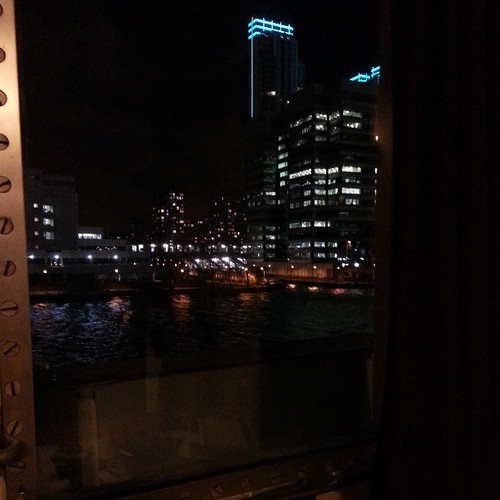
I’m sitting on a repurposed fishing boat, which is now an art, music, and hacker venue. Last night I toured the guts of it, slipping between shoulder-high engines, the air smelling of diesel and slick oil. Doors hiding computer terminals, and audio mixing setups, and soldering stations, and a lathe so large they must have built the ship around it. Blo letting me onto the bridge, where the only piece of new equipment is the mandated ship locator and broadcaster. The crew asks for your preferred language and then your name when you enter the tiny mess hall, a window cracked for the hand-rolled cigarettes. I now have just enough German to nearly state that for my language, but am still too self conscious, so instead I listen to theirs.

view of Canary Warf from MS Stubnitz

View from my room on Stubnitz

It’s the first quiet time I’ve had in a week, the last being a six hour moto ride through the English countryside. Sheep perched on stone walls, eyeing us as we went by, hugging curves and throttle. Between then and now have been hours of hard work, rockstars of response tech tools building and conversing, finding overlaps and launch points. Between that and the ship were also bombs in Boston, staying up late into the night funneling the energies of people seeking information, freeing up brain cycles to respond rather than question.

And today was Camden Market, strange back alleys and food smells. Wandering aimlessly with no purpose, simply to see and examine, ask and listen. The papers held by passengers on the London Underground all have Boston on their front pages. Half the emails in my inbox are the same, the vast myriad of my social (fingers in) pie (charts) exhibiting ripples. I find a shop that sells mediocre doner and examine horse statues. Tomorrow is Krakow, after the flight to Warsaw and the 3 hour express train. The distraction and calm are perfect in coping with the vast ocean between me and anyone I could be hugging, which is the most I could be doing right now anyway.

Tonight I’ll sit on my tiny bench on Stubnitz, with my too-quickly-ending book, and listen to sounds of an empty banking hub from out my window. The disco balls will hang deep in the ship, refracting light inside the hull; and I’ll daydream about sailing away with them, with spotty wifi and floors to scrub, to write about what I haven’t yet researched.

Expectations

There’s something about the fantastic Saving The Hackathon blog post on TokBox, that gets to the crux of the cognitive dissonance around hackathons. People expect the next technological tool or application that will change the world to come out of these. Sometimes they do, but rarely. (Insert side-rant about the expectation of perfectly-formed tools, objects, or people appearing from anywhere; as specifically articulated in my comments to this blog post). As I’m sure we’ve talked about before, I deeply believe that technologies only amplify human intent. I have yet to see anything that contradicts this. When it comes to disaster and humanitarian response hackathons, they get a lot of press. But what is the tangible output? What expectations can we set for ourselves and attendees?

So far as tools which can immediately be deployed in the field, not much. Not to say it doesn’t happen at all, but it is rare. The amount of forethought and digging which must happen to find the specific pain point which tech can help ease or automate is not something the affected population or the responders really have time to deal with while they are also doing response. Even when something appropriate is built, you have to worry about dissemination, training, and failure modes. Thus why the most useful things come out of things like Random Hacks of Kindness and CrisisCamps are awareness building and warm fuzzy feelings.

Yes, both warm fuzzies and awareness are legitimate, useful things. Too often, as technologists, we are separated from our world. We spend time behind screens, acutely aware of crises and issues but detached from the response and ownership of those situations. Civic media is an exceptional example of how technology has helped to close that detachment rather than deepen it. I see the same reclamation of involvement at the heart of the maker movement also at the heart of digital humanitarian work. No, this is not something we can leave up to some organization that we don’t know about, that isn’t accountable to us, and that doesn’t have mechanisms for listening to the very people it claims to serve. This is something we must do ourselves, calling upon the institutional knowledge and resources of those large organizations as needed. The things we create, which work, including processes, need to be codified. Sometimes into consensual hierarchies, sometimes into bureaucracy (both of which can be useful, as painful as that might seem). These assumptions of interaction allow us to operate at the next higher level, just as a language allows us to converse more easily, and a shared word set (for a discipline, say) allows us to have even more specific and deep conversation.

rhythmic tapping will solve everything!

rhythmic tapping solves everything

And on the institutionalized side of another false dichotomy, the awareness and warm fuzzies remove the mysticism of tech. People in traditional sectors all too often see applications and networks as some ruby slippers, easily deployed and perfectly aligned if you just knew the right phrase. And the same fear that goes along with a belief in such power, the misunderstanding of a very real (but also not ultimate) power. It’s not just developers who think the thing they build will be the next big thing – it’s also the people in response-based orgs not knowing that they need one section of a workflow automated, not a geotagged photo sharing platform (we already have those).

So response hackathons are a great place for the amplification of human intent and desire to assist the rest of humanity. That’s great. Now – how do you make those intentions deployable? IE, now that you’ve had the cancer walk, who’s doing the research and implementation? That’s a smaller group of people, who are willing to take the risk of plunging into work that doesn’t pay like the rest of the software world. That’s a small group of people who are willing to suffer the heart break and soul crushing that seeing the horrors of the world can cause, in order to see your tiny steps (maybe) make way against that. That’s an even smaller group of people who also understand how to support and care for themselves while they do that work, to find sustained income (sometimes from the people you are wanting to help most – which is still a cognitively sticky bucket for me), so they can keep going. And the fight isn’t just to make things better, it’s also about how that exists in the current world, with policy and with culture.

Response hackathons absolutely have a place in this system of engagement. But it’s one part. Without the continuation programs like Geeks Without Bounds and SocialCoding4Good, we all just pat ourselves on the back and go home. We start to wonder if it’s even worth going to the next one. But accomplishment takes hard work, and sometimes working on the fiddly bits. And that means deep learning and conversations with the user. That means advance work, and continued work. Which I believe you can do. Don’t just create in response to things going pear-shaped. Build things to better understand them. Create to make the world better. Make with purpose. The disasters and obstacles we face in the near future are unpredictably complicated and massive. We have no way to train for them. But we also have massive untapped resources in the sharing of our brains and hearts, brought out when we create, and share, and build.

It is with all this in mind that I am excited about how Geeks Without Bounds is starting to look at how we will interact with OpenHatch, in an effort to contribute to (and learn from) the open source community. It is with all this in mind that I am excited about DataWind, and AppsToEmpower, and shipping low-cost tablets into developing area pre-loaded with useful tools. It is with these things in mind that I am excited about the continuation of EveryoneHacks, and how it creates space for new creators.

OpenITP San Francisco: FOIA Club

Geeks Without Bounds helped facillitate the Open ITP Club meeting at the Noisebridge iteration in San Francisco. We’ve compiled the resources gathered at the event, including videos of the talks and our notes on the event.

Nate Cardozo from EFF spoke on the process of the Freedom of Information Act, commonly referred to as FOIA (note: the first rule of FOIA club is that you must FOIA). Check out his presentation below, and follow along with the slides here.

Important Points
Who can I get the information from?
FOIA is applicable at the federal level, and is not the same as state-level “sunshine acts.” Information must be requested from the appropriate agency (i.e., don’t ask for FBI records from the Dept. of Agriculture). Agencies must respond within 20 working days. Sue after 20 days of inaction, and you MUST appeal if they refuse to release records.

Things you will not get:

  • Classified materials
  • Internal rules or procedures
  • Items excluded by outside laws
  • Trade secrets
  • Intra-agency memoranda and drafts
  • Privacy-related items
  • Law enforcement information
  • Financial records
  • Information on landmines

How do you ask for the records?
The request has to be regarding specific records referencing what you want to know, not the actual question itself.

The 1996 FOIA amendment says that records must be in the best available or native format (Example: The photo itself instead of a photocopy). You can appeal to the DOJ if it is indicated that records are not eligible or don’t exist.

You must send a request to a specific agency/field office to obtain records. Describe your request in detail and for a lay audience. Include any references to records in the media. Ask for expedited processing and reduced fees (if appropriate). Often agencies will work with you to narrow search parameters.

Asking About Yourself: FOIA vs The Privacy Act
Request your own information using the Privacy Act to keep your records from becoming public. A right is everyone’s right, therefore if you FOIA yourself, the waiver you sign makes your records a part of the public domain. In terms of your medical records, HIPAA medical record laws only apply to medical agencies, not other agencies. It allows other agencies to refuse, but does not mandate refusal. The deceased have no privacy rights, but familial survivors have those rights and can block information from being released.

Flash Talks
Immediately following Nate’s presentation were the flash talks on related topics:

Linkage
Check out the official technoactivism notes on the Open ITP site, and Willow’s visualization of the EFF FOIA talk. Join at the next event March 18th. A participating list of cities is available here, and we’ll be helping with the one in Boston!

The Informal Side of Sandy Response

So, apparently I was at the White House today – my first time, as I never went on any of those tours as a kid. In a series about the FEMA Think Tank, this was the first to happen there, and somehow they decided inviting me was a good idea. Sure, I know inviting the rest of the field time is a good move. But this satire-punk kid? Oof.

The whole thing was streamed as a phone call (that, and other notes, will be available at http://www.fema.gov/fema-think-tank within a week or two. The chat was live-tweeted as well via the hashtag #femathinktank – some interesting stuff there.

img by Scotty! Thanks for indulging Galit and myself.

img by Scotty! Thanks for indulging Galit and myself.

After the mics were off, we did a round-table on connecting the formal to the informal – honest discussion about some tough ideas on moving forward. I was asked to be one of the four people to lead us out. Here’s a summation of what I was getting at:

We’re talking about connecting the formal and informal. Somewhat obviously, I’m from the informal

Individual voice (sometimes represented through social media) is important in response because it gives high resolution and granularity to our understanding of what is going on. Instead of dropping in one massive block of resources, we can figure out where tiny bits go. How communities can help themselves and help each other. In short, mutual aid. This is couple with wanting to respond at the pace our technology has made us accustomed to.

I look at this a bit like the record industry in the age of the internet. FEMA right now can become kickstarter or some other platform on which people can connect directly, and have a way of interacting and supporting each other. Through providing those connections, you can bring your institutional knowledge and directive of assistance to bear on interaction. Or you can be like the record industry and become not only obsolete but also unliked. (I like you all.)

How do we create space for innovation in tech and in policy while allowing paths for systematizing? The things that work can’t just be ad hoc all the time. Challenges are bigger than we can plan or train for – have to give people space and support to figure it out on their own.

The tools exist, as we’ve shown, and we can make more. What is needed is an assumption and platform for us working together.

Be transparent about what you do, how to be in touch. It’s already chaotic, help make it less so. The populations we aim to help can be included in that knowledge. We need your bigger abilities and institutional knowledge. We as individuals also have to learn to support you as our government. So many of these things happen out of directed conversations and open minds.

Ialsomaybetookapictureofatinyoccupytentwhileinthewhitehouse. And slid down the railings. ([x] World Bank [x] White House [ ] NASA). I wonder if they’ll ever let me back.

Hurricane Sandy: Response Overview

This blog entry was co-written by Galit Sorokin and Willow Brugh, and edited by Lindsay Oliver. Mad props to them and to all the fine folk we had the honor of working with. Special thanks to Tropo, who made it possible for me to deploy with the FEMA innovation team. And kittens and hearts to the Field Innovation Team.

Background of experimentation and collaborative innovation

Humanitarian and disaster response is a layered and multifaceted complex system of invested stakeholders, criss-crossing operational levels, and overlapping missions and goals. IE, there are all sorts of players in the field, and they have different motivations and modes of operations. Think about all the different components that go into an office job – operations, staff, developers, and the like. Then you get into the tech that supports them, how they interact and are influenced by the space they inhabit, and the like. All of this revolves around a shared purpose of output and expectation. Then remove all the intentionality and shared methods of communication, and make everything immediately pressing. You now have some idea of what disaster response is like: while there are needs that must be prioritized and protocols to be followed, every issue to solve feels like an emergency – because they are all emergencies.

There are many efforts around linking separate operational nodes and helping them to be more interoperable, reducing redundancy in response and furthering existing efforts. Two such efforts are Camp Roberts RELIEF and STAR-TIDES.

Camp Roberts RELIEF experiments have catalyzed the development of interoperable disaster management tools. It has brought together interagency partners and humanitarian responders with the institutions responsible for building situational awareness and informing key decision makers.

STAR-TIDES (Sharing To Accelerate Research-Transformative Innovation for Development and Emergency Support) is a research effort that promotes sustainable support to stressed populations – post-war, post-disaster, or impoverished, in foreign or domestic contexts, for short-term or long-term (multi-year) operations.  The project provides reach-back “knowledge on demand” to decision-makers and those working in the field. It uses public-private partnerships and “whole-of-government” (the philosophy that everyone in a community has responsibilities and roles in a disaster) approaches to encourage unity of action among diverse organizations where there is no unity of command, and facilitates both inter-agency and international engagement.

This sort of cross-agency and cross-organizational innovation is the background from which much of the following approach stems. The team brought experience from these events to respond to Sandy as a part of the FEMA Field Innovation Team. We chose to focus on the Disaster Recovery Centers (DRCs) as the interface between the affected population and responders. In this case, “responders” refers to response professionals, such as the Office of Emergency Management or EMTs. DRCs can be put in place by formalized groups such as FEMA and Red Cross, or can be community efforts by churches, schools, and ad-hoc groups. “DRC” in a standalone reference  refers to an official one, “Community DRC” refers to a non-official one.

As Sandy crept up the East Coast, the Field Innovation Team rallied around the following directive goals:

Pre-purpose Deployment

Mobilizing the whole community requires an interfacing contact at the Disaster Recovery Center (DRC) level whose sole focus is connecting FEMA to the social network and resources of the DRC’s local context. This proposal outlines the potential deployment of a tiger team, experts that solve systemic or technical problems, whose mission would be to:

  1. Identify needs in the region and specific community where a DRC is operating; (building check points along the way).
  2. Communicate those needs to the DRC along with potential whole of community approaches that could be mobilized against those needs;
  3. Design innovative approaches to meeting the identified needs using participatory (multi-stakeholder) processes, mobilizing whole of community to pursue a community-designed solution (akin to CAP at Camp Roberts). Down-select and/or fuse to one that most closely matches the needs, opportunities, and constraints of the in-need populace.
  4. Implement solution and track effectiveness. In parallel, track these needs and chosen solutions as indicators of capability gaps that could be explored through exercises and field experiments (such as through RELIEF) and turned into lessons learned/issues identified.
  5.  Take capability gaps identified during deployment to subsequent field exploration at RELIEF/Camp Roberts, where the NPS/NDU team can convene multiple stakeholders to further develop and explore innovative, scalable solutions that can be deployed in the next disaster.

Tangible Example
With communications failures in the residential and commercial sectors, DRCs require a means to connect disabled citizens with their loved ones and provide disability services. FEMA has acquired iPads and software that can facilitate communications, but requires a team that can deploy with these devices and devise a CONOPs in real time (and problem-solve in real time). The tiger team would work with stakeholders to design methods for deploying the services via iPad, implement one or more of these methods at DRCs, track the success, and take any gaps into subsequent field explorations.

With all of this in mind, we deployed with the following mission:

To strengthen whole of community by amplifying the connection between the formal and informal sectors.

Questions we use to frame our work

  • What can we do in these areas which is not already being done?
  • Would what we propose to do provide innovative, systemic changes?
  • How much time will it take? Is it accessible?
  • When identifying needs in the field, we assess if needs are being met.
    • If no, then why not?
    • If yes, then how?
    • Are needs met traditionally? If not, then what ad hoc solution was made possible and implemented?
    • Note: While this is may not have been how we framed our work or responded, it’s how we assessed what was going on and can be used in future scenarios.

Initial problem set assessment

Power:

  • Was unscalable, and behind too high of walls to access.
  • Power was too big an infrastructural problem to tackle due to lack of access to data and red tape.
  • This is now a project for Camp Roberts.

Housing:

  • Was outside our connections and capabilities, but was a missed connection. Could be an attainable goal in later efforts with appropriate communication channels open.
  • Too broad an issue to tackle in such short a time. Also, we were discouraged and bumped off from spending energy on the problem.
  • Connections were available but uncommunicated across teams.
  • Housing is too big an issue to resolve with quick technology based solutions and therefore did not recieve as much attention

Education:

  • Came back online much more quickly than anticipated. Was not as much of an issue during triage and initial recovery, and was locally resolved relatively quickly.

Communications:

  • We helped install vsats and signage (not just communications to the rest of the world but also on the ground and between groups).
  • While a well planned-out approach, there was a lack of opportunity to properly and fully implement.
  • Signage was tested and successfully installed. It is important to note that this location’s communication came online faster than most.

What we ended up working on:

How FEMA gets to enter an area

Currently deployed with FEMA’s innovation team (iknowright?) for #Sandy, so I’ll be brief. Lots of stuff being worked on, lots of approvals have to be gotten before it sees the light of day. But here’s a brief overview of how FEMA is able to deploy anywhere, to address some rumors and assumptions going around.


People in state and city have to even know that they can, and must, request from state. Then they have to know how. Same goes for state.

This process happens every. single. time. Want to put in a DRC? State has to request it.

Arrows are one way.

Why groups like Occupy and other localized efforts are important – these rules don’t apply to you. The info you create and the knowledge you have can be acted on.
Groups like FEMA also have historical knowledge. Some policy DOES exist for a reason, which is difficult to understand outside of context.

Last mile is the problem. Resources pushed to state, up to them where it goes.

A lot of people are saying FEMA isn’t around. Think about this – they have 900 community relations people are currently working New York and New Jersey. Out of 3500 total FEMA staff. Think about that – 900 of those are community relations, deployed, right now. They are there. But they need your help.

V&TC summit summary

Huge hearts to Galit for so much help on this doc, and to Matt Stempeck and Heather Leson for their heavy input.

On October 10th, a small group of Volunteer and Technical Community leaders and academics focused on crisis and humanitarian response gathered at the Woodrow Wilson Center in Washington, DC. The V&TC summit was scheduled to occur just before the annual International Conference of Crisis Mappers (ICCM) beginning the following day. The session provided an opportunity to establish and strengthen face-to-face relationships, open channels of communication to be built upon at ICCM and extend beyond the framework of the event.

The event was conceived and subsequently organized by Willow Brugh (Geeks without Bounds) and Pascal Schuback (Crisis Commons). The location for the summit was generously offered up by Lea Shanley and David Rejeski, both directors within the Science and Technology Innovation Program at the Wilson Center, in support of V&TC efforts.

A number of active community members from a range of backgrounds and affiliation were able to attend the summit on the painfully short notice we were able to provide, forming a dynamic group of individuals. The full-day session yielded a better understanding of challenges the broader V&TC network faces in responding to humanitarian needs and communicating amongst each other and with more traditional organizations. Ideas for improving upon volunteer response and organization were outlined, as well as a followup plan of action to provide continuation and solidify development.

Below is a summation of what was discussed, and how we hope you’ll comment and contribute.
Continue reading