Empathy without Responsibility

At the end of each year, I pick a word or phrase to guide the following year. Sometimes it’s really impactful, and other times I barely remember it, and sometimes I even miss the mark. Last year’s was one I was particularly nervous about.

My phrase for 2025 will be something I’ve already begun working on – empathy without responsibility. I was exhausting myself by always wondering if I was focused on the right thing, always doing triage on what might be a better use of my time. Instead, I’m going to focus on what is in front of me and what I have some influence over. I can send money to Translifeline and if a trans kid from Florida shows up on my porch I can house them. But I cannot drop everything in my life to move to Florida to fight the good fight. What I am already doing matters, and I should focus on it.

This is something I had even begun thinking about months before the end of 2024, and realized I needed to pin my year to it. One of the conversations I have had with Reed is about how having a drink helps me give myself permission to disengage from the world. “I am now off duty” I am broadcasting by imbibing. And as someone who is nearly always “on,” that is a useful tool. However, learning to turn down if not off is a skill worth acquiring, and so I set out for the year.

I’m working two approaches: classifying and trusting.

For classifying, I’m determining if something is actually classed into a category that I do have responsibility for. Ends up this is a much smaller set than I initially felt it was. I’m still responsible for a lot — my role in the household, being a parent to my child, an organizer for my neighborhood, the steward of some extra cash to give to others, etc. I am NOT the responsible party for getting an unhoused neighbor on their feet, but I AM responsible for being kind to them and being sure they know about nearby resources and maybe helping them get to those resources. I can also be responsible for making sure that nearby resource knows I have their back, volunteering occasionally, and donating when I have extra. I am not responsible for how Locke does in the classroom, but I am responsible for guiding his behavior when he is at home, and making it clear to the school that I have their back while also having his. Etc.
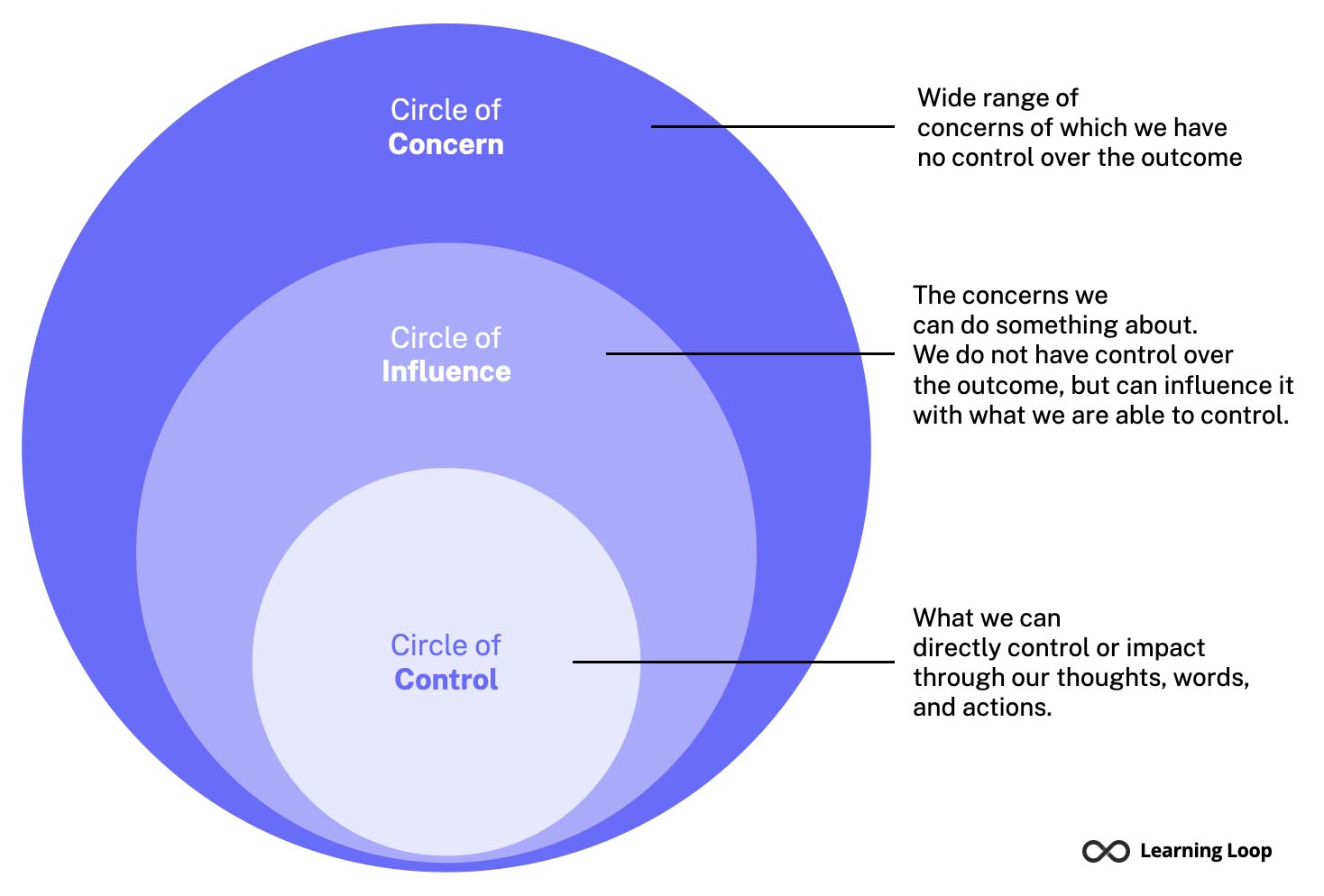
The smallest circle is the lightest in color, and reads "circle of control" with a pointer that continues "what we can directly control or impact through our thoughts, words, and actions."
The next circle, which encompasses the smallest circle entirely, is slightly darker and reads "circle of influence" with a pointer that continues "The concerns we can do something about. We do not have control over the outcome, but can influence it with what we are able to control."
The final, darkest circle encompasses the other circles and reads "Circle of concern." with a pointer that continues "Wide range of concerns of which we have no control over the outcome."
Screenshot

For trusting, that means I am also trusting the other people in my network and neighborhood to do what they are responsible for. I stay out of their way except for when I have something to offer that might help. I build unlikely friendships with people who have very little practical overlap with me but with whom I am ideologically aligned. I deepen friendships with people similar to me but doing their things further afield so we can align with and learn from each other.

But! I am still looking for tools to deepen this practice. A very dear, very long-time friend of mine is also an exceptional facilitator and is doing a free session on just this thing on Tuesday, November 25th from 9:30a-12 PT. You could come learn with me if you struggle with similar things. It would be great to see your faces there.
Value-Based Design Workshop

Bex and I put together a Value-Based Design workshop for the Codesign Studio at MIT Media Lab. Originally posted on the Codesign site (and then to the Civic blog and Bex’s blog). Here’s how we did it:

link to the hackpad version of this post

When you are designing a project for social justice, where do you start?

In this workshop, we practice value-based design, a method that helps us to design for large scale social impact and to relate this directly to how we plan and implement projects. We envision the impacts we’d like to contribute to in the world and the values we bring with us into our work as the first steps in this design process. As individuals, this method helps us to express our connection to our projects on a personal level and to prevent burnout as we are able to identify work that resonates with our values and to set aside work that doesn’t. As a team, this method helps us to identify shared values and to make design decisions based on our shared vision instead of personal preferences.

At the last Codesign Studio, Bex and Willow took the class through an hour-long workshop toidentify our individual values and to design our projects and approach around shared values.

This workshop is inspired by Monica Sharma’s work in transformational leadership for large scale system shift. In this article, she describes the framework of the methods she shares for this kind of work. Connecting with our personal values and designing based on values is a key component. [Sharma, Monica. “Contemporary Leaders of Courage and Compassion: Competencies and Inner Capacities.” Kosmos Summer 2012.]

Individual Values


Purpose
Uncovering our core values gives us better understanding of our own purpose and desire in the world. Doing this exercise with teammates is a great way to connect to each other’s inspiration.

Process
(3 min) Select one person in the room to work these questions with:

Share something you’ve worked on that you had some role in designing.

Ask the following questions:

  • What did you envision as success for that project? Often people will dissemble, and say it wasn’t a success. People will also commonly talk about the activities of the project, things they did, instead of what the vision was of the project. So:
  • Ask them to imagine that it WAS a success. What is happening in the world then? How are people living? What is the quality of life?
  • Drill to one word. That’s the value you were working from. The value you represent. The word should not be an action or process (manifestation, collaboration, interaction, etc), but what people feel like if they can act or work in that way (joy, justice, inclusion, health, etc).

(12 min) Now, break into pairs. If there are project teams in the room, ask people to work with someone in the same team and ask each other the questions above.

(at 6 min) Remind people to switch

Reportback
Have each person say their value when you reconvene. If you can, write these somewhere that will be visible for your team as you continue to work together.

Value-Based Design


Purpose
Designing a project with the larger purpose in mind helps to think big and understand that your actions connect to your visions of social justice. It also helps your team to recognize shared values, a great starting place for connecting when you have to make difficult design decisions.

Overview (5 minutes)
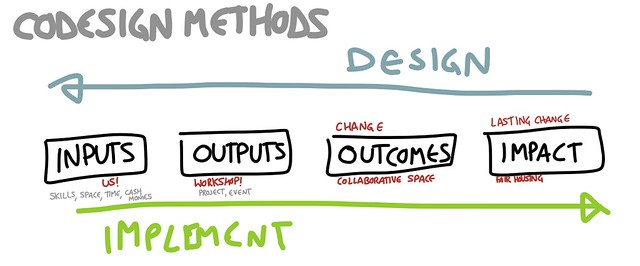
In this method, we design with our teams first by developing shared understanding of the impacts we want to see as a result of the work we do together. These will be large-scale and will likely relate to values we identified in the Individual Values exercise. In this exercise, Impacts, longterm sustained state change.

Because we can’t implement impacts directly, we continue to design our work into pieces of work that we can implement. We divide these pieces into three categories: Inputs, Outputs, and Outcomes.

Process
Share the above graphic.

Go through an example, here is an example of how we might have used this methodology in developing Codesign:

Ask what desired impacts of Codesign are:

  • Impacts – sustained state change. – What do you think the intended impacts of codesign as a method are? Empowered and equal engagement.

Ask what some inputs, outputs and outcomes are of Codesign:

  • Outputs – collaborative workshops
  • Inputs – YOU! Partners, us, this room, MOUs, etc
  • Outcomes – A change, but requires continued effort to maintain – Such as social relationships, people try it and don’t keep it up

We tend to fill these three categories with information in a nonlinear way — recognizing an Outputmay surface desired Outcomes and Inputs. Broadly, we design right to left and implement left to right.

Project Design (25 min)
Now practice the value-based design methodology with project with your team. If you are at an early stage in your work together and you haven’t yet identified or selected a project you will work on, you can begin by taking the various partner’s organizational values into consideration. Broadly, what are the impacts that your team’s members envision?

Before completing the exercise, have each group fill in at least 2 points under each section.

Wrap It Up
Reportback (15 min)
Ask people to share their process. Try using the Green/Yellow/Red method and ask each group to share one Green – a thing that was easy or clear; Yellow – one thing that was challenging or that they learned something from; and Red – something that was difficult or a block.

If the teams went to different parts of the room, have everyone tour around. Document the work of each group.