“Your struggle is my struggle. While I had a really rough time growing up, it must have been just as hard for people like me, and even harder for those facing structural oppression. I want to fight these systems with you. When you say I’m ‘privileged,’ I feel like my experience is being discounted and it makes it difficult for me to be in solidarity with you.”
I feel like this is what Laurie is asking for. I know it’s what I would ask for.
Years ago, after Chaos Congress, Rubin insisted we go to some art show. I, as always, preferred to stay at home — whatever continent, country, city home might be in that day. But Rubin can be lovingly persistent. It would be worth it. It would be beautiful. We went, mere hours before I boarded a plane from somewhere to somewhere else.
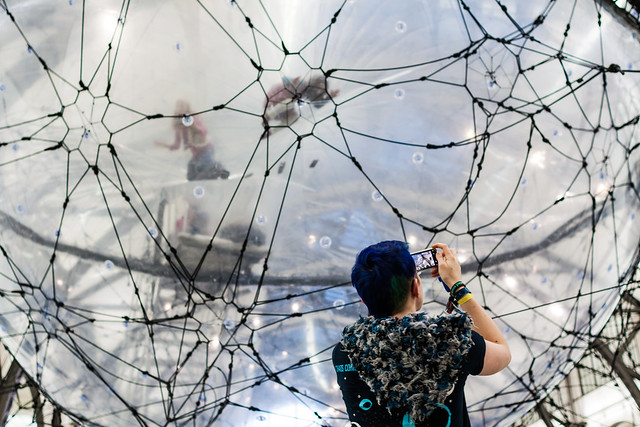
Biosphere was a study in liminality to me, suspended spaces tethered to more commonly understood as habitable floors and walls. Perfectly clear water in heavy plastic and vast space define in clarity and iridescence. It was a liminal future, an in-between home, the moment the wheels leave the runway. The terror of my anxiety and the complete love for the possibility of Something Different, wrapped up in the moments of stepping into the future. In short, Rubin was right.
Jump forward a few years.
When Pablo invited me to Development and Climate Days in Lima, I was glad to go. Even before the deeply pleasurable and productive Nairobi gig with Red Cross Red Crescent Climate Centre and Kenya Red Cross, I trusted Pablo to have spot-on inklings of the future. Maybe all that climate forecasting has gotten into his social forecasting as well. His efforts around serious games resulting in their now being generally accepted, he told about an art-involved step to get people to think about the future differently. Something about plastic bags, and lighter than air balloons. Would I be willing to, in addition to my talk, document their process of creating a Museo Aero Solar for others to participate and replicate? Of course – distribution of knowledge, especially with illustration and technology is kind of my jam. It would also help me venture into the city.
I arrived at 2a to a deserted city and a vast and rolling Pacific out the cab window. I cracked jokes with the driver based on my poor grasp of Spanish (“ehhhh, Pacifico es no muy grande.”) He humored me. And in the morning, mango that tasted like sunlight, and instant coffee, and the Climate Centre team of whom I am becoming increasingly fond. And a new person – the artist Tomas, with whom Pablo and I ventured to an art space to join the already-started process of community building and art creation, large bags full of plastic shopping bags ready for cutting and taping. Pablo eventually had to go spend time at COP20, I relished not going.
I took such specific, ritualistic care with each plastic bag. Cut off the bottom, cut off the handles, cut a side to make a long rectangle. Lay it gently on top of the pile, pressing down to smooth and order. Pick up the next bag. Feel it on my hands. The crinkle, the color. Smooth it out. Cut. Place. The sound of tape being pulled, torn, applied, and stories told in Spanish. The slow joining of each hand-cut rectangle. I smiled, to dedicate so much care to so many iterations of things which are the detritus of life. Francis laughed with me, saying she felt the weight of each one. A heavy statement for something so light. Tomas walking around, constantly seeming to have attracted a bit of plastic bag handle to his heel, no matter how many he peeled off, a persistent duckling of artist statement.
We went to the Lima FabLab to speak to a hackathon about making a GPS and transponder so we could let the creation fly free without endangering air traffic. And this time I saw it from the outside – seeing Tomas speak to a group of self- and community-taught Peruvian coders, and seeing their faces display disbelief and verge protection against the temporal drain of those outside your reality. Then, as he showed step by step, and finally an image, that these can fly, their cousins can lift a person, grins break out. Peoples’ hearts lift, new disbelief replaces the jaded. There is laughter and a movement to logistical details.
And then we took it to the D&C venue, and it worked.
I imagine what Pablo must have gone through, to get bureaucratic sign-off on this. No metric of success. No Theory of Change. Him, fighting tooth and nail for a large and hugely risk-adverse organization to trust fall into the arms of a community, an artist, a facilitator, and a game maker. And they did. And it changed the entire event. People in suits crawling into this cathedral made of plastic bags, each individually cut and added with love to the whole. A pile of fancy shoes outside the entrance, like a ballroom bouncy castle. People’s unabashed joy watching art some of them had made become a room, and then lift off to become a transport.
This future we want — it’s hard work, it can seem impossible. But it’s right here, we made it. It works, and it is beautiful.
I brought up ways for other people to participate. In a beautiful act I would associate with Libre ethics, the Lima crew have opened up not only our stories, but our process. We want you to join us. We want you to be a part of this future, and it means hard work. The fledgling wiki and mailing list can be found here. I hope you hop on.
Hugs and thanks to Lindsay Oliver and the Kenya Red Cross team for their contributions to this entry.
On November 15th, I helped facilitate the Red Cross Crescent Climate Center’s HeatHack 2014, a gathering of amazing people to collaborate on solutions to climate-related challenges. This event focused on the risks and impacts of heatwaves, and how to provide community care and safety nets for at-risk people during extreme weather episodes.
In case you wonder what a hackathon is:
A hackathon is a gathering of diverse people who form teams to work on addressing challenges over a short period of time. These challenges can be technical, physical, resource-based, or even social. During HeatHack, participants learned about heatwave challenges from climate experts and people who have experienced heatwaves firsthand. Teams formed around potential ways to address these challenges, and worked together to come up with solutions to present to the judges. Prizes were awarded based on innovation, documentation, usability, and inclusiveness.
Why “HeatHack”?
Heatwaves can cause power outages, wildfires during a drought, buckling and melting roads, burst water lines, and serious health effects such as severe sunburn, heat cramps, heat exhaustion, heat stroke, and death.
According to NASA, when the temperature hits 95*F (35*C) your ability to function drops by 45%. Your loss of accuracy is 700%.
MPR News reports that body temperature can rise to 105*F (40.6*C) if working outside in a heatwave. Death occurs usually when a body temperature reaches 107.6*F (42*C).
Despite the severity of heatwaves, the health risks often go unnoticed because the people most affected are easily overlooked in a large population, especially if they are poor. We need to create ways of responding to these challenges to care for people who are currently at risk and to prepare for future heatwaves. As the effects of climate change become more severe, the number, length, and temperature of heatwaves will increase – including in Nairobi! Climate change affects the entire globe, and Kenya can lead the way in creating solutions that help as many people worldwide as possible. Continue reading →
I met this guy named Pablo Suarez in a pub in Boston, when our mutual friend John Crowley insisted I leave my introvert-hole. When John insists, I tend to listen. And as always, it was totally worth it. Pablo plays games. As a climate scientist, he got tired of people falling asleep in meetings. He was aware of the direness of the situation, but no one else felt the same urgency. So he started expressing probability and costs and delays through dice, and beans, and objectives. He’s played these games with people who live in disaster-prone areas on through people at the UN who make policy about resource allocation. He’s created actual, connected change through an entire system. We’ve since embarked upon a few event adventures together, and I’m glad to call him friend and cohort.
My experience with KRCS
And so I met this guy named Dr James Kisia, when Pablo suggested I take a gig at the Kenyan Red Cross. In a continuing trend, when Pablo suggests things, I tend to listen. James has become well known as an innovator in the NGO/innovation space. As an example, reframing the understanding and practice of social entrepreneurship in resource-poor settings. Exploring sustainable resource mobilization for an organization whose relevance in disaster-prone Kenya is increasingly becoming apparent. The KRCS runs 3 hotels in Kenya, taking advantage of the fact that conferencing is a major business in Kenya, and in Nairobi particularly. It might seem paradoxical, having a five star facility on the campus of the a humanitarian organization, but the money the hotels make is ploughed back into the humanitarian work of the organization — including non-funded sudden onset disasters.
Based entirely on good faith, shoe strings, and a few well-placed calls, James and I embarked upon a trust fall with each other, based entirely on Pablo’s word. The Web of Trust in real life. I arrived to Nairobi for 4 weeks of work with little guidance beyond to lay groundwork for a Dadaab-focused intern or contractor, as specific to what would be applicable to climate change issues as well. Continue reading →
Death is different now. In a time of networks and social media, it’s not just having a song remind you of your deceased loved one anymore, it’s Spotify suggesting you listen to their playlists. It’s scrolling just a bit too far too soon and seeing their last shares on Twitter or Facebook. It’s not just figuring out funerals and atom-based belongings granted through wills (or figuring things out there wasn’t any pre-planning), it’s a faceless mass of internet informing you that your friend has died. It’s not just compiling half-finished scrawled songs and old love notes, it’s debating cracking the password for a laptop full of memories. Because the internet and technology haven’t just changed how we live – it’s changed what happens in death. And we can simply be awash in tragedy in these new ways, or we can use those new connections to show our care and values, even through death.
Today the spontaneity of planning, which makes it possible to search for a place to eat with your incoming friend while already out the door, forms habits making the avoidance of planning for death even easier. But after working through the unexpected deaths of a number of networked friends, I have started explicitly planning for the eventuality of my own death, to ease the burden on others. I’ve set up a living will (detailing things like whether I want to be kept on life support — I don’t), a will (what to do with my corpus and my corpse — open them up and share the contents), and mechanisms for notifying the many communities I inhabit, helping them find each other for support. The compartmentalization of online selves otherwise makes discrete and care-full notifications difficult, and sadly the current viable option is mass broadcast.
Because I’m also from the parts of the internet that care about open access and free software, friends and I have taken my death preparations and formed a guide for the bits of postmortem planning other guides may have missed. Based on ideas from open access and information security, it includes topics like how to deal with passwords, contact lists, plans for account deletion while archiving information, and donating one’s body to science in ways that support open research.
This living documentation is called NetworkedMortality, and I hope it helps others to start thinking about and planning for the inevitable, either privately or in this wiki-based and public place. Just as the internet is about creating, storing, and transmitting knowledge, this guide is about contributing to something larger than the individual. It’s about continuing to build the commons, establishing protocols for death in the digital. The sorrow of death need not also be accompanied by confusion over what intentions would have been or who should know what. Funeral home directors and lawyers have helped guide us through the protocols of death in the better-known world. In this new space those steps are considered by Twitter, Facebook, and Google, but I at least would prefer to trust people I know to deal with my wishes more accurately and with more love. We’ll be hosting a “death drill” to test out these new protocols on December 13th from 2p-5p at the Berkman Center.
Too often, we think only about the short term – this quarter, this school year, this laughably short short life span – when considering how we plan as well as what we build. We must instead intentionally look to the public future, and our responsibility as members of that shared story. We must contribute to freely available knowledge which lasts beyond our brief moments. An unavoidable part of life is death. Let’s care for each other, and hold true to our values, through the entirety. Let’s network our mortality, together.
P.S.
It is possible to speak about death without fear – I hope you can act from this place. If you are in danger of harming yourself, please get help, rather than indirectly indicating through things like estate planning.
I went to AkiraChix: Women in Technology Conference in Nairobi, Kenya this past Saturday. It was pretty outstanding. A couple hundred people in attendance, including a few men, and an incredible variety of relationships to tech (women who run the business side of tech orgs, sysadmins, bloggers, PHP devs, those in technical classes, etc).
Here are some things that stood out to me, in no particular order:
Cross-generational mentoring: There were students from 2 (3? 4?) high schools in attendance. AkiraChix has ongoing talks and workshops at these high schools, and the young women were definitely a highlight of the conference. Some jumped to interact/speak up, some needed/wanted encouragement to speak up, but each had astute and empathetic contributions to the conversations and workshops. Those who have been in tech for 20+ years in Kenya and the rest of the world had a reigniting of passion, and the interactions seemed great all around. I’ve been inspired to make more of an effort in integrating youth in future events I participate with.
Celebration of achievements / ritualized phases: AkiraChix has a bunch of photos of graduations from classes/bootcamps the group has held, and were hosting a competition for tech for women’s empowerment, etc. I often get so lost in process I forget to celebrate the milestones that have been accomplished — this was a good reminder that these moments of pausing and celebration are important.
Integration with educational systems: The students in attendance felt comfortable in their skills as well as with the other attendees in no small part because of the consistent interaction between high schools and AC. AC has created curriculum for (I think) both their own workshops as well as for general use in schools.
Self-care: Every. Single. Volunteer and Speaker consistently asked each other “how are you doing? Have you eaten? Do you need some tea or water?” It was difficult to not take care of one’s self, and it was infectious to offer care to others around you after this had been instilled. A++, 1 million points.
Focus on interactivity: The day was led by a keynote from Juliana Rotich, about the new AC tagline, “she builds, she serves, she leads” which was powerful and inspiring. This was followed by a panel with lots of time for Q+A, 3 rounds of breakout sessions, and a wrap-up panel (again, with lots of Q+A). The interactivity made sure everyone had a chance to speak, as well as breaking down more traditional (and hierarchical) “I speak, you listen” modes. I find this important to systemic change.
My experience, and a few sticking points:
Despite traveling globally pretty consistently for the past 4 years, I’m still very much aware of having been raised in the whitebread American Midwest, and feel that my experience of being aware of, but not the target of, power inequalities in race might be similar to those of feminist men. Intersectionality is something I studied… 10? years ago (oh man), but not something I’ve been deeply committed to understanding until these moments of enforced empathy. Sorry for being so late to the game, everyone.
I am not scared of being shouted at for saying something wrong. I’m terrified of no one talking to me about it if I do. That makes my bringing up sticking point in this context difficult – being still somewhat fresh to post-colonialism, there is definite deference to the light-skinned in Tanzania (and I think a lesser but still present tendency in Kenya), i.e. my Tanzanian friends get frisked before entering buildings, whereas I don’t. Differing with people in at the conference was delicate business I tended to avoid in deference to this. Was this power dynamic not present because I was in a space AkiraChix had created, and invited me into? Was it something to pay even more attention to, as one of three mzungus there? Is my assumption of this power dynamic reinforcing that power dynamic? Have I used the term “they” somewhere in this entry because it would be ok in other contexts and I missed the othering it causes in this one? HOLY SHIT THE ANXIETY. Regardless, here are the things I still found sticky, and I hope everyone feels comfortable telling me if I’m wrong, or even simply presenting it in a terrible way:
Rhetoric of Lean In: The idea of “just try harder, stand up, etc” is incredibly disconcerting to me. This is a tension between activism (things are going to suck, you’re going to get hurt, but it’s worth it for societal gain) and basic human dignity (you shouldn’t have to “lean in” at the office, as a woman. You shouldn’t have to, anywhere). This happens in the weird time between legal equality and normalized equality. But is Lean In different, in this cultural context? I heard many women speaking of men whose verbal representation had changed after street harassment exposure, and of fighting to have their voices heard, and it now being understood as culturally normative in some spaces. In short, because this idea doesn’t work for my circles, does it mean I need to bring it up here, and what does my bringing it up mean in larger contexts?
Tension of timeliness and inclusion: The “successful/productive” technologist is also perceived as a timely one, a value instilled by the Global North, which is in tension with those with less time or access to transportation, who spend longer in traffic and are subsequently 30 minutes or two hours late to any endeavor. This was hard for me because of my own temporal anxieties. There has been a shift in Kenya in the year I’ve been gone, across the groups I’ve spent time with, with more value now placed on timeliness. I don’t know what this means, and I don’t have the language to speak about it.
Finally (have you made it this far? holy wow), I had the honor of being invited to sit on the closing panel of “Securing Women’s Spaces Online.” The video will be up eventually, but the prezi follows. I encouraged the re-writing of social scripts/memes to not include attack nor rockstar martyrdom (common in hacker circles, and a script I’m concerned about being transmitted), and to remember that homophiliy is easy but serendipity is why the internet seemed/seems so wonderful.
When people tell me that Cartesian systems are optimized, I want to laugh. Of course they are, but we’ve optimized for the bits we know about. We’ve focused on optimization of output, not on optimization of adaptability. And the Quest for the Upper Right Quadrant (aka Capitalism, aka the Singularity, aka any overly simplistic idea of infinite growth and eventual overall simplicity) is always about output. In systems in which the power distribution is also hierarchical (aka, the ones we’ve got), people are not empowered to deviate from set tasks to cover those unknown parts. This is why the idea of innovation and entrepreneurship is so fraught. To some, it’s about empowering for adaptability and connection, for gap filling. For others, it’s about hurry up faster to that upper right.
Which brings us to this article I referenced a bit ago as abhorrent.
After all, which economy is more productive — one in which every single person is an entrepreneur, or one in which a minority of entrepreneurs employ the majority of people?
To understand why, consider a common-sense question: How big can a business be in a rural village? There aren’t many customers there, and incomes aren’t very high either. A business would have to serve several villages to start creating jobs in any significant numbers. Now, consider rural women with families. They may be reliable repayers of loans, but they’re much less mobile than single men. Single men can move to cities, or at least cover a lot of ground in the countryside, in an effort to win new customers.
…
Of course, these jobs won’t always go to the rural women helped by microfinance programs. Microfinance programs may be one of the best ways to help them, short of having their children take jobs in cities. Nor are these jobs necessarily the ones that fulfill the social goals in the mission statements of Western nonprofit organizations. But they are the kinds of jobs that brought hundreds of millions of Chinese out of poverty and could someday do the same for Indians, Haitians, and Congolese. In these countries, the quickest way to escape poverty is likely to be via bus to the nearest city for a manufacturing job. Hundreds of millions of economic migrants know this, but so-called antipoverty experts are just beginning to understand it.
Two things in this that bring out my “are you fuckingkidding me” reaction.
I find it distracting and ridiculous when untenable living situations are equated to financial poverty, and focus only on the funds, not on the conditions which the funds MIGHT alleviate. It’s possible to work and still be miserable. Wage labor rant. Being slowly crushed by capitalism (or communism!) rant. Capitalism is but one way to attempt to interact, not the only way. Sure, it’s good at propagating ideas quickly, at fast iteration, etc, but too often it leads to:
The idea that we have a hierarchy as a necessity in any business. That there are employers, and there are those who do the shit jobs to keep things running. We are all humans, we are all equal, and it is just as possible to find joy and honor (or misery and bitterness) in driving a taxi or gutting fish as it is to find the same in leading a multinational business or making the internet work. To insist otherwise is to discredit the experience of millions (billions?) of people. To want to reinforce the idea that those jobs are actual shit is to actively demean everyone doing them.
No business, organization, relationship is dependent upon power structures being in place, where some work is “more important” than other work. A business, organization, and relationship where all parties are encouraged and expected to examine, innovate, and contribute is one which is adaptable and successful. It is one which is scalable in a complex and networked world. So yes, teach that woman to fish. Better yet, ask her to teach you. She’ll catch more than you ever will, with all your business and economics training.
I want to give special thanks to Meredith (@maradydd), Sam (@metasj), and the Berkman crew (@berkmancenter) for help in parsing all these complicated ideas. I’m forever grateful for our conversations.
The existing harms of social scripts we ran while in smaller, geographically-constrained groups are being amplified due to network effect. Tiny unchecked errors, scaled, become large harms as people find ways to exploit them, in life just as in software.
I propose we hold a 2-day event to understand “weaponized social” historically, tangentially, neurochemically, and technically — and to arrive at ongoing ways of addressing them. These challenges are not new, they are simply arising in space we consider new. Given the erosion of trust online, I see meeting in person as vital to rebuilding trust. You can suggest when and where the event takes place via http://goo.gl/forms/2iBJbHXD5E
Context
There was a time when the hacker and academic circles I run in had the default assumption of “it’s better to have your idea broken by your friends than by someone else.” The implicit assumption being that we’d build even better ideas, together. I *hate* that loving dissent is disappearing from my corners of the internet, when I used to dream it would spread. I hate that there’s a vanishing chance I can reasonably assume a trolling comment online is social commentary from an yet-to-be-known compatriot dealing with the same bizarre issues of a system that I am; but rather must now deal with such as a potential precursor to having to leave my home based on legitimate death and rape threats. I hate that some of my intelligent male-shaped or neuro-atypical friends are scared to join conversations online for fear of being severely and permanently ostracized for slight missteps. I hate that some of my intelligent female-shaped friends feel unwelcome online – yes, because of “trolls” who often happen to be self-male-identified, but ALSO because of an incredibly strange practice of women belittling each other. I hate that I only know how to speak to these issues in a gender-focused way, despite knowing damn well race and class come strongly into play, and having the sinking suspicion that cohorts don’t feel safe calling me out. I hate that nearly all my lovely friends of all genders feel unwanted and unsafe because they and others happen to be organisms interested in sex, and respond to culturally indoctrinated shame (in response as well as in self-assessment) by pinning problems on the tangible other, building self-fulfilling prophesies of distrust and violence. And I hate that we’re driving each other off pro-social paths, making taking an anti-social one more likely. I’m sick of these social scripts we’re auto-running, and I’m set on returning to lovingly breaking my friends’ ideas, and us examining and strengthening those ideas together. Please join me in this act for this event, the surrounding ideas, and the rest of life.
Since online conversation is currently so focused on gender divides, let’s look at that for a moment. This proposed re-scripting is complicated by women being socialized to understand men, to reach out to them, to be accommodating. In a desire to NOT run dis-equalizing social scripts, we as female-types are instead falling into scripts of victimization and back stabbing/”you’re doing feminism wrong.” I’d consider the former set worth embracing as human, the latter to be consciously left to the wayside. Those socialized to be masculine have social scripts they’re bucking and/or selecting, too. Scripts about being protective, and reliable, and strong. Scripts about being stoic, and angry, and omnipotent. But such re-scripting is entirely doable, and we should hear from people about why these cycles happen, and how other disciplines have escaped cycles and built new scripts. Attendees will be trusting me that other attendees are here in good faith, a meatspace web of trust, and that means attendees will be vetted. We will talk about difficult things, and we will set an example of doing so with an interest in begin tough on ideas but kind to people. There will come a time that we can expect every human to stand open but unwavering; but personal, cutural, and institutional histories matter. Violence across these has left a wake of torn-down individuals, and in this space everyone will be expected to be kind.
The re-writing of scripts has proven powerful and useful in other spaces. There are communities in conflict zones which refuse to adopt the identities of victim nor aggressor, instead providing pockets of increased stablity in tumultuous geographies. They do this not out of pacifism, but because that particular conflict doesn’t work for them. We see things like Popehat emerge to offer a way out of victimhood and isolation in being targeted by unparsable legal threats. We see groups like Strike Debt question entire financial structures, providing paths to visible solidarity in otherwise isolating systems. Others have shown it is possible to forge new paths, many in more dangerous and complex situations than what we face. Let’s learn from them.
If you’d like to contribute suggestions to who should be invited to speak, examples to look at, or even helping with the event itself, please be in touch!
Dreams of safe havens with story-checks before you could enter, only the most widely acknowledged versions of stories and their tellers allowed in. We began inscribing the truths we had lived in our skin, to meet in dark back rooms to reconstruct our history in these new places.