
A Flag of Last Resort
Reply
Early this year, yet another friend of mine up and died. There was of course a mess of things that had to be figured out. It wasn’t just the traditional things of cleaning out her house (I wasn’t around for that part) or figuring out the funeral (Viking in variety). It was new and interesting technical and moral turmoil of getting into her hard drive, questions of “should we even?”- her prolific music and authoring contributions rivaled by her extreme privacy. It was seeking the edges of her far-flung pockets of internet community to notify them personally, racing the deluge of social media notifications, not wanting them to find out about her the same way I found out aboutmy grandmother – before the familial phone tree had reached me, a peripheral friend calling me based on a facebook post from my sister. A morbid seismic wave.
While I don’t have any control over how others plan for (or don’t) their demise, I have a say over my own. I can show my care for people dear to me my own compulsive, facilitating way by being sure they find each other as they find out, and in making sure information and knowledge I have to offer continues to be released under open access, even if I’m not there to do it. From doing humanitarian and disaster response (and just a general “awareness of the abyss,” as my mother used to tell my vast and angry younger self), I have had to face the looming possibility of my own death head-on. The networked reality that brought those strange new questions and moral quandaries for my friends’ deaths can instead be used to carry forward care and knowledge. This is a sort of guide for the bits of postmortem planning the internet and most lawyers have missed. It’s not complete – I’ve run into some interesting blocks and quirks, around which I’m eager to collaborate with others.
It’s called NetworkedMortality, and it needs your help with continuing to build it out. It includes some methods of Shared Secret for passwords, storing instructions in password vaults, and mailing lists for notifications of far-flung internet social groups. But it still needs to be fleshed out around how to best shut down accounts while archiving meta data for posterity and research, how to donate a body to open access science, and more diverity in threat and failure models.

Author’s note: I go to, organize, and facilitate a *lot* of hackathons, and while I’m thrilled about most of them as chances for people to learn and get involved in a field of research, I’m also fairly skeptical of them. So I’ve limited myself lately to events that can really make a difference, not only for the participants, but for the people who would benefit from the things they work on. Most recently, I’ve been doing events in Dar es Salaam with Taarifa and Geeks Without Bounds around water point mapping. I think this event has an opportunity for significant impact as well – this event especially in the arenas of health and gender equality. The following post was written by the hackathon team, of which I’m honored to nominally be a part.
Breast pumping is an experience many women dislike, yet it saves the lives of premature babies and permits working women to continue a nursing relationship with their babies. The health benefits of breastfeeding for both mother and baby are numerous, and include reduced risk of type 2 diabetes, hypertension, female cancers, heart disease, and osteoporosis. Despite the overwhelming data and worldwide endorsement of breastfeeding for the first two years of life, many women do not breastfeed at all or wean after several months. In particular, low-income, working women are rarely able to take extended maternity leave, afford the cost of a pump, or pump breastmilk at their workplace. In emerging economies around the world, women who go back to work wean their babies rather than using a breast pump.

The breast pump is the rallying cry for the event because it is a symbol of a technology that could be better integrated into people’s everyday lives in order to save lives, save money, and lead to healthier and happier families. At the same time, our goal is to make space for innovation in family life more broadly, and to support a wide variety of different kinds of projects at the hackathon- and beyond.
This is the second of these events, with a writeup of the first here. Check out some challenge definitions and inspirations on the Tumblr, and join us if you can!
When: Saturday, September 20 & Sunday, September 21, 10am-6pm
Where: MIT Media Lab
Win! World-class judges will be giving cash prizes to the best ideas
Register Now (Registration is free but space is limited)
Bringing together parents, medical professionals, designers, policymakers, MIT students, and engineers to radically redesign the breast pump, as well as explore other innovations in maternal and pediatric health to improve the lives of families and children around the globe.
Our generous supporters of this event include Vecna Technologies, Medela and Naia Health.
Presented by the MIT Media Lab with organizational support of iKatun.
Join us for a free public screening and discussion of Breastmilk: The Movie on Wednesday, September 10, at 7pm at MIT Bartos Theater, 20 Ames Street, Building E15, Lower Level, Cambridge, MA.
No RSVP required! Babies welcome.
Questions? Check out our website or contact us at breastpump-organizers@media.mit.edu.
Written by @Willow Brugh, with feedback and general awesomeness from John Willbanks, Sam Klein, and Michael Stone. Additional props to Adrienne and Sands for edits, and to Fin and Matt for kicking my butt into delivery.
In loving memory of my crypto-loving, open-access enthusiast, and occasionally suicidal friends. We will build more open worlds with our corpses. I just wish you would have held off for more unavoidable causes.
Early this year, yet another friend of mine up and died. There was of course a mess of things that had to be figured out. It wasn’t just the traditional things of cleaning out her house (I wasn’t around for that part) or figuring out the funeral (Viking in variety). It was new and interesting technical and moral turmoil of getting into her hard drive, questions of “should we even?”- her prolific music and authoring contributions rivaled by her extreme privacy. It was seeking the edges of her far-flung pockets of internet community to notify them personally, racing the deluge of social media notifications, not wanting them to find out about her the same way I found out about my grandmother – before the familial phone tree had reached me, a peripheral friend calling me based on a facebook post from my sister. A morbid seismic wave.
While I don’t have any control over how others plan for (or don’t) their demise, I have a say over my own. I can show my care for people dear to me my own compulsive, facilitating way by being sure they find each other as they find out, and in making sure information and knowledge I have to offer continues to be released under open access, even if I’m not there to do it. From doing humanitarian and disaster response (and just a general “awareness of the abyss,” as my mother used to tell my vast and angry younger self), I have had to face the looming possibility of my own death head-on. The networked reality that brought those strange new questions and moral quandaries for my friends’ deaths can instead be used to carry forward care and knowledge. This is a sort of guide for the bits of postmortem planning the internet and most lawyers have missed. It’s not complete – I’ve run into some interesting blocks and quirks, around which I’m eager to collaborate with others.
This post is less about things like wills (what happens to material possessions, who doles it out, and the like) and living wills (if you want to be kept on life support etc) – although I’ve added the templates I used to the wiki associated with this post as it includes digital artifacts and more awareness of gendered pronouns than other bits of the internet. This write-up focuses on specific aspects for Open Access and encryption enthusiasts. Brace yourselves for a morbid entry. Know I’m peachy keen, and being an adult about things, not in danger of harming myself or others. If you are in danger of harming yourself, please say as such directly, and get help, rather than indirectly through things like estate planning. It should be possible to speak about death without fear – that’s what I’m doing here. I hope you can hear it (and act) from a similar place.
I’ve divided components up into documents, accounts, notifications, and people. Documents are centralized with accounts, which are propagated via notifications to people, as triggered by a notification from a person. This means I only have to worry about keeping something up to date in one place — a change to a will or to a website password simply happens in the place of storage, without needing to notify everyone involved. As people become close to me, or exhibit destructive behavior, they can be added or removed from the notification pool. The notification mechanism is the one thing that has to remain consistent in this set up. Continue reading
editor’s note: While this entry was initially posted as password-to-view in September of 2014, I made it publicly viewable on April 22nd, 2016. I did this because 1) the court case with Diggz is now settled and GWOB is the rightful owner of its collateral, 2) I had made it clear that Diggz should only ever contact me again if he had gone through an abuser- or substance-abuse-recovery program. He violated this boundary a few months ago, and while I don’t have the bandwidth to take legal action against him, 3) I am in a stable enough place that I feel like I can cope any potential fallout from this. I do not want this to become A Big Thing, I’m just wanting to be sure my truth is in the public record.
I really hadn’t wanted to write this. This is one thing I really didn’t want to have to learn in public about. Because it’s without the consent of all involved. It’s not giving props to someone. But it’s been terrible, and now have people and something I care deeply about under attack. Obviously, this is the story of one person, and I’m sure it differs from other takes. Get those stories if you can, discretely, and be sure you’ve read to the end before doing so, so you can understand my concerns. Here goes.
When we tell the story of Geeks Without Bounds, it’s always about Diggz talking about (then) Geeks Without Borders at Gnomedex, right after my speaking about Transhumanism, and us sitting down to lunch together and talking about how to actually make it happen. He helped be sure it could be funded through Tropo, which is an organization full of incredible and gifted people. We went on tour to ask people in hacker and maker spaces what they would want to see out of an organization like GWOB, how they would want to help the world be a better place. It was a month on the road after just meeting someone, and we didn’t talk for 3 months afterwards.
Part of that was because there were attentions he directed at me, which I very clearly indicated were unwelcome. Hotel rooms with shared beds (an issue I’ve never experienced discomfort with, when involving friends, near-strangers, unstated crushes, etc because most people in this world understand that “not interested” transfers to the whole shebang, not just the current thread of interaction) became uncomfortable after boundaries were drawn but not-quite-respected. He dropped it, but brooded. I was just glad to be home.
After a few months had passed, we picked things back up. We wanted to keep building GWOB. But an unhealthy trend formed: about once a quarter, Diggz would indicate interest. I would decline, and we would have long, heart-felt conversations about relationships, love, desire, etc. He seemed to be getting a lot from the conversations, growing, being accepting (as proven by his change in attitude around non-heteronormativity). But always, a few days later, I would get explosive phone calls and emails about how everything in the set up wasn’t working, that he was going to fix it, that I needed to get out of the way or be run over, that he was going to pull funding. At first, I would be upset – what was he talking about?! How dare he act so arbitrarily. But this was also accompanied by his pulling hard with me for the thing we both cared about, and getting it funded, and supporting my broke ass while all that was being worked out. I realize in writing this just how abusive this is.
Eventually I saw the pattern, and tried to broach the subject with him. It wasn’t me being narcissistic, it was clearly response to his being turned down. He had none of it. I finally took the matter to the person connected to our joint endeavor. I had written a letter to Diggz’s superior, and I wanted solidarity in sending it off, honest feedback on how it might land. Instead I got a “I will take care of this” – exactly what I didn’t need. Getting shut out of my own restoration was infantalizing. I expressed as such, and was told I had dealt with enough already, and should let the person take care of it. I dropped it.
Just as upsetting to me about all this is not simply how I was treated, what these people thought was acceptable behavior — but also that I thought it was just par for the course. Which is is. But just as I experience righteous indignation when someone tells me a rule is upheld because “it’s policy,” I am outraged that they thought this was acceptable simply because it’s widely accepted.
Tired of the drama and constantly being in jeopardy, I set up a stand-alone non profit, filed all the paperwork, and asked that the name and collateral (trademark, domain, etc) be signed over to it (and so much love to the person who helped with this path). This would be less complicated. He did sign all the things, and it was less complicated. For a long time. Diggz pulled his funding, but stayed nominally involved. The transition of assets was slow, but forthcoming. There were a few loose ends, but we were friends again, so it was ok. There weren’t the complications, we got to hang out in a way that didn’t have a power struggle in it, and he’s honestly a good friend in those circumstances (this is why it’s so hard for even those close to an abuser to see that they can be so awful to others). There were still moments of “heyyyyy” when he had been heavily drinking, but those can dealt with, despite it not being ok.
GWOB evolved, and Lindsay and Lisha became the main carriers of it. I was doing work at Civic and Berkman, related to GWOB, but I was now focusing more on the work itself rather than the maintenance of GWOB as an entity. We had internal turmoil, but always with each others’ best interests in mind. Lisha stepped into the role of executive director for a multitude of reasons, and we updated the advisors, and the teams, and the website, etc.
While this was happening, Diggz was going through some rough times. He claims to have been blacked out while he sent me pornographic messages regularly over a week. I finally got tired of talking to him in the mornings about what he was going through, and told him he needed to see a therapist before I’d be willing to talk to him at all. He messaged me a short time later to indicate he’d gotten sorted out, and was ok again.
At the beginning of a very long series of trips for me, Diggz finally read some emails about role transition at GWOB and flipped his shit. The night before I gave a keynote, he kept badgering me about giving GWOB back to him, that Lisha was going to ruin everything, etc. I asked him for space, he didn’t listen. I insisted on space, he didn’t listen. And I finally snapped. I informed him that I was going to block him on every platform, and if he attempted contact, I would file charges.
And then, as always with a turn-down on advances or shutting down of aggression, there was a period of strange calm followed by an explosion. Which is what his happening on Twitter and Facebook right now. But this time, it’s worse. One of those last threads from collateral transfer was the domain registration. Which he used to get to our servers. Which he then nuked, cascading to ability to use email. Which disrupted work, AND is just an awful thing to do.
So now we’re figuring how legal courses – can we talk about this online? Defamation suits are winnable if you’re telling the documented truth (which we are), but still expensive. So I can’t talk about this in public. And I have to ask you not to talk about specifics online for the same reason. Getting the domain back will either entail either his agreeing to hand it over, or going through expensive channels of domain contestation.
I’m tired. We’ve got other shit to do. It’s upsetting to me that his desire to control a thing (I assume to make it awesome?) is what is currently messing it up. So. That’s where things are.
I’ve had a few people over the past few weeks make a special point of pointing out how (overly) productive I am. And because part of the way I do things is doing them in public, I figured I’d put together an overview of how I work for The Internets. Much of it is not healthy – I battle with temporal compulsiveness in a way I can only imagine is similar to the exerted control over diets those dealing with eating disorders display. So this is a less a “how to be productive if you find yourself uninspired” and more a “how to funnel your anxieties towards good use.”


This is actively not a way to interact with people you’re Not Working With. This is a constant battle with me, as it’s easiest for me to interact with people around projects. But that’s not fair to people I care about AND work with. It might not even be a way to interact with people you are working with. I’ve tried to have that tension/disfunction show through in this post – the same things that make me really good at productivity are what also make me have unreasonable expectations of carbon-based life forms.
Some of the following advice also has to do with deceiving yourself or other people, primarily about timelines, in exchange for projects being delivered on time. Every person is different – it’s important to ascertain if someone can self-regulate on time and deliverables, or if they need to be managed and reminded. It’s ideal if you can have a frank conversation with someone about this – but I’ve had this go both splendidly (“I’ve got this” or “Yes, please pad my time”) or horribly (“you lied to me? How dare you” (while still delivering late)). YMMV. Informed consent is important. Continue reading
The Bank booked my tickets for me (yay no financial overhead!.. but–) with an 11-hour layover at LHR. So I popped on the Heathrow Express to Paddington. I’m sitting in a Starbucks, of all places. They’re playing Morrisey. It’s pretty awful, but it’s also a holiday and everything else around here was closed. I was meant to have been back in Boston for the past week, after a long stint of travel, but things got extended by a continent, so here I am.
I gave a keynote at Cascadia.JS, and the event and its people were absolutely wonderful. Even played some pinball with Case (oh, PS, we’re throwing a CyborgCamp at MIT in October and you should come). I was soooo stressed when I gave this talk. Not from the talk itself – this community is lovely! I even wrote about it on the Civic blog – but because of the things surrounding this entry. When I watched the video later, it’s actually pretty alright. They gave me a full 30 minutes, and I wish I had padded it with more information. C’est la vie. Huge huge hugs to Ben and Tracy and the rest of the crew. You made a rough time easier through your care.
The drawings I did for other people’s talks are all here.
This was my first Wikimania, and it was stunning. So so much fun. Many things to think about, frustrations in new light, conversations over cider, and even more stick figures. And! Some lovely person taught me how to upload my drawings to the commons, and so now I’ll be hosting from there instead of from Flickr. Got to spend too-short time with Laurie (who I’ll see more of in Boston! Yay!), AND found out about Yaneer’s work on networked individuals and complex systems which rings closer to true in my intuition than most anything else I’ve run across recently.
Getting to know a neighborhood in London that I actually like, with art in the alleys and a bike repair and tailoring shop with a pub and wifi while you wait that is totally hipster gentrification and I so don’t care. And a strange moment in a Bombay-style restaurant of a half-recognized face, that ends up being the brother of the heart-based Seattle ex-Partner. We hug fiercely (as is the way of his family, and mine), until his manager gets angry. We laugh and promise to catch up.
Thence to Future Perfect, through the too-early fog of morning, and a panic attack, and dear Sam handling the accompanying compulsive need to stick to The Plan, even if it did not make the most sense, with the sort of calm curiosity and fondness which is exactly what is needed in those moments, and jogging through far away airports to finally arrive at our not-even-yet-boarding gate.
A short flight (slept through) and a longer ferry ride (also slept through) through the archipeligos of Sweden, and Sam and I are on the island of Grinda for Future Perfect. We’re here at the behest of one Dougald Hine, long-time mirror-world not-quite-yet-cohort, to be Temporary Faculty at the festival, and to “difficultate.” It’s a strange thing, to be encouraged to ask the hard questions, and Ella and I are a bit adrift in the new legitimacy of our usual subversive action. “Ella, I think we’ve just been made legible.” “Shit. Quick, act polite!” But there’s an awfully strong thread of Libertarianism and Profiteering From The Future, so it’s not a difficult thing to ask stir-up questions. I sit on a panel called When Women Run the World, and mock the title, and question the assumption of binary sex, and point out matrixes of power. I draw as people talk, and post the print-outs to a large board for all to see, a strange combination of digital and analogue. Another panel I’m pulled onto I advocate for inclusion and codesign on the basis of values – not everyone bites. So then, pulling from Yaneer’s work, I point out that hierarchies fail at the capacity of any individual, whereas examined networks can scale in complexity. They nod. I grit teeth.
We also meet Bembo and Troja Scenkonst and Billy Bottle and Anna and the Prince of the Festival Lucas, and see old friends Ben and Christopher and Smari. We walk through the cow and sheep pasture as a shortcut from breakfast to festival, avoiding dirty boots and communicating via body language to over protective rams. I jump into the half-salt water of the archipelagos after a long sauna stint, and we drink sweet Swedish cider, and we sing Flanders and Swann across our joined repertoires. Ed gives me access to his audio book library, and I’m high on dopamine and scifi for hours to come. Our tiny temporary faculty crew sleeps in adjacent cabins, keeping the floors swept and porches clean.
And another early flight, stomach dropping as the pre-booked taxi service couldn’t find us and didn’t speak English (and Sam doesn’t hold Swedish in his repository of languages), no Ubers showing up on the app as they had the previous night, and finally finding a taxi app that would generate our location and sent a lovely driver for us. Getting to the airport, again, in time, with an uncertainty of how to part ways from this other human-shaped being who moves at high velocities, having been caught up in each other’s orbits for a short period of time, still texting threads and punctuation past gates.
And then I went back to Dar. And I realize in writing this how worn down my travel-muscle is, exhausted to the core. Less able to appreciate the beauty of a second wrecked ship on a calm sandy beach, unable to see the trying and hurt at the core of some of the people we hear speak. I am frustrated that the workshop I have been flown here to participate in has people reading verbatim from slides, that at the core of this workshop are not the people who are the most marginalized. I am brief, and I am blunt, and I do not show the same care that I expect to be shown to everyone. I become even more blunt with those who are unkind to others, a sort of brute force function into civility, and I and others know it will not work.
But some of the workshop has us figuring out hairy problems like reducing the 16-digit identifier for water points to locally useful and uniquely identifiable phrases for the database lookup table. I listen while the People Who Decide These Things think their servers won’t have the troubles other servers have. And some sections have people talking about appropriate technology and inclusion. It is productive, though differently than I’m used to.
I exchange a quiet conversation in the front of a taxi that waited for us at a restaurant, a practice which I hate, on the long journey home. The driver having not said more than a word or two at a time at first, now sharing anger about high taxes and now visible payout. The roads are paid for by other countries, the buildings, the power grid… where are his tax dollars going? We talk about schools, and his sister, and about how he has no way to speak.
We work with the Dar Taarifa team, who are unfolding and learning to push back, hours into github and strange google searches and odd places to encourage and odder places to encourage disagreement. We pause for translations, and I try to bow out so they’ll operate at full speed in Swahili, rather than moving slower so that I might understand.
One of my drawings ended up all over the place:
Isn't @willowbl00's stick figure explanation of targeted surveillance the best? (as used in –http://t.co/JipKempRTQ) pic.twitter.com/YIwBUoTG6j
— Morgan Mayhem (@headhntr) August 16, 2014
Morgan’s research is pretty boss, and Barton did a great job writing.
It looks like I’m going to be in Kenya in parts of October and November playing games around climate change.
This post is apparently in the memory of LJ.
We’ve started telling people how they are expected to act. That’s a phenomenal start. We’ve started making it clear that there are paths to justice, in the case that those expectations are not met. Also great. But I don’t feel like it’s enough. Often, issues are forced into a boolean framing, with only a boolean response. Either something is dismissible, or scorched earth. And so many things go unaddressed, and the few things that aren’t are either viewed as “how did we wait so long?!” or “that seems like overkill.” The former continues to vilify the perpetrator, and the later vilifies the person(s) on the receiving end.
If we simply kick out anyone who messes up, we end up with empty communities, and that’s not a new future.
If we don’t hold people accountable for being abusive, we end up with rooms filled only with those who love their pre-existing power, and that’s not a new future.
League of Legends is the best example I know of how to deal with this properly, or at least better than usual. If you are an asshole to someone, you go to Tribunal. They do this because there are rarely “problem players,” but most incidents are “players having a bad day.” And if you got rid of all those players, you wouldn’t have anyone left. If you put a bad mark on “problem players” or some other permanent thing, people simply recreate accounts, and are pissed off while they play in the beginner brackets, and then you have a toxic environment for the newcomers, only the toxic stick around, and then the whole place sucks.
Let’s bring this to issues of gender and sexual advances specific to our geek communities. It cannot be fun for most of the people who are causing these problems. Just think – you try to make a pass, it either isn’t well received or seems to be but then later it turns out wasn’t, and no one is telling you what is actually expected. Except sometimes that you’ve done something wrong. Of course yes to consent! Yes to enthusiastic consent! But women especially are also socialized to give what is seemed to be desired. For safety. For society. Etc. And so consent is the first essential step along a path, but is not the end-all-be-all.
What I’m proposing is this: if someone violates a safe space agreement, or continually makes people in the community feel squicked, or whatever else… we need to have a path laid for them to get better. And if they’re not willing to take that path, we know they’re doing it because they’re an asshole, and not because they’re socially awkward. Awkwardness can be because of a commitment to consent, and is no excuse for many of these issues. Just ask someone I’ve dated. I am not smooth.
So what are those paths? Restorative justice seems to be a useful alternative for urban communities with generations disappearing into the legal system, but which has been co-opted by the privileged to avoid accountability. I’ve asked around about programs for people who are abusive to “get better,” with little luck. Are there paths already out there? Do we need to create them? Please do comment here, let’s have a discussion.
We have such an investment in the written word in our world right now. And it’s beautiful. Uses different parts of the brain at the same time, allows for storage of thought to be passed down and through and re-examined and loved through time. I love the written word.
But I am also dyslexic. I love books, but I hate reading – I feel like an idiot. I have to read each sentence twice (at least), at the same pace that I’d read aloud. I still don’t always understand what I’m reading – not the concept, mind you, simply the written words which are used to express it. I know the deep knowledge represented on each page, and yet I dredge through it like a 7 year old, frustrated by the time it takes to get through the simplest components. Still. At 30.
Listen – I ingest information best audibly, loving stories read aloud, going through most of my online reading through text-to-speech (thanks, Quinn), and learning best from the lecture, not the readings. Because of this, my writing cadence matches my speaking cadence nearly exactly – mainly because there were years where I would record myself speaking, and then transcribe it. It wasn’t writing. I don’t know how to write. I know how to speak. But that dyslexia isn’t just in reading, it’s in general language processing, and that includes the spoken word. Which means I miss chunks sometimes – able to hear beyond the normal audio range, but the content simply doesn’t land at times.
When I started drawing, 4 years ago, it helped me link together what I was hearing, with what I knew, in a way I could see how it all connected. No more missing gaps. There was something new that was coming out in this way of understanding and expressing the ideas that were already being expressed verbally or textually. It seemed that I like to ingest information audibly, but process and re-state visually. And try this out – I can make a proportional sculpture, because it feels right, while my stick figures are disproportional in order to indicate movement, and because I can’t get two dimensions to be technically correct. Each method lossy in its own way.
At Wikimania, I’ve been surrounded by incredible, intelligent people… all of whom place a huge value in cataloging, expressing, and defending through the written word. They use copyright to protect copy. It’s been like visiting an alien world I know I can never emigrate to, where my methods of expression are valued but not import-able. Something you’d see in a museum, but never purchase a gift for your loved one as you exit through the shop.
Understand this: When Tricia gave her talk at Berkman, she had visual cues, she delivered verbally, on a subject she had written about, and I expressed that visually. Each of these is a different expression of the same idea. It is not the same expression re-done verbatim (ha!) in another format. I don’t want to listen to a re-reading of the transcript of the audio. I want to listen to the writing on the subject she did. These are different aspects of the same knowledge set.
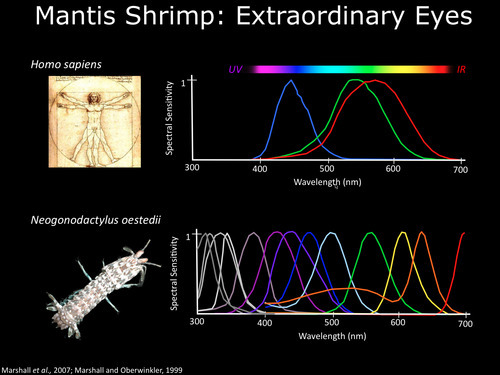 Another example: when the always fantastic RadioLab did a particularly stunning episode on color, there was a bit on the visual capabilities of the Mantis Shrimp. While a diagram of the eye’s capability can be drawn and compared (see diagram), and what happens with that extra perception vectors can be described in text, it was the choral rendition of complexity of vision that made what was actually going on readily understandable to we who have 3 vectors in our eyes.
Coding and software, and more recently the opening up of fabrication technologies, are about more people being able to express themselves in a way that is best for them, and that also means people who ingest information in those formats have a better chance to understand more of the world. The more vectors we have of expressing, the more vectors we have of understanding. And isn’t that what being human is about?
If that’s not enough, consider this: one of the things about code is that it has opened the doors for some to income and prestige that otherwise would have been closed. It broke down entrances to what “legitimate expression” is. When we stick to only the knowledge expressions and storage we understand, those who are best able to use those (i.e., those who have already been in long practice) will continue to benefit. And now, so many other things are possible to digitize, to pass on and posterityze. Why remain so hyper-focused on the written word?
“I am, somehow, less interested in the weight and convolutions of Einstein’s brain than in the near certainty that people of equal talent have lived and died in cotton fields and sweatshops.”
― Stephen Jay Gould, The Panda’s Thumb: More Reflections in Natural History
I care less about “accessibility” as “bringing ‘disabled’ people into a world as ‘able’ people experience it,” and more into “everyone having the best opportunity to express themselves, and to be understood.”
I’ve told you all before about my past abusive relationship. I’ve also been doing a lot of work in how to be more accepting of people. It’s a strange and new thing for me – to stand up for myself, to know my Self well enough to NOT be trampled on, not in a way that requires blustering or forcing respect.
…
I had wanted to tell you a story. But that’s not something that’s allowed in these situations. Our social and legal systems prevent me from talking about what, specifically, happened1. I don’t believe in unexamined support, and so asking people to express solidarity when I can’t express all the details (nor do I particularly want to, in the interest of the other person maybe… changing… one day?) is pretty weird. So let’s say this: I had to cut someone off recently for abusive behavior. Not one of my wonderful partners2. And while the situation is being handled, I wanted to talk a bit around what the experience has been like, socially, and how I think it can be handled responsibly.
Of those people I can talk to about it (for legal and social reasons), their responses are aiming for protective, seeking understanding, and solidarity. But these can easily end up instead falling into one of the following buckets: infantalizing, dismissive/justification, and overkill. While in this situation, it’s more difficult for me to do affective labor (cognitive and emotional processing) for other people. I need them instead to help me with mine. So here’s a general breakdown, in the hope that it helps me out, as well as others (if it fits with them/you as well).
To me, what it takes to be a good ally in these situations is to simply say “I am sorry” / “that sucks” + “What do you need right now?” That gives space to decide what is needed, in relationship to the person asking. Often the same places are gotten to, but together. And remember, listen to the person who is affected. Just like codesign. Just like anything else in life. The person living it is likely the expert in their experience.
So far as the person I cut off, I went through these steps, which I find important: expression of care, re-statement of disregarded boundaries (and how those had been crossed), new boundaries (ie, “don’t talk to me, on any platform”), consequences for crossing those new boundaries (legal action), and recourse (“until/unless you’ve completed an abuser program”). This leaves no ambiguity in the situation, and I’ve also laid a path to action for myself that I can read and stick to when/if things get complicated.