Port-au-Prince

Landed in Port-au-Prince a few hours ago. Have had a nap, and a salad, and a tour of where we’ll hold the hackathon. I waited for Marco, our driver (green car), by the hotel’s road, prolonged looks from passers-by and giggles from children. Marco assures me it’s because my hair is so different, not because I am stumbling blatantly in any social way.

I’m here for a gender-based-violence hackathon put on by Digital Democracy – Schuyler linked us up. The call center which Kovaviv has going for victims of gender-based violence, to get them medical and psychosocial and legal help, is in need of some scaling and shoring up. (We’ll be using #HaitiHack for the event.) We’ve called together an international team and a local team to get the work done, housed out of a university with a charming leader obsessed with perrier. I drank coffee out of a tiny cup while we explored the space we’ll have access to, and ran into some folk from NetHope – the social singularities continue even here.

Everything is bright, and covered in hand-painted advertisements, and it is hot. High ceilings and open windows allow heat to pass through, vast empty rooms cooler than the crowded outside. I feel unhappy but grateful for the luxuries of the hotel they have put me up in – A/C (should I want it), hot water (should I want it), and wifi (definitely want that). There is teasing about my wilted demeanor in the heat, and I tell them about Seattle and the overcast and how people wear all greys and blacks and drink a lot of coffee. The traffic is chaotic but predictable, reminding me of driving in New York, but more so. Taps on the horn for communication, not anger. People walk and ride with assurance tempered with awareness.

Flocks of children recently released from schools, far enough from origin to have their uniforms mix together, some bands still holding strong. We talk about how a school uniform means if a student is found but the parents can’t for the moment, the school is a place to return to for safety and waiting. Marco is incredibly patient with me while I try to ask how attendance is determined – based on the ability to pay, not location. Cognitive leaps I barely get away with among native English speakers will not do here.

Guards with shotguns watch soccer alongside students, everyone piled into the cafeteria, ignoring the vista to cheer their team. It seems all the infrastructure (not just architectural, but also social, and network, etc) are either under repair or being built afresh. I wonder if this leads to a predictability which can be assumed, or means nothing is so stable as to built upon (hearts, dreams, and mortar). I imagine I will be in awe either way.

In a few hours, we’ll go to a restaurant-bar quietly owned by the same folk behind an LGBT advocacy group here. While not a “gay bar” (the backlash here would still be too great and violent), it is a safe space and a welcome meeting place. My utter lack in the language and many of the social cues prevent me from interacting much beyond planned meetings, but those few are with people who express mild curiosity and quick smiles. Tomorrow the rest of the crew arrives, but today I’m still trying to get some kegs picked up in San Francisco and my belongings shipped from Seattle to Boston. It is an interesting world.

Conflict Engagement

Recently I predictably found myself careening towards the 520 by way of 5, my nose in a book, much like the rest of the passengers aboard. During a moment of looking up from my book – to see the sky, which looks remarkably like this some days (tho not that day), or to prevent car sickness, or whatever – I noticed something odd at the front of the bus. Someone standing by the driver, in that hunched way that usually means aggression but can also mean trouble keeping your balance while standing in a bus that’s moving down a highway at more than 50mph. I looked around. Being towards the back half of an accordion bus means there were plenty of people closer – surely if there was something wrong, one of them would have stepped up. Based on their body language, though, most were actually absorbed in their media. Some of that focus was obviously intentional, rather than on whatever was going on at the front. Not a good sign.

bus layout-1

I packed all my stuff away, put my phone and my wallet into my pockets. Asked the person next to me to watch my stuff, and walked towards the front. Walked past maybe 20 people, a few of whom looked up at me while I went by – we’re on an express route, and didn’t have a stop for a ways.

“How’s it going?” I asked, looking at the driver in the mirror.

“It’s.. ok,” he said, making eye contact.

The older, swaying man scoffed, turned to me, and said, “why, what would you do about it?”

“Whatever necessary to return the driver the attention he needs to keep us safe” I responded.

It then became an act of distracting him away from the driver, without having him escalate towards me, while our steersman got us to the next stop safely. The man experiencing angst had missed his stop (a significant thing on an express route), and the driver had not let him off at a non-stop area. Because of safety, and consistency, and because infrastructure does indeed have to adhere to The Rules. But I didn’t ask him about that (he was wrong, and would not have been persuaded otherwise. If he had valid concerns I would have focused on that, and proper channels to deal with complaints), I only kept reminding him that we were ON A BUS ON THE HIGHWAY AND HE WAS DISTRACTING THE DRIVER. I focused on the lives, in a very immediate and pressing way, which were at risk because of this distraction, not his behavior or what had triggered it. Focused only on potential outcome of his current approach. It mostly worked. He tried insults about my hair (heard it), my gender presentation (yawn), his physical superiority (just try). When we had arrived at our stop and he had been booted, I checked in with the driver – does he need my contact in case there is a report? Did he need anything else? – and then returned to my seat. Seething. Why is it an appallingly normal situation that, of all the people in an area, conflict resolution lands on the shoulders of myself and those I keep the company of? I nearly (nearly) had a “sheeple!” moment. And then I took a deep breath and drew a chart instead.
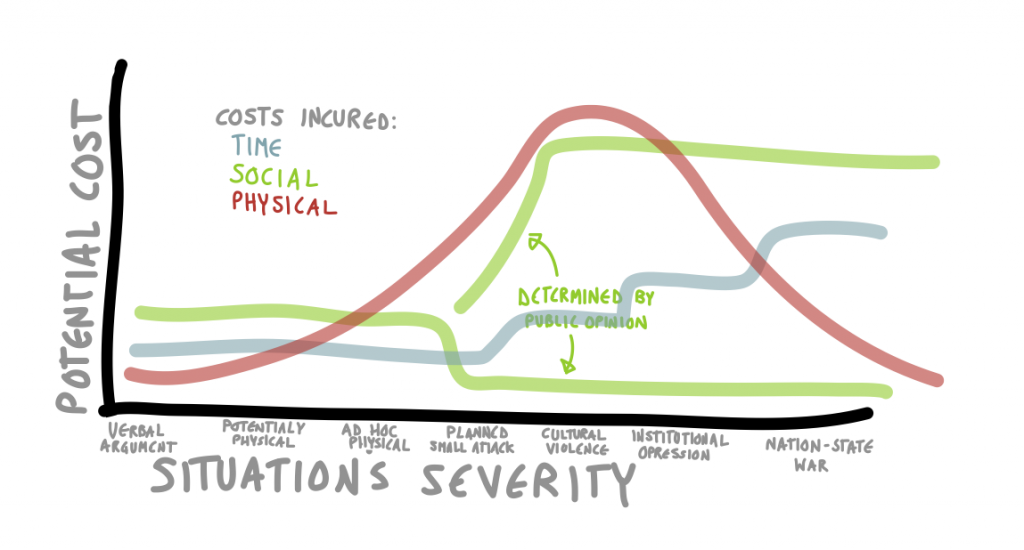
conflict engagement

Physical harm based on proximity to incidence. Of course this graph is subjective.


I started to think about why people don’t engage in situations like these. Things like Diffusion of Responsibility have been studied at great length in the past – the same reason asking someone to watch my bag for me is successful is also why individuals don’t step up to help an individual when a large group is present. See the obligatory reference to Bystander Effect and Kitty Genovese (case taken with grain of salt, but Bystander Effect is well established). But I would hope that the people I associate with would actively dislike being a bystander, and are simply lacking the understanding of how to engage.

Here’s a quick run-down on how I engage with conflict. The base assumption being that you HAVE to, as you’ll be the only one. (Except for when you’re not, and the beauty of a group of strangers coming together around a pressing issue is beautiful. You will be supported, and supporting someone else. Just because one person has stepped up doesn’t mean you shouldn’t as well.) First, you have to assess the situation. These are generalities and non-linear.

  • Assess what is going on, severity, is this for you or “official” response, etc. Who is most at risk? Are you protecting or breaking things up?
  • What is the end goal?
  • Where can you help, if you can? If you can’t help, what needs to happen to assist the situation?
  • What sort of engagement can you do, and what is the backup plan if it escalates past that?

Now that you know vaguely what you’re dealing with and what your limits are, it’s time to engage. Certainly contextual to danger you’re not prepared to deal with.

  • Check in, usually via eye contact. Do this with the person who is least in control. Also do this with the person in the most control to see if they’re of the persuading type. Ask each how they are doing.
  • No matter what insults are thrown, or arguments are made, stick to what your goal is. It can be hard to be rational in these situations, and easy to get pulled into the energy. Stick to your mental guns.
  • If needed, enlist someone nearby to call authority figures. You need your attention where it is, and hopefully this means you’ve pulled at least one person out of by-stander headspace into up-stander headspace.
  • Oftentimes, just being called on being inappropriate it enough to get an individual or group to desist.

Me, personally, I’m pretty ok with getting into a fist fight so long as I am fairly certain there aren’t any weapons around. While getting hit sucks, the mere willingness to put yourself at that risk deescalates most situations. Think of it like poker, and you’re calling a bluff – but you have to be willing to take the hit if you’re wrong. Here is why I think it’s imperative to take responsibility in these situations, broken down in chart format:
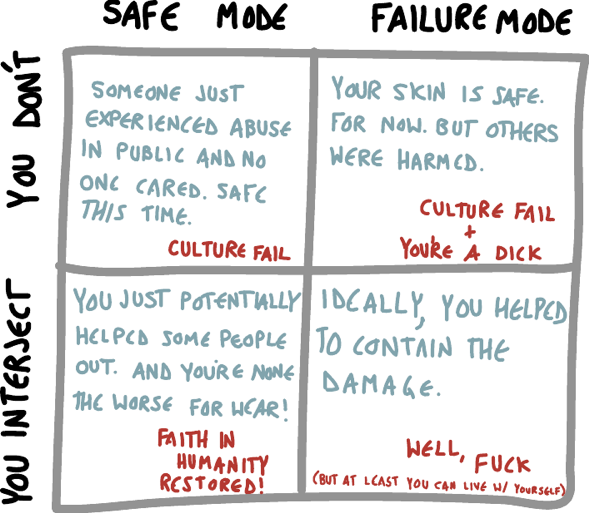
conflict grid

This is important to me because, honestly, sometimes I need backup too. I’m reminded of sitting on the BART, headed to the airport, when two guys came and sat in the seats near me. There was the pretty standard come-ons, accompanied by aggressive body language, clearly trying to box me into the seat. I did my usual progression: first good natured “sorry, not interested, and did you know your approach is kind of awkward?” followed by “not even cute. Piss off.” They even pushed it to the point of dead-on eye lock with “Look. Either persuade me you don’t have balls, or I’m going to remove them.” They got off at the next stop, muttering between themselves. While their actions were appalling, what I found so much more awful were that when I had tried to make eye contact with the other people on the car, of whom there were plenty, no one would. And while I can take care of myself, the thought of someone who is less willing to cause lots of damage (even if losing) seeking help and not getting it makes me feel utterly disgusted.

Our system is incredibly flawed in how we hold perpetrators accountable for their actions. I am not disputing that. But equally (or more) dangerous is a lack of taking bystanders to task. And to that end, I want you to listen to the most recent Brainmeats! podcast on Social Scripts for Abuse, and think about how we can fix this. What role does a community play around bad actors? That community can be social or geographic. As always, it starts with you. Stand up. I hope this has given the beginning structures on which to engage.

Safe space (online and off) isn’t just about policies and retributions, it’s about how we as individuals encourage, expect, and enforce it. It’s not about ego (either it getting bruised if you fail, or bolstered if you don’t), it’s about being able to exist.
Inappropriate

I run into the problem a lot that one of my favorite folders in TheOldReader is my NSFW one. It contains images of beautiful tattoos on beautiful bodies of all kinds, of intimate exchanges, of expressions of gender and love. But it’s labeled “NSFW” because I can’t load it in airports or coworking spaces or .. most anywhere, really. But that also transfers pretty clearly into how I filter myself for professional situations. I have ranted about this before. But this particular day prompted a tiny rant on Twitter about how much it sucks to have to constantly keep parts of my personality under wraps. There were a myriad of responses.

The general trends of feedback were as follows: female-bodied and queer folk affirm through response or favorites. Some folk suggest a division of presentation (public/private). And some say “what’s the big deal with expressing such things?” I would like to lovingly point out that the people in this last category are cis gents, whom I adore and with whom I am friends (hey, I have plenty of friends (and lovers) who are straight!).

Given that I work with all sort of populations from all sorts of backgrounds, my appearance and expressions have been carefully shaped in some ways. I no longer sport my mohawk. I tend to wear long pants rather than stompy boots and fishnets. My tattoos and piercings are easily covered. This is not so much an issue of subculture, this is much more an issue of how sexuality and respectability tend to be mutually exclusive. Which is to say: if I were to act and dress as I like, I would be sexualized, and therefore viewed as less competent. Which is a funny trade-off, as in especially technical communities, competence is seen as sexy. But the moment you enter one sphere, the other attribute goes away (for most people) (the link is about promoting sexualization to obscure the competence). Welcome to one of the tightropes which must be walked by the simple act of being female bodied. (But I don’t do that! you might say. Well, it’s not just about you. It’s about a long line of actions and incidents which by necessity make me wary of any sexuality-respect-shaped exchange. Both of those links have a trigger warning, and are more severe than what I’m personally speaking of, but they do get the point across.)

I say this because the idea of “just be awesome, and everything will work out!” is a privileged viewpoint. It’s something that can be said when you play on the easiest setting. Here is the thing – I have jeopardized jobs, missed opportunities, and lost friendships because I thought my competence was more relevant than my attractiveness (whatever the level of either of those). (I have also jeopardized jobs, missed opportunities, and lost friendships for other reasons. I am not scaping the goat here, as it were). For most of my life, and to some degree still, what is (or is not) between my legs has meant passing up those opportunities meant I might not get another such opportunity. This is not a “screw that person, something better will come along!” life. Now that I live in the enchanted world of people who “get it”, this is less of a problem. We can share dark humor, stories about compersion, and analysis of queer theory. But the path to here was long, and that’s from a privileged white girl.

From “Said the Pot to the Kettle” by Margaret Killjoy

It’s hard to talk about these things in public, because respect for me goes down, and therefore respect for what I do. We do not see individuals as many-faceted beings (something I think is deeply tied to our idealization of geniuses rather than polymaths), and so if I talk about gay rights or safe words, that is suddenly what I am to the exclusion of all else. I’m supposed to “pick my battles.” Which brings us to the second sort of response, which is to divide profiles. Now, I do have a snark twitter account, which very few people have access to. That is where I am snarky, which is something I don’t want other people to see. Unwavering optimism tempered by experience is what I think is most effective in public discourse (at least for the things I like to do), and so I keep my “really? seriously?” things to myself.

In contrast, my sexuality is a big part of my personality, and I would like it to be ok to share that. One of the reasons I find sexuality in general so fascinating is because it is the most basic part of being an organism (ANY organism), but is the most socially constructed for humans (the link as but one recent striking example). In general, I am wary of fracturing identity online, because I feel it’s important to stick your neck out (again, privilege talking) to make it safer for others to fully express themselves. (Caveats here about pseudonymity, activism, finding a new self, etc etc etc inserted here). Only by presenting ourselves respectfully as multi-faceted creatures, and calling bullshit when such a thing is not treated as the norm, can we build this better future.

So while I would really, really like to be able to crack a joke about Jesus dying on the cross because he forgot the safe word to a group of educators, humanitarians, and military folk, it’s just not going to be the case. It’s considered inappropriate coming from me. Which sucks, because Ye Olde Boys Club still can, if they want. What I have decided on, while writing this entry, is that it is worthwhile for me to be more outspoken so that it is easier for the people who come after me. But maybe I’m only saying that because I’m sitting in San Francisco right now, and it seems so easy. And I hope that my competence and ability to execute now fully trump whatever does or doesn’t happen between my bits and other people’s bits. And as in the links I’ve included here, I’d prefer people go after me than after someone else. I like the fight.

Studying Decentralized Structures

So I have just been officially offered a research affiliate position at the Center for Civic Media out of MIT’s Media Lab. I’ll be moving to Boston in February. Zomg. I’ll be spending 20-30% of my time studying how decentralized structures scale. The rest of my time will continue to be spent on Geeks Without Bounds (funnily enough, figuring out how to scale it). I assume things like this lead to papers and things. I’m also working on fellowship applications. Here’s a basic summary, and a request for help.

An Open Letter to theoldreader.com

Reader was my favorite social network, hands down. I was incredibly sad to see it go. When I found out theoldreader.com existed, I was giddy all day.

I wrote the team to thank them (hello at theoldreader dot com) and to also trouble shoot a bug. They were incredibly kind and prompt in response. After they fixed the glitch my massive address book was causing, I asked the following:

Next dreams:
What are privacy settings? Can only people I follow see my posts, only the friends of people I post comments to see those comments?
Multi-shares in same social network list people who shared rather than showing the post repeatedly.
But these are again, dreams, not issues.
Are we going to be able to pay the team a nominal amount to keep the project going? I would like to be able to support a group to do continued support rather than having this thing we all love die again.

Their response:

As per our privacy policy, all shared posts are currently public. We do have ‘private accounts’ feature in our roadmap that will allow users to expose their shared items only to a limited number of accounts they choose. However, this has very low priority for us; most users only read public RSS feeds that are available to everyone in the first place, so hiding them makes little sense.
We have discussed the mechanics of multi-sharing before and decided to stick to the current implementation to avoid mixing comments to two different shares into a single thread. Sometimes people discuss not the shared article itself, but rather the sharer’s comment to it – so, each shared post becomes unique in a way and deserves a separate comment thread.
At the moment The Old Reader is not backed up by any company, and we are still looking for the best way to allow our users to support the project. We will definitely update our blog when we decide on something, so make sure you are subscribed to it 🙂

Here is what I have sent them. I hope you’ll join me in politely, lovingly, requesting the same. I would also like you to be willing to throw in to support the team if that is the route they go.

I’d like to lobby that privacy get moved up the list. A few reasons, personal, individual, and communal. First, I work in humanitarian and disaster response, with volunteer technical communities and military alike. I also have an incredibly dark sense of humor. The people I work with tend to check out who I am and what I like – having another public space on which to express myself doesn’t really allow me to express myself. Those same working conditions also make it incredibly important that I be able to have a safe space to talk and connect.
On an individual level, I saw friends discover themselves because Reader was a safe space. Things like gender, sexuality, and approach in life are not things which can be held without care. People with very public lives have been able to go through self-discovery with a small group of trusted friends.
And finally, communal – while with privacy my own shares are only to those who I have approved, my comments on a friend’s share are visible to their friends. *This is essential* – there is at least one pairing from our previous ShareBro network which happened because of this serendipity in safe space. They are now married.

As it is now, it’s more like a Tumblr than it is like Reader. I hope you’ll institute the privacy and sharing layers sooner rather than later. Again, I’m happy to contribute what I can towards this being a sustainable effort.

All my best, and thanks again,

Willow

Cochlears and Culture : Some Extrapolation (3/3)

Final of a three part series. Find parts one and two.

Now that we understand some of the history behind the debate on Cochlear implants, let’s look at how it relates to other groups.

“Because they don’t consider themselves as patients with broken auditory equipment that needs fixing. They don’t see themselves in terms of loss or deficit. They don’t see themselves as candidates for head surgery. They see themselves as whole, just as they are. They live full, rich, rewarding lives as Deaf people. They consider CI surgery a violently extreme intrusion into their bodies. The message they’re getting from the medical establishment is “Society isn’t comfortable with your deafness problem, so let’s fix you.”

missing a source credit – please help.

While we might like to pretend we have more sensitivity to people than we used to (imperialism is about taking over new geographic areas and asserting your cultural values – it’s kind of the history of the demographic of this blog does), let’s look at our own shores (for some readers) in our own times (I assume for all readers). Members of [Native {American] Indian} groups decide, on an ongoing basis, whether or not to stay on specified land with their children. If they stay, they effectively remove later opportunities within larger culture in exchange for imparting the values of the pocket culture.

I think we can all agree that a more diverse population is a more robust one (if you don’t, I don’t know what you’re doing here). But at what level of the fractal do we take this? Does an individual need to have many abilities (specialization is for insects), and/or contribute to a diverse locale (like the city or town they belong to – mine is based on internet subgroups), and/or to a culture at large (the country or world)? (Insert side discussion about Simmel and the roles of people in towns versus in cities. Seriously one of my favorite sociologists).

Now, do you understand my fascination with peer- and self-rescue in humanitarian response? That we cannot simply swoop in to “save” people and then leave. While part of our culture is about running over other cultures, thinking ours is best, and that individual reasons will trump all these – these are just examples of cultural values. They change based on your context. And while it is absolutely imperative to reduce suffering in the world (both current and potential future), we must come to the table ready to listen.

There’s a nested, Simmel-based conversation here about self-segregation and how people often opt for that over fighting to diversify the next larger group to theirs. People who share your history, context, and dialect allow you a path to more complex exploration, but at the detriment of robustness in larger culture. This is not an either/or situation, however – it is possible to spend time with people who “get you” as well as doing outreach to groups. Let’s celebrate some serendipity.

Now – let’s sidestep and make this even more complex by adding on a layer of governmental support for “disabled” people (in quotes not because I don’t think some folk deserve assistance, but because it’s such a loaded and questionable term). If parents did not take the expensive (monetarily, culturally, medically) action to get their child into mainstream society, does the child or parent qualify for disability payments or other societal support systems? They would indeed have fewer paths open to them, despite the one they are on being useful to them as well as to society at large. Regardless of what choices an individual makes, it ties into larger culture. This is not even getting into making life-changing (not life-saving) operations on individuals who cannot meet the three requirements for opt-in surgery: of age, informed, consenting.

Of course the easy answer would be that we just optimize and adapt based on historical context, who is present, what they can do, and what needs doing; but why would we go for that path? While it is important to give each person the same potential to have a fulfilling life, that doesn’t necessarily mean enforcing the same starting point. An informed, mature conversation with all people affected by a policy is a good step in what I see as a better world.

More media:
Rebuilt
Charts and graphs

Remainders (things I think are important, but would have made this series even more unwieldy):

  • While the hardware of cochlear implants can be installed, it is still a limited technology. And while the software may get better, the hardware is limited in updates as to what the engineers predicted the market to do, and by available processing power at time of install.
  • Issues of who owns the hardware in your head, the information going through it, and the way that information is processes is a hot topic in the hacker community. I’d love to hear people’s takes on that within this context.
  • The world as an API you can pull information from, regardless of how you choose to skin/interpret it. The functions we choose/are able to call, and the way that information is presented, have deep impact on how you perceive, and therefore live, your life.
  • Anecdotal stories from people who have gone through (or not) whichever process are not enough to understand the cultural issues. People come up with the best story they can to explain how they got to where they are now – it’s an essential part of being happy, or at least of making sense of your world. We also misrepresent other people’s progress dependent on what we think needs to happen overall. I’m likely doing that even in these posts.

Cochlears and Culture : History and Brains (2/3)

Second of a three-part series. Find part one here.

The Deaf Community is a somewhat new thing. The first documented Sign Language is about 500 years old (I’m so not going to get into sign before spoken language – I can only be so esoteric in even a three-part series). The first school, meaning a concentrated population, was around 1760. There is a fantastic RadioLab on language, including sign, that you should have checked out from the last entry. Without an established culture through which language (and other things) can be transmitted, people who are deaf, sans the Deaf Community, are left out in the cold. And without the basics of language to structure thought on, many contextual thought processes cannot be completed (“left of the blue wall”). Additionally, only after more complex ideas (like misdirection) filter into the group can people understand all parts of a story. EG, “Becky leaves a teddy bear under the bed. Timmy moves it into a chest while she is out of the room. When she comes back, where does she look?” Someone who hasn’t learned the sign for “lie” or “misdirection” would say “chest” because that’s where it is. Someone who has learned the word/symbol/sign for “misdirection” would say “under the bed” because that’s where Becky thinks it is.

With me so far? The point is that having a baseline of shared input/output methods leads to reduced difference in approach, normalizing a population. The result is what many call therapy – bringing individuals in a population to a shared standard. But should this be enforced on traits which define pocket and sub cultures? Before advances in science, they wouldn’t have learned the “normal” way of processing. Taken out of these cultures and definitions, individuals would not have gained this different way of processing. Their lives lend to cultural diversity.

A cochlear implant gives the ability to hear to a person by triggering receptors in their ear with electrical pulses. If a parent opts to not put their child through this risky and expensive process, they have passively removed the child’s ability to fully integrate with the world at large because the basic structure of the brain is different in such a way that a shared language is incredibly difficult to achieve. To the parent, it is often made to preserve the connection between child and family. If the implant is installed, the child is actively removed from their home life and neighbors. A rift is formed in each option. From a bird’s eye view, this choice to not install is made in order to preserve the pocket or sub culture.

Viewing and reading before the next entry:
Sound and Fury
Cochlear War

This series will be completed in an entry on Friday.

Cochlears and Culture : Some Context (1/3)

From the blog the image links to. Also includes a good interview.

This series is based on two conflicting assumptions that exist in the circles in which I run – one that non-mainstream culture (either opt-in subculture or historical/ethnic/geographic pocket culture) is worth preserving, and another that there is a universal standard of living which should be adhered to.

My dad’s side of the family is Irish Catholic, and I am a member of a vast family which proves it. A set of cousins have taken an active role in a Deaf Community in Illinois. One has married a lovely Deaf gentleman and is a principal at one of the Deaf-specific schools, the other two are instructors. The whole batch of them live on the same street with a collection of children, mostly adopted from other countries where deafness is considered to be too much of a defect to bother with those affected by it. My interactions with this tight-knit community have been warm, welcoming, and frank. Because of this, I was so immersed in the debate about cochlear implants that part of my honors thesis in college focused on it (Difference Between Therapy and Advancement in Medical Technology). In fact, it’s such a strong community that the D of Deaf is capitalized – it is an identity.

Disclaimer that I am not deaf nor Deaf, and while I represent things here as accurately as my studies and experience allow me, I may be completely wrong. Please notify me if you find anything disheartening or inaccurate here. My contact is available on the About section of this website.

Here is how the debate goes: a child is born and cannot hear. If a cochlear implant is installed early on, the child has a chance of learning the nuances of sound which will allow them to operate pretty “normally” in the world (at least in that regard) – most prominently, they will likely understand spoken language. However, that means they will not be a full participant of the Deaf community. If the parents are Deaf, it means there will be a deep difference between them.

It’s a fascinating moral dilemma – unlike other Birth Stigmas (not all stereotypes are negative, but all stigmas are), this one can be changed during a short window of time. The other two categories of stigma are Choice and Accident (the ABCs of discrimination!) – and what group a trait belongs to changes how the person associated with it is viewed by the culture they belong to. Another interesting example of a mis-perceived is religion – it seems like a choice stigma but is actually a birth stigma – deviation from childhood religion is not statistically significant. Some people might leave religion during early-mid life, but they return to the church if they have kids. The cochlear implant debate is a great example of how subcultures and pocket cultures are constantly barraged by the mainstream to not be the “Other” – to leave behind a trait which is stigmatized.

Your reading/listening before the next of the series (seriously, it will be hard to keep up without this context):
RadioLab episode on language and brains
A great short history

FaceBook

The time has come to cull my facebook account. This is both a personal decision and a cultural one. Afterall, cultural change is an individual’s responsibility.

I’m tired of people feeling like having a mark on someone, a way of contacting them because they maybe crossed paths at one point, takes care of actually engaging people. I’m sad the drama and shallow exchanges facebook not only permits but, by its very infrastructure, encourages.If you want to take action with me, find me in these places. If you want to actually talk to me, you can find me via text or in person or at an event or during office hours.

This is part of my finally establishing personal boundaries on my time. My core group of friends get the vast majority of my time. Maybe this round will even stick. The world is, afterall, full of shiny and awesome people. This is not me saying I don’t care about who you are or what you do – it’s that I no longer have the bandwidth to share it with you so much. I can trust you to take care of your section of the world, yes? And you want me to be happy and focused, even if that doesn’t involve you? Awesome. I’m glad we can agree.

I want it to be ok for people to grow out of a time in their life. I want attention to go to the things immediately around people and their interests, not some trivial game with someone they had one (albeit amazing) conversation with two years ago. Let life be a process, a continuum, let go of the things that are done.

The only thing Facebook has going for it is critical mass. And that won’t change unless we, as individuals, take the detriment to our social currency to choose to interact in better forums. You won’t lose the people you actually care about, promise. Everyone else is just your cognitive heat sync.

Now that I’m done with the first phase of deleting things, I’m left with this weird middle ground – the people I talk to regularly I have culled, as I have better ways of contacting them. The names I don’t recognize are gone. It’s like being in a dream… this weird hodge-podge of “don’t I know you from somewhere?” and “you look so familiar” and “I feel like we went to the same event one time, and had an amazing conversation over beers after.”

Monkeys

I’m upset at culture.

c'mere, culture, let me hug you

Let me rephrase that. I am *furious* at culture. I am pissed off that I can’t go play, that it has so much to do with gender roles, and so little to do with the actual people involved.

First, let me set the stage: most of my interactions are within geek subculture. There are certainly some appalling gender ratios in most geek space, with “Sausage Fest” being a common term. That’s fine. I get along better with people who have been socialized to be outspoken, physical, and crass – ie, more masculine than feminine types. And I’ve talked before about constructing Safe Space. And long ago (so long ago it was on LiveJournal) about being a being in a woman’s body who also happens to be precocious, comfortable in sexuality, and tactile – and the assumptions that go along with that (that assumption being that I Want To Bone You — I don’t). But it’s come up again – the falsely inverse-d relationship between sexuality and respect. Something I said in a recent interview (published soonish, methinks):

I think it’s totally appropriate to find intelligent people attractive, and that the best potential dates ARE your equals. The issue is that there’s this separation of sexualization and respect. They should be completely independent OR have positive correlation, but instead they seem to have a negative correlation in our culture. IE, if someone finds me hot, they are also likely to care less about listening to my ideas. For me, it boils down to consent. If I consent to being hit on by someone I am also attracted to, that’s awesome. If someone continues to hit on my after I have made it clear I’m not interested (either in them, in dating within that social group, or in dating in general), then it’s *not* cool.

What brings this up is being a “free agent” in my social groups has meant that some people have turned their focus on me. And while I’m flattered by the attention, it kind of sucks socially. The attracted people who don’t know me well either discount my ideas in lieu of trying to get into pants, or the idealization of physicality trumps the interest in ideas. Those who know me AND like those ideas tend to play a game, knowingly or not, about declaring intellectual territory via sexual or romantic advances on me. And those who actually like me and my ideas and who don’t play those games I STILL can’t associate with because the social response has to do with the first two sets of people (see me with partner, either discount any brainmeats I have or assume I’m at play in a game).

Respect for people while sexualizing them is only difficult because our culture makes it so. Beauty vs Brains is, clearly, a false dichotomy. But it’s one we still have to deal with while we murderize it. And I have no idea how to live my life in a way that tears down those stigmas while not being (non-consensually) objectified.

Monkeys piss me off. Maybe I shouldn’t listen to Sex At Dawn as I do my dishes and walk around Seattle. Gah!

What I can do right now is work on having more women in geek space. I feel like brute-forcing the problem, to say it in a very awful way. Care to join me?