Chaos Communications Camp is something that happens once every four years, and it is My Favorite. It’s a few thousand hackers etc camping together in Germany. There’s brightly colored hair everywhere, and a slowly improving gender ratio, and stickers on laptops, and a gigabit to the tent. There are disco balls in trees, and competing soundscapes of German techno and old rock and roll or hiphop, and a giant sparkley rocket ship called Fairy Dust. I’m camping with Norton’s Obscure Phoggy Embassy (the manifestation of a few Bay Area hackerspaces), which is successfully trolling much of the rest of Camp through their assumption we’re being colonial (because Emperors), as well as having an inflated shark Rubin‘s been shouting at people to jump over. Also, NOPE attire are booty shorts.
I was invited to sit on a panel called “What’s the Catch?” put together by nat from Open Technology Institute. Josh (also from OTI), Kate (from tor), and myself were the three panelists. We each attempted to speak for about five minutes, and then we focused on questions from the audience. Our topic was an ongoing debate in infosec (and other) circles : is it possible to take money from governments and corporations while maintaining a project’s integrity? I vote yes, if you work really hard at it. The talk will eventually be up on the CCC wiki (and I’ll likely post it here once it’s up) but for now, this is the rant I put together when I was considering how to concisely state why I think this is the case.
In relation to this, and the other existential questions which I continually struggle with, I refer often to a quote from the Zapatistas, one of the few groups to maintain a governance structure after their revolution: “Caminando preguntamos,” which roughly translates to “we walk while asking questions.” To me, it means that we should move, but let’s analyze as we do. Let’s be in both critique and solidarity with each other.
I’m going to attempt to touch on three points, alliterated for your memory: perfection, pluralism, paternalism. Continue reading →
I’ve started writing about response over on the Aspiration blog, but this one still has cursewords in it, and is very much in my own language, so I figured I’d post it here first.
The problems our planet is facing are becoming more extreme. People and politics mean there are larger populations more densely packed in cities. Nomadic populations traveling along their historical routes are now often crossing over arbitrary (have you *seen* some of the country lines people in Western countries have drawn in places they might never have even been!?) political boundaries, making them refugees or illegal immigrants. Climate change means more and more extreme events are impacting those populations. We have *got* to get our shit together.
In all this, the people who have been historically marginalized often become even more so as those in power see scarcity encroaching on their livelihoods. But the ability to hold people accountable in new ways (through things like social media), as well as (I hope) a real awareness and effort in the long arc towards equality, means there are groups of people seeking new ways to better allocate resources to those most affected by these events. Often, these groups are also in a post-scarcity mentality — that, when we work together, wisely, we can do a whole lot more with a whole lot less. These are folk who think we *can* reach zero poverty and zero emissions (within a generation). These are the folk who see joy in the world, and possibility.
The resource allocation and accountability necessary for these transitory steps towards a world that can survive and even thrive won’t happen in a vacuum. In the organizations, governments, and grassroots efforts there are entire supply chains, and ways of listening (and to whom), and self-reflexive mechanisms to consider. In these are embedded corruption, and paternalism, and colonialism. In these, too, are embedded individuals who have been Fighting The Good Fight for decades. Who have added useful checks and amplifiers and questions. It’s into this environment we step. It is, at its core, like any other environment. It has History.
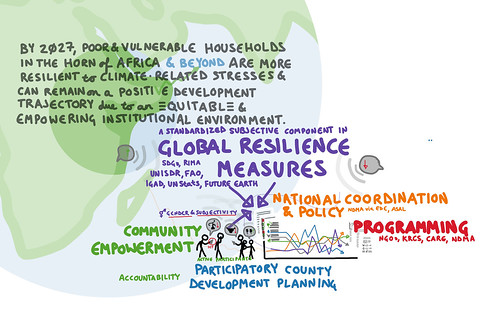
It’s in this context that I’m so excited about Dialling Up Resilience. It taps into questions of efficacy in programming by using and contributing to metrics for success in building resilience. It assumes good faith in policy makers and implementers by offering up data for them to do their jobs better. It protects against bad actors by providing granular, speedy data aggregated enough to protect data providers but transparent enough to be clear when a program is working (or not, if those we’re assuming good faith in don’t actually deserve that). And, my favorite part — instead of contorting and posturing about what makes people able to bounce back faster after a climate-related shock… we just ask them. Of course, it’s a bit more complicated than that. But the core is there.
We’ll be working with a few different groups in Kenya, including the National Drought Management Authority (and their Ending Drought Emergencies program) and UNDP on their existing surveying initiatives, as well as groups like GeoPoll (SMS), Twaweza (call center), and Kobo (household) on stand-alone surveys about how communities estabilish and track their own resilience. If we get the grant extension, we’ll work more directly with communities using tools like Promise Tracker and Landscape (a digitized version of Dividers & Connectors) to be closer to their own data, and to subsequently be able to have more agency over their own improvement as well as accountability.
What’s also exciting is that our means and our ends match. I was recently in Nairobi for a stakeholder workshop with not only the project partners, but also with the organizations which would eventually make use of the data. We’ve been conducting community workshops to test our basic assumptions and methods against reality, as well as to be sure community voice is at the core of each component we consider. We’ve thrown a lot out… and added some amazing new things in. We’re hoping to break down the gatekeeper dynamic of accessing communities in the Horn of Africa, and we want to be coextensive with existing programs (rather than supplanting them). It’s feminist and it’s development and I’m kind of fucking thrilled.
For a long time, it wasn’t possible to include everyone’s voice in planning or decision-making without impossibly large amounts of time. There was no way to listen, at scale. So aggregation and centralization became common, especially in times of urgency, even with the troubles these tend to cause.
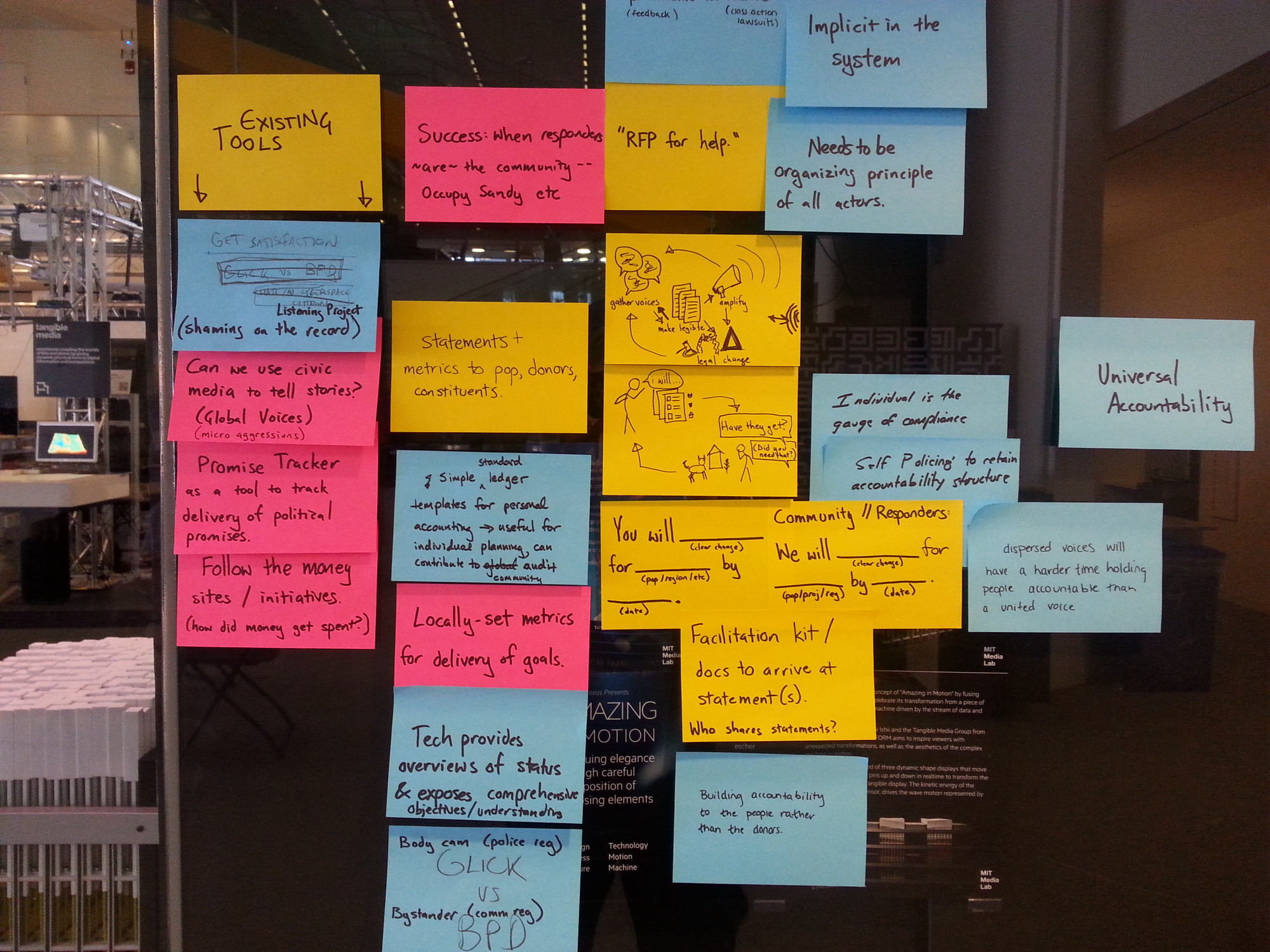
But now, with the technologies we have, we can *listen*, in high resolution and in high fidelity. But technology isn’t a silver bullet. We also need the political will and the personal values to make that happen. With Aspiration’s new Digital Humanitarian Response program, we get to support some of the rad people willing and able to make these movements happen. In May, we hosted the Humanitarian Technology Festival at MIT. The Digital Response Wiki provides resources and notes, and here are some top-level highlights from the event:
Disaster and humanitarian issues don’t happen in a vacuum
Groups like Public Lab help lay the groundwork (both socially and technically) for fast-cycle disasters, via their ongoing interaction with communities around environmental justice. This also provides scaffolding for handing off responsibilities after an extreme event. Kathmandu Living Labs, a group committed to mapping the infrastructure of their geography, is an excellent case study in this. When the Nepal earthquake hit, they were able to jump into action quickly due to pre-existing Open Street Map communities, workflows, data infrastructure, and (most importantly) social ties. Kathmandu was then capable of making use of (and maintaining) the updated data after the fact. Simply by being (and being allowed to be) active in affected communities on a day-to-day basis, organizations can support communities in becoming more resilient to disasters.
That said, preparing for extreme events before they happen can help mitigate the severity of impact on people lives. We explored the idea of games to make what might be considered dull more fun. No need to start from scratch (though that can be stimulating as well!). Climate Centre makes such games, and publishes them openly over on their website.
We already have much of what we need
One of our spectrogram statements was, “We already have all of the technology we need.” While we were divided in our responses, we acknowledged that the ability of groups of people to make do with what they have in disaster is astounding. And our preferences apply here technically as well as ethically. Distributed, federated systems both for technology and for communities/governance are more resilient than centralized systems (as well as addressing human rights in general). There are a few of these rad systems being built, NYC Prepared being one of my favorites.
Data and consent are deeply linked
Data use with populations that are vulnerable (based on their history, their current circumstances, or both) is still a big question, but not one we need to face on our own. OpenGov, Missing Persons, and other transparency-related initiatives have figured an awful lot of that out, and we should take note. Additionally, while consent is different in high-stress situations than in long-term advocacy campaigns, it should still be a strong consideration in any plan or intervention.
We looked at the Framework for Consent Policies which came out of a Responsible Data Forum in Budapest, and suggested advocating for a “notify this set of people in case of emergency” embedded into social platforms, similar to Networked Mortality or ICE contacts in some phones. This way, people would be consenting and determining who would be their contacting associates in case of disaster (unlike what Facebook recently did). Consent is a component of accountability, both of which highlight how frontline communities might be the architects of their own rescue.
Accountability is just as important in precarious situations as it is in everyday life, if not more so
Accountability is sorely lacking in humanitarian aid and disaster response. Fantastic organizations exist to track where spending is going, but money is often considered misspent. Frameworks exist for deploying aid in ways which alleviate, rather than exacerbate, conflict and tensions. However, these frameworks and mechanisms are still sometimes insufficient, as even well intended groups remain in regions for decades while populations become reliant on them, rather than becoming self sufficient.
Rather than come up with an external group to hold response groups accountable, we figured the frontline community could state whether or not initiatives are working, and those reports could be sent directly to the response organizations, their donors, and relevant constituents. This factors in strongly to the Dialling Up Resilience initiative grant of which Aspiration is a part (Yes, it’s spelled with 2 L’s. They’re Brits). More on that soon.
You can find more thorough notes from Humanitarian Technology Festival on (you guessed it) our wiki. Reach out to us if you have any questions about this ongoing work. Contact us here: humtechfest@aspirationtech.org / @willlowbl00
Weaponized Social is an emerging program that seeks to support a healthier online ecosystem. Since our last gathering in New York, we’ve been to Nairobi on May 2nd, hosted WeapSoc SF in our office home in San Francisco, and facilitated a highly relevant event, the International Workshop on Misogyny and the Internet in MY home base of Cambridge, MA. We’ve continued to build out the Weaponized Social Wiki with notes from conversations, projects, and possibilities.
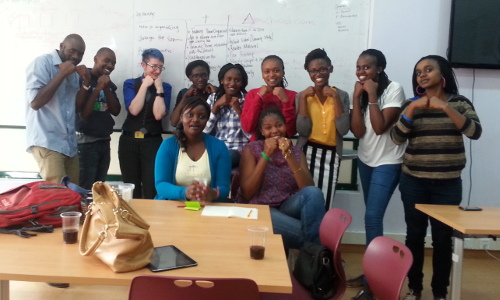
In Nairobi at AkiraChix, we further refined the checklist for making safe space and started two projects: FaceOff and Trolling the Trolls. FaceOff provides space for highly visible people to interact in a nuanced way, posting back to short-form spaces, so as to ask their constituents to be better balanced. This is a response to the very real occurrences of politicians calling their online followers to take action (sometimes violent) in offline space. Trolling the Trolls seeks to use language patterns from sock puppet accounts to find those accounts sooner, and respond to them before they have a negative impact on the speech of marginalized individuals online. Yvonne, who suggested this, also introduced me to ZeroTrollerance which was then represented by Peng! Collective.
San Francisco’s attendees on May 16th and 17th at the SF Nonprofit Tech Center were highly influenced by the book Thinking, Fast and Slow, which explores the two systems we have for thinking: one which is based on intuition (and assumption) and on which we most often depend, and one which is based in logic and analysis which comes with a cost to use.
Often, when in difficult exchanges online, we default into the intuitive to protect ourselves. This prevents us from reaching any different understanding of an encounter than what we came to it with. To cope with this, we devised the Introspection Bot, to help you break from whatever mental rut you’re in and consider the wider picture. We also developed the idea of redirecting dog piles of outrage into actual long-term efforts to address systemic problems. We performed some heavy lifting around dissecting what aspects of sociality go into platforms, including privacy control and friend count, which we offered to the Center for Civic Media’s Uncomfortable Networks.
One major difference in perspective between these two events was that freedom of expression is so enthusiastically valued in both the American and internet freedom circles I run in, but in Kenya, just as in other places, concern over hate speech inciting violence is very real. This tension is difficult to navigate both in everyday life and in the microcosm of a session. This is one reason why I was so thrilled when Aspiration was asked to facilitate the Berkman Center’s International Workshop on Internet and Society (IWoMI). Here, there was an international crowd committed to understanding and preventing misogyny (a bit more specific than Weaponized Social events, but focus can be a good thing!) online and off.
We made explicit space for, though still struggled to ingrain, non-Western perspectives in our conversations, including with one conversation about reporting abuse on platforms. A number of memorable things took place:
I continue to be honored and thrilled at the vast amount of brain power and heart the powerhouses of human beings involved in this movement are extending to solve these problems. To have such an international, intergenerational, and human-rights-supportive group set on making the internet a healthy place gives me hope we might even make it happen.
My students just gave their final presentations. Their projects are the most important part of this entry, but because of narrative arcs, come last. If you read only one section of this, please read that.
Last summer, I was looking for more paid work. A job posted to some list I’m on, for a Digital Storytelling position at Brown. It didn’t require a degree, surprisingly, and I thought I’d take a shot. I sent some of the digital animation and community work I’m proudest of, and crossed my fingers. They wrote back to tell me it wasn’t exactly digital storytelling, but it was something, and we should chat.
And so I embarked on the rather bizarre adventure of creating a syllabus (so many thanks and props to Jo, Debbie, and Susan in this especially), and of planning my life around being in Providence every Thursday. At least. I do, in theory, live t/here. Each week, I would stay until the last second of the Civic lunch talk, endure the anxiety of attempting to catch a very exact train to Providence (and sometimes pay the cost for the Acela which departed slightly later), walk or cab to the Nightingale Brown House, and teach a class. Continue reading →
I came on with Aspiration back in January as the Community Leadership Strategist, to merge the work I’ve been doing in the humanitarian and disaster response space with Aspiration’s practices and team. It’s been a *blast* so far, and continues to be.
Most of the work I’ve done in the last 5 years has been about what social justice looks like when we’re doing response, with a focus on technology (as that opens up paths to conversations we otherwise quit having). With Geeks Without Bounds, we did hackathons all over the world, including Random Hacks of Kindness and SpaceApps Challenge. I’ve been a coordinator for the Digital Humanitarian Network, keynoted the IEEE Global Humanitarian Technology Conference, was invited to the White House to talk about Sandy response, facilitated the first hackathon IN (not just for) Haiti, etc etc etc. I’ve also had a huge organizational crush on Aspiration since my first DevSummit in 2013, attending as many Aspiration-connected events as possible. When I was able to join Team Aspiration, I was overjoyed — even while much of the work I’ve continued to do on response had already existed, it’s been a slow shift to get those previously-defined objects to be a bit more Aspiraiton-shaped.
The Humanitarian Technology Festival in Cambridge May 9+10 is the first event that is both committed to response and framed on Aspiration ethos. I am SO EXCITED about this it hurts. Let me explain why.
The very way we deliver aid perpetuates the need for more aid, both for fast- and slow-onset disasters (or “extreme events” or “humanitarian issues” or “earthquake” or “famines” or whatever you’d like to say). When people need lodging after a hurricane, they’re either told to evacuate and/or they’re put into temporary homes, away from neighbors and family. There is little impetus to return and rebuild both social and tangible structures. People are uprooted, and must start from scratch. When, instead, we see that people don’t just need lodging but in fact need social fabric, responders (and the technologies used for response) can focus on how to maintain family and neighborhood ties. People are then less stressed as well as being more likely to take their own actions to return and rebuild.
For humanitarian aid, this is even more paternalistic and stratifying… while not actually “fixing” any of the things it aims to. Aid is primarily about making the giver feel better. But like Tom’s Shoes picking up on the “buy one, give one” idea that OLPC actually handled with cultural grace and systems thinking, instead Tom’s put some people out of work while trying to provide something THEY thought others needed. Even if it had been delivered in a less-jerky way, aid often ends up with locations dependant on that aid, rather than internally strengthened. This is one way we keep extracting resources out of other places without actually contributing to those locations. See also this bit of the paper I’m still working on. This allows the worst parts of globalization (erasure of cultures, consolodation of wealth, etc) to continue.
Some might say “fine, let them fend for themselves,” but that’s not ok either. When we don’t have to look at our neighbors (when we build walled housing complexes, or segregated schools), we can ignore how bad things are for them. And that’s also not an acceptable answer.
What we need are ways to listen to what people can offer, and what they need, under the assumptions that we are equals. This is why I’m so excited to see how the participatory methods I associate so strongly with Aspiration come to bear on this space. Just do a search-and-replace for “Nonprofits” to “Affected Communities” on our Manifesto and Participant Guidelines. People in these fragile situations are NOT a population to playtest new tools. Not only do failures have a larger impact in these spaces, but to think of another location and its people as “demo” space is undignified and unjust. We need better ways (not just better tools) for life EVERYWHERE, and to assume that we WEIRD (Western Educated Industrialized Rich Democratic)-o’s have all the answers is downright arrogant. By instead, as we do at Aspiration events, speaking to each other in easy-to-understand language, under the assumption that everyone is bringing something meaningful to the table, and that together we’ll figure it out; we can shift not only how we do response, but the after-effects of that response.
I’m especially excited to speak to people about distributed response, and how the tools we build for ourselves can be welcoming to others using as well. Check out NYCprepared and Taarifa to see what this can look like.
One used to pick me up from the airport, on whatever motorcycle was working, my hip-shaped leathers on under his, a matryoshka doll of care. We’d each have a backpack, holding on tight for safety and because it was the thing to do.
Another still does sometimes, eye-corners crinkling, the easiest silence. The city always appearing around the same bend, a skyline of calm.
Wedged in the front of a bicycle’s cargo bucket, luggage on my lap, while one took us to a front-yard farm to play ukulele music.
Another took pictures as I rode off, capturing our overlapping liminal spaces.
One with temporal and signal precision to arrival doors and green lights, dive bombing down hills and through streets. Rapid-fire catch-up on passions and focus.
A surprise-pile of people under bags in a backseat, through the deserted streets and crunching deep snow of some city. A warm greeting after a stressful time.
One took my 10+hours off-zone self to a warm bed and a shower in their profane and sacred home.
Finding the metal angler fish to get to the private plane, to be taken to find a car covered in floppy disks stashed away in a parking lot, followed by blissful water and the first time we slept intertwined.
In the backseat, a tiny person knitting, another devising experiments to make explosions scientific. Me not holding your hand.
One dropped me off at an airport on one side of the country, and weeks later retrieved me from somewhere else, that same smile and hatchback somehow transported. Now accompanied by a very polite dog and a growing history.
When one held the art between us, wind rushing past, uncertain if the high was from the bike or from the fear.
I took the train from the plane, and another handed me a heavily caffeinated drink and a helmet.
From the backseat, staring at the headlong scar from home to departure, through radiation-thinned hair, a freckled abyss.
But usually it’s gruff drivers, or confusing transit, and I’m not sure I’m thrilled by the adventure any longer.
Most of my work focuses these days on social justice in networks. Distributed response is this – how do we perform mutual aid in times of extreme events? Weaponized Social is sort of this (hey, did you know we’re doing one in Nairobi? Also in San Francisco?), of the role of an individual and a group in a networked culture. Networked Mortality is about how we deal with death in a networked age, how a distributed group copes with the loss of one of its members. I gave a talk at Arse Elektronika years ago about PostGeographic Sexuality — what it was like to be partnered with people when encounters are instance-based, rather than cycle-based.
The whole thing a little bit ago with the manic episode pointed at something else glaring in my life which needs to be explicitly coped with in a new way: pattern detection. While I could just take medication to create hard-borders around my affect, I’d rather at least attempt meditation practices to cope. But the interim is potentially dangerous – what if my unpracticed mind isn’t able to do it, or (worse yet) fails to catch that it’s not working? A person with a more standard life might ask a neighbor or partner to look out for them, but that’s not much of an option for me. How am I, who at my most stationary still spends half of each week for 3 weeks a month Providence and the other half in Camberville, and one week a month in the Bay Area; supposed to benefit from people who care for me noticing my unhealthy patterns? How is anyone supposed to notice a pattern with me?
So I’ve started to do this intentionally, similarly to all of the other exercises. A small group of people, who do see me more often (and regularly) than most, have been put in touch with each other with the explicit purpose to check with each other if I seem to be going off the rails in any way. I’ve caved and purchased a fitbit (an evil step sibling to the Pebble of which I’m quite fond), so the Warning Signs (excess coffee, extended sleep deprivation, etc) can be noticed by other people. A tiny web of friendly surveillance. I don’t yet know how it will go, but I do find it highly amusing that Distributed Life is present even here.
I’ve detailed out my process, in case anyone is interested in replicating it. Continue reading →
Been working the new job with Aspiration in SF (while I still live in Providence and Cambridge), which is outstanding. Also been working on a paper about the topic I’m focused on with Aspiration, of how we perform mutual aid, at scale, specifically in disaster response and humanitarian aid. It calls for what we’d call a “mixed-mode system” in Complexity Science. I gave a talk at Berkman Center yesterday on the topic, and they’ve already got the video live. I had a great time! Thanks to everyone for coming out and sharing your brains with me.
NECSI’s action-based 4th Wednesday Salon focused on First Day. This is an event which provides the resources, framing, and impetus to take personal responsibility for community health. It is not a fix-all, but is it an important, missing piece in the US health care debate, and a fulcrum for connected shifts to a healthier society.
On Wednesday, March 11th, we will hear talks from Deb Roy from the MIT Media Lab, Devin Belkind from OccupySandy, and Sam Klein from Wikimedia on Distributed Organizations. Register here.
First Day is about taking personal responsibility for your own wellbeing at personal and global level. Inspired from the idea of regeneration and new year resolutions, First Day wants to create a community level engagement at a personal level and community level.
Deck created by Catalina Butnaru
We assumed those attending would be both in a position to, and have a desire to, act. The Wednesday before had provided space for folk to ramp up to this state, including review of readings about a similar Wal-Mart initative. We were additionally inspired by Boston’s own First Night and City Awake.
After very short reminders of what we were there to accomplish for the day, each person introduced themselves and what they were interested in specific to First Day. From these, we pulled out a few break-out sessions tasked with creating an actionable list or guidelines for organizers to work with. The overarching points we ended with were an appreciation of the need of safe space for people to ask questions which might otherwise be taboo (especially around health), comfort in complex problems having interventions (especially with a light hearted attitude!), an appreciation for existing cultural events (Days of the Dead as well as Chinese, Tibetian, and Indian celebrations of new cycles and health), and holistic approaches to mental and physical health.