Dar pt 3

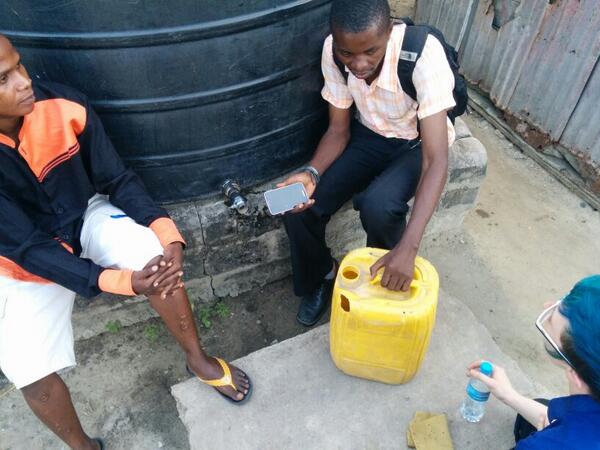
Thursday is a holiday, and so no meetings – we wake up early and head to Mkuranga District – a rural, rather than urban (like Tendale), slum. We run for the ferry, tho thankfully we don’t have to jump for it, new journalist friend Erin in tow. On the other side of the sea, we drive for hours, slipping between staring out the window and talking about interactions and plans. When we finally arrive, Msilikale talks with some women about if they’d be ok to be interviewed. We negotiate money amongst ourselves – in the US and Europe, you get paid for research subject time. Here, there’s an expectation that uzungu will provide money. I offer to buy a meal or drinks1, but it doesn’t go over. Even this is complicated, with potential larger ramifications. What expectations are we setting? Are those ok? Ethical? The lacking infrastructure and predictability isn’t just about drains and tap water, it’s also about social interaction and protocols2

We talk about sewing, and water, and responsibility. There are only wells here, and those only produce salt water, with which they clean, wash, cook, and drink. There was once a community-held water point, but it broke at some point and it wasn’t fixed. The assumption is that the government will install the infrastructure, in the same breath as a complete lack of belief that it will ever happen3. Water can only be gotten when there’s electricity.4, when it can be gotten at all.

reports from the field

Again, there’s no central square, no place for known dissemination of information. Everything is done by word of mouth, neighbors talking to each other. Do they ever update each other with phones? No, there’s too much worry about the cost coming back to them (or to the person they contacted). But they’d be happy to do what’s needed to bring water to their place. If mgunzu like me try to figure out things, how can we avoid being jerks5? So long as the government brings it in, they’ll work with it. Again, this weird relationship to authority.

We hang out by one of the salt-water wells while Msilikale finds a taxi6, watching people bring carts and buckets to fill up. Children throw rocks at a lizard, chase each other, drink water from the bucket used to wash clothes now hung to dry. We stand under the gas station awning during a short but heavy rain, and then pile into a car for the long journey back to Dar es Salaam. Now it’s back to interaction at the scale of organizations, but now as informed as it can be on our short time scale by interactions with humans as humans, not in aggregate for logistics. The UNHCR refugee camp in Northwest Tanzania seems most appropriate for the water sensor innovation test deployment, as it’s a closed loop. Kibaha makes the most logistical sense for the test deployment of Taarifa, as a lot of cultural work around accountability has already been done there by a potential partner organization. Mkuranga doesn’t make sense because it’s too far out, there’s no existing social infrastructure for organizations, and there aren’t plans to put in water infrastructure for awhile yet, so people would quit reporting after awhile of no results. It’s all practical, but not cold. People here feel their responsibilities, just like anywhere else.

The next morning it’s raining as we gain a blessing from the Ministry of Water – we’ll work with their water engineers on updating reports of water points7. We sit in a taxi in traffic and talk, then meet with a potential local partner who will help with social interaction and embedding – managing expectations, closing feedback loops, continual interaction for a more successful launch – or for a better understanding of a failed launch. If it works in Kibaha, we’ll try it out in Mkuranga, with more focus on the sensors than on the reporting, to ease survey fatigue. We get back in the taxi and talk more while we head back to the Ministry of Water to talk to some engineers about what they would want out of a reporting system (yay more talking to people who use Taarifa, not just read the outputs!). As the depth of the water on the road increases, the speed of the traffic decreases. Finally, concerned about even making his flight, we send Mark off in the taxi with his luggage, and I pile into a bajaj with my own suitcase. A meeting to get to, and facilitate, on my own!

Everything goes beautifully. I’ve learned to hold firm when I’m told someone doesn’t have time, or tells me they only have a few minutes. “We’ll talk again on Monday, but right now I do want 15 minutes. That’s it.” Engineer B and I end up sharing frustrations, drawing on pieces of paper, and giving a firm handshake at the end. Msilikale and I meet up, and head to my new lodging – not the fancy hotel anymore, but a friend’s-of-a-friend house. From here, I can still see birds flocking, and the sun setting over the sea, but there are also bugs and the shower is weird and it feels so much more comfortable than the fanciness. We have dinner with one of her Dutch friends, and brave traffic, and bond over growing up in the Midwest. The ensuing days are similar, with one day blissfully off. Plans for Zanzabar are trumped by epic, amazing rains. I read frivolous articles on my iPad and watch the rain roll over the sea.

In all this, the World Bank8’s hammer is money, and so everything looks like a project to fund. What makes this a complicated mess to my anti-capitalistic heart is that, indeed, many projects do need funding in the current environment. I see the “we read as much about about a grassroots thing that works as we could, and this is how we think we should do it…” All the people I’ve met within the org want a way to make the world to suck less. But these are institutions whose tools are people, and funding, and other institutions. And while they try various tactics, and sometimes make headway, in making the world suck less… they’re also held accountable for their actionsIn theory.. The difference is, the people in grassroots initiatives have to live with the reality of the failings and successes of their (and institutional) endeavors. So of course they are who I think of first. And last. And always9.

And Msilikale and I go over the drawings I did, and listen to music, and talk about all sorts of things. The power goes out, and we keep talking, the windows closed against mosquitos and the oppressiveness of the growing heat inside overwhelming. We walk in the dark to a local Indian joint, eating overly peppered food and listening to the calls to prayer out the window. The lights go out there, too, and we eat by the light of cell phones until the generators kick in. “This,” say Msilikale, “is Dar es Salaam.”

1. Worked for Kibera.
2. Scott’s Seeing Like a State is ideologically interesting, but if there’s no way to get clean water but through organized distribution of resources, such ideology gets tempered at least a bit.
3. It’s like breaking up with someone before they break up with you.
4. Mind you, this is a project with the Ministry of Water. Not Ministry of Power. This is with water. So we can only focus on water. *shakes fist at silos*.
5. Again, Msilikale mitigating anything that seems like a promise. Or hope, really.
6. Easier to negotiate price if we’re not there.
7. The hand washing tap in the MoW does not in fact produce water. Oh, the irony.
8. A World Bank innovation fund is what is supporting this initiative.
9. Not saying others don’t, simply that there sure does seem to be a lot of reminding.

Dar part 2

People don’t lean out of vehicles to ask for directions here, as they did in Nairobi. The security guards, when they exist, lounge in chairs and ask questions rather than standing, mostly silent, with automatic weapons. But like Nairobi, meetings can start (and end) hours late due to traffic, to tardy risers, to rain that causes traffic, to conversations running long, to torn-up infrastructure (that causes traffic), to slow service for your lunch meeting. Tardiness is sometimes used as a sort of posturing card to play – whether or not someone gives you a meeting, and how prompt they are, as sorts of indicators of status.

Everything we’ve done here has required status strutting in order to gain speed. Those plates I told you about? Only people with yellow plates get pulled at traffic stops, because they won’t be diplomats, or military, or donors, or government. If you get stopped, it’s easier for everyone if you just hand the officer money rather than pay the huge fine for driving illegally. Which most are. And because we don’t want to slow down our project, nearly every introduction is “and this is Willow, from MIT.” Which is great and all1, but as someone who prefers to be affiliated with institutions for access to incredible brains and the space to consider at length, rather than constructed legitimacy, it makes me feel like I’d be prettier if I just smiled2.

Those same posturings and rerouting the system means there’s a fear of transparency here. Entire systems here are built up around being opaque. People across all walks of life ignore the floods for fear of being blamed for what happened, being put out of a job. This means any transition into transparency will require safe space. No “we’re coming after you” attitude, but a “we have been operating to the best of our abilities within the structure we have. Now that the structure is changing, we get to change as well!” But it seems enough people into open data and transparency have done it with a vindictive streak that everyone balks these days, and it’s a slow, gentle process.

Two and a half days into an 8 day trip, we’d chatted with NGOs, World Bank3 employees, the Ministry of Water, UNHCR, and no people who actually live the experience this technology would change. And as much as I trust all of those people (and my hosts) to know what the status of their work is, I needed to go see things. Establish ground truth. Everyone gets caught up in paperwork, rhetoric, image, and email, and so seeing it for oneself is always imperative. Mark, an amazing guide and cohort as always, got us out to Tandale a full day early for the sake of my patience and sanity.

On the way there, Msilikale leaned forward to ask the bajaj driver to drive like he does, not like we’re tourists. The roads had washed out from the recent floods, full of pot holes and rubble to negotiate and lurch over. Tandale is a slum in Dar es Salaam, and is a place to live, just like anywhere else. We walk with a man who has lived there, him taking us past houses with water lines up to our mid-thigh, insides still covered in silt, to the river running by the open defication area (ODA here). Kids run by with make-shift toys, and young women peep out to ogle my hair (or Mark’s size)4. As we stand by a washed-out bridge, our guide explains context.

The river divides two areas, one has most of the markets and the other is mostly houses. There’s no grid system (it’s an informal settlement), and so paths are highly reliant upon available bridges, and new structures are based on those paths. IE, functionally ad hoc labyrinthine. And when the floods came, the bridge washed out, and there are still people learning about that and figuring out new routes home. No one is responsible for the bridge – the government won’t come fix it, and the man who built it and had lived nearby died awhile back. No one takes responsibility, either.
It’s not just the bridge getting washed out – it’s the height at which the water rose, and that the ODA is not much higher than the river on a regular basis anyway, and it’s certainly lower than the water marks. So all the trash and bodily functions and such from the ODA get caught up in the river, which means it gets clogged up (as do the drains in the area), which means standing water, which means more mosquitos, and mosquitos are bad news bears. That’s besides all the things in the ODA also flooding into the houses with the rest of the river water.
Flooded or not, the water from the river (and the wells around it) is used to wash, cook, and sometimes drink. This is only for people who can’t afford the water out of the water points – which can be salt or fresh. For half price, you can get jugs of salt water to wash with, and sometimes for cooking. For full price, you can get fresh water. The water is delivered out of water points – giant containers, raised up off the ground, from which people purchase water. These are privately owned, though installed and supplied by the government, and few enough are stocked and working at any given point that there are queues for the resource.

I ask questions. How do people know that one is broken? I wonder about where knowledge of what is going on would be hosted and shared. Is there a town center where things are posted, or is it all word of mouth? No center, just neighbors telling neighbors. No bulletin board system. I saw a vanishingly small number of feature phones while we were out. Only government and donor officials and contractors smart phones. Which, to me, makes me wonder how to get maps built of the water system back to the people in the area5. And given the level of corruption in the country, that data being only accessible to groups already in power is fraught with peril. Mark, aware to not ask questions about anything that won’t have a guaranteed resource response, waves me off asking more specific questions of how points break, and how to track response, what would next challenges and steps be, etc6.

Night threatening and malaria mosquitos7 lazing about, we walk back towards the main road. At a bodaboda station, we negotiate with the fliers. I feel like I’m choosing who to be auctioned off to, having to dismiss the enthusiastic and be wary of the most aloof. Msilikale shoos off the most invasive, and I’m glad of a native Swahili speaker friend and a friend who’s 6’6”. That negotiated, we take a rather epic dive-bomb through traffic route home8, avoiding jams and vehicles traversing the median to gain a clearer route. Only one or two of the passing bike riders make kissy faces and eyebrows at me. Mosquitos die on my visor, and mud splashes on my boots.

And I stare at the bathtub in the hotel room, and think about not finishing my dinner when I was young and knowing most parents referred to starving children in Africa. But the issue then, and with this, is in supply chains and politics around them.

1. Waves MIT flag.
2. Institutional objectification. Which is at least different from institutionalized -isms.
3. Yes, of course I wore my “/capitalism” pin, why do you ask?
4. Please forgive my tense-shifting.
5. A core ethic when obtaining data. See also this blog entry.
6. DEMAND EQUITABLE ETC9
7. Dhengi for day, malaria for night.
8. Sorry, mom.
9. Inside joke.

Topic: Revolution and Technology

Livebloggers: Sasha, Nathan, Erhardt

Today, we’re joined by Stephan “tomate” Urbach from the activist group & think tank Telecomix, which works to circumvent surveillance, and to promote internet freedom and human rights. During the 2011 uprisings in North Africa, Telecomix activists helped to bypass technologies of censorship and communication-interruption. They currently work to shuttle videos and other information safely out of Syria. Urbach is a Telecomix member, and has acted as their de facto spokesperson. He was a member of the Pirate Party in Germany, and worked for the Berlin Pirate Parliamentary group from 2011 until February 2014.

http://prezi.com/embed/kzyc1pmrynri/?bgcolor=ffffff&lock_to_path=0&autoplay=0&autohide_ctrls=0&features=undefined&disabled_features=undefined

Vizthink by Willow Brugh

Tomate joined telecomix in 2010, during the uprisings in Egypt and Syria. He worked in parliament for 2 years. He begins with an overview of Telecomix:
Telecomix (read about them here) isn’t a formal organization, it’s a network of activists who convene and disperse as needed. They’ve done this several times over the last few years. In 2006 in Sweden, there was a telecommunications bill, people gathered and formed Telecomix. After the telecom package was stopped in Sweden, they fought the data retention directive across the EU. At this stage, many people joined to do research and activism work. When the Egyptian uprising kicked off, Telecomix was galvanized into action: specifically, when Mubarak shut off the internet. They decided to figure out how to get access to folks in Egypt even in that context. They set up phone lines that people could use for dial up access. They set up around 300 lines for people to connect to the Internet. Weeks after the net went back up, tomate got an email from a young man in Egypt thanking them for providing access to be able to share their thoughts. This is the kind of thing Telecomix loves.

They see censorship, and internet blocking, as a crime.

Some people have asked them whether the regime might have used their lines. That’s possible, but they don’t know that. Back at the time, Telecomix talked about technology as neutral, although today tomate doesn’t believe that anymore. Then Syria happened. They found that internet surveillance in Syria was planned since 1999. They also found that Blue Coat, Siemens, and other companies were involved in providing surveillance technology. When they released this information, Western countries were publicly enraged. Telecomix suggested export controls, but no one was willing to go that far. The US department of commerce did investigate Blue Coat and their affiliates for selling to Syria after the trade embargo. ComputerLink a middleman company was fined $2.8 million by the department of commerce.

Telecomix found that every message, on every network, was monitored, and every phone call was recorded, both mobile and land line. They also found that people went missing after writing posts on SNS. Telecomix was in touch with Syrian activists on the ground. At the time, they felt clear about who was ‘good’ and ‘bad,’ now it is much less clear. They provided secure networks, software, and servers for activists on the ground. They made comms “as secure as possible,” but never promised 100% security: “whoever says this is a jerk,” tomate tells us. Some Anonymous people apparently promised full security, and local activists believed them. That’s a problem. Phone lines were then blocked in Syria. Calls to tomate’s personal number were blocked (listed online), calls to other Telecomix numbers were also blocked. When Telecomix released the Blue Coat files, revealing how it worked, the blockade system became better: Iranian telcos joined the Syrian telcos.

Around this time, Tomate received a call from German intelligence warning him to watch out for Syrian activities in Berlin. They found that the surveillance toolbox was installed in Syria, Egypt, Beirut, and Kazakhstan. But it was not always correctly configured. Telecomix has evidence, although not enough to publish, that Western companies are selling to dictatorships. They think that’s wrong, and want to generate a public outcry.

Throughout this process, Telecomix has learned a lot. Access blocking, traffic monitoring, deep packet inspection, laws that forbid certain kinds of speech on the internet. These are things that dictatorships are known for doing, not “free” countries. They also learned that hacking the backbone in Syria was great and everyone loved it. But if someone from Africa hacks the EU backbone they’re a ‘terrorist.’ So it depends on your point of view.

Telecomix also learned that the surveillance methods used in the West are the same tools dictators use. Everything from everyone is monitored. In Germany, they started to scan mail at the post office: front and back side. Started to scan postcards, and not sure what they’re doing with the scans. In EU, there’s a fight against data retention, and we won, since a court said data retention can’t be performed like that. It’s not a full victory: the court said data retention is OK, just has to be bounded in certain ways. In Europe, public is not ‘public.’ For example, Tomate thinks if he posts on his FB wall, it’s public. But many think that publicity is platform bounded.

Germany has one of the hardest privacy and data laws, the EU is potentially adopting this. It may be good for users, but not so much for companies providing services. For example, when Google did Street View, many houses are blurred based on people saying ‘not mmy house!’ But the same houses are available on Bing, and on other services. So Google now isn’t updating street view Germany, and the images are several years old. So Europeans think about data as ‘mine,’ even when it’s been posted publicly. We have a database of people’s personal information including salary, and we deleted it because of privacy concerns.

Snowden documents revealed that the ‘conspiracy’ of surveillance was actually true. For example, in 1998 we knew that the Echelon program might exist. Hackers knew it existed, but were called conspiracy theorists. Now there’s a public outcry for EU action against the NSA. tomate doesn’t think it makes sense: what should we do? Embargo trade with the USA? There’s an initiative to ban intelligence services from. In Germany this was specificaly because of an national intelligence failure to capture (neo)Nazis.

German intelligence, The exterior intelligence, supports the NSA, then gets internal surveillance on Germany, which they are not allowed to collect domestically. These exchange programs exist all over the world in contravenience with privacy laws. The only proposal they can think of against surveillance is to make it more expensive. The more encryption people use, the more expensive it will be, for example. One idea is to create as much spoof data as possible, such that intelligence agencies will spend all their time processing the spoofs. Another idea is to rebuild networks with new hardware and new protocols that will be less amenable to surveillance.

But as in all places, no one wants to pay for something. If you get paid as an activist, no one will consider you a proper activist, which means that activists have to work for free. If you look at what the NSA, Brits, French, Germans, and everyone else are doing, it’s the same as what the dictatorships are doing. What makes a democracy? People can say they don’t want this surveillance, but the government does not listen. Tomate is focused on the European debate about surveillance, not so much the NSA debates in the US. But he hopes that some day we can ban intelligence surveillance in democracies.

Slides: http://files.herrurbach.de/doc/framing.pdf

Q&A

Ethan: Tell us about how Telecomix thinks of itself differently than other organizations in the space. During the blackout in Tahrir Square, lots of organizations got involved like Tactical Tech, also based in Berlin. Telecomix has always had a certain amount of secrecy around it. How did this come about and how does Telecomix see itself fitting amongst other organizations in the space?

tomate: Telecomix does not see itself fitting into anything. This is important. It is a space for exploring things. At the point, people can join Telecomix. The aura of secrecy is wrong; it’s one of the most open/transparent groups I’ve worked with. The problem is that many journalists struggle to understand Telecomix—they group us in with Anonymous, which is wrong. They builders and rebuilders, rather than attackers—they don’t take sites down using DDOS. One characterizing is the Yin to Anonymous’ Yang. We also do a lot of theoretical work in the space, differing us from other activist organizations. We are also not people that work in public wearing masks. We do try to secure our members who are not in a position to go into the public because of the work they do, and others take the role of the public face of the organization.

Sasha: How do you make decisions as an organization? Like who represents the organization to the public?

Tomate: We do not use formal consensus-building processes because they don’t work. We run an IRC do-ocracy. Admins do have too much power.

Willow: Can you tell us about Cameron?

Tomate: We have a bot named Cameron. We can ask her questions and get responses. We sometimes make her the public face for interviews, including a few that were published in Swedish newspapers. They asked for a photo and we sent a picture of the old mac that she was running on. She is crypto-sleep because we forgot the password to the harddisk. But now we have no one to ask what we should do. She was a symbol for us for a long time.

Cameron Kerry :http://en.m.wikipedia.org/wiki/Cameron_Kerry (former General Counsel, US Dept f Commerce) I was encouraged by the data of a “Data Schengen” but over a month ago, the EU parliament voted that the European Commission should come up with a protocol for keeping EU data within national borders? How do you change that strong sentiment?

Tomate: Currently, Deutsche Telecom markets itself as keeping your data in Germany, which is false, it doesn’t. The idea of keeping the data national is nice, but it doesn’t solve the problem anyway. The privacy activists in Germany and Europe believe that if a law says something like this then it works, but that’s not right. They always ask the state to handle it, but they can’t. We are working on new protocols and projects ourselves to handle privacy. We rely on infrastructure form the 70s and we can’t rely on it much longer. We hear in Europe that the US created the internet and they can control it.

Ethan: In response to surveillance people are looking for many paths. But HTTPS (Heartbleed) was broken for years, and it was open source code. Tell me why you are optimistic that we are going to solve this problem with better network design.

Tomate: People in Germany are being paid to do open source code audits. They are funded through donations right now to work on this issue. We need to do more audits and pay people to do them, multiple audits for software are needed.

Sasha:

Tomate: We need export controls on technology that can be used as a weapon. We also need to rebuild our networks with the state. But these are two different things, building the network and sending out products to dangerous people.

Ethan: Who would you want to enforce those export controls? I think the export sanctions push is a really messy one. We’ve seen a lot of cases for export controls are taking really useful tools out of people’s hands.

Tomate: I don’t have solution for that question. For instance, my country is selling tanks to dictators. So I wouldn’t trust them to sell any hardware to countries.

Eleanor: The only reason we have strong crypto is because we regulate code as speech and thus it can’t be sanctioned under export controls. The only way we got PGP out there was a loophole in ITAR rules using a free speech definition. I would rather use a limited liability laws rather than export controls.

Sands: Is there a lot of discussion at Telecomix about mesh networks for activists?

Tomate: As I said, Telecomix is not really active right now. I live in Berlin, which is the main city for mesh networks. There are discussions for how to activate local networks and then bring them online later.

Dalia: I think the public is missing in this discussion. What I’m not hearing is how we can have people change things. I’m hearing that it’s happening in IRC channels. But many people aren’t adopting the necessary technology or talking about it.

Tomate: In Europe, we have many crypto parties currently. It’s amazing how many people are coming. People get the tool as well as the explanation for why we need to do this right now. We show them how they affected by the surveillance. It helps that we now have the evidence of this, so people are listening.

Yu: After hearing about the decision-making process, how do you manage your brand?

Tomate: Don’t break anything. If you break down communications it is not a Telecomix thing. We don’t try to manage it, but we explain what we do to new people in the IRC channel, explain it is we try to do, the same we respond to the media. Anyone can use the logo, and people do, but it hasn’t failed yet.

Serious Games with International Red Cross Climate Group

Pablo is a force to be reckoned with. That crazy energy that seeps possibility into the most jaded of souls. He doesn’t just pull you out of yourself – he gives you somewhere to go. And even more incredibly is that he seeks to make the things he has made possible thrive beyond himself – how can he support others in making change? How can the things he’s instigated be documented and live on? A reminder of how much good facilitation matters in events and life.

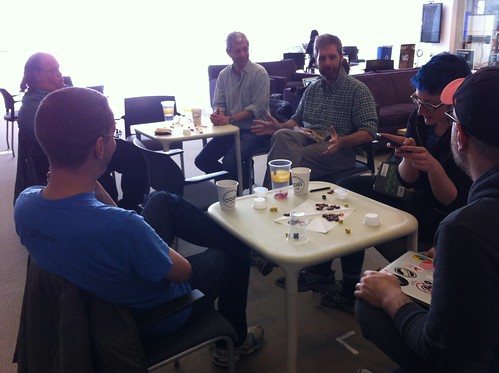
We played a game of being Red Cross employees, responsibile for entire areas (my quandrants were dubbed after Lord of the Rings. The other was simply CMYK) and you “win” with the most resources put into long-term endeavors (HIV/AIDS education, infrastructure, education, etc) and with the fewest catastrophies (when you didn’t have the resources to respond to flooding in time). I could go on and on about the mechanics of the game, but really you should just play a round yourself. What matters are that we suddenly had a much better understanding of probability and consequence based on tangible interaction. I encourage you to read more at the multitudes of documentation on their specific branch fo the topic, often with recent MIT Conversation guest Colleen.

The main takeaway specfic to my tech-in-response-space and facilitator double-heart (+10 geek points if you get the reference) was the unapologetic conviction with which Pablo addressed uncertainty and unfairness in the game setup. Don’t understand? Oh well! 5.. 4.. 3.. Just like life. As someone who is constantly struggling to find balance between building capacity in dealing with chaos, and the ease of interaction that clear guidelines bring, this was beautifully blunt. Because the point of the game isn’t just optimizing for resource management, it’s in dealing with the unclear rules, political agendas, donor whims, and the other players that you have to worry about. The math can be gamed, graphed. The social interaction is far more fascinating and flexible.

This clearly wasn’t just about me – we were joined by an incredible group of people. For examples, Jason and Matt. Jason, from the Game Lab and a cohort of mine at the Media Lab, brought his long experience in improv, facilitation, and gaming to the.. table (I couldn’t help it! Pun!). From him, we had an examination of game structure regardless of content, of technical levels, and of on- versus offline-games. We were also joined by Matt from MetaLab and the MaleriaAction game – using human pattern-recognition abilities to cut down massively on computational modeling time. From him, we examined the continuum between what great work for people to play, to understand their systems, and what is great for modeling, and how that better understanding might feed back into tabletop games.

We also explored the brain-overloading awesome that somehow lets me into its structure on a regular basis : the MIT Media Lab. Specfically, we visited CityScope in Changing Places, LuminAR in Fluid Interfaces, and Paula Dawson‘s holograms in Object-Based Media. With City Scope, we examined how using city and environmental models in play – moving LEGOs around to try out different plans and structures – can lead to a similar base understanding as the tactile interaction the games brought. With LuminAR, how can we display the probability functions we had gotten a solid sense for via the games (rather than numbers or an undeciferable graph, a set of dice – one covered and one exposed) to people who actually need to know there are ways of optimizing their response and funding structures? How about projecting calculations based on the beans and dice they’ve laid out? And from the holograms, how can we see one aspect of a problem from one side of a table, but a very different perspective from the other side?

And always, for me, the Center for Civic Media idea of how this brings voice and understanding and storytelling to more people. And this is where game structure becomes so intersting. By having a clear game infrastructure with modules, you can build whatever game you like co-creatively. What are the major things to pay attention to? What would the costs and risks and win conditions be? By working with a group to discover what is important to them, you also understand what the complications are. AND it shows that systems are malleable. My favorite.

Epic thanks to everyone who made the day possible. I’m excited to see where we can take the enthusiasm, intentions, and heart as we forge ahead into a future that might just suck less. In no small part because we don’t just have scientific and mathematical inputs – but we understand what they mean, and how to use them.

Happy Birthday Debcha!

I’m about to get on a plane to the West Coast. Three incredible guitar players practice so adeptly nearby that the desk folk have turned the overhead music off – think Triplets of Belleville soundtrack. This morning I kicked off SpaceApps Boston, and then I got to sit for awhile to listen to a great lineup of my friend Deb‘s friends give talks for her birthday. My talk was to draw everyone else’s talk, and then show them at the end. I’d usually post this over on bl00viz, but it’s more personal, and I do try to not cross the streams too much.

Deb was/is a core part of why I now feel so at home in the Boston area. She reminded me that part of having a history with people was building that history with them, inviting me out to dinner parties, talking on Twitter, checking in on text. And always amazing music, Zoe Sighting, Emergency Leroy. Thanks for being persistent proof that people can be amazing, intelligent, kind, calm, and stimulating. Happy Birthday.

Value-Based Design Workshop

Bex and I put together a Value-Based Design workshop for the Codesign Studio at MIT Media Lab. Originally posted on the Codesign site (and then to the Civic blog and Bex’s blog). Here’s how we did it:

link to the hackpad version of this post

When you are designing a project for social justice, where do you start?

In this workshop, we practice value-based design, a method that helps us to design for large scale social impact and to relate this directly to how we plan and implement projects. We envision the impacts we’d like to contribute to in the world and the values we bring with us into our work as the first steps in this design process. As individuals, this method helps us to express our connection to our projects on a personal level and to prevent burnout as we are able to identify work that resonates with our values and to set aside work that doesn’t. As a team, this method helps us to identify shared values and to make design decisions based on our shared vision instead of personal preferences.

At the last Codesign Studio, Bex and Willow took the class through an hour-long workshop toidentify our individual values and to design our projects and approach around shared values.

This workshop is inspired by Monica Sharma’s work in transformational leadership for large scale system shift. In this article, she describes the framework of the methods she shares for this kind of work. Connecting with our personal values and designing based on values is a key component. [Sharma, Monica. “Contemporary Leaders of Courage and Compassion: Competencies and Inner Capacities.” Kosmos Summer 2012.]

Individual Values


Purpose
Uncovering our core values gives us better understanding of our own purpose and desire in the world. Doing this exercise with teammates is a great way to connect to each other’s inspiration.

Process
(3 min) Select one person in the room to work these questions with:

Share something you’ve worked on that you had some role in designing.

Ask the following questions:

  • What did you envision as success for that project? Often people will dissemble, and say it wasn’t a success. People will also commonly talk about the activities of the project, things they did, instead of what the vision was of the project. So:
  • Ask them to imagine that it WAS a success. What is happening in the world then? How are people living? What is the quality of life?
  • Drill to one word. That’s the value you were working from. The value you represent. The word should not be an action or process (manifestation, collaboration, interaction, etc), but what people feel like if they can act or work in that way (joy, justice, inclusion, health, etc).

(12 min) Now, break into pairs. If there are project teams in the room, ask people to work with someone in the same team and ask each other the questions above.

(at 6 min) Remind people to switch

Reportback
Have each person say their value when you reconvene. If you can, write these somewhere that will be visible for your team as you continue to work together.

Value-Based Design


Purpose
Designing a project with the larger purpose in mind helps to think big and understand that your actions connect to your visions of social justice. It also helps your team to recognize shared values, a great starting place for connecting when you have to make difficult design decisions.

Overview (5 minutes)
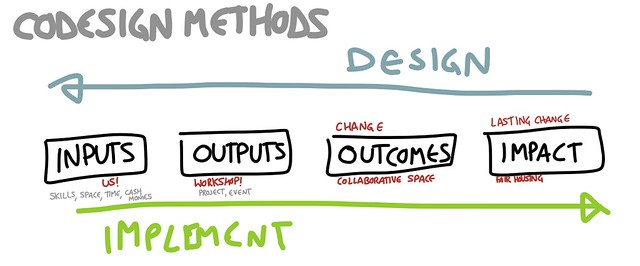
In this method, we design with our teams first by developing shared understanding of the impacts we want to see as a result of the work we do together. These will be large-scale and will likely relate to values we identified in the Individual Values exercise. In this exercise, Impacts, longterm sustained state change.

Because we can’t implement impacts directly, we continue to design our work into pieces of work that we can implement. We divide these pieces into three categories: Inputs, Outputs, and Outcomes.

Process
Share the above graphic.

Go through an example, here is an example of how we might have used this methodology in developing Codesign:

Ask what desired impacts of Codesign are:

  • Impacts – sustained state change. – What do you think the intended impacts of codesign as a method are? Empowered and equal engagement.

Ask what some inputs, outputs and outcomes are of Codesign:

  • Outputs – collaborative workshops
  • Inputs – YOU! Partners, us, this room, MOUs, etc
  • Outcomes – A change, but requires continued effort to maintain – Such as social relationships, people try it and don’t keep it up

We tend to fill these three categories with information in a nonlinear way — recognizing an Outputmay surface desired Outcomes and Inputs. Broadly, we design right to left and implement left to right.

Project Design (25 min)
Now practice the value-based design methodology with project with your team. If you are at an early stage in your work together and you haven’t yet identified or selected a project you will work on, you can begin by taking the various partner’s organizational values into consideration. Broadly, what are the impacts that your team’s members envision?

Before completing the exercise, have each group fill in at least 2 points under each section.

Wrap It Up
Reportback (15 min)
Ask people to share their process. Try using the Green/Yellow/Red method and ask each group to share one Green – a thing that was easy or clear; Yellow – one thing that was challenging or that they learned something from; and Red – something that was difficult or a block.

If the teams went to different parts of the room, have everyone tour around. Document the work of each group.

10 Years Later, My Soul Still Flinches

I was recently triggered by a dear friend. He had no way of knowing – I don’t talk about these things, and on the rare occurrence that it comes up in any context, I take care of it myself. But we’ve been close for awhile now, and he deserved some sort of understanding as to why I nearly walked out, no reasons, to clear my head and calm my breathing.

My tendency is to not talk about things until I have both a clear understanding and a clear action to take. If understanding is all that is needed, I sometimes keep that to myself, unless it benefits everyone to express it. Mind you, with a high emotional metabolism, these processes can take from minutes to hours – rarely on the scale of a full or multiple days. But I suppose it’s important to talk about abuse, especially as someone who apparently seems functional.

Corey used to leave me places. We lived in a bad neighborhood in Suffolk, and I was new to the area, and I worked doubles at an Applebees a few miles from home. The one time I tried to walk home late at night, a car stopped to proposition me, and became quite angry when I didn’t accede. I was 19 at the time. I didn’t have a phone – we only had one, and Corey had taken it, but wasn’t answering. Being that poor also meant I didn’t have cab fare, there were no buses, and my new coworkers were uncaring. I didn’t have my car – he had taken that, too. To do… something.. while I worked and he didn’t. After that, even when I couldn’t get ahold of him, I would wait at the restaurant, sometimes for a couple hours, until he would come to get me. He would then “tease” me for how often I had called or texted him.

When I would insist on taking my car with me, it became an argument about trust. Why didn’t I trust him to have the car? It was just going to sit in the parking lot all day, whereas he could use it. Didn’t I trust him to come get me? Did that mean I didn’t trust him at all in anything else? I was a horrible person! He was simply absent minded. My lack of trust was undermining the relationship.

Later, things slowly escalated. We would get into regular yelling matches. He broke his hand from punching the floor when I stated my intentions of leaving, permanently and immediately. I drove him to the hospital instead of driving myself to my cousin’s, crying because I knew the ensuing hospital bills would threaten the move back to Indiana so I could return to school (my parents’ sneaky trick to get me back into a social safety net). I still don’t know the laws about physical abuse if you hit back. It wasn’t pretty. And always the underlying thread of distrust. Any fight always came back down to my not trusting him. I finally left him after 2 and a half years, discovering that the problem was not my lack of trust but his untrustworthiness. We still had to live together for awhile, again from his financial insolvency. There was a final morning with him not letting me leave the house, my finally calling the cops as he slammed doors back shut and then stood in front of my car.

Recovery takes time, and I’m still not done with it. I reflect less often, but more publicly. But it’s important to know that even badasses like me have baggage. So do others.

  • 2007 : http://willowperson.livejournal.com/129303.html
  • 2008 : http://willowperson.livejournal.com/167449.html
    • http://willowperson.livejournal.com/186020.html
  • 2009 : http://willowperson.livejournal.com/197463.html
  • 2010 : https://blog.bl00cyb.org/2010/09/diaf/
  • 2013 : http://brainmeats.net/ep8-social-scripts-for-abuse

When an ex-lover in Seattle had pulled my motorcycle battery to get his own going, I lost my shit. In his  excitement over mechanical triumph, he tossed his feature phone towards me to gain my attention while stopped on the curb. He had just removed both the ability to communicate and my transportation. Of course he had no idea why this would be so bad. Nor could he, until I expressed it.

The thing that makes emotional abuse difficult to overcome is that erosion in the baseline of trust. The initial giving of trust is still pretty easy to me, it’s the response to being in an iffy situation and determining how to navigate it. My attempts to vocalize about being uncomfortable in the past meant all the structure of the relationship was torn away (not by me, I know that now). So my knee-jerk response to situations now is that of having to choose to quietly deal with the feelings that I’m having, or having trust itself questioned. My heart doesn’t understand there can be an third option between stoicism and complete tear down. And I like the trust established with the Boston Sweetie (who I’ll note wanted to be called the Boston Strangler here, that is how awesome he is).

But now I have space again to ask questions and think through things safely, I don’t have to have a rational reason for feeling the way I feel. Maybe someday I get to be rational about all this again. Maybe. In the meantime, I just have to accept that the people around me might actually want to help, not take my need for help as a personal affront. All I have to do is be brave enough to explain what’s going on in the tumult of feels, even if it doesn’t yet make sense. Especially if it doesn’t yet make sense.

It’s important to know that even the ability to speaking about the abuse is what is ripped away. This is why it is difficult to speak out. The podcast, listed above, has some pretty heart-felt conversation from a variety of people in it. Worth checking out. And speak out. It helps. Even a decade later.

A Week of User Rights and the Tools to Support

What a crazy week. This has mostly been typed on a plane back to Boston, where I get to be for a few days before heading to DC and then home to visit. When I landed to SF a week ago, I had plans to see friends, to lounge a bit, to enjoy a city I love so much. Instead, and just as happily, it was a whirlwind of jam-packed braining and action around user rights and the methods and tools to support those rights.

Countersurveillance DiscoTechs

With the Codesign Studio I TA with the Media Lab, a series of Discovery Technology (DiscoTech) Workshops were put on. The ones in Bangalore, Ramallah, Mexico City, Boston, and San Francisco were all inspiring. You can see more about the projects, art, and progress over on our hackpad. Some examples were stories from Venezuelan activists, face painting to deter facial recognition (so hard!), long-time surveillance on poor communities in America, and spoofing DNA.

And seriously. Take a few minutes to go through the partner pages for this. Need a bit of morning outrage? Think everything’s going pretty ok in the world? Nope!

UI/UX for Crypto Tools Hackathon

The second usability hackathon with OpenITP went incredibly well, and repped as the San Francisco DiscoTech as well as its own thing.

It was utterly luxurious to work on large team of people. Ciprian had logistics covered, solidly. Gus knew the projects inside and out. Bex had notes and tone in beautiful competence. Anytime I would think “oh, we should..” it was already in progress. All I had to do was herd the kittens, which was absurdly fun.

RightsCon

It was really nice to completely surrounded by the people I usually see when we all jam into the one or two sessions at any tech or policy event which involve both. But that overlap was the whole conference, so we were able to dive in much deeper, see more nuance, and see next steps. I learned about funder motives, and the initiatives which backed tech in atrocity prevention/detection/accountability, and about many many tools used to amplify the voices of marginalized people. I drew a lot, and I hugged even more.

VizNotes

Full set on bl00viz.

Typed Notes!

I typed notes for two interactive sessions for sake of formatting. One was a review of the the UI/UX hackathon the weekend before, the other was stories from the field and suggestions for how to be better trainers. Those can be found over on the Civic blog.

Responsible Data Forum

Thursday I trekked out to Oakland to participate in Engine Room‘s Responsible Data Forum, as hosted by the inspirational Aspiration Tech. Again, I was spoiled by being surrounded by an impressively diverse set of people interested in the same fulcrum of concern and change. We skeletoned out plans for checklists before collecting data, and workflows that include project death, and illustrated how data moves through a company. We talked hosting and coercion resistant design and informed consent. We also talked about context-based privacy in disasters. I’m looking forward to seeing what comes of the day.

Liveblog for Rightscon USABILITY AND DIGITAL RIGHTS TOOLS: PROBLEMS AND SOLUTIONS FROM THE FIELD

Liveblog from the Usability panel at RightsCon. It covered the Countersurveillance hackathon we had just wrapped up, a SF event headed by OpenITP but also linked to the recent Countersurveillance DiscoTechs. I typed this live and published right after the sessions for the day – please forgive typos etc.

Usability as a huge issue. Doesn’t matter how much we train if the software isn’t usable.

OpenITP has done two events around crypto and usability now – DC in January, and SF in March. OpenITP tools brought to be worked on. Not hard to do a hackathon on usability. Can get people in to improve documentation. User testing is a thing that can happen in a day. Making wireframes. We’ll do a report back on challenges faced, what people are doing usability-wise. What they’re doing to correct those things.

Barbara with Benetech
Martus – about 10 years old, end-to-end encryption for folk in the field doing human work. This is using old software and design patterns. We were super security-focused, but maybe did it wrong. Example of protecting against key logging by clicking with the mouse to put in a password. To avoid pattern recognition, we’ll randomize the screen every time. But people don’t use that.


You can get really detached from what the users want/will use. Even if we had protected the password, the rest of it would have been key logged. Usability is a security feature. The people who need security the most are usually those who understand it the least. And human rights documentarians are targets. Usability can protect them.
Used the DREAD model to make specific threat models and user stories as a way to bring together engineers and designers. Out of that, one of the ways we made the conversations easier was creating a shared language. DREAD is broad, so we clearly defined what we meant by things in simple language.

Bex
Codesign facilitator and community organizer at Center for Civic Media MIT Media Lab. Shared values, common language. We design with the users, but we also see everyone as a designer. Everyone makes a decision together about how technology works and what it does, means it’s more likely to work for people.
Discovering Technology – getting together to share about technology, learn. Very hands on – at the Boston event, used face paint to thwart facial recognition software. Surveillance camera walking tour as a way of calling attention to the social implications. In Bangalore, they did DNA spoofing. So, as far as UX being about how people relate to tools, the DiscoTechs talk to that, and how tech is used to build power.

Projects
Commotion Project
Our goal at Commotion is to make it really easy for anyone to make their own wireless network. There’s a lot of complicated technology under the hood. Want to make the technology interface as simple as possible, but on the other side we have a construction kit that is a visual documentation set anywhere from installing to engaging your community.
As much as we can explain it to ourselves and our colleagues, that is not our audience. This is a hard problem – community organizing to wireless interference. A number of volunteers approached us – which is inspiring – you are so valuable. We don’t know where the mistakes are, we don’t know what doesn’t make sense. Had a number of folk go through documentation, gave them a big red pen. Circled things, this doesn’t make sense, etc. also went over our website. where do you find it, if it exists at all? Someone going through and gave a long feedback form. Also some folk translated.

Serval Project
Having people come in and say our selves, our family and friends at home need this. Make the user interface accessible to them. Take a situation that is incredibly difficult, choose disaster response – don’t know who is alive, where things are. And we’re saying “hey! here is new technology to learn so you can organize!” and your brain isn’t in a place to learn that. We are painfully aware that. It does the job but it’s not the most elegant. The codesign process has been great in getting us to that.
Group from Venezuela where gov is either turning off net or making it go very slowly. Controlling media. Where do you get toilet paper, communicate to people? This is a direct need – they’re talking about their families.
Ok, so if this is for Venezuela, can we get this to work there? They asked for a Twitter without the connectivity – like storyful.

Guardian Project – InformaCam
Collecting digital evidence in encrypted and verifiable media by journalists and migrant farm workers. We went through all these use cases to identify the data visualization needs of these different groups. InformaCam collects a bunch of metadata, which is useful for lots of people (so it’s also sensitive, needs to be protected). Range of uses means collecting and displaying the data needs to be useful to the folk collecting the data. We got a bunch of good suggestions about how to improve the interface by making it more configurable on the backend so when admins come into the system, they can customize the display for the users to either aggregate records based on locations or teh submitter. Also raised a lot of suggestions around additional features, how to
improve the system when there’s low or no internet. Messaging systems other folk worked on.

Guardian Project – Bazaar
Extend the Fdroid market for peer-to-peer, so if there is an app I want to share to friends when bandwidth is super low or down. We went in with a prototype around sharing apps between the phones. Bluetooth, NFC, SD card, etc- how do we distill all these different means into a flow handled by non technical users. “Do both of our phones have bluetooth?”
Worked on distilling the best method to learn those things. Also came to understand how some of the terminology we were using didn’t translate. Repositories, packages.. these words mean nothing to people who just have a few apps they want to share. “Share,” and “Swap.” Above the technical mumbo jumbo.

Small World News – StoryMaker
Anyone can learn to make a better story out of multimedia. We’re building a secure camera that we can also guide people at the point of production. A guiding principal is to put the trainer in the phone. People pay the most attention when they’re doing what they want to accomplish. This weekend we had an initial exercise of value-based design with outsiders – what is the value of story makers. You should feel more capable of doing what they do. Implicit understanding that people are capable, convince others of that. What are different ways to guide them through production process – pay attention to sound, you’re shooting vertically, etc. We started building out the UI with things like level of notification based on triggers (tiny icon if you’re tilted, animated arrow to rotate if you need to 90*). as we work on the variables, it will become magic. Oh, I am a great storyteller! Don’t have to worry about craft.

Questions!
Having people in the room that weren’t on the tech teams was super useful.
User stories, field experience, etc. Started you thinking about how to make your tool more useful. What can we do to make that more possible?

Most Users are Abroad – How do you Engage with Them?
Skype screenshare etc for instant feedback?
OpenITP is looking into this. Operational Security – if we do remote testing, it’s really video heavy. If you’re directly interacting with activists you might put them at risk. Work more with trainers.
Oktavia was suggesting a (non F/OSS) tool to mark up a page about things like “this button is places strangely,” or “I don’t know what that means.”
Shuttleworth Foundation has an F/OSS tool for this! Annotate
Community outreach – groups should be able to do this without us, which requires intervention at a different stage. Carl Vogel on OS projects – not just about the code being open, but the developers being open to questions as well. Having an open IRC channel, but always looking for more ways to show openness.
Training as a multi-week process. Not just fly-in, fly-out. What format do we need for the trainings?

Open Source vs Free/Libre
Free Software was about software respecting the rights of the people using it. Open Source doesn’t do the same. Think about free, don’t get distracted by open source.
In the field, people aren’t aware of whether it’s open source or free. They use what is usable – Facebook and Google. We have to take the bandwidth and financing to make our tools usable, too.

Goal is to not use Google Play
App stores are censored, closed webs.
Not about how to be fun, design for addictiveness. But Google and Apple have realized that you can identify what you need in an app store to be successful, how can we riff on that and make use of the space carved into brains around us. Interface side of things.
Fdroid is just one way of doing this.

Analytics,  Tracking Where Trouble is Happening
No one knows how to track their web logs any more.
Having tools that aren’t cloud or invasive. Guidelines for data collection on your users that are safe? Does that exist? When we track users or deploy elsewhere, is there a list of what to not do?
Benetech has gone through a process of collecting even less data. I get where you’re coming from, but if you get 5 people in a room to talk about a project, it’ll get you 80% understanding. Tracking gives you specifics but not real usability understanding.
Printed things out, people went around with post-it-notes, basically gave us user analytics without logging. People don’t print out paper. Just accept that you’ll do that, have every tiny step involved.
No data without explicit permission. We do everything distributed – we don’t have a way to get anything back
When you have specific steps of opting in, not just a block of ToS. Difference in what permissions you’re giving on different options.
Hearing from users is not anecdotal, it’s data.
Go places, talk to people.
As  a trainer, I’m a filter. The organizations are filters for other  people. Anecdotal is good. It can be enough for the 200 members of teh  organization.

Localizing Our Software
How can we do that without compromising the privacy of the users.
This is where codesign comes in.

Marketing
Lots of people build software, but who is marketing it?
In funding, it’s difficult to support marketing. Usabilty is a sort of marketing. When people like it, they want to tell other people. Usability is easier to finance.
People will push it through their community if they like it.

Example of User-Centered Design that has Been Widely Adopted?
Firefox browser is a F/OSS developed by the users.
Cryptocat. Started with user in mind, had great success for that.
Guardian Project. Seen Informacam iterate through, seen a lot of improvements.

Idea for a Tool, Gets Developed, then Users Asked to Evaluate
This is a part of the funding process. How do you come up with the tools that you build? Do you go out and ask people what they need? When the ideas are codesigned, not just the build, stopgapping after.
Worked for a human rights org called Witness before Guardian. In working with people there, found out that people needed their faces blurred out of photos. Brought this to a hackathon, cobbled together a prototype. Should strive for that more.
Working with migrant farm workers where we made something and it didn’t work, wasn’t understood, drained battery. So we scrapped, rebuilt… but the guts were the same.
Sometimes groups that are already organized will come to us, ask us to engage in that process with them. We’re collaborating from teh beginning. Guardian is partnering with MA ACLU and MIT to reshape something that already exists. You can write for funding together, or the community groups wil have written for funding.
Commotion writes into grants that the community interaction is first. Digital Stewards – we teach them, they teach us how to do it better. Every network tells a story – take cutouts of parts of a network, let them build the network they want.

Impression of Tech in Western World
DRC, trying to make Medicat, merge medical evidence and documentation of medical evidence with ability of camera culture to end goal of prosecuting. Piloted in field SUPER early, revamping based on what we learned. Has to be reframed. Environmental factors, how limited the resources are.

User’s Rights / Non User’s Rights
How do we protect the data from our platforms for use in other places? In SF, it’s not about documentation, it’s about follow-through. Institutionalized problems. What are we going to do with keeping records?