Attention and Atrocities

Every year, Canada’s Médecins Sans Frontières (AKA Doctors Without Borders / MSF) meets for their Annual General Assembly. I know about this because two years ago their topic was “Is MSF missing the technology boat?” to which I was invited to speak about Geeks Without Bounds and community technology projects with the talk “Technology as a Means to Equality” (video broken because of issues with GWOB YouTube account, and with my apologies). I went back this year because my organizational crush on them maintains, and because Aspiration (my employer for teh past 2 years, a technology capacity building organization for nonprofits) has been working on an ecosystem map of the digital response space. The real-world and values-driven experience of MSF provided valuable insights and data points for that map, and so I went seeking their input. I spent the first day at their Logistics Day hearing about 3D printing for manufacturing and prosthetics, telemedicine, and use of smart phones. My second day was for the Annual General Assembly again, this time as an attendee. The first half of the day focused on how to deal with the bombings of hospitals in war zones, the second half on mental health for patients and for field practitioners. I’d like to speak to you here about the first half of that day, how it overlaps with things I’ve learned here at the Center for Civic Media, things I was reminded of during bunnie and Snowden’s announcement at Forbidden Research, and things which have sadly continued to be relevant.

#NotATarget

There are certain things that humanity has learned we find untenable from past experience. Some of these lessons are most notably codified in the Geneva Conventions, ratified by the UN and its membership. Among other things, the Geneva Conventions cover how noncombatants should not be involved in conflict, the right to bring someone to trial for war crimes, and the right to access to medical treatment. This last is of most concern of MSF, namely in that more and more hospitals in war zones are being bombed. These bombings are happening without the external accountability which the Geneva Conventions and the UN Security Council claim to uphold (then again, 4 of the 5 permanent seats on the UN Security Council are held by countries linked to these bombings, so that’s maybe a conflict of interest and integrity). So, maybe this is not a system of accountability we can necessarily depend on any longer. How can the bombings be stopped? Who can (and should) hold those doing the bombings accountable, if not the long-standing (albeit imperfect) Geneva Convertion mechanism? MSF has been maintaining a campaign for public visibility, hoping this will lead to some level of accountability via #NotATarget.

The question that I remembered during bunnie and Snowden’s announcement at Forbidden Research was: are these individual blips of horror across many different countries, or is this a new norm? bunnie and Snowden were referring to the subtle but systemic targeting and killing of journalists. MSF panelists spoke of the picking off of hospitals in conflict zones, sometimes when nothing else around them has been attacked. There are two things at play here: a technological way to do the targeting, but also the acceptance of this happening. One speaker at MSF AGA, Marine Buissonniere, spoke to both of these points by indicating that we should be able to hold both highly contextual circumstances and overall trends in mind at the same time. Perhaps the bombing of one hospital happened in a silo of decision making for one military, but the fact that it is deemed acceptable by so many at the same time indicates a deeper shift in global cultural norms. She and the other panelists also spoke to how this is an ongoing attack on civic life, that hospitals are the last refuge in times of war, and to make them unsafe is to remove the provision of basic needs to entire regions. Whether a subtle cultural shift or a concerted effort to errode transparency, accountability, and safety; both the cases of hospital bombings and targeted journalist killings come from a similar place of disregard for human life and for accountability. It is our responsibility to hold those taking these actions accountable.

It can be difficult to understand what this sort of thing means. It is difficult to build empathy, a huge component in bringing sufficient public attention on those trampling human rights to hold them accountable. The panelists acknowledged “outrage fatigue” coupled with the failure to act from enforcement agencies and courts. When our attention wanes, so too do the mechanisms of accountability. Similar to the work already done around Media Cloud and Catherine’s work on location of the news, a question emerged: would people have cared differently if these bombings were happening a part of the world other than the Middle East and North Africa? Regardless, those perpetrating these violences are benefiting from our outrage fatigue. How can we take care of ourselves and each other while balancing our areas of influence with our areas of concern? How do we choose which actions to take?

Journalism and Medicine

This is in part why I think MSF is so amazing. They act both to respond to a basic human need (access to medical care) in places often abandonded or never paid attention to begin with, and they speak truth about the circumstances in which they do so. To publicly statewhere a hospital is both puts them in immense danger and also protects them through public outcry against that danger… but only if those outcries continue to occur. To seek justice for infractions to human rights can be seen as non-neutral, which would then put MSF deeper in harm’s way.

One way to navigate this might be divvying up parts of this ecosystem. Diederik Lohman from Human Rights Watched joined the panel to speak about documentation and accountability — documentation which MSF practitioners are not trained to create, and the creation of which might jeapordize their status as neutral parties. If instead someone from Human Rights Watch were to document, could MSF better maintain their role as a humanitarian, and therefore neutral, party?

Truth is the first casualty of war

Many of the atrocities associated with #NotATarget remain unaccounted for due to politics. But some have to do with a lack of visibility of the incidents and others of the context of the incidents. MSF often doesn’t disclose the nationalities of their clinicians as a way to emphasize that all tragedy is human tragedy, rather than allowing countries to cherry-pick reporting based on what seems connected to them. But they’re also not great at indicating how many different demographics across civilians and combattants they’ve served on a given day. The impartial nature of their service delivery is invisible to both local and international crowds. What would documentation look like which helped MSF do its job, made disruptions of that work visible in a trusted way, and wouldn’t add to the reach of the surveillance state?

I came away from both of these sessions with more questions than I arrived with, but also greater trust and awareness of the others doing work in these spaces. All my best, in solidarity and hypoallergenic kittens, for all that you do.

local San Francisco neighborhood preparedness

One of the hardest lessons and ongoing challenges in digital disaster and humanitarian response is how to connect with a local population. While many digital response groups deal with this by waiting for official actors (like the affected nation’s government, or the United Nations) to activate them, this doesn’t always sit well with my political viewpoints. Some of these affected nations have governments which are not in power at the consent of the governed, and so to require their permission rankles my soul. But to jump in without request or context is also unacceptable. So what’s to be done? It’s from this perspective that I’ve been diving into how civics, disaster, and humanitarian tech overlap. And it’s from this perspective that I’ve been showing up to Bayview meetings for San Francisco city government’s Empowered Communities Program. ECP is working to create neighborhood hubs populated by members already active in their communities. Leaders in local churches, extended care facilities, schools, etc gather about once a month to share how they’ve been thinking about preparedness and to plan a tabletop exercise for their community. This tabletop exercise took place on October 20th in a local gymnasium.

The approach of ECP is generally crush-worthy and worth checking out, so I won’t dive into it too much here. In brief, it is aware of individual and organizational autonomy, of ambient participation, and of interconnectedness. It has various ways of engaging, encourages others to enroll in the program, and lightens everyone’s load in a crisis by lightening it in advance. I am truly a fan of the approach and the participants. It’s also possible to replicate in a distributed and federated way, which means digital groups like the ones I work with could support efforts in understood and strategic ways.

Here is what doesn’t necessarily show through in their website: how grounded in local needs and social justice these community members are. There is a recognition and responsibility to the vulnerable populations of the neighborhood. There is a deep awareness of what resources exist in the community, and of historical trends in removing those resources from a poor neighborhood in a time of crisis. We’ve had frank conversations about what they’ll do about debris, and how the Department of Public Works parking and storage in their neighborhood is suddenly a positive thing. About what to do with human waste, and what a great boon it will be to have the waste water plant in their neighborhood. The things that wealthier parts of the city have vetoed having near them because of noise, pollution, and ugliness (NIMBY, or “not in my back yard”) will make Bayview resilient. They’re preparing to take care of themselves, and then to take care of other neighborhoods.

There’s a plan in NYC now to knock on every. single. resident’s door in the next crisis. It’s an approach other cities might also consider. But it’s one which is nearly impossible to implement. Who is doing the knocking? What are they doing with the information they gain? ECP’s approach is to apply their own oxygen masks first, and then to check on their neighbors, to know what the local Hub can take care of and what is needed for external support. When/If a city employee comes knocking on their door, they can then speed up the process of getting aid to where it’s needed (“I’m ok, but Shelly up the street has our 7 disabled neighbors there and they need a wheelchair, medication, and no-sodium food.”)


The end of the tabletop exercise had Daniel Homsey, the gent who heads up this program, talking about how we didn’t devise plans while together, but we did learn how to suddenly have to work at another role with people we’d barely or never met before. And I, as a digital responder, listened to what the community’s needs were, how they organized themselves, and considered the smallest interventions which could be maximally applied.

Is there a digital response ecosystem?

Originally published on the Aspiration blog

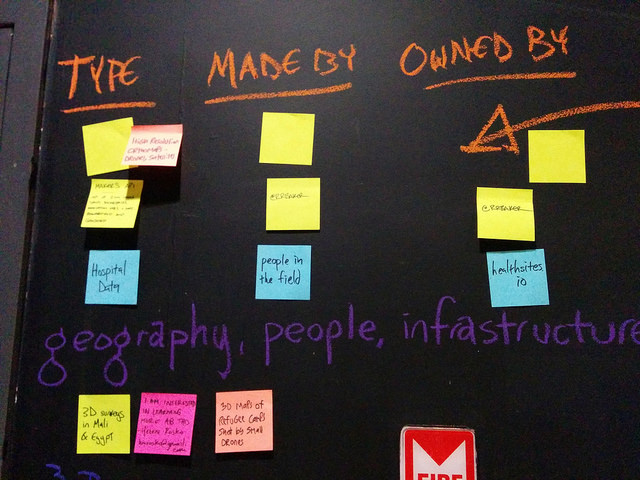
We have been working on a map of the digital response ecosystem here at Aspiration. While we still have a ways to go, I wanted to pause to reflect on why we are working on it and some things I have learned along the way. If you’re so inclined, the closing section includes a request for feedback and a way to be in touch.

The current state of affairs

Disaster and humanitarian response happen in a chaotic and low-information environment. Even if historical context, accurate maps, and up-to-date data existed before a shock, an extreme event will have disrupted that baseline in dramatic ways. Response organizations deploy into these environments seeking what we call “situational awareness,” sometimes wondering about who to ask about the location of vulnerable persons, other times wanting to know which roads are still navigable. In order to know more about their physical and logistical environment, many response organizations and community groups are beginning to make use of digital tools. There are also digital tools which allow us to do truly new things in addition to information gaining and sharing. Digital tools might be in the form of crowd-sourced maps about needs and outages made from Twitter updates with hashtags, or images composited from a drone for an overview of an affected region for locating the most damaged areas, or heavy statistical modeling based on datasets from multiple sources for more precise resource distribution. The introduction of these new people, processes, and tools for digital response can increase the chaos of response or alleviate it.

Official and specialized actors such as United Nations Office of Coordinated Humanitarian Affairs (UNOCHA) and the International Federation of Red Cross and Red Crescent Societies (IFRC) stand to benefit from the new skills of digital tools and the processes they enable when they are able to fold these new tools into their existing structures. When they are able to do this, we all benefit from their increased capacity. Frontline populations in affected regions continue to use digital tools like Signal and Facebook to organize themselves and coordinate response. Community groups such as churches and schools are using their existing digital community infrastructure to organize larger local relief efforts. Digital responders help to clean, structure, and utilize the massive amounts of information generated in times of crisis so those in the midst of the chaos can have more visibility to the requests, offers, and other factors in play around them.

Is there any signal in this noise?

What does this flurry of activity look like, and how can it be improved? How can we someday make crisis response boring? What are the patterns in who does what, when, and how do they coordinate with each other? While some official organizations have name-brand recognition, there is little understanding of local, emerging, and digital sectors. Their contributions and challenges are often rolled up into the official response organizations’ documentation, if it is documented at all. The flows of information, communication, and other aspects of coordination are poorly understood, even by those within the ecosystem, and especially in regards to the smaller and newer groups. Is it feasible to have a roster of all local groups with capacity related to response? Who would build it and keep it up to date? Would we trust the data it contained?  It is this complexity which is partly to blame for official response organizations not being able to have situational awareness and to relatedly struggle to meet local needs. So when an extreme event happens, groups spin up locally and remotely because of pressing need and the invisibility or inadequacy of pre-existing response groups. Those new groups persist, morph, merge, or dissolve through response and recovery phases of the disaster cycle. It used to be standard for several hundred response groups (pre-existing or otherwise) to respond to a crisis. Four thousand responded to the Haitian earthquake. The desire to involve technology in this mix has increased the number of factors to consider by adding in tools, active remote and local people, and even new abilities. Most people also point at the 2010 earthquake in Haiti as the first instance of digital tools making a discernible impact in crisis response. While this is a moment of potentially increased chaos in a space sorely needing alignment and sharing, it is also a moment of potential. What if we bring our ideals of openness and co-equality to the table? What if we trust the network (frontline community members, official responders, volunteers, remote assistance, etc.) to understand and sort itself out, adapting to challenges as they emerge?

Making the invisible visible

With acknowledgement that the digital response ecosystem is a living and changing thing, a map of it could provide a shared view of current actors, the tools they use, the data generated and used by those tools, and the resources we build from and contribute back to. Our hope is that this shared view might help us to provide better ground for refining information flow, to discover possibilities for collaboration, and to devise shared infrastructure. We could thus begin to think more holistically about response, get insights into how to make response infrastructure and mechanisms more sustainable and scalable, and be able to easily share an overview to newcomers or other interested parties. It is with these hopes that we started asking for help in building a map of the digital response ecosystem. Through calls with allies and structured activities at Humanitarian Technology FestivalHumTechthe Doctors Without Borders Logistics Day, and at the June 2016 Digital Responders’ Meetup, the map is slowly beginning to take shape. Here are some things we have learned along the way. 

This is a volatile space

Crisis response is by its very nature generally unpredictable. A rare caveat are hurricanes, as our weather science is getting better and better so we can approximate their strength and direction. But because we still do not understand what is going on with the earth’s crust and seas, earthquakes are still widely considered impossible to predict. Droughts are often just as political as they are about complex environmental factors, so anticipating them is somewhere in between. This means it is difficult to get any sense of predictability to rely upon or plan within for crisis response. Our data model needed to factor in the components which trigger a response group deploying or emerging from a frontline community. Activation could be based on geography (local, regional, national, international), based on the part of the disaster cycle, or based on an explicit request (from an international agency, national or local government, or a community group). Some groups (like Doctors Without Borders) are not activated from external cues per se, but instead based on their own mandates. And each of these groups focuses on different topics, ranging from accountability to mapping to data sharing to telecommunications infrastructure. To try to show connections and flows between these different entities which also bridge geography and time cycles can be somewhat daunting! Too much granularity and the whole thing is overwhelming, but too little and no patterns can be picked out.

Our sharing gaps are significant

Open (and responsible) data, libre source code, and collaboration are heavily advocated for in humanitarian and disaster response. We often hope to work miracles on shoestring budgets and with little awareness of what our comrades are up to. With a few shining examples such as Kathmandu Living Labs in the 2015 Nepal earthquake and Crisis Cleanup for Sandy, efforts to share our knowledge and intentions with each other are more often stymied than not. It is a common story that the country office of one international response nongovernmental organization does not know how (or even what) the office in another country is doing. This means it is even less likely their partner organizations or other groups in the same deployment know what they are up to. During a crisis, sharing and communication occur by force of function, but also in hugely inefficient ways because other priorities are at hand. UNOCHA has done a lot of work in this space, making it easy for deploying groups to upload and view data in a shared space through the Humanitarian Data Exchange and the Humanitarian Exchange Language, along with their traditional Cluster Approach. However, much of this work is targeted at established and dedicated response groups who know how to look for each other and have potential funding infrastructure which requires their collaboration. The smaller, ad hoc, and digital response groups do not have the context or infrastructure for their sharing and collaboration amongst themselves nor with larger response groups. There is still a lot of work to be done in sharing data and plans within and between organizations, across different parts of the response cycle, as well as with local community groups.

Who will (and can) show up changes

Because there are so many factors in who can deploy where, when, and why, investing the time in building relationships and channels for communication and sharing could be seen as a waste. It is even more impossible to have a plan that will be of any use in this circumstance than in nearly any other, and to rely heavily on rigid plans rather than adaptability is a recipe for disaster. But planning is still necessary if we are ever going to get better at response than we are now. Rather than rigid plans and expectations, we can instead focus more on the sorts of response groups that show up, the types of local groups which emerge, and the patterns of their interaction. Resources for these categories and personas have to be generalizable enough to be used, improved, and updated by anyone in that category or of that persona. Mapping the ecosystem is not just about having an easy-to-approach description of the space, but also about discovering the most strategic communally-held resources to create (or to find and share).

Where to from here?

We are moving towards a stable draft of the ecosystem map, and we want your feedback! You can attend the August Digital Responders’ meetupjoin the mailing list, or just ping us directly.

We would like to thank all the folks who have already spent so much time and energy on this concept with us. I have especially benefited from conversations with Devin Balkind, as well as referencing past collaborations he had a huge hand in, namely Aid Badges and Resilience ColabHeather Leson has been a huge contributor and supporter. The attendees of Humanitarian Technology Festival, the hallway conversations at HumTech, the participants of the Doctors Without Borders Logistics and Clinician Day, and cohorts at the June Digital Responders’ Meetup have also added a great deal of information and structure to this data. Because we are doing this together, it can grow beyond a proprietary or bottlenecked resource into one useful for the entirety of the space.

Forbidden Research liveblog: Against the law: countering lawful abuses of digital surveillance

With bunnie huang, Author, Hacking the Xbox: An Introduction to Reverse Engineering and Edward Snowden. Liveblog by Sam Klein, Erhardt Graeff, and myself.

Introduction and overview from Snowden

This is my first time giving an academic talk, and I think it’s the first time a US exile is presenting research at a US academic institution. One of the great things about Cory’s talk is that we don’t talk enough about how laws are a weak guarentee of outcome. theft, murder, etc still happen.

I’m Edward Snowden, I’m director of the Freedom of the Press Foundation. Some years ago I told the truth about a matter of public importance. Some years ago a warrant was issued for my arrest. I’m no longer allowed to travel freely. I’d like to thank MIT for organizing ths conference and the opportunity to speak to everyone in the room today. For journalists in the audience, that’s not a small thing; they deserve credit for living up to that commitment to knowledge. No one is perfect, everyone makes mistakes, but that is quite a risk. This may be the first time an American exile has been able to present research at an American university. That’s [already] enough reason to have this talk at a forbidden research conference.

The guiding theme of many of the talks today is that law is no substitute for conscience. Our investigation covers lawful abuse. What is that? It seems it might be a contradiction in terms. When I talked to someone on Twitter, immediately they said ‘lawful abuse – it’s not a contradiction!’ But if you think about it for a moment it might seem more clear. The legality of a think is after all quite distinct from the morality of it. I claim no special expertise for any of this, but having worked for both the NSA he CIA I know about about lawful abuses. After all, mass surveillance was thought to be constitutional… yet it was later found by the courts to be different, after more than a decade. A lawful abuse, I would define as “an immoral or unethical activity protected under a shell of law”.

What about things that are more recent? Mass surveillance is closest to my own experience, but let’s set that aside. What about torture? the Bush administration decided that this could be indefinitely [legalized]. What about internment? Extra judicial killing, far from any war zone, often by drones? The [targets] may be criminals, or armed combatants — in many cases, but not all. The fact that these things are changing, often in secret, without anyone’s consent, should be concerning.

Such abuses aren’t limited strictly to national security. We don’t want to this to be about politics between doves and hawks.
Segregation.
Slavery.
Genocide.
These have all been perpetuated under frameworks that said they were lawful as long as you abide by regulations.

Lawful abuse surveillance might be more difficult to spot:

  • A restriction on who and how you can love someone,
  • An intentional tax loophole, or
  • Discrimination.

Lawful abuse: so we’ve defined the term. [Willow is thinking about an anarchist zine about D&D called “Lawful Ain’t Good” and how there are only 8 (not 9) alignments.!]

Combined with legal frameworks, our daily activities produce an endless wealth of records which can and are being used to harm individuals, including those who have themselves done no wrong. If you have a phone in your pocket that’s turned on, a long-lived record of your movements has been created. As a result of how the network functions, your devices are constantly shouting into the air, via radio signals, a unique identity that validates you to the phone company. This is not only saved by the phone company, but can be observed as it travels, by independent, even more dangerous third parties.

Due to proliferation of an ancient 3d-party-doctrine style interpretation of law, even the most predatory and unethical data collection regimes are [usually] entirely legal. So if you have a device, you have a dossier. They may not be reading or using it, but it’s out there.

Why should we care? Even if there are these comprehensive records of your private activities: where you are, who you went with, how long you were there, who you meet with, what you purchased – any electronic activity records…?
I can think of 1,070 reasons why it matters. According to figures of the committee to protect journalists, more than 1070 journalists or media workers have been killed or gone missing since January 2005. This might not be as intuitive as you expect… we’ve had a number of wars going on, those could be combat deaths. But: murder is a more common cause of death, and politics was a more common newsbeat [to be targeted] than war correspondence.

Why is this? Because one good journalist in the right place and time can change history. They can move the needle in the context of an election. They can influence the outcome of a war. This makes journalists a target, and increasingly the tools of their trade are being used against them: technology is beginning to betray us not just as individuals but as classes of workers, including those putting a lot on the line in the public interest – especially those who rely on communication as part of their daily work.

And journalists are being targeted specifically based on those communications. A single mistake can have a lot of impact; it can result in detention. For example, David Miranda (related to reporting on Snowden) had his materials seized by the British government, after they intercepted his communications about plans to travel.

It can also result in far worse than that. In Syria, Assad began surveillance the city of Homs, to the extent that all foreign journalists were forced to flee. The government stopped accrediting journalists, and they were being beaten, harassed, disappeared. Only a few remained, including a few who specifically headed there to document abuses being visited upon the population.

Typically in such circumstances , a journalist wouldn’t file reports until after they had left the conflict area, to avoid reprisals. But what happens when you can’t wait? When there are things a government is sort of arguing aren’t happening, but are happening? At the time they denied they were targeting civilians; they were claimed to be enemy combatants. These lawful abuses of activities happen in many places. You say surely this isn’t lawful! By international law you are right; by any interpretation of the Universal Declaration of Human Rights, it’s not lawful. But domestic laws are a hell of a thing… China, Russia, North Korea, Syria have courts. They have lawyers and general counsels, who create policy and frameworks to justify whatever it is the institutions of power want to do.

In Homs, the Syrian government was lying in a way that affected international relations: they justified the offensive, but there was a reporter there [Marie Colvin] infiltrating the city. She crawled in through a tunnel in the dark, climbing stone walls, not speaking to avoid being fired upon. She said this [the government’s claim] was not the case. She filed live report despite the fact they worried about reprisal. She spoke four times to government agencies on a single day. [quote from Colvin’s report – “there are only civilian houses here”], the building she was in was later precisely targeted, and she was killed.

This might sound like just another war story. But the next day, the makeshift media center she was working out of, was repeatedly and precisely shelled. She died, as did a French journalist. The photographer she worked with was wounded. It wasn’t until a while after that we found, based on intelligence collection, that the Syrian Army had given the order to target journalists. How did they discover her? Know where to aim? According to reporting this week: her family has filed a suit against the Syrian government, claiming the audio frequencies of her communications were intercepted by the army (using direction-finding capabilities). Then they walked artillery fire towards the makeshift media center. They had a spotter somewhere in the city helping. By the time the second shell hit, they know they were in trouble… She was caught by a shell and killed.

There’s a question here among policy officials: was this legal, how do we remediate these threats when they happen, when do policies fail? This is an argument that the Syrian government says the event was misunderstood—these were terrorist attacks, or they were lawful.

But does it matter, if it was lawful or not [by national law]? [Perhaps we should ask:] Was it moral? Can we put safeguards in place for future journalists? What about journalists who have to meet with a source in a denied area? They don’t want their phone to be shouting indications of their movements.

This is the area of our research.

We also wanted to investigate: Can we use devices, that are so frequently used against us, as a canary to detect these new efforts to monitor us? (ex: malware attacks, to compromise the phone)

For example, there was an Argentine prosecutor [Alberto Nisman] who was killed. They discovered malware on his phone. It did not match the OS, so it was not responsible in that case, but it was clearly an attempt has been made to compromise devices and use them against him. This same attack was used on other lawyers and journalists in Latin America.

If we can start using our devices as a canary to know when phones have been compromised, and can get that to a targeted class of individuals—journalists or human rights workers—so they know they are acting in unexpected ways. We can affect the risk calculation of the offending actors. The NSA is very nervous about getting caught red-handed. They don’t want to be known to target these groups, journalists and lawyers. They have only done this rarely; it’s not their meat and potatoes [but it has happened].

But if we can find out when it happens, we can start to change the risk calculation. If we can create a clear record of activites. In the cases so far, impunity was the most frequent outcome. Perhaps, we can start affecting the cost of carrying out lawful abuse of digital surveillance.

Let’s go to the technical side and talk about what we’ve done. [to bunnie]

Great #forbiddenML talk: @Snowden & @bunniestudios on hacking phones to detect hacked phones https://t.co/KnuQncm66z pic.twitter.com/h21qx55p9S

— Erhardt Graeff (@erhardt) July 21, 2016

bunnie tells us about the technical parts

There are a lot of smart people working to turn phones into cyber fortresses. But smartphones are a large, complicated attack surface. Can you trust the gatekeeper and UI? If you read things about airplane mode after ios8, it doesn’t turn off GPS. It’s constantly on without any indicator on the phone. So you can turn on bluetooth or wifi mode… but The little icon makes you still think you’re not sending or receiving signals. Can we have a CCTV on our own phone? Technical goal is to be sure the cellular model, WiFi, GPS, etc. Trying to secure this against a state-level adversary is difficult. Turn over the phone and look on the back, and you have a surface that’s simpler, with only two notable features: antennae. A choke point for things going in or out. If you want to ensure your phone isn’t sending signals, you can turn on airplane mode.

Technique: “Direct introspection”
Principles:

  1. OS and inspectable, you don’t have to trust us.
  2. partitioned execution environment for introspection. (in case phone was compromised, don’t ask it to self-eval)
  3. proper operation field-verifiable,
  4. hard to trigger false positives (like walking by a strong wifi emitter),
  5. hard to trigger false negatives Vendor can put holes in a wall that you once thought was intact.
  6. be undetectable: avoid leaving a signature that’s easy to profile (that you’re introspecting)
  7. intuitive interface 🙂 Shouldn’t have to be a cryto person to use it.
  8. final solution should be usable every day; not hard to do while traveling in and out of protected areas.

With that in mind, I went to shenzhen and started buying a bunch of bits and bobs. Are there any viable signals to introspect? We found signals strongly correlated w/ activation of the radio. even firmware updates would have a hard time bypassing that. Candidate wires/signals: configuring antenna switches, configuring power amps, baseband to comms, wlan to comms, reseting pci bus, bluetooth to comms, gps quality sync.

Next steps:

  • Develop hardware. Build circuit to monitor signals. “Battery case” add-on to existing iPhone 6
  • Extend technique. Other makes and models of phones. Filesystem and OS integrity using disk introspection.

Closing

See more: htps://goog.lg/y0Fslu and pubpub.org/pub/direct-radio-introspection

This was my first acad collab; having bunnie as your first collaborator is amazing. He is one of those individuals whose competence gives people impostor syndrome. So, I’ll do my best. thank you very much.

Forbidden Research liveblog: Messing with Nature: Genetics and Climate

Live blog by Sam Klein, Natalie, and myself.

Genetics

How do you innovate in a field of massive potential and risk? When it comes to genetically engineering living things, most of the technology being developed happens behind closed doors. How do we change the perception of science and genetic engineering with an emphasis on openness for the sake of safety, ethics, and cautionary vigilance but continue to move forward? Who should be responsible for making “god-like” decisions that will ultimately affect our entire future as a society? Megan Palmer, Senior Research Scholar, Center for International Security and Cooperation, Stanford University was our moderator.

Developing the field of synthetic biology. Policy and practices around the safety, security, ethics, governance around engineering biology. Does getting better at doing this actually increase our health, prosperity, etc? Microscopic organisms are already trying to kill us all the time. Are unintentional ramifications or malicious use open us up to unacceptable risks? Can we make this information open to the wide public? We’re both destroying and saving the world all at the same time.

There’s a First Robotics competition. We have genetically engineered machine competition. What will undergrads make? Don’t compete them against each other, but instead “what is the most useful thing we can do with this tech?” Give incentives and rewards to be thinking about these questions the whole way. Learn the US had a destructive biological warfare program. Since the 70s we don’t do that, that they have to uphold that. Limit between what is constructive and destructive. Dual use research concerns, like work on pathogens. When we develop the data about balancing things, the jury is still out. Who decides in these cases of uncertainty?

Community consent, the dangers and benefits of bioengineering

Kevin Esvelt, Director of the Sculpting Evolution Research Group, MIT Media Lab
When we engineer life, what does that say to other people? What are the repercussions to the living systems we depend upon? We tamper with them at our peril. When we alter one organism, we tamper with something nature has optimized to thrive in the wild. So we end those threads when we mess with individual organisms (or we upset the rest of the ecosystem). Gene Drive Inheritance makes dominant genes (so spread through the wild). Block out all mosquitoes that carry malaria. Make crops that are not tasty to invasive species ending blights. What if someone makes a mistake? Public backlash and harm to the planet, to the population, to the field, to research. Working to make all work in the open. If we have the possibility of messing everything up, everyone should be able to see what we’re doing. We’re not always careful, there are laboratory accidents. Right now it’s hard to find other pieces of the puzzle, hard to know if your efforts are wasted if someone else is already doing it. By working in the open we are more effective AND more ethical.

Preventing mice at Martha’s Vineyard from getting infected with Lyme disease, which means no ticks would have it, which means kids don’t have it. Working with the potential community before we even start the research. We want independent monitoring set up by you to be sure everything goes well. End points for the project unless you say it’s ok to proceed. [and of the 100 people who came to this meeting, every one supported moving forward]. So there is a way of moving forward in cases like this, but trust is not a given. It must be earned each and every time.

Bringing back from extinction, or revitalizing endangered species?

Ryan Phelan, Executive Director and Co-founder, Revive & Restore, The Long Now Foundation

No one believed we could completely wipe out a species. But now it’s ingrained that extinction is forever. Is there recoverable DNA? Would that change the game? Woolly Mammoth in a healthy ecosystem someday. It’s a long project. But it’s super taboo for academics and funders. But they’re happy about the other side (helping endangered species come back). Secure gov sponsorships, fish and wildlife, etc.

It will take away from teh concept that “Extinction is Forever” as a rallying cry which has helped us be motivated as citizens. But if we’re pioneering this, like from the Passenger Pigeon we could recreate that ecosystem. Taking money away from conservation (if it’s a 0-sum game). We want to bring more money in. We may release a problem for future generations. We’ve made it look easy so people will take money off of protection. Frozen Zoo! Was considered rouge for taking in and saving endangered species DNA. But we’re now taking cells out to increase genetic variation. Now the Frozen Zoo is prescient.

The context of genetic engineering

George Church, Professor of Genetics, Harvard Medical School
It may be forbidden to do some research on others, but it seems moral to experiment on yourself, your own body. I know a number of people, now, doing gene therapy on themselves, way in advance of animal trials.

There are a number of trials currently underway. This ability to self modify is quite prominent. It’s not all about genes. Many things which are heritable. We have four generations of phones in my family. We talk about genes as irreversible. the other things we inherit are hard to reverse like our culture and our technology. What we’re worried about is that something we do could be very attractive in the short term which has repercussion in the longer term. We worry about changing our environments in unintended ways. We have twice what we thought was the carrying capacity of the globe, and half of what we will end up with.
This has been a core part of our work in our lab: Making open

  1. How people are involved in medical research so they have access to their own data.
  2. Rise of synthetic biology – we’re on an exponential curve. I Argued for [open] surveillance of the uses of synthetic biology, since things are changing so rapidly, so we’re aware of what is happening

We don’t just need a reaction to things we think are yucky (germline is more acceptable than abortion to some folk). We need to think a bit out of the box rather than immediate rejection. Altering our minds, electrodes implanted in our brains for epilepsy and depression. Will become more and more biological. This can happen much faster than the germline. This is going to be a much faster revolution.

Genetic question and Answer

how do you reconcile? advisors?
* openness to being advised. listening carefully as well as teaching. hear what folk are up to, worried about. Make a special effort to make our information public (ignoring possible competitors)
* what if Martha’s Vineyard hadn’t been 100%? Would have been up to the community to decide percentage for consensus? He wanted at least one skeptic, as those are the folk who actively check you for the things that will destroy the project or allow it to cause lots of issues.
* have you decided to move forward outside of consensus? Revive and Restore adapted to public response asking for shorter term gains. We don’t need consensus to do science, but we do need public input.
Not all of our community takes these precautions. How do you resolve your differences with them?
* We decided to tell everyone BEFORE we did the thing, which is just not done in science. You usually prove it before you tell people. The history of science is that of closed doors. We can get away with being open, but what about our students? Us pushing them to being open means our students might get scooped, and that ruins their career.
We publish about the study and then ask for public comments. Sometimes we don’t get any, and somtimes they’re not good.
* You can’t just publish a lab notebook and expect others to know what to do with that. We write stories around it.
* Fruitflies – a group was going to do self-inserting CRISPR, going to publish it as a method for others to use. not thinking about ramifications across everything else. We can’t think about all the ramifications on our own.
We claim to be democratizing things, but are we actually distributing everything?
* sequencing that is hand-held. Wearable sequencing. Surveillance of micro-organisms. DIY Bio should be the ultimate in citizen science. Outreach through films and congress and etc.
Informed consent can’t be given for algorithmic decision making. What are the folk in Martha’s Vineyard consenting to? [side note from Willow to check out the Framework for Consent Policies]* Ask people to take an exam about if they understand what they’re consenting to.
* People are consenting to trying it out right now, not anything else.
As we talk about ideal genetics, who gets to decide about the ideal human? What we currently call disability, what gets expressed and not expressed? What happens to the forms that are or aren’t expressed?
* More discussion around how ti INCREASE (not decrease) diversity. There’s no ideal put forth. The lesson we learn time and again is that diversity is an extremely good thing. Culture, color, neural, bio. We’re selecting for female when we select. We’re selecting away from painful diseases.
Is any attention being given to LACK of habitat for these revitalized organisms?
* Yes. We’ve helped shape de-extinction guidelines. one main one is where they would flourish. Others include that the purpose is encouraging the flourishing the species in its natural habitat, not as a zoo specimen. And that the original cause of the extinction (hunting, pollution, etc) has been removed. increasingly we have new challenges like diseases, invasive species taking down bottleneck.
A CRISPR product has been introduced (a mushroom). There was no policy or regulation around it.
* Let’s not demonize a specific tech, but know what we do and don’t want from it.

Genetic closing

What’s the one rule you love to break, or what is one forbidden thing you’re thinking about?
* We break the rule of being silent scientists. Some colleagues say it’s not their responsibility to point things out (esp related to their funding). I don’t feel edgy stating that we’re not like that.
* Do we have a chance to think beyond what we’re doing right now?
* people in our field think that we “shouldn’t tell the muggles.” I think we should. Evolution is amoral, nature is amoral. Evolution hasn’t optimized for flourishing and wellbeing, should we be doing that? Is that moral?

Climate

Moderated by Stewart Brand, Editor, Whole Earth Catalog and Founder, Long Now Foundation; with panelists David Keith (Professor of Applied Physics, Harvard School of Engineering and Applied Sciences, and Professor of Public Policy, Harvard Kennedy School) and Gernot Wagner (Research Associate at Harvard School of Engineering and Applied Sciences, Co-author, Climate Shock).
Geoengineering, or using technological interventions to address climate change, is much on the minds of scientists, policy makers and citizen groups. As our ability to “mess” with nature evolves from science fiction to reality, we are faced with serious questions about whether the possibility of success is worth the massive potential risks. Technologies for reflecting solar radiation back into space are being researched, but what will happen if we deploy them? Who should decide? Who will?

If anything could go wrong with something new, don’t do it. Moral hazard is “lack of incentive to guard against risk when one is protected against its consequences.” Treating the symptoms of climate change, giving people the ability to ignore the causes. “A junkie figuring out new ways to steal from their children.” The Whole Earth Discipline.
Solar geoengineering rests on the simple idea that it’s possible to make the whole earth a little more reflective. Reduces the risks of carbon. It’s relatively easy and it’s relatively cheap. It could also diminish the problems we care about most. We could bring temperatures back to pre industrial. That’s not doubted. But does it deal with extreme events like big storms, heatwaves, rising sea levels? We have no real research programs as we don’t want to think about it. But now it’s been modeled etc. On a region by region basis if used appropriately reduce all these risks, increase productivity of crops worldwide. How do we control and learn more?

Why don’t we just stop emitting carbon dioxide? no cars, planes, powerlines. Would it get warmer or colder? Warmer, because we have a delayed feedback loop. Might be up to a century. Solar geoengineering is different. We still have to get emissions to zero. It partially, imperfectly deals with the CO2 we’ve emitted in history. Lots of questions about tying ourselves to the mast, about messing with history, etc. We’re already messing with nature, it’s going to keep being messed with. We might be doing less than if we don’t do solar geoengineering.

If a person comes in who needs Lipator, they also need to diet and exercise. As an economist, you would reduce your 30 minutes of exercise by 30 seconds. But people actually do 90 and keep doing 90. Those who do none might say “holy shit I need a pill to keep me alive? Maybe I should also take the stairs more often.” Because people aren’t rational. So if we’re talking about acting on solar geoengineering as a response to climate change, are people more or likely to vote for things that reduce emissions?

We have next to no support in doing this. This research has been suggested since 1982. Field experiments might make sense as a study 2 years ago. People don’t argue back, but somehow we just can’t. There are now formal Chinese programs, EU programs. US programs are done by diverting funds or philanthropic. And this is a sort of political cowardice. Almost all climate models. Some small experiments to understand the key processes to understand the risks and efficacy. All modeling or social sciences (there might be more here and governance than science). We talk more about whether or not its ok to talk about than talking about it.

Want to deliver how to do this in a technical sense, what failure modes would look like, how to monitor for failure, governance structures. Those are our goals within the decade. Sulfuric acid because we know volcanoes do it. Limestone might slightly restore the ozone layer. We know what nature does, how long it lasts, what sort of cooling it does. Sulfate damages the ozone layer. All of this is talk until we get to experiment. Looking at key chemistry interactions which we don’t know yet. Release small amounts of various materials we think would work, see how it affects things around it. We’re not saying it should be done, we’re saying we need to develop the knowledge of how to do it so we can make informed discussions.

We can do better than sulfates for solar geoeng: Calcium carbonate; diamond dust [factory production (vapor deposition) is cheap]. System engineering when we don’t fully understand it, is that responsible? We’re committed to it. We’re already doing it. How do we couple human governance with planetary management? How intelligently are we doing to do this? We’re already altering the environment and our planet.

The people most affected by climate change are those in tropical countries who feel the heat the most. The moral pressure to protect those most affected is huge.

Challenge with cutting CO2 emissions: You don’t feel the effects of your own actions – CO2 emissions. The reason we aren’t cutting emissions, unlike progress with pollution cutting, is because the generation of people who will be cutting CO2 emissions aren’t the ones who will benefit from decrease. Simple thing is just to keep putting CO2 in the air. Mitigation takes a long time to get it to happen, slow response time. You’re talking about a quick intervention. Solar geoengineering happens within a political cycle.

Urge us not to assume that the natural answer is that the possbility of solar geoengineering. We need to do the best we can to tip the balance of the planet into our survivability. We’re up to 8 or 10 professors, getting funders to pay attention to us. Prominent environmental donors are coming up, hoping to tap in there. Harvard and China.

For solar geoeng, it’s so cheap that any country could just do it…. [or some individuals]Some companies, new startups, are working on capturing CO2 in the air. That’s less controversial: make low-carbon fuels for power. There is a competitor in Switzerland called Climeworks AG.

CO2 removal is complicated. Solar power is getting cheaper. Can use that to produce hydrogen, combine with sequestered Carbon, make fuel. Carbon in and out of the biosphere, it’s like having a pile of flamable stuff in Central Valley California. The cycle is hours (foreset fire) to decades (ecosystem life cycle). To put carbon in the ocean doesn’t work.

Recent research showing some hurricanes are being suppressed due to aerosol. Ice sheets are deeper, different.
Clearing up pollution in China — is that going to warm things up? Should we stop cleaning up the air? No! Europe in the 70s started cleaning up because acid rain etc. For Europe, decreasing tropospheric aerosol pollution has likely incrased temps in the Artic by half a degree celcius. Should we stop killing people? But then stratospheric injection. 50*26 for sulpher we put in the lower atmosphere, [THERE ARE NUMBERS I DON’T KNOW WHAT’S GOING ON — willow]

We’re talking about doing some things on islands to control for impact. What about consent when it’s the whole globe?
Sulfur doesn’t have sex. if you do a tiny experiment in the stratosphere, and you quit doing it, you’re back where you started. There’s some small risk bio would run amok. Except for a moral hazard.
But how we make a global decision like this is unprecedented. How do you handle global consensus? There is no global government. For oceans, there’s teh World Ocean Commission. 15 or so wise men or women, they don’t have any power, it’s a talking shop but it’s a place to give guidance. Step one is to take the decision away from teh scientists. They can provde the technology but it’s literally everyone else who needs to be there for when to turn the knob. We’re not tryking to deploy this, we’re trying to research it. Are the benefits and costs balanced? Vaccinations were 1000 to 1.

Will we end up with citizen science/disobedience of people doing small versions of this?
Forbidden Research liveblog: Messing with Nature: Genetics and Climate

Live blog by Sam Klein, Natalie, and myself.

Genetics

How do you innovate in a field of massive potential and risk? When it comes to genetically engineering living things, most of the technology being developed happens behind closed doors. How do we change the perception of science and genetic engineering with an emphasis on openness for the sake of safety, ethics, and cautionary vigilance but continue to move forward? Who should be responsible for making “god-like” decisions that will ultimately affect our entire future as a society? Megan Palmer, Senior Research Scholar, Center for International Security and Cooperation, Stanford University was our moderator.

Developing the field of synthetic biology. Policy and practices around the safety, security, ethics, governance around engineering biology. Does getting better at doing this actually increase our health, prosperity, etc? Microscopic organisms are already trying to kill us all the time. Are unintentional ramifications or malicious use open us up to unacceptable risks? Can we make this information open to the wide public? We’re both destroying and saving the world all at the same time.

There’s a First Robotics competition. We have genetically engineered machine competition. What will undergrads make? Don’t compete them against each other, but instead “what is the most useful thing we can do with this tech?” Give incentives and rewards to be thinking about these questions the whole way. Learn the US had a destructive biological warfare program. Since the 70s we don’t do that, that they have to uphold that. Limit between what is constructive and destructive. Dual use research concerns, like work on pathogens. When we develop the data about balancing things, the jury is still out. Who decides in these cases of uncertainty?

Community consent, the dangers and benefits of bioengineering

Kevin Esvelt, Director of the Sculpting Evolution Research Group, MIT Media Lab
When we engineer life, what does that say to other people? What are the repercussions to the living systems we depend upon? We tamper with them at our peril. When we alter one organism, we tamper with something nature has optimized to thrive in the wild. So we end those threads when we mess with individual organisms (or we upset the rest of the ecosystem). Gene Drive Inheritance makes dominant genes (so spread through the wild). Block out all mosquitoes that carry malaria. Make crops that are not tasty to invasive species ending blights. What if someone makes a mistake? Public backlash and harm to the planet, to the population, to the field, to research. Working to make all work in the open. If we have the possibility of messing everything up, everyone should be able to see what we’re doing. We’re not always careful, there are laboratory accidents. Right now it’s hard to find other pieces of the puzzle, hard to know if your efforts are wasted if someone else is already doing it. By working in the open we are more effective AND more ethical.

Preventing mice at Martha’s Vineyard from getting infected with Lyme disease, which means no ticks would have it, which means kids don’t have it. Working with the potential community before we even start the research. We want independent monitoring set up by you to be sure everything goes well. End points for the project unless you say it’s ok to proceed. [and of the 100 people who came to this meeting, every one supported moving forward]. So there is a way of moving forward in cases like this, but trust is not a given. It must be earned each and every time.

Bringing back from extinction, or revitalizing endangered species?

Ryan Phelan, Executive Director and Co-founder, Revive & Restore, The Long Now Foundation

No one believed we could completely wipe out a species. But now it’s ingrained that extinction is forever. Is there recoverable DNA? Would that change the game? Woolly Mammoth in a healthy ecosystem someday. It’s a long project. But it’s super taboo for academics and funders. But they’re happy about the other side (helping endangered species come back). Secure gov sponsorships, fish and wildlife, etc.

It will take away from teh concept that “Extinction is Forever” as a rallying cry which has helped us be motivated as citizens. But if we’re pioneering this, like from the Passenger Pigeon we could recreate that ecosystem. Taking money away from conservation (if it’s a 0-sum game). We want to bring more money in. We may release a problem for future generations. We’ve made it look easy so people will take money off of protection. Frozen Zoo! Was considered rouge for taking in and saving endangered species DNA. But we’re now taking cells out to increase genetic variation. Now the Frozen Zoo is prescient.

The context of genetic engineering

George Church, Professor of Genetics, Harvard Medical School
It may be forbidden to do some research on others, but it seems moral to experiment on yourself, your own body. I know a number of people, now, doing gene therapy on themselves, way in advance of animal trials.

There are a number of trials currently underway. This ability to self modify is quite prominent. It’s not all about genes. Many things which are heritable. We have four generations of phones in my family. We talk about genes as irreversible. the other things we inherit are hard to reverse like our culture and our technology. What we’re worried about is that something we do could be very attractive in the short term which has repercussion in the longer term. We worry about changing our environments in unintended ways. We have twice what we thought was the carrying capacity of the globe, and half of what we will end up with.
This has been a core part of our work in our lab: Making open

  1. How people are involved in medical research so they have access to their own data.
  2. Rise of synthetic biology – we’re on an exponential curve. I Argued for [open] surveillance of the uses of synthetic biology, since things are changing so rapidly, so we’re aware of what is happening

We don’t just need a reaction to things we think are yucky (germline is more acceptable than abortion to some folk). We need to think a bit out of the box rather than immediate rejection. Altering our minds, electrodes implanted in our brains for epilepsy and depression. Will become more and more biological. This can happen much faster than the germline. This is going to be a much faster revolution.

Genetic question and Answer

how do you reconcile? advisors?
* openness to being advised. listening carefully as well as teaching. hear what folk are up to, worried about. Make a special effort to make our information public (ignoring possible competitors)
* what if Martha’s Vineyard hadn’t been 100%? Would have been up to the community to decide percentage for consensus? He wanted at least one skeptic, as those are the folk who actively check you for the things that will destroy the project or allow it to cause lots of issues.
* have you decided to move forward outside of consensus? Revive and Restore adapted to public response asking for shorter term gains. We don’t need consensus to do science, but we do need public input.
Not all of our community takes these precautions. How do you resolve your differences with them?
* We decided to tell everyone BEFORE we did the thing, which is just not done in science. You usually prove it before you tell people. The history of science is that of closed doors. We can get away with being open, but what about our students? Us pushing them to being open means our students might get scooped, and that ruins their career.
We publish about the study and then ask for public comments. Sometimes we don’t get any, and somtimes they’re not good.
* You can’t just publish a lab notebook and expect others to know what to do with that. We write stories around it.
* Fruitflies – a group was going to do self-inserting CRISPR, going to publish it as a method for others to use. not thinking about ramifications across everything else. We can’t think about all the ramifications on our own.
We claim to be democratizing things, but are we actually distributing everything?
* sequencing that is hand-held. Wearable sequencing. Surveillance of micro-organisms. DIY Bio should be the ultimate in citizen science. Outreach through films and congress and etc.
Informed consent can’t be given for algorithmic decision making. What are the folk in Martha’s Vineyard consenting to? [side note from Willow to check out the Framework for Consent Policies]* Ask people to take an exam about if they understand what they’re consenting to.
* People are consenting to trying it out right now, not anything else.
As we talk about ideal genetics, who gets to decide about the ideal human? What we currently call disability, what gets expressed and not expressed? What happens to the forms that are or aren’t expressed?
* More discussion around how ti INCREASE (not decrease) diversity. There’s no ideal put forth. The lesson we learn time and again is that diversity is an extremely good thing. Culture, color, neural, bio. We’re selecting for female when we select. We’re selecting away from painful diseases.
Is any attention being given to LACK of habitat for these revitalized organisms?
* Yes. We’ve helped shape de-extinction guidelines. one main one is where they would flourish. Others include that the purpose is encouraging the flourishing the species in its natural habitat, not as a zoo specimen. And that the original cause of the extinction (hunting, pollution, etc) has been removed. increasingly we have new challenges like diseases, invasive species taking down bottleneck.
A CRISPR product has been introduced (a mushroom). There was no policy or regulation around it.
* Let’s not demonize a specific tech, but know what we do and don’t want from it.

Genetic closing

What’s the one rule you love to break, or what is one forbidden thing you’re thinking about?
* We break the rule of being silent scientists. Some colleagues say it’s not their responsibility to point things out (esp related to their funding). I don’t feel edgy stating that we’re not like that.
* Do we have a chance to think beyond what we’re doing right now?
* people in our field think that we “shouldn’t tell the muggles.” I think we should. Evolution is amoral, nature is amoral. Evolution hasn’t optimized for flourishing and wellbeing, should we be doing that? Is that moral?

Climate

Moderated by Stewart Brand, Editor, Whole Earth Catalog and Founder, Long Now Foundation; with panelists David Keith (Professor of Applied Physics, Harvard School of Engineering and Applied Sciences, and Professor of Public Policy, Harvard Kennedy School) and Gernot Wagner (Research Associate at Harvard School of Engineering and Applied Sciences, Co-author, Climate Shock).
Geoengineering, or using technological interventions to address climate change, is much on the minds of scientists, policy makers and citizen groups. As our ability to “mess” with nature evolves from science fiction to reality, we are faced with serious questions about whether the possibility of success is worth the massive potential risks. Technologies for reflecting solar radiation back into space are being researched, but what will happen if we deploy them? Who should decide? Who will?

If anything could go wrong with something new, don’t do it. Moral hazard is “lack of incentive to guard against risk when one is protected against its consequences.” Treating the symptoms of climate change, giving people the ability to ignore the causes. “A junkie figuring out new ways to steal from their children.” The Whole Earth Discipline.
Solar geoengineering rests on the simple idea that it’s possible to make the whole earth a little more reflective. Reduces the risks of carbon. It’s relatively easy and it’s relatively cheap. It could also diminish the problems we care about most. We could bring temperatures back to pre industrial. That’s not doubted. But does it deal with extreme events like big storms, heatwaves, rising sea levels? We have no real research programs as we don’t want to think about it. But now it’s been modeled etc. On a region by region basis if used appropriately reduce all these risks, increase productivity of crops worldwide. How do we control and learn more?

Why don’t we just stop emitting carbon dioxide? no cars, planes, powerlines. Would it get warmer or colder? Warmer, because we have a delayed feedback loop. Might be up to a century. Solar geoengineering is different. We still have to get emissions to zero. It partially, imperfectly deals with the CO2 we’ve emitted in history. Lots of questions about tying ourselves to the mast, about messing with history, etc. We’re already messing with nature, it’s going to keep being messed with. We might be doing less than if we don’t do solar geoengineering.

If a person comes in who needs Lipator, they also need to diet and exercise. As an economist, you would reduce your 30 minutes of exercise by 30 seconds. But people actually do 90 and keep doing 90. Those who do none might say “holy shit I need a pill to keep me alive? Maybe I should also take the stairs more often.” Because people aren’t rational. So if we’re talking about acting on solar geoengineering as a response to climate change, are people more or likely to vote for things that reduce emissions?

We have next to no support in doing this. This research has been suggested since 1982. Field experiments might make sense as a study 2 years ago. People don’t argue back, but somehow we just can’t. There are now formal Chinese programs, EU programs. US programs are done by diverting funds or philanthropic. And this is a sort of political cowardice. Almost all climate models. Some small experiments to understand the key processes to understand the risks and efficacy. All modeling or social sciences (there might be more here and governance than science). We talk more about whether or not its ok to talk about than talking about it.

Want to deliver how to do this in a technical sense, what failure modes would look like, how to monitor for failure, governance structures. Those are our goals within the decade. Sulfuric acid because we know volcanoes do it. Limestone might slightly restore the ozone layer. We know what nature does, how long it lasts, what sort of cooling it does. Sulfate damages the ozone layer. All of this is talk until we get to experiment. Looking at key chemistry interactions which we don’t know yet. Release small amounts of various materials we think would work, see how it affects things around it. We’re not saying it should be done, we’re saying we need to develop the knowledge of how to do it so we can make informed discussions.

We can do better than sulfates for solar geoeng: Calcium carbonate; diamond dust [factory production (vapor deposition) is cheap]. System engineering when we don’t fully understand it, is that responsible? We’re committed to it. We’re already doing it. How do we couple human governance with planetary management? How intelligently are we doing to do this? We’re already altering the environment and our planet.

The people most affected by climate change are those in tropical countries who feel the heat the most. The moral pressure to protect those most affected is huge.

Challenge with cutting CO2 emissions: You don’t feel the effects of your own actions – CO2 emissions. The reason we aren’t cutting emissions, unlike progress with pollution cutting, is because the generation of people who will be cutting CO2 emissions aren’t the ones who will benefit from decrease. Simple thing is just to keep putting CO2 in the air. Mitigation takes a long time to get it to happen, slow response time. You’re talking about a quick intervention. Solar geoengineering happens within a political cycle.

Urge us not to assume that the natural answer is that the possbility of solar geoengineering. We need to do the best we can to tip the balance of the planet into our survivability. We’re up to 8 or 10 professors, getting funders to pay attention to us. Prominent environmental donors are coming up, hoping to tap in there. Harvard and China.

For solar geoeng, it’s so cheap that any country could just do it…. [or some individuals]Some companies, new startups, are working on capturing CO2 in the air. That’s less controversial: make low-carbon fuels for power. There is a competitor in Switzerland called Climeworks AG.

CO2 removal is complicated. Solar power is getting cheaper. Can use that to produce hydrogen, combine with sequestered Carbon, make fuel. Carbon in and out of the biosphere, it’s like having a pile of flamable stuff in Central Valley California. The cycle is hours (foreset fire) to decades (ecosystem life cycle). To put carbon in the ocean doesn’t work.

Recent research showing some hurricanes are being suppressed due to aerosol. Ice sheets are deeper, different.
Clearing up pollution in China — is that going to warm things up? Should we stop cleaning up the air? No! Europe in the 70s started cleaning up because acid rain etc. For Europe, decreasing tropospheric aerosol pollution has likely incrased temps in the Artic by half a degree celcius. Should we stop killing people? But then stratospheric injection. 50*26 for sulpher we put in the lower atmosphere, [THERE ARE NUMBERS I DON’T KNOW WHAT’S GOING ON — willow]

We’re talking about doing some things on islands to control for impact. What about consent when it’s the whole globe?
Sulfur doesn’t have sex. if you do a tiny experiment in the stratosphere, and you quit doing it, you’re back where you started. There’s some small risk bio would run amok. Except for a moral hazard.
But how we make a global decision like this is unprecedented. How do you handle global consensus? There is no global government. For oceans, there’s teh World Ocean Commission. 15 or so wise men or women, they don’t have any power, it’s a talking shop but it’s a place to give guidance. Step one is to take the decision away from teh scientists. They can provde the technology but it’s literally everyone else who needs to be there for when to turn the knob. We’re not tryking to deploy this, we’re trying to research it. Are the benefits and costs balanced? Vaccinations were 1000 to 1.

Will we end up with citizen science/disobedience of people doing small versions of this?

Forbidden Research liveblog: Sexual deviance: can technology protect our children?

liveblog by Alexis, Sam Klein, Natalie, and myself

Ethan Zuckerman, Director, MIT Center for Civic Media moderates.

Conducting research on adults who have sex with children is virtually impossible due to ethical and legal restrictions. The advancement of technologies like robots and virtual reality has opened the door to exploring questions that were previously not possible. But while a U.S. court case has held that virtual child pornography is legal, the law in this area is controversial and emotionally charged. Legal uncertainties and vast stigma make actual research difficult. At the same time, a better understanding of this deviant behavior has the potential to significantly change lives.

Lead to paraphilia. We’re not showing explicit imagery. It may be triggering. Going to try to deal with this very difficult topic. Lots of real world ramification. 1300 people are serving time for sex crimes just in MA. X are in indefinite civil confinement – finished sentence, but not released into the general public because of fear of recidivism. Research on the statistics. 10% to 50% which suggests that there isn’t a ton of research. We know very little indeed. Most people who are afflicted with pedophilia are actively trying to fight these urges. When talking with therapists, they’re trying very hard not to act on these urges they’re suffering from. There are some existing efforts to develop support programs. Whether there are ways of treating with VR, intimate robotics, etc.. It’s a challenging topic with a lovely set of folk willing to take it on.

Kate Darling, MIT Media Lab, IP Theory, Policy, and Robot Ethics, Fellow at Harvard Berkman Center is looking at the NOW of robot-human interaction. Leads us off. Human robot interaction, how we behave around robots. People treat them as though they’re alive. We know they’re just machines, but subconsciously when we interact, we treat them as if they’re alive. Not just about people getting used to a new technology but instead something which is biological. Our brains might project intent and life on moving things which seem autonomous. How strongly we respond to the cues these machines give us. Gives us a chance to study human psychology. People who have low empathic concern for others treat robots differently than those who have high empathetic concern —this is part of a research study Kate has been conducting with Palash Nandy, a researcher at the Media Lab in the Personal Robotics group. Those who treat robots like a living thing makes them a potentially great tool for

When child-size robots come to market, will they be used to address desires and protect children, or to normalize it and put more children at risk? There’s no way for us to know. These urges are not a moral failing, they are a psychological issue. Nearly impossible to self-report as you’ll get booked. If we really care about children, we might need to be preemptive about this.

Courts don’t know what to do with these robots, since no child has been harmed in making them.
While high quality sex robots are not coming as quickly as some might think (or like), but they are coming at a pace that’s faster than society is willing to talk about.

Child porn doesn’t exist for at least two reasons: because we think it’s not ok, but also because a child was harmed in its creation. 3D modeling etc would shift that. Do any international courts handle this differently? Need intent as well as harm to have broken a criminal law in the US. In the US in ’96 we had an act forbidding pornographic CGI depicting children. In ’02 the supreme court decided there was a free speech issue that overruled, and struck down parts of that act. Since then, a new act “Protect” has been passed, which prohibits “obscene” cartoons. They’ve shifted the child piece towards obscenity, which is not well defined and depends on community standards. Ex: some media showing young girls performing fellatio was targeted b/c it was aimed at an audience of young girls to teach them improper behavior, not because it included images of young girls.

Back to the question of legal status, but what is exploitative and what is put into legal frameworks because it is uncomfortable?

Ron Arkin, Roboethicist and Professor, School of Interactive Computing, Georgia Tech. Robots and robot ethics. Sex, laws, and violence. Robot deception, killer robots, but today we’re talking about sex.

There’s plenty of money to be made in lethal autonomous weapon systems. The USG doesn’t do? that, but some people do. And I do work in robot deception (how and when robots lie?) but that’s not what we’re discussing today. Outbranch from Genevive Bell. Intimate Robotics. Most concerned with lethal autonomous systems, but also concerned about something else that is happening now. I work with Sony, and the Aibo. we know how to make people fall in love with these things. What if we start crossing from teh social space into the sexual space? the questions we ask are around if human-robot intimacy is acceptable? Do you become a deviant if you have sex with a robot? [What about one indistinguishable from a human?]

Can [sex with a robot] it serve sort of like methadone for [sexual] deviants? These are research questions which need to be explored. Any time past offenders are released back into society, there will be more victims. [as there are already today] We need to be prepared for that.

Thank you for this forum for sharing this discussion with the audience and the public.
Uncanny valley has to do with behavior, temperature, texture, etc. Roxxxy, VR robot. How will the prostetution industry do in light of these dolls etc? Some see it as a way to free prostitutes to do other things (this is a rather paternalistic view). [Examples from non-sex robots, and sex robots, the former already well-funded by governments.]

Article from the Atlantic recently: “Can Child Dolls Keep Pedophiles from Offending?”
VICE: “Canada’s Child Sex Doll Trial Raises Uncomfortable Questions About Pedophilia and the Law” A man ordered one in Canada and gets arrested. Methadone is perscription, maybe we need to do the same here.

Protest: there’s a group called Campaign Against Sex Robots, viewed by the founder as “part of a cultural pattern to legitimate pedophilia more widely”. [This reminds me so much of some of the arguments against prostitutions, not seeing how sex is a basic human need ].

Study from Stanford University — touching a robot’s ‘intimate parts’ makes people uncomfortable. Published in an obscure journal, couldn’t find funding source listed. Study on body comfort zones: differences between Japanese and American adults re: where they normally touched close friends or sexual partners, and where they touched their parents, when they met. Dramatic differences in all cases; which one would take into consideration with any robot designs.

Wanting to establish a research agenda. Will sex robots increase or decrease urges? We have an ethical obligation to do this research.

Christina Couch, Journalist
Written on the question of computer imagery. How our feelings, thoughts, desires shape our our technology is designed.

Working on an article – therapeutic uses of VR : Treating PTSD, depression, phobias, addictions. Patrice Reneaud studying pedophiles right at the point of arousal. Having someone at that point requires a stimuli, which for pedophiles have super valid concerns attached to them.

Dr. Patrice Renaud – “assessing deviant preferences in sexual offenders” using virtual immersion.

Mostly audio, having a hard time getting data. His team published a paper that even when they KNOW a subject is a known pedophile, they couldn’t evoke a response just using audio files. When VR started working, they started building scenarios with [fewer] concerns. The differences are in motor and eye movement. The data we have on recidivism is nebulous because it’s really hard to study this group. Interested that VR is what opened up these possible studies.

Also a shift in how we view pedophiles. Virtuous Pedophiles is a support group of people trying to prevent acting on their impulses. Another group like them is called the Dukelfeld Project. Confidential treatment focused on preventing them from acting out. Accessibility to a population which has been traditionally hard to research PLUS new research tools usually means a huge amount of research coming out, but not so much for this case. Dukelfeld was able to get on their feet because there aren’t reporting issues, it might be covered by insurance.

In the US, Lupron (what people use to chemically castrate themselves) can be gotten under perscription as well. We’d first need a better idea of this as a psychological problem rather than a moral problem. How is the legal system changing? We used to think homosexuality was a moral failing, and then a disease, and is now accepted. How does that transition happen? Popular culture led. TV shows etc. The law came afterwards. Untouchable was a documentary on this. If you throw the word “pedophilia” into any legal debate, all the politicians jump in to vote for it. There’s no nuance. The topic (understandably) raises so many emotions for folk that it’s difficult to have a rational conversation about it. The YouTube videos for NYT articles are saying they need to be slaughtered for saying it might be an illness rather than a moral feeling. European culture just thinks about porn files as any other file. It allows them to approach all of this in different ways.

Q+A

So: you’re a robot ethicist. What’s stopping you from studying this? A: Funding. It can come most easily from foundations, but only a limited amount does. Most governments don’t support it [though as noted elsewhere: in Germany treatment for pedophilia is covered by insurance].

Can people get help with their urges? What are their motivations for doing this work? Is there a trend in what’s going on?
I don’t know that the landscape of research today is big enough to generalize. I know of only 2 researcher using VR for this. Maybe there’s more than that, but it is small.

Q: What are the key research questions in this space (intimate robotics)? As an experimentalist, are there things you’re thinking about studying that will help answer these Q’s?
A: (Kate):- how do our interactions with robots affect our interactions with humans? I think about harm: if our interactions with robots lead to harmful interactions with other humans, than that is a bad thing. But we don’t know if our interactions with robots will lead to any of these negative outcomes, so we have to do the research.
We currently know how to observe and measure behavior with robots, but we don’t know if this changes your behavior with people. That’s hard to study in any arena, and especially with intimate robots, I’m worried we won’t do it at all. If a big name in social robotics can’t get support for such work, how can anyone do that?

Q: In defense of continental Europe and its culture – I have experience with Quaker work in this field; they are some of the frist to visit prisoners, and they work with sex offenders. All these technologies seem to further sequester and isolate offenders from society. That seems to be something they’re trying hard to get over; they want to integrate with society. Do you think it is possible in the US to propose a system where groups voluntarily engage w/ pedophiles, on the basis that they are humans, and shouldn’t be treated even worse than violent criminals?
A: (Christina) A story just came out about a [NJ?] task force that is dedicated to that. I don’t have any way to answer, but people are starting to consider it.
A: (Ron) I don’t think this is a panacea for reintegration; but it should be considered as a possible positive force.
A: (Kate) People being visited are the small percentage who have been convicted of a crime. Most people affected have a hard time coming forward at all. I love that groups are forming to help (convicts), but we need legal changes and maybe tech changes as well if those can help people.

Q: (Willow) You’re talking about a lack of data and other things. This is the most academic panel we’ve had so far. I wonder if by opening up science to more citizen science approaches like other panels have, we might catch more data and discover more things. Are there possibilities to try citizen science approaches to sex studies?
A: (Ron) Yes, and I support anyone who wants to contribute to this, but: this does need strictly controlled science evaluation, with IRB and other controls, to get reliable data. We couldn’t even get accurate recidivism rates, and how hard could that be? Numbers were all over the place, because of the dearth of data. And we need to understand the tech coming down the pike. That might be easier to distribute, rather than the study of sexual deviance.
A: (Christina) VR is also bing used to study and treat victims of sexual trauma. This (type of tech) isn’t a one-way street. When we talk about amplifying research methods, it’s not just for offenders.

Q: You all seem to say that lack of funding and stigma are barriers. What would this look like if those didn’t exist? Get to Ethan’s initial questions: how does culture change, this medium change, over the long term? How does this change the future of dealing with taboo paraphilias?
A: (Ron) Human research interaction work has at present gone almost too far in requiring huge amounts of data. I think we can develop research with small focused sets of data. Then a series of progressive experiments could gather a larger body of data over time.

Q: There are studies that suggest porn has changed standards of sex. If these child robots are rolled out, who gets to decide if you can have such robots as therapy, or as entertainment?
A: (Kate) A lot of research here has been very [basic]. Many studies have questioned if violent/sexual games change behavior. Methods used in those cases can be applied to robotics. The increased realism may have more of an effect, but similar approaches may apply.
A: (Ron) To my mind, courts or physicians would say it is appropriate. But there would have to be quasi-controlled environments for this to work.

Q: (Victoria) I’m interested in areas where sex is considered? inappropriate such as w/disability. Looking at sexual deviance – how much correlation or research has been done to see whether pedophilia is different from other deviances? (anything considered unnatural by any society: bdsm, homosexuality, &c) If we’re talking about changing human behavior, can we cross-examine sth like violence, and the relevant effects of VR? [To inform these questions in a less taboo realm.]A: (Christina) I don’t know if any correlation like this has been done. In 20y of VR research, we find that yes it can influence RL behavior. PTSD can be reduced more quickly… unconscious racial bias can be reduced (in at least one study), though that’s incredibly difficult to break even temporarily. It’s not crazy to think this could influence behavior in pedophiles.
A: (Ron) Changing human behavior happens routinely, with or without robots – a change wrt. views on marriage, bestiality

Willow question: why can’t people consent to sexual research?
Question: how do advanced robots consent to sexual research?
Willow question: why are we talking about fully autonomous systems? Does the debate in self-driving cars and mixed-control systems apply here?

Forbidden Research liveblog: Disobedience: breaking the rules for social good

Many ideas and norms once considered unthinkable, like test tube babies and gay marriage, have now become everyday norms. It’s impossible to imagine life without them. For society to evolve, however, we must always be challenging our norms as well as the rules and laws that reflect them. Our institutions must lead in a way that harnesses this questioning into a driver for positive change. This session looks at how institutions can become “disobedience robust” — cultivating the ability to question themselves and accept questioning from others.

Moderated by Joi Ito, Director, MIT Media Lab with panelists
Liz George, MIT Alum Class of 2008
bunnie huang, Author, Hacking the Xbox: An Introduction to Reverse Engineering
Karrie Karahalios, Assistant Professor, Siebel Center for Computer Science, University of Illinois

All panelists are former MIT students (although Joi says he come in the backdoor:). Before this event, Joi interviewed lots of administrators at MIT including John DiFava. And everyone said that they had never met a student who was a bad person. And DiFava spent his career chasing bad guys with the MA State Police before coming to MIT.

Karrie remembers coming to MIT for rush week her first year. She took an “orange tour” and loved it, and it seemed like it was sanctioned by the university. Her House Master encouraged the students to win the East Campus lockpicking contest. And students were constantly hacking things in the dorms like phones and washing machines.

A discipline committee was set up around 2003. The police stopped arresting people at all, but started picking up more people and sending them to this discipline committee. So people who would have been let off altogether were getting in trouble.

The trouble now is that students have this fear of getting caught.
Should they not?
Then it’s hard to abide by that last point of the hacker ethic: avoid getting caught, but if you are, cooperate fully.
I find in some places if everything is legal, it’s not nearly as interesting. Is that a big part of it or not?
Sure it is. [but that doesn’t mean “risk of imprisonment”]“Just so you know, statue of limitations is 7 years.”

There’s a thing, ‘if you see something broken, report it to Physical Plant’, we would note these things if we were up on the roof and tell them. That almost helped build as sene of community across the groups. I did get caught at the ML, I was picking a lock here, I wanted access to one of the tool rooms? They described me as “tall kid, dark hair, asian” in an email to ML. I could have avoided fessing up, but I did tell someone in my lab. They got reasonably mad at me, saying just ask for permission, it’s not hard, and showing me how. That was a scolding, not disciplinary action. I’m a little cynical about MIT’s stance – Liz said MIT likes to own successes and disavow failures [JI – that’s broadly true you know, in the world] But a university is a good place to catch people when they stumble. Especially when they just did something unfortunate [not hurting others]

The ethics associated with hacking. Breaking the rules mindfully. MIT hacker secret sheet #forbiddenMLpic.twitter.com/V2ctRuvZiV

— andres lombana b. (@vVvA) July 21, 2016

Hacking the xbox led me to discover the problems with the DMCA which led me down this whole long path to where I am today [w today’s announcement]. My advisor Tom Knight introduced me to the general counsel, I was all excited; they met me with a sealed envelope on the table; they said I just want you to know we don’t want to touch this or have anything to do with it; you did this on your own time with your own funding, good luck.
I wanted to know, why is the institute disavowing me? I didn’t even disclose what was going on, I just wanted their help to do disclosure responsibly. They wouldn’t even hep with that. Fortunately Hal A and Tom K helped me find an amicable solution (via the EFF).

Joi: Ethan mentioned TidBit, where we had a student working on a project. It’s funny b/c MIT’s counsel represents MIT. There’s some things they can and can’t do. We ended up setting up a law clinic – I’ll give credit to the GC’s office and Provost for this fully-funded and pro-bono clinic at BU. So any problems a student has can go to a BU clinic; in your case they could have directed you to that. This is recent, within the last several months. One of the problems has been the liability concern that something happens and the inst. gets sued by the parents, and lawyers are lawyers. We’ve been trying to set up ways for people to talk to the admins. Legal support is key. Hoping that will help in the future.

There are certain things the institute should sanction, but there are certain things we can’t. On the research side, there are things that affect the whole institute. Some kids don’t know what the repercussions are. I went to a lot of cases I heard about to hear their side of the story. If some of these things came out, it would hurt privacy of the student. It can be better. But the trust gets developed when you have communication. Need informal communication because formal puts you at risk in other ways. Secret backchannel. So the hackers will often tell the police so they’re not caught off guard. No formal acknowledgement. People based and don’t persist over time. 4 year turnover. Met about what could be done. The policy in the handbook was drafted, students said “given all the things that have happened, you can’t ignore it.” You can’t say “look how amazing this place is” and then not support people when they get in trouble. People had to meet with a lot of people about what could be said legally. What was acceptable to write in there? The trust went up a lot after that.

What are the principals we put into a disobedience prize? Principles, playfulness, creativity, social benefit. Large scale collaboration. Swipe all cards in all doors as a way to add noise into a database. CSAIL and Media Lab run our own networks. Here we retain as little information as possible. No cameras here because it creeps us out, can be taken over. We have a lot of theft here, we know we wouldn’t catch the professionals anyway. Research in how we increase security without sacrificing privacy.
What aren’t you allowed to do? Purposefully destruct something for the sake of being destructive (if you’ve evaluated that it’s necessary, go for it).

Relationship between an institution and those performing civil disobedience is difficult. People who get attacked by people on the other side of the argument. Building an institution where disobedience doesn’t have grave consequences. It doesn’t have to be completely safe, but reasonably safe. Tenure, if you piss off the people in your department you don’t get it. How do you do things which speak truth to power while still being on people’s good side.
Tenure was put in place to allow people to be disobedient during McCarthyism. But maybe you’re past that phase in your life by then, you’re like 45. High school Japanese kids working in a lab, being picked on by grad students. Academia shouldn’t be about that, it should be the new people encouraged to question authority. “Does scientific research advance one funeral at a time?” – Max Planck Spoiler: yes [according to a recent MIT paper (PDF) which you should read].

These people learn most of their things on the internet; but without access to journals, they have a hard time applying it. We can go to first principles and questioning these things. That’s what I want to start with: questioning these things [publishing, bad laws]

Q+A

Q: do you think the administration today is too strict? A: when I was a student, yes. students aren’t doing this for the thrill of the illegal; but curiosity, exploring the inaccessible, doing a great piece of engaging engineering.

Maria Zuber: We now have a list of amazing, disobedient folk… a list we have to protect.
How is our Head of Research about this? I’m so glad we’re great at being self-reflexive. I think it went well. You’re listening to all this and some of it is shocking or discomforting, but the MIT administration talks about this stuff all the time. There’s a whole range of opinions. The administration gets a full spectrum of points of view. The ones we heard here [today] are not in the center of the bell curve on where the campus falls in a lot of matters. If there’s a question of how far we can push something, we can always have a conversation about it at least. Try to find the right balance. Try to explain why when we can’t do something.
One thing we are talking about is: is it OK to take an action that affects a broad population? IRB violations could shut down research across the institution. When things come to me, I have to think about the balance of people wanting to do something that moves their work in a positive direction (for them) but may affect others.
Can I ask a Q about that? ITAR rules for instance prvent you from bringing IR sensors into certain countries. Shoud an institution like MIT be pushing back against these rules with the govt? Saying these are rules that are iportant? MIT as an institution has a lot of clout.
A: on that particular issue, I have in fact been pushing back, personally. I’m a space scientist, so I care a lot also about thse cameras. We do that. but in the meantime we [may?] have to also obey the rules so people can continue to do their work.

Joi friend at Twitter and now White House. Would go to police events and just hand out his business card. So instead of busting things, we’d just have people calling him to fix it first. [This is so reminiscent of disaster response I can’t even]. When it happens in public there are egos on the line, too.
(Cory) The opposite of disobedience isn’t obedience, it’s compliance. it’s if you don’t immediately comply with an order, you risk summary execution.
Need to challenge laws in order to progress the nation.

(Sam) There are simple laws and painful laws. How do we make sure the institute isn’t standing in for excessive response, even when it happens outside that bubble?
(Joi) There are laws which are supported by commercial interests (DRM, CFAA, SoPA, PIPA). The Media Lab has made statements against those, and we have a lot of money from Hollywood (none of which went away). Courage to stand up to those that are backing you. We’re in a privildeged position to do that. Then there are laws that limit academic and scientific progress. There’s a way to try to talk to the authorities. There are broad thinkers there.
(Liz) those of us with power need to take those risks, support our folk when they cause problems.

(Kendra) Institutional trust and these back channels, I feel that insitutional trust is not something everyone has. What is MIT doing to help students know they have support? If you are a young black man, being arrested has different connotations.
(Joi) I’m thinking about this a lot lately, and it’s not just for us. I just try to talk with and connect with as many folk as possible
(Karrie) That you have this clinic is a huge signal that you want to support your students. I’d love a phone number for those students. I’d love to be able to promote this sort of structure at my university. We don’t have access to this sort of clinic.
(Joi) if we can figure it out, I hope others will also follow.

() This has been fantastic and it’s appreciated. What about research that would piss off your liberal collegues? It’s close to an ideological monoculture. Many of these entrenched things are not useful. Can we have another Forbidden Research conference which pokes holes in liberal assumptions?
(Joi) DARPA study on race and bias etc. The Uni had to be sued to release the study.

Steward Brand, claiming the final question
What’s most interest to me is the elegant hack, minmax, lazy hack. So fiendishly clever, subtle and undetectable. And yet has a great big effect. Do you have any examples of that?
(liz): The insription in Lobby 7 says what the institute was founded for: ‘for the furthering of science and technology and agriculture and commerce’ 20yrs ago some hackers made an incredible reproduction, but replaced the last two words with ‘entertainment and hacking’. Anyone passing by thought it was the original; and it was there for a really long time until a tour guide noticed it, and said “Here are the famous founding principals of MIT, and read it outloud.”
Joi: there’s a piece of artwork, metal and black, in front of the Green building. it’s a bunch of pieces of metal. some kids would leave pieces of metal, and people would think it was broken and weld it back on… it’s a good story, don’t know if it’s true.[Willow – I feel like it’s fine for institutions to move slowly. I feel like this whole thing is about an over extention and crimilization of otherwise inconsequential acts.]

The technology of Doctors Without Borders

Originally posted on the Aspiration blog

After HumTechFest and the Humanitarian Technology Innovation Conference, I headed up to Toronto for the Doctors Without Borders (Médecins Sans Frontières / MSF) Canada Logistics Day. This is a day where MSF showcases and explores the ways they currently (and potentially could) do logistics. This happens in tandem with the Clinical Day, where the doctors, nurses, and other clinicians of MSF share their technology and practices. I have been a big fan of MSF for years — their delivering basic human services into regions generally abandoned by anyone else shows a level of dedication and gumption I find admirable. Medical service delivery to these areas comes with challenges even beyond standard response. Public attention has often waned, leaving a gap in funding, donations, and international accountability. Stigma is often attached to those gaining access to basic human rights, as MSF provides medical care to civilians and militants from all sides of a conflict. Many of these regions are extremely remote. The doctors and nurses delivering these services are called medics, and the folk who back up the medics are logisticians, sometimes called “Logs.” Both sets work remotely for some tasks, while other tasks require them to be in the field. The set of Logs and Clinicians in the field and remote are linked together through communication and practice, often facilitated through technology.

One of the reasons I see MSF as so amazing is because everything they do puts the patients first. The rest of their logistics, technology, and even governance systems are designed outwards from that. Any new technology is assessed in a highly pragmatic way including questions like “what impact is it likely to have?”, “what is the failure mode?”, “who is already doing this?”, “is it worth the overhead of asking skilled practitioners to learn this new thing?” It was from this progression to the the Plateau of Productivity in the hype cycle that we looked at 3D printing and then did an overview of many different technologies, including contributing to our ecosystem map of the digital response space

An honest look at 3D Printing

I have to admit I am hugely skeptical of the promise of 3D printing. While I lived in Seattle, there was a friendly competition between Mark Ganter at UW in what strange materials he and his students could make work through proprietary machines versus the hacked-together machines themselves produced out of Metrix Create:Space. This framed my understanding for what intellectual property battles were being fought around machines and material, how to think about material science as related to structural integrity, and what (if any) actual utility beyond prototyping 3D printing might provide. So when my host Chris Houston at MSF indicated 3D Printing was to be a topic at MSF Log Day, I balanced my desire to be skeptical with my trust that MSF is made up of realists. I was not disappointed.

Manufacturing

Let us say you are a field practitioner working at an MSF hospital in Afghanistan. If the brackets on a baby incubator break, the entire expensive and needed piece of equipment becomes a doorstop because one of the walls that would keep the baby from falling out will not stay up. To work with your Logs to get a new set of brackets possibly requires

  1. order forms to be filled out with specifications,
  2. for that order to fit into other work flows,
  3. for the company to be willing and able to produce you new ones within a decent time frame and budget,
  4. shipping those tiny pieces in with massive amounts of other goods (meaning what box it goes in matters so you can find it later),
  5. those boxes likely getting held up at customs for an unknown amount of time, and
  6. needing someone to figure out how to swap in the new working parts,
  7. (often on equipment which is highly proprietary).

This can take weeks if not months (if it happens at all). All that time, there is not a safe place for babies you are delivering and care taking.

Field Ready (as represented by Eric James) is helping field practitioners both with those one-off items through 3D printing and with relying less on an international supply chain. By putting engineers and industrial designers in the field with production skills and tools, conversations open up about what can be manufactured locally — with 3D printers, desktop milling machines, laser cutters, and through pre-existing local facilities. Someday there may be no need to order 20,000 buckets from Geneva and wait for them to be made, shipped, and clear customs when there is a local bucket manufacturer. This would also keep funding and capacity local. 3D printing is shiny and new enough that it opens up these conversations about what can be made more locally and why (or why not), whether it is with a 3D printer or in a manufacturing center.

Field Ready@FldRdy

Look what we found in Nepal… A giant laser cutter! We helped @KarkhanaN volunteers learn how to maintain it today.

View image on Twitter

68:56 AM – Dec 13, 2015Twitter Ads info and privacySee Field Ready’s other Tweets

I am excited about this Field Ready because they are training up locals on the equipment, increasing technical capacity in-region. They are working to keep international aid money local, as well as strengthening those production ties to the international response scene. And they are honest about their abilities and intentions.

Prosthetics

Another use case which is worth the fickle nature of 3D printers and works within the structural integrity of the objects they produce is prosthetics. The creation of prosthetics is a time consuming and artisanal practice, requiring weeks to produce something which a child might outgrow within months. By introducing new scanning and production techniques, well-fitting prosthetics can be produced in days and at significantly less cost. This means those in need are more likely to stick around for the process, and are more likely to have better fitting pieces (which means healthier physiology) over the course of their lives.

Dan Southwick of the Faculty of Information (supervisor is Matt Ratto) provided a reality check on both of these promises by giving a very blunt overview of both the limitations on 3D printers and the contexts into which they are deployed. 3D printers are fickle, needing what is closer to a lab (controlled) environment than what a humid, buggy, and high-stress field environment might be capable of maintaining. A group he and Matt have worked with, Nia Technologies, encountered a girl wanting a second left foot as her prosthetic, as the only right foot available was not a skin tone match, and there is a cultural stigma with a missing limb in that region. While a 3D printer could have printed out a new one, knowing to bring a variety of colors for printing material is important. The culture and environment in which we work matters, and cannot be glazed over. Computer Numeric Control (often just called “CNC”) machines like 3D printers and milling machines were also created to get people out of the chain of production, as people are unpredictable. Rather than follow this pattern of pushing people out of the process, the Critical Making Lab has worked to involve them. This also maintains a long chain of knowledge and increases local capacity.

These pragmatic and committed individuals are working hard, often together, in order to ease the complications in the field by MSF practitioners.

The rest of the day

But the day was not even over yet. Brains and bellies full, we dove into the end of the day with a rapid review of other technologies MSF had been making use of for the past year, including telemedicine, mapping, mobile diagnostic tools, and an MSF app.

Telemedicine

Human beings are complex, and the things that can go wrong with our bodies are hugely diverse. When working in the field, you may be one of only a few medics for hours and hours, and the special cases which crop up can be far outside your knowledge. There are no specialists to send someone to. Store and forward is a way to benefit from specialists who are far away. Images and descriptions of cases can be sent outward for either verification (it is comforting to have someone else say “yes, that is fatal” when you would otherwise be the only person who could make that call) or diagnosis and suggested treatment for something you have never seen or read about. MSF has been using this system for a couple years now, to great success. Each response takes a few hours, so your patient is often still present for response and treatment.

Another form of telemedicine has to do with increasing capacity through ongoing communication between emerging local practice and clinicians elsewhere. More real time, this is about conversation and skill building rather than edge cases and verification. I am excited to see both models being deployed, and how it starts to cover the complicated vastness of medical service.

Mapping

Knowing where to go relies on local knowledge and maps. Some parts of the world are not even mapped! Using satellite imagery, MSF has been working with Humanitarian OpenStreetMap Team (HOT) and the Red Cross on mapping these regions which have not been mapped before in a program called Missing Maps. Digital volunteers review satellite imagery and trace objects likely to be houses or farms, which can then be reviewed in service delivery plans to make sure more people are being reached. (Side note that the map-tile categorizing tool Map Swipe which folds into Missing Maps did a user test at our digital responders’ meetup on June 16th.) 

Mobile Diagnostic Tools

Medical equipment is bulky, expensive, and often single-purpose. With more and more sensors available via open hardware, smart phones, and wearables, MSF clinicians are experimenting with the possibility of other diagnostic tools. We heard from someone who was working in a region with higher-than-normal rates of epilepsy. In a “normal” hospital, the patients would be diagnosed by wearing an EEG cap attached to a bulky and expensive piece of equipment that would analyze the brain activity. But she was now able to process the data directly on her smart phone, eliminating a single-purpose piece of equipment which is expensive, has to go through the supply and logistics chain, and is just as prone to breaking as anything else.

Guidance mobile app

MSF has a lot of guides for various parts of their practice, but these are in paper format and often are either locked in a cabinet or are over-worn from use. It is not searchable, and any given clinic may not have the whole set in the most recent version. Asking forgiveness rather than permission, a set of MSF-ers transferred this knowledge into searchable and cross-linked information in a smartphone application. It has since been expanded to include telemedicine aspects and the layout of clinics. The use analytics show where training might be lacking, or where an outbreak may be happening. They are using that data to improve their overall feedback loops.

A web of technologies

All of this technology comes together in a web of communication and practice between clinicians and logisticians, often as facilitated by technology. Commitment to the end user, interoperability, and ease of use are the core components to these various technologies easing the suffering of others, rather than weighing practitioners down even further. Aspiration is eager to see how our ecosystem map and ongoing work in the digital response space can help (or at least not get in the way of) these efforts from Doctors Without Borders.

Community organizations in times of crisis

Originally posted on the Aspiration blog

We have been working at Aspiration on our digital humanitarian and disaster response program for a year and a half. On June 4th and 5th, we hosted our second Humanitarian Technology Festival as an interactive and participatory event for practitioners, students, designers, etc. to gather and contribute to the current state of response. Deep thanks to all the participants, especially those who took notes so others could benefit from what we learned. We played a gametook care with ourselves, and enjoyed the outdoors.

But I do not care about humanitarian or disaster response

We all have enough to worry about without adding in disaster preparedness, even if research points to it being worthwhile (PDF). It is difficult for community groups to know how to prepare for (let alone know how to support in) a crisis. The existing resources are for enterprise-level businesses, or are focused on individual response. There is not much in the way of resources for the groups that Aspiration considers itself in solidarity with. (If you have found some — please do let us know! We would love to point at those resources.)

This challenge came up at both a session at the 2015 Nonprofit Development Summit and at a skill share at California Technology Festival Watsonville. A project started forming around how to be an active organizational participant in crisis response and recovery — without becoming a response or recovery organization. Our dream is that response, recovery, and humanitarian aid will look more like civics than a specialty, and that means embedded capacity in the existing network. Getting started on this path might look like a guide for community groups during a crisis. But a new challenge emerged — I have never been a part of a community group which has responded to a crisis. I have always been outside help.

HeatherLeson@HeatherLeson

Moshing the ideas #humtechfest @aspirationtech

View image on Twitter

57:04 AM – Jun 4, 2016Twitter Ads info and privacySee HeatherLeson’s other Tweets

Together, we know a lot

Palante Tech has been a community group supporting their pre-existing network in crisis, however. During Superstorm Sandy, Palante kept the groups they already served up and running, when possible, as well as providing information about what neighborhoods had what functioning communication infrastructure (and why). They would like to know how to do it better in the future. The Humanitarian Technology Festival (#HumTechFest) was lucky to have Jamila from Palante in attendance, and they led a session about how to better understand and document the needs of community groups in a crisis. Our goal is to come up with a lightweight guide with some suggestions which are manageable to deploy in advance of a crisis, as well as some guidance in how to deal during and after a crisis. The session was also attended by some folk who work with New York City for small business preparedness, an international aid networking person, and a creator of games who is generally interested in response. They talked through the arc of the disaster cycle, faith-based volunteer organizations which activate in response, and the specificity required in interacting with formal organizations.

We still have a lot of questions

Could such a guide document the needs of non-response community groups in such a way to make those needs visible and easy to process in order to get available and needed aid from official response organizations? Better yet, is it possible to do so in a way which will hold those organizations accountable?

  • What questions would you have about how your organization could be more resilient in times of crisis?
  • What measures have you already taken to deal with a possible crisis?
  • What have you done to keep your doors, or the doors of your constituents, open during a crisis?
  • How do trainings provided by groups like Voluntary Organizations Active in Disaster fit with your needs (or not)?

Send your answers (and questions!) our way. We are excited to build this resource with you, but we cannot do it on our own.

Thank you to the HumTechFest attendees, to Jamila in particular, and to Ken for broaching this topic at CA TechFest Watsonville.