Chaos Communications Camp is something that happens once every four years, and it is My Favorite. It’s a few thousand hackers etc camping together in Germany. There’s brightly colored hair everywhere, and a slowly improving gender ratio, and stickers on laptops, and a gigabit to the tent. There are disco balls in trees, and competing soundscapes of German techno and old rock and roll or hiphop, and a giant sparkley rocket ship called Fairy Dust. I’m camping with Norton’s Obscure Phoggy Embassy (the manifestation of a few Bay Area hackerspaces), which is successfully trolling much of the rest of Camp through their assumption we’re being colonial (because Emperors), as well as having an inflated shark Rubin‘s been shouting at people to jump over. Also, NOPE attire are booty shorts.
I was invited to sit on a panel called “What’s the Catch?” put together by nat from Open Technology Institute. Josh (also from OTI), Kate (from tor), and myself were the three panelists. We each attempted to speak for about five minutes, and then we focused on questions from the audience. Our topic was an ongoing debate in infosec (and other) circles : is it possible to take money from governments and corporations while maintaining a project’s integrity? I vote yes, if you work really hard at it. The talk will eventually be up on the CCC wiki (and I’ll likely post it here once it’s up) but for now, this is the rant I put together when I was considering how to concisely state why I think this is the case.
In relation to this, and the other existential questions which I continually struggle with, I refer often to a quote from the Zapatistas, one of the few groups to maintain a governance structure after their revolution: “Caminando preguntamos,” which roughly translates to “we walk while asking questions.” To me, it means that we should move, but let’s analyze as we do. Let’s be in both critique and solidarity with each other.
I’m going to attempt to touch on three points, alliterated for your memory: perfection, pluralism, paternalism. Continue reading →
A complex systems science perspective on the education system can help guide improvement efforts. The New England Complex Systems Institute is conducting discussions to nucleate innovative efforts in action based upon this perspective. One example is the education system.
The education system performs a highly complex task. Many individuals are educated but their capabilities and other qualities are diverse and they will eventually do many different things in society. Despite this diversity, the current way of coping with the large number of students has been to evaluate success of the individual and the system through standardized testing. Many educators and parents are not happy with this approach. Standardized testing can be considered to be like asking different kinds of animals to compete in the same task, like climbing a tree. The commonly used alternative is portfolio assessment that does not give objective or comparative indications of capabilities or of the effectiveness of teaching. The biological analogy to animals, however, provides a different alternative, niche selection. Niche selection is the idea that each type of animal competes in a different set of tasks, but they do compete. In education this would correspond to having multiple tests that evaluate different types of capabilities, while still enabling competition that provides measures of success and guidance about where an individual can best contribute in society. Cohorts associated with a particular set of skills can move through the system challenged by their interaction with peers. This is one of the important ideas that are motivated by complex systems science others are discussed here.
On May 27th, NECSI welcomed a set of educators to discuss their viewpoints on the educational system: one focused on intrinsic motivation in learning from the perspective of an individual’s role in community (Olin College), one on interaction with difficult challenges in a way which helps the individual see their impact on larger society (Facing History), one on large-scale scaffolding for curriculum propagation (OpenEdX), and one on using the new abilities of technology to support outliers in learning (CMSAS). Each of these groups also distributed different components of their endeavors, and centralized other parts. Facing History centralized through slow training of instructors. Olin centralized through slow training of institutions. Both struggle with how to scale — because of the strong individual touch involved, it’s difficult to instill these approaches beyond the speed of individual instructors. OpenEdX centralizes the knowledge repository structure — anyone can spin up an instance, anyone can put material on it. They don’t do quality control for the hosted material, and struggle with how to reach marginalized populations. CMSAS has a model of small online classes which combine many of the above things. Want to offer up their model for anyone else to use as turn-key solutions for education.
Facing History And Ourselves is a human-centered program operating for 40 years. He tells us that “we teach teachers how to teach.” Facing History creates humanities curriculum for teaching about moral and ethical issues. They help teachers one by one, and treat them as professionals, just as we train doctors.
He asks us what can be systematized or at least tailored. We make complex choices about material, but in a structured model. What are all the factors that shape decisions, not just for education, but also in how we shape our worlds? What about how groups impacted by historical issues choices/made choices? How have those ideas changed over time? How did democracy unfold? How have democracies dissolved into dictatorships? Not just teaching the impact of the small results, but thinking in complicated ways about responsibility, and then look at their own roles in society. Facing History helps students and teachers look at the story, and to see how they can make a more positive impact in their communities. This takes serious intellectual rigor, ethical reflection, emotional engagement. All of these are facilitated by the teacher, who must always be reading the class. A teacher makes about a thousand choices in a classroom a day.
Adam points at the 3 things Facing History provides:
professional development
engaging resources
educator community
Their program is deployed teacher, by teacher, by teacher. One staff member becomes their lifetime coach. That’s a lot of work. But Facing History supports about 90k teachers, who then reach a half million students.
Beliefs:
Teachers are adult learners
Working with, not around, teachers
Adolescents are budding moral philosophers
Universal insights come through studying the particular/Details matter
Part of being a good teacher is customizing curriculum
We have a pedagogical model that works
So, how do we scale this model?
Centralized is what Facing History has been doing
A next step would be being more decentralized — what can we start to give away to other groups to use?
What would it look like to become distributed?
Some questions to consider:
What does technology enable us to do?
How do digital technologies meet the realities that teachers face?
What is the role of a teacher? What needs to happen in the classroom? Build student confidence.
What kinds of education content can be systematized?
How can we support learning goals outside of traditional learning environments? The change we measure is in 46 week incriments. What happens if you don’t have that? Can you support larger learnings?
Q&A
Teacher’s unions, and pushback or no
if it’s mandated by the district, that’s when unions have *sometimes* been an issue. But when it’s teachers coming to it on their own that it’s WAY more time than they would otherwise. The more it becomes systematized, the more you become a piece of a machine.
How much have you seen teachers taking the distributed technologies into their classrooms?
that’s super interesting. maybe a lot, but we don’t know. we had a digital initiative documenting, but couldn’t sustain it financially. What I am seeing is teachers doing professional development for other teachers. Can’t follow it.
Outside the classroom?
Scott O at MIT is talking about games environments. Should games be inside the classroom. Keeping the larger ideas in the curriculum. Play it outside the classroom, which reinforce the values, but aren’t the content. Then you teach the teacher every one inc awhile, tso they can make the connection. Reinforce.
Molly DeBlanc works with OpenEdX, the open curriculum platform started by MIT and Harvard. It hosts courses on the site, and has started offering low-risk credits (you only pay if you pass). There are all sorts of great partnerships listed on their site, and are worth checking out. Molly is focused on the code component behind the platform.
She tells us about the code as a bunch of files on github, which are used to supply courses. This code supports video and audio files, and questions and interactions between students and faculty. While the classes are not in real time, the basics are pulled from real time conversations. EdEx is in use all over the world in very different ways — they don’t know all the courses or organizations.
Many universities are using it — take courses and get it further out there. Some companies and organizations use it internally for their training material. Beyond that, there are some people are *only* taking classes online, who have strange schedules, or who are far from the offering institution. Even in more traditional educational setups, students are doing lectures at home, with classroom time doing more interactions and workshopping together, more problem sets. One class ditched the textbook and just had lectures online, to great ends. Nonprofit in DC using the platform for low income nutrition and financial education. Russian method of teaching mathematics, tailored it to an American audience.
Things to think about
How far can this be pushed? This is mostly universities pushing classes to audiences. What ELSE can we do? What about how teachers interact with each other?
Who needs to be using the Open edX platform? Most of the people using this are white, male, upper class. What about access to resources, what about language, etc?
What tools and features are needed? Not just about folding proteins, also maybe how to connect students doing well in one area connecting with students doing less well.
Policy, outreach, impact
Not just digital accessibility, but access to the resources needed to use it.
Q&A
How do you help nonprofits understand the value of edx?
Talk with a bunch of different groups about what it might look like.
Talking with groups with work with a bunch of nonprofits
Signup versus completion?
Signing up is 2 buttons. 5% from signup to one course. First exam completed to doing more is 30%.
People are starting to make shorter courses. 8 hours a week from Harvard?! 16 weeks from Stanford?! No!
Smaller bites of information is basically you can watch your videos wherever you want.
Completion for self-paced?
All are arguably self-paced, material stays up.
Certificate for completion vs certificate for credit.
Third world use?
platform and courses, yes.
Use of vocational training.
Teacher training but also student training.
Lab simulations for use in rural Ghana.
Care about?
Platform, we’re delighted when we see people using it. There are some companies which say “if you complete this course within this time, you qualify for hiring” which is not “be a student at a fancy school”
Olin has recontextualized what engineering education is done. They have guiding principles, and work with institutions around the world about how they work with their students. The most basic is intrinsic motivations, which is not whether someone is motivated or not as a quality of who they are. People tell Debbie, “your students are motivated and super smart,” but the reality based in research (Why We Do What We Do by Deci and Ryan) is that… We do lots of things we chose to do voluntarily, and many we do because we have to. Someone puts a gun to your head and tells you to do it. But that’s a terrible reason! If you tell people to do something because of the gun, it’s not actually going to stick, nor be fulfilling. There’s a somewhat similar thing called external regulation, which is when you chose to do something because you know it’s the right thing to do (like going to the gym). Intrinsic motivation is a bit different, and it’s when you teach yourself to do something. When you play guitar, you’re deciding when and how to do it. Often a link to community. You can tell you’re getting better at it.
To be intrinsically motivated, you need:
autonomy (setting it yourself)
purpose (often community)
competency development (know when you’re getting better)
Traditional education is REALLY good at scaffolding learning, but NOTHING else. People who are good students are not motivated, they’re motivated BY THIS SYSTEM. So Olin works on creating systems which create those three factors to foster studentsto be intrinsically motivated.
Debbie contrasts this model with MOOCs, which are focused on those who are already well served by the traditional educational system. Those who are instrincly motivated have much better learning outcomes over time. These are individuals who can’t tell you what was on a test, but can tell you about a report they wrote, for which they decided the topic.
Project based learning at Olin is about autonomy and purpose. Then our job as educators is to provide the scaffolding. The student makes a project which makes them the expert. The educator is here to provide scaffolding.
Q&A
What is engineering specific?
very little of this is engineering-based. Adam spoke about it in another format.
How are you finding the continuity ? You had a vision, you’ve reshaped things, new people, etc.
I’ve been there from the beginning. The students are new every year.
Continuity is a virtue and a vice. We thought we’d restart every 5 years. Now we think about how to evolve parts. You don’t do a gut reno every year, you do a wing and then systematically renovate the entire house.
How do you handle evaluation without tests?
We had a huge fight at the beginning about grades. Good arguments for both. Grades as an API for the rest of the world — allows our students to get jobs and go to grad school. So we still use grades, but along different rubrics. Design and education (not about right or wrong)
Even if you have a math exam with right and wrong answers, and you are still making judgment calls about what you value. If a student misplaces a positive or a negative sign in an equation, do you mark the whole thing as wrong (because the final answer is wrong), or do students get partial credit (because the process is sound)?
That said, we’re accredited. We show that people learn and change things in a way the acredation body is interested in. We demonstrate that at an institutional level.
The collective purpose of engineering in society? Individual purpose and collective purpose.
individual purpose is often related to community. So often it’s thinking about what that community is. EdX has learning communities in different spaces. Curriculum is user-oriented design. People not like you. Humanities team.
Want our students to graduate as globally aware citizens.
Students can take classes as-is, top to bottom, OR they can modify that, and demonstrate the mastery in another way. CMASAS students are from all over the world, learning differently, and some travel a lot.
As an example, a surfing student demonstrating physics learning by working on a surf board, otherwise top-down. That student later demonstrated business skills by starting a business around those surf boards.
Whether examining the CMASAS setup by grades, or student feelings, or college acceptance, they’re noticed by 3rd party ranking systems. Now that they’ve done this and are growing, how do they get this model out there more? Start other schools using our turn-key system? Partner? Learning centers? Training? Assist in untraining and retraining of teachers, administrators, parents. Take it to the next level!
Q&A
Socioeconomic makeup of your students?
we’re tuition based, so higher-ish class, but about half the tuition of many places. (5k per year, 7k for unlimited credits)
the model does work in lower income places
want to get it into more public schools
Like the mastery model. How do you work with things that are a softer skill, not performance assessed? (classic model etc, studying a model)
have some explicit instruction in whatever parts they were going to study. talk with teacher about those aspects. What do they want to pay attention to? Reading comprehension, what did the character do versus interpretive. Take the students where they’re at, move them forward from that. The students have a lot of way in what literature they’re looking at.
Not going to fit on a SCANTRON. We’re doing more than that — we ask a lot of our teachers (and we pay them well). It’s scalable, but we have a smaller number of students per teacher to make it work. Want the student to be meta-cognitive.
Panel Discussion
Re-estabilsh trust in education?
“X is broken” — why are you saying that? What is the motivation? We have a factory model now. We think people have to have the same levels of skills, people as widgets, need quality control on our widgets. Education as a for-profit system, we want an ROI. Instead of an investment for its own sake. The other model is a garden model. You have a bunch of plants in your garden, they all grow into different plants. But we’ve decided that public education is a thing we don’t spend money on. We have to decide it’s something that matters to us. Not “do what we tell you.” — students AS WELL AS teachers.
Accountability goes from student to teacher to superintendent. What you’re doing as a good teacher is violating rules. I work at a nonprofit of people who broke the rules.
People not seeking a diploma, they’re seeking a different way. Needs to be possible and meaningful. Why do we need to know this stuff?
Focus on an individual student — what about groups?
At Harvard, of the 50k signed up to a Harvard edX class, the highest rates of completion were around students who were getting together themselves.
Encouraging networks, connecting people into the networks. When we talk about individualized education, we’re serving a learner for their needs… but those needs aren’t an independent thing. How do you let the networks emerge. Those clumps were an emergent property of the system.
Creating new habits. Hard to get people to listen to each other in a room. Hard when you’re in an online discussion space… Institute for the Future does a thoughtful space. But many people post without reading what’s gone before.
Synchronous vs Asynchronous?
Facing History: 50/50
Olin: synchronous. If you know students work better in a group, why wouldn’t you design for that? The community aspect of edX… it’s hard to have community online. Clear that people who have met before work better together. Being geolocated, having a learning community, having a study group has a huge impact.
Do you think that’s face to face or a certain style of interaction?
As a community manager, you have a different accountability to people after you’ve met them. You know “I have met PERSON, I know them, tey are nice.” I feel responsible to them now.
There are functional online communities. SciFi space where hundreds of comments on a post, all thoughtful.
People have met each other online, then met in person. There are caveats, of course.
Multiplicity of ways people interact, so we need to add to that.
Accumen has their own courses, you can take it at your own pace, but has to be with people.
How could you treat ethics without other people? It’s the meeting of different people together which builds tolerance.
Online homeroom for CMASAS, have meetups in different locations. Clubs to meet people from all over the world. Graduation ceremonies for those who can make it, help offered for those who can’t afford it. bonding had definitely happened for these students who had known each other for a long time.
How do you get people to be autonomous?
Autonomy isn’t binary. It’s not an all-or-nothing thing. We scaffold autonomy just like anything else. Start with more, end up with way less. By graduation, they should be self-driven. First year is pass/no credit.
All the schools scored <25% on language. No shared history from which topics to emerge from. The kids demanded to be challenged, wanted ideas to challenge. What do you give up? Challenge the kids, otherwise they’ll spin in their own circles.
Technical communities. People get involved to have power, skill, ability. You point them at things they can handle themselves, and give them the tools to do it. Give them more responsibility over time. So when someone completes a project, you give them something else to look over. Add in more steps for responsibility.
What is the situation, who is the learner, where are they at? All the skills, anything they gain is still a gain. Sugatra Mitra talks about getting out of kids’ ways. We have an intro course to become self-aware and -directed.
No magical bullet. There are certainly ways to approach it, focusing on students and scaffolding etc. But the ways to implement are context-dependent.
Dichotomy of Individual or Societal Benefit
One of the things we have to do from a complex science perspective, fostering individual development becomes synergistic instead of oppositional.
I’ve started writing about response over on the Aspiration blog, but this one still has cursewords in it, and is very much in my own language, so I figured I’d post it here first.
The problems our planet is facing are becoming more extreme. People and politics mean there are larger populations more densely packed in cities. Nomadic populations traveling along their historical routes are now often crossing over arbitrary (have you *seen* some of the country lines people in Western countries have drawn in places they might never have even been!?) political boundaries, making them refugees or illegal immigrants. Climate change means more and more extreme events are impacting those populations. We have *got* to get our shit together.
In all this, the people who have been historically marginalized often become even more so as those in power see scarcity encroaching on their livelihoods. But the ability to hold people accountable in new ways (through things like social media), as well as (I hope) a real awareness and effort in the long arc towards equality, means there are groups of people seeking new ways to better allocate resources to those most affected by these events. Often, these groups are also in a post-scarcity mentality — that, when we work together, wisely, we can do a whole lot more with a whole lot less. These are folk who think we *can* reach zero poverty and zero emissions (within a generation). These are the folk who see joy in the world, and possibility.
The resource allocation and accountability necessary for these transitory steps towards a world that can survive and even thrive won’t happen in a vacuum. In the organizations, governments, and grassroots efforts there are entire supply chains, and ways of listening (and to whom), and self-reflexive mechanisms to consider. In these are embedded corruption, and paternalism, and colonialism. In these, too, are embedded individuals who have been Fighting The Good Fight for decades. Who have added useful checks and amplifiers and questions. It’s into this environment we step. It is, at its core, like any other environment. It has History.
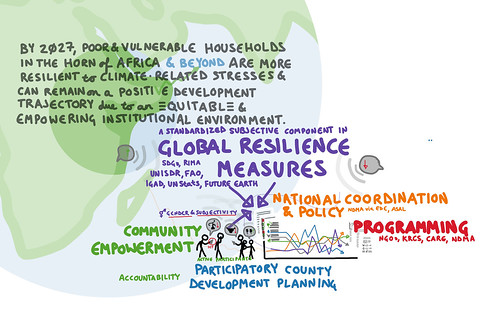
It’s in this context that I’m so excited about Dialling Up Resilience. It taps into questions of efficacy in programming by using and contributing to metrics for success in building resilience. It assumes good faith in policy makers and implementers by offering up data for them to do their jobs better. It protects against bad actors by providing granular, speedy data aggregated enough to protect data providers but transparent enough to be clear when a program is working (or not, if those we’re assuming good faith in don’t actually deserve that). And, my favorite part — instead of contorting and posturing about what makes people able to bounce back faster after a climate-related shock… we just ask them. Of course, it’s a bit more complicated than that. But the core is there.
We’ll be working with a few different groups in Kenya, including the National Drought Management Authority (and their Ending Drought Emergencies program) and UNDP on their existing surveying initiatives, as well as groups like GeoPoll (SMS), Twaweza (call center), and Kobo (household) on stand-alone surveys about how communities estabilish and track their own resilience. If we get the grant extension, we’ll work more directly with communities using tools like Promise Tracker and Landscape (a digitized version of Dividers & Connectors) to be closer to their own data, and to subsequently be able to have more agency over their own improvement as well as accountability.
What’s also exciting is that our means and our ends match. I was recently in Nairobi for a stakeholder workshop with not only the project partners, but also with the organizations which would eventually make use of the data. We’ve been conducting community workshops to test our basic assumptions and methods against reality, as well as to be sure community voice is at the core of each component we consider. We’ve thrown a lot out… and added some amazing new things in. We’re hoping to break down the gatekeeper dynamic of accessing communities in the Horn of Africa, and we want to be coextensive with existing programs (rather than supplanting them). It’s feminist and it’s development and I’m kind of fucking thrilled.
For a long time, it wasn’t possible to include everyone’s voice in planning or decision-making without impossibly large amounts of time. There was no way to listen, at scale. So aggregation and centralization became common, especially in times of urgency, even with the troubles these tend to cause.
But now, with the technologies we have, we can *listen*, in high resolution and in high fidelity. But technology isn’t a silver bullet. We also need the political will and the personal values to make that happen. With Aspiration’s new Digital Humanitarian Response program, we get to support some of the rad people willing and able to make these movements happen. In May, we hosted the Humanitarian Technology Festival at MIT. The Digital Response Wiki provides resources and notes, and here are some top-level highlights from the event:
Disaster and humanitarian issues don’t happen in a vacuum
Groups like Public Lab help lay the groundwork (both socially and technically) for fast-cycle disasters, via their ongoing interaction with communities around environmental justice. This also provides scaffolding for handing off responsibilities after an extreme event. Kathmandu Living Labs, a group committed to mapping the infrastructure of their geography, is an excellent case study in this. When the Nepal earthquake hit, they were able to jump into action quickly due to pre-existing Open Street Map communities, workflows, data infrastructure, and (most importantly) social ties. Kathmandu was then capable of making use of (and maintaining) the updated data after the fact. Simply by being (and being allowed to be) active in affected communities on a day-to-day basis, organizations can support communities in becoming more resilient to disasters.
That said, preparing for extreme events before they happen can help mitigate the severity of impact on people lives. We explored the idea of games to make what might be considered dull more fun. No need to start from scratch (though that can be stimulating as well!). Climate Centre makes such games, and publishes them openly over on their website.
We already have much of what we need
One of our spectrogram statements was, “We already have all of the technology we need.” While we were divided in our responses, we acknowledged that the ability of groups of people to make do with what they have in disaster is astounding. And our preferences apply here technically as well as ethically. Distributed, federated systems both for technology and for communities/governance are more resilient than centralized systems (as well as addressing human rights in general). There are a few of these rad systems being built, NYC Prepared being one of my favorites.
Data and consent are deeply linked
Data use with populations that are vulnerable (based on their history, their current circumstances, or both) is still a big question, but not one we need to face on our own. OpenGov, Missing Persons, and other transparency-related initiatives have figured an awful lot of that out, and we should take note. Additionally, while consent is different in high-stress situations than in long-term advocacy campaigns, it should still be a strong consideration in any plan or intervention.
We looked at the Framework for Consent Policies which came out of a Responsible Data Forum in Budapest, and suggested advocating for a “notify this set of people in case of emergency” embedded into social platforms, similar to Networked Mortality or ICE contacts in some phones. This way, people would be consenting and determining who would be their contacting associates in case of disaster (unlike what Facebook recently did). Consent is a component of accountability, both of which highlight how frontline communities might be the architects of their own rescue.
Accountability is just as important in precarious situations as it is in everyday life, if not more so
Accountability is sorely lacking in humanitarian aid and disaster response. Fantastic organizations exist to track where spending is going, but money is often considered misspent. Frameworks exist for deploying aid in ways which alleviate, rather than exacerbate, conflict and tensions. However, these frameworks and mechanisms are still sometimes insufficient, as even well intended groups remain in regions for decades while populations become reliant on them, rather than becoming self sufficient.
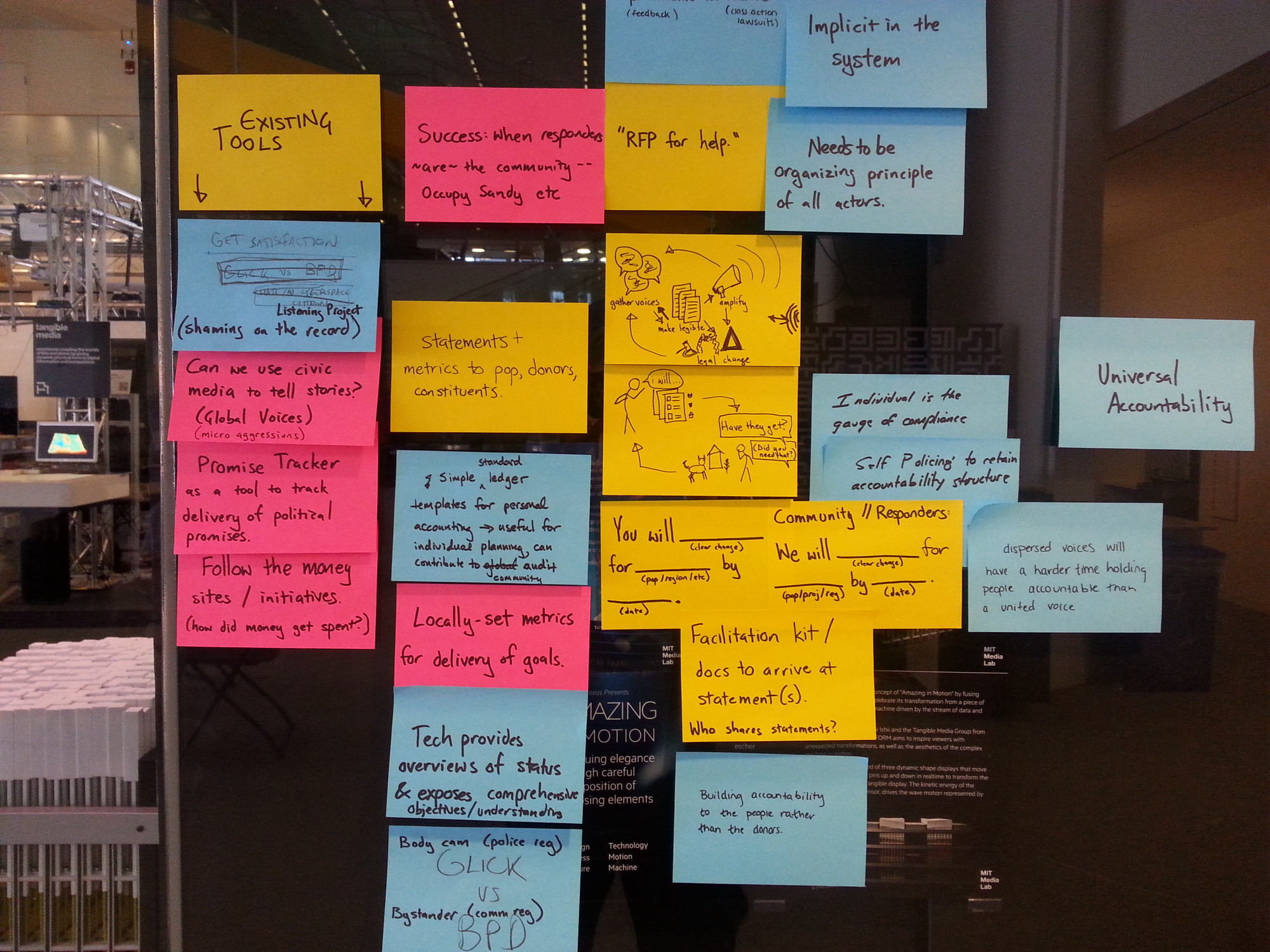
Rather than come up with an external group to hold response groups accountable, we figured the frontline community could state whether or not initiatives are working, and those reports could be sent directly to the response organizations, their donors, and relevant constituents. This factors in strongly to the Dialling Up Resilience initiative grant of which Aspiration is a part (Yes, it’s spelled with 2 L’s. They’re Brits). More on that soon.
You can find more thorough notes from Humanitarian Technology Festival on (you guessed it) our wiki. Reach out to us if you have any questions about this ongoing work. Contact us here: humtechfest@aspirationtech.org / @willlowbl00
My students just gave their final presentations. Their projects are the most important part of this entry, but because of narrative arcs, come last. If you read only one section of this, please read that.
Last summer, I was looking for more paid work. A job posted to some list I’m on, for a Digital Storytelling position at Brown. It didn’t require a degree, surprisingly, and I thought I’d take a shot. I sent some of the digital animation and community work I’m proudest of, and crossed my fingers. They wrote back to tell me it wasn’t exactly digital storytelling, but it was something, and we should chat.
And so I embarked on the rather bizarre adventure of creating a syllabus (so many thanks and props to Jo, Debbie, and Susan in this especially), and of planning my life around being in Providence every Thursday. At least. I do, in theory, live t/here. Each week, I would stay until the last second of the Civic lunch talk, endure the anxiety of attempting to catch a very exact train to Providence (and sometimes pay the cost for the Acela which departed slightly later), walk or cab to the Nightingale Brown House, and teach a class. Continue reading →
I was in Nairobi, Kenya, at the end of April participating in various happenings across humanitarian response spaces. From interactive gameplay to resiliency indicators, here’s how we focused attention on frontline communities through digital means.
Facilitating gameplay to model for resource allocation
The game stems from Taarifa, a free software project that has been widely deployed to collect, visualize, and map infrastructure information. The Climate Centre is well known (and appreciated) for their distillations of complex climate, environmental, and social systems into fun-to-play games, which are available on their website.
Often, these games start simply, and then complexity is layered on as each set of rules is understood by the participants. There are additional challenges when designing a “pervasive game” like this one, which is a game that extends play out into the wider physical world. All the details needed to be written on one piece of paper and accessible across languages, and players need to be able to join at any point, and without a facilitation start-session. Phew. We did our best, and you can view our materials here.
Day one was focused on re-creating the system as it is now – everyone had to find the rest of their community, their malfunctioning water points, and engineers. Some would know the problems in space and time, but others had the tools to solve them when and where needed. How to link problem and solution? Communication was intermittent, if it happened at all. Information sharing was consistently one step behind of the facts.
On day two, we introduced the ability to SMS update and query, thus enabling a faster and more efficient match between broken pumps and the engineers who could bring tools and parts to help communities have safe water. People now only needed to find each other to make exchanges, and they were able to document and share in real time where water points were and what the status was.
How’d it go? It was confusing… just like life. There was slow uptake… just like life. Only one group used the technical assist (i.e., SMS)… just like life.
This game showed what we think we already know— that having a solid technical tool doesn’t mean anyone is going to use it. But as community-based adaptation practitioners, we often need to (re)learn what we kind-of know, and ask some tough questions, such as ‘why are available solutions not being fully embraced by those who can allegedly benefit from them?’
This game created a space for conference participants to see the same lack of uptake in their own behavior that pervades climate and development work, rather than it being an externalized problem space to grapple with during program design and implementation. It highlighted our collective need to better tap into the social systems around digital solutions, and rethink how to enable genuine embracing by those who can benefit from them. The Climate Centre will be taking the game forward into Zambia, where climate change and infrastructure are already under intense scrutiny.
Supporting community-driven indicators of resiliency
We are taking part in an initiative to build locally-driven strategies for resilience to extreme events such as drought. Our focus within the “Global Resilience Challenge” is on local indicators, or measurements, of resilience.
“You get what you measure,” as systems thinker Donella Meadows once said. When we talk about indicators of resilience, things like gross domestic products, income, and education come to mind. But that doesn’t work for everyone in all places. Actually, we often find that “more” (higher GDP, more trade, etc) is a dangerous synonym to describe “better” when we are trying to evaluate resiliencey.
In response, a few groups have worked on measuring other things, such as the happiness index. Similarly, what matters in resilience is that frontline communities are the ones describing what their own environments look like, what is important to pay attention to, and laying boundaries in how to interact. If communities have the ability to determine their own indicators and carry out subjective measurements within open data frameworks, large-scale understanding can also happen across communities.
What do we even mean by subjective? My favorite “subjectivity” delineation occurs around “framed” and “open-ended.” For example, we could set out a frame of the top five things we think are related to resilience, and then ask community members en masse how they rate their own standing on those things. Or we can ask people what they think is important to their own resilience. Both are subjective indicators.
I came on with Aspiration back in January as the Community Leadership Strategist, to merge the work I’ve been doing in the humanitarian and disaster response space with Aspiration’s practices and team. It’s been a *blast* so far, and continues to be.
Most of the work I’ve done in the last 5 years has been about what social justice looks like when we’re doing response, with a focus on technology (as that opens up paths to conversations we otherwise quit having). With Geeks Without Bounds, we did hackathons all over the world, including Random Hacks of Kindness and SpaceApps Challenge. I’ve been a coordinator for the Digital Humanitarian Network, keynoted the IEEE Global Humanitarian Technology Conference, was invited to the White House to talk about Sandy response, facilitated the first hackathon IN (not just for) Haiti, etc etc etc. I’ve also had a huge organizational crush on Aspiration since my first DevSummit in 2013, attending as many Aspiration-connected events as possible. When I was able to join Team Aspiration, I was overjoyed — even while much of the work I’ve continued to do on response had already existed, it’s been a slow shift to get those previously-defined objects to be a bit more Aspiraiton-shaped.
The Humanitarian Technology Festival in Cambridge May 9+10 is the first event that is both committed to response and framed on Aspiration ethos. I am SO EXCITED about this it hurts. Let me explain why.
The very way we deliver aid perpetuates the need for more aid, both for fast- and slow-onset disasters (or “extreme events” or “humanitarian issues” or “earthquake” or “famines” or whatever you’d like to say). When people need lodging after a hurricane, they’re either told to evacuate and/or they’re put into temporary homes, away from neighbors and family. There is little impetus to return and rebuild both social and tangible structures. People are uprooted, and must start from scratch. When, instead, we see that people don’t just need lodging but in fact need social fabric, responders (and the technologies used for response) can focus on how to maintain family and neighborhood ties. People are then less stressed as well as being more likely to take their own actions to return and rebuild.
For humanitarian aid, this is even more paternalistic and stratifying… while not actually “fixing” any of the things it aims to. Aid is primarily about making the giver feel better. But like Tom’s Shoes picking up on the “buy one, give one” idea that OLPC actually handled with cultural grace and systems thinking, instead Tom’s put some people out of work while trying to provide something THEY thought others needed. Even if it had been delivered in a less-jerky way, aid often ends up with locations dependant on that aid, rather than internally strengthened. This is one way we keep extracting resources out of other places without actually contributing to those locations. See also this bit of the paper I’m still working on. This allows the worst parts of globalization (erasure of cultures, consolodation of wealth, etc) to continue.
Some might say “fine, let them fend for themselves,” but that’s not ok either. When we don’t have to look at our neighbors (when we build walled housing complexes, or segregated schools), we can ignore how bad things are for them. And that’s also not an acceptable answer.
What we need are ways to listen to what people can offer, and what they need, under the assumptions that we are equals. This is why I’m so excited to see how the participatory methods I associate so strongly with Aspiration come to bear on this space. Just do a search-and-replace for “Nonprofits” to “Affected Communities” on our Manifesto and Participant Guidelines. People in these fragile situations are NOT a population to playtest new tools. Not only do failures have a larger impact in these spaces, but to think of another location and its people as “demo” space is undignified and unjust. We need better ways (not just better tools) for life EVERYWHERE, and to assume that we WEIRD (Western Educated Industrialized Rich Democratic)-o’s have all the answers is downright arrogant. By instead, as we do at Aspiration events, speaking to each other in easy-to-understand language, under the assumption that everyone is bringing something meaningful to the table, and that together we’ll figure it out; we can shift not only how we do response, but the after-effects of that response.
I’m especially excited to speak to people about distributed response, and how the tools we build for ourselves can be welcoming to others using as well. Check out NYCprepared and Taarifa to see what this can look like.
Towards the end of December 2014, with a very probable full-time gig with Aspiration (which I continue to adore) on the horizon, I realized that I would (for the first time in my life) have slightly more money than I needed to live off of. Rather than expand into the space via my consumption (ok, I’ve done a little of that, too), I wrote to the Berkman list asking for help in investment or saving.
After years of living by the skin of my teeth, it seems I’m about to have steady employment. I don’t know how to invest or save money, and I generally think capitalism is pretty evil. However, I do need to survive in the long run in the world we’ve got. Does anyone on this list have advice on 1) who I can talk to about this (I am _clueless_), 2) how to do this as someone who cares about disinvestment from petrol, promoting social justice, smashing the patriarchy and maybe the state, etc?
This was met with an outpouring of advice (and some fascinating discussion about monopolies, silicon valley, investment, etc, which I won’t get into right now), which I’ve distilled here as best I can for a wider audience. Caveat that I have absolutely no idea what I am talking about, and I look forward to making further edits (with credit!) based on feedback. I’d like to specifically thank Brian Keegan and Tom Stites for their amazing overviews and deep investment (ha!) in the topic; Andy Ellis for sitting on the phone with me; and Hasit Shah, Emy Tseng, and Amanda Page for their distilled wisdom and links.
Apparently, socially responsible investing is something tons of smart people have already put a lot of thought into. Hooray! Less work for me! One basic thing to consider is the level of granularity and control you want to personally have — stocks, bonds, and companies are the more granular. Preset choices, such as through funds, are easier to manage, and you can still have some selection-level control. It’s also suggested “to (1) diversify so that all your eggs aren’t in one basket and (2) keep investment costs low so that your returns aren’t eaten up by paying other people to manage your money.” Amanda pointed out that tutorials exist on the websites of Vanguard, Fidelity, and TIAA-Creff, and more.
One suggested thing external to investment is to just have charitable petty cash on hand – like Awesome Foundation – just giving directly to charities without ending up on their lists of People to Pester.
The easiest (and seemingly least risky) thing to do is to set up an Individual Retirement Account, or IRA. My bank had a special portal just for this, and it took about 10 minutes. You can set aside $5,500/year in this, and apparently it does nice things to your taxes.
Things to be aware of, when dealing with the risk of investment:
A healthy approach seems to be thinkng “I’ve lost the money” the moment you give it. Like covering a friend for lunch — it’s nice to be giving money to something it’s nice to spend money on, but will also enjoy the reciprocal motion if it happens.
Via Andy, “always ask yourself, ‘is this too good to be true, and why do I have this opportunity?'”
“The investment world is a peppered with people and institutions devoted to fleecing the public, usually in entirely legal ways, so beware.” – Tom
Calvert Foundation is a community investment fund – as in, you’re loaning money to communities so they can improve themselves. This was recommended by Tom and stands out to me the most as a meaningful investment.
Global Alliance for Banking on Values. One thing that stood out to me from this group was their goal to “promote a positive, viable alternative to the current financial system.” While it’s not possible to interact with this group directly, it seems like a good roster to select a bank from, if you are opening a new account of various sorts.
5 Mutual Funds for Socially Responsible Investors: This one is written in a concise way with plenty of numbers coupled with ethical considerations. It’s a good place to look at how people combine thinking about both, and there are also some suggestions to consider for yourself.
There is no direct path from index funds, which by their nature cannot exclude any particular companies, to customary approaches to socially responsible investing, which insists on excluding the worst actors. Socially screened funds charge way bigger fees than index funds — they’ve got to pay people to assess companies and exclude the worst — so one approach is to use index funds and take the money saved by not paying high fees and put it in community investment vehicles offered through the nonprofit Calvert Foundation. Using socially screened funds may help you feel virtuous, but community investment funds can actively make people’s lives better. – Tom
Based on all this, (for as long as it’s possible,) I’ll be putting the suggested $5,500 in my IRA each year, and putting the bit extra into the Calvert Foundation through one of their suggested advisers. Next, I need to figure out what state I actually exist in, if that even matters. Emails are out, we’ll see how it goes.
Been working the new job with Aspiration in SF (while I still live in Providence and Cambridge), which is outstanding. Also been working on a paper about the topic I’m focused on with Aspiration, of how we perform mutual aid, at scale, specifically in disaster response and humanitarian aid. It calls for what we’d call a “mixed-mode system” in Complexity Science. I gave a talk at Berkman Center yesterday on the topic, and they’ve already got the video live. I had a great time! Thanks to everyone for coming out and sharing your brains with me.
On January 28th, the monthly salon gathered at NECSI to discuss ethnic violence from the lens of complex science. Yaneer Bar-Yam, president of NECSI, gave a brief talk about NECSI’s paper about modeling violence. Marshall Wallace, past director of the Listening Project, also gave a quick talk about his field experience with communities who opt out of violence. Again on Feb 4th, NECSI hosted an informal discussion around the case study of Libya. What follows are my big take aways and Sam’s asides, embedded into the fairly rough live notes from the salon. I call out these take aways and asides specifically because note takers often are lost in the notes, just as a photographer is never in the picture.
We hope you’ll join us on Wednesdays of this month to begin exploring medical systems, on ensuing fourth Wednesdays for structured discussion, or on other Wednesdays for more informal times.
Register for this fourth Wednesday here.
I am primarily left with a sense of purpose towards fostering collective intent towards alleviating suffering. In this entry, you’ll see a few ways large-scale violence is posited to be avoided. It is my personal opinion (of which I will opine at the end) that diversity is the key to equality as well as dignity, based on both the complex systems modeling and field experience framing these discussions.
But first, what do we even mean by “violence”? We’re referring to violent events occurring at level of massacres or bombing. These levels do seem to be slightly contextual based upon general violence levels in the area. Continue reading →