Yesterday I walked to the top of a hill to see the Notre Dam de la Garde, and was sad that it was just as Catholic as any other cathedral, and even more filled with tourists. I had somehow hoped for a pile of tiny boat models, superstitiously left over decades in hopes of protection. As I couldn’t discover hidden pockets of trust and hope made manifest, my favorite part was sliding down the railings back down the hill.
The week has been dedicated to Global Voices Exchange, a project to create a digital advocacy campaign guide by and for women of the global south. 20 of us gathered to question, scaffold, and draft the guide. I was honored to facilitate in my role at Aspiration, and as a friend of the Global Voices community. It was amazing to remember that about 2 years ago, I had facilitated the GV strategy meeting, and it was the first intensive time collaborating as mentee to Aspiration. It was incredible to see the progression of my skills (still so far to go!), the continued trust put in me by GV, and also how significantly working with Aspiration has influenced me. Continue reading →
For the January salon at NECSI, Ethan Zuckerman and Erhardt Graeff led a discussion and workshop on civics in a distributed society. Both are at the Center for Civic Media at the MIT Media Lab, Ethan as director and Erhardt as a PhD researcher. We explored how people with influence/power/money try to create change in the world, how those affected by those changes view and respond to those attempts and changes, and also what we would do as people of influence/power/money.
Many thanks to Ethan and Erhardt for their valuable time and attention as well as images used in this blog entry, and to Erhardt especially for designing such a great workshop, and for suggesting edits to the blog itself. Y’all are pretty great. ❤ – w
Many people want to change the world.
Leverage through money or power
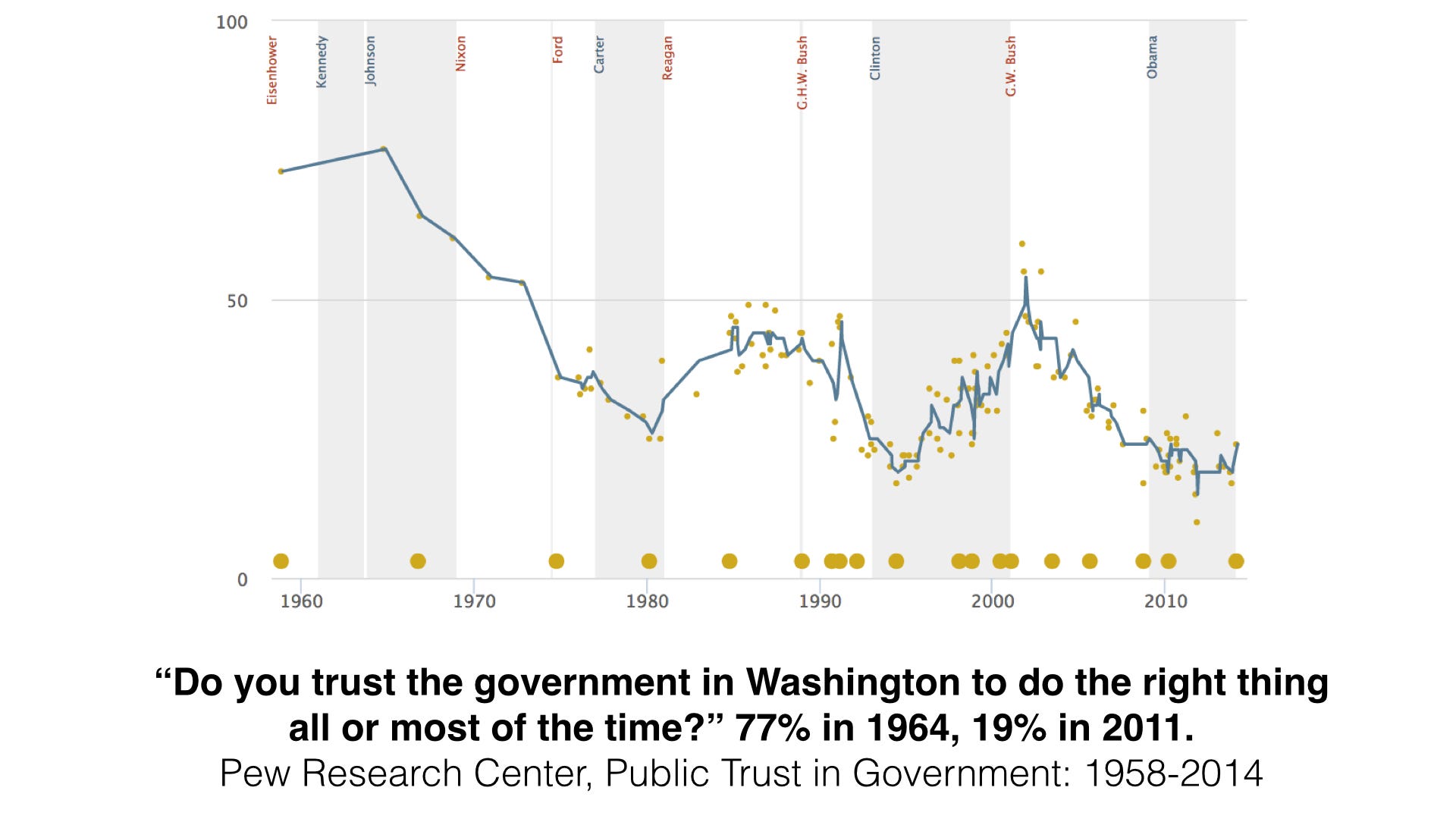
Democracy as it tends to be generally practiced is the act of selecting people for positions of power, and then pressuring them through petitions, protests, and letters. Ethan remarks that this is a remarkably impoverished view. We also interact with governance and our social systems based on what we buy (and don’t buy), where we live, how we speak. However, today our trust is low, and not just in government, but in institutions as well; and not just in the US, but all over the world (see Figure 1). (note: The origins of distrust may be traced to the high complexity of society that makes centralized decision making ineffective.) Many of us would like to change the systems we live in to improve the world. What strategies are available to make such change?
Figure 1
Among those who are trying to make changes are individuals and foundations with large amounts of wealth who strive to act in ways that will improve the world according to their perspectives and understanding. What strategies do they use to exert influence? How successful are they at achieving their objectives? Examples ranging from the Koch brothers to George Soros provide some insight. They might invest in think tanks, in market-based interventions, in campaigns to affect public opinion to place pressure on courts and elected officials.
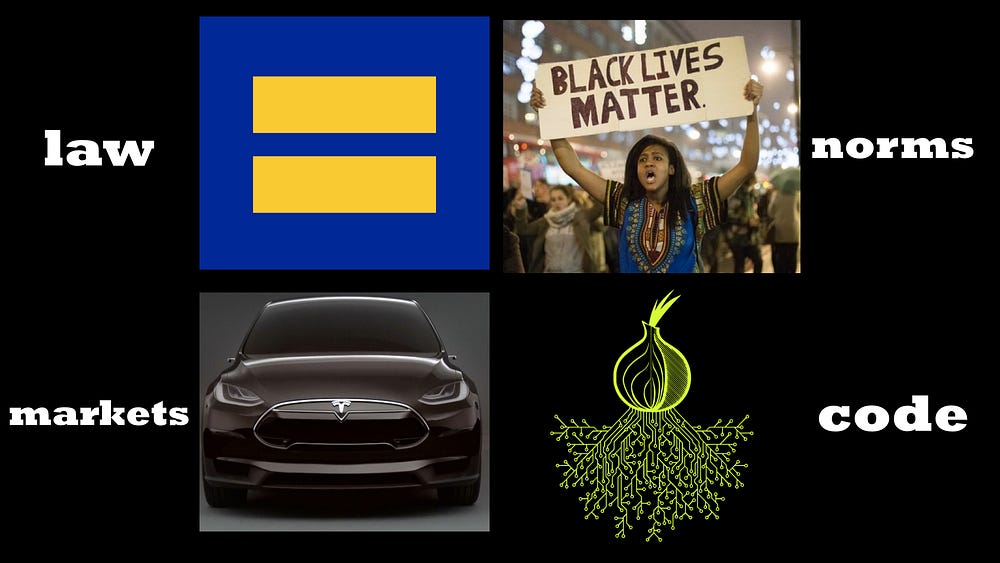
Regardless of whether an individual came to have influence through an electoral process or through access to wealth, Lawrence Lessig provides a framework in his book Code and Other Laws of Cyberspace on which most (if not all) change is attempted.
Four fulcrums
Laws are explicitly stated codes of behavior, created and enforced through governance systems.
Norms are often implicit social expectations, enforced through social pressure and assumptions of media and other communications.
Markets shape behavior by making some actions more or less expensive financially or time.
Architecture/Code are the frameworks that surround us and must be adhered to because we act within them. Today many of these frameworks are technological which might be called: the tyranny of the database, or how interfaces demand obedience.
How do you know if what you’re doing is working?
The enforcement of laws can be tracked. Market costs can be quantified. The use of an architecture implies success of its constraints (though choices of what architecture to use, and innovators, hackers and other reappropriators, provide freedom). Ethan and Erhardt primarily focus on changing norms. These are also arguably the most difficult to characterize and to discover if a hoped-for-change is occurring, as norms are often implicit, rather than explicit, and are distributed across the statements of individuals, groups and media sources.
At the Center for Civic Media, they think about norms and the attention economy, and one way of seeing shifts in norms in this view is by tracking how the media talks about a topic. They use a tool called Media Cloud for gathering media sources, creating visualizations, and comparing the words used to talk about topics of discourse. For instance, Erhardt analyzed the dynamics of the media conversation around Trayvon Martin through the roles of broadcast and participatory social media.
In short, creating change is hard, even if you’ve got money and/or power.
Here’s the video from our salon
More on the topic of civics in a distributed society from Ethan’s post about his keynote at Syracuse University’s Humanities annual symposium on Insurrectionist Civics in the Age of Mistrust (highly recommended, and most of the images on this blog comes from the associated slide deck).
How would YOU create change?
With this framing, this question was posited to the salon attendees. Erhardt facilitated an interactive workshop: “So let’s say you have 10 million dollars. What would you do, about climate change? Fund think tanks and organizations? Fund advocacy groups / passing laws? Fund research? Create tech to do things we can’t otherwise do?” The room divided into 4 groups, and then picked one of Lessig’s four means of interventions and brainstormed ideas.
What would you focus on doing, and how would you know if it was working?
Architecture/Code: Attach sensors to cars, trucks, and environments focused on transportation-based discharges of greenhouse gases. The emissions sensors could provide immediate feedback to drivers and city officials when emissions go to high and trigger sanctions.
Markets: Invest in a startup that offered green logistics/delivery services such as bicycles that would compete with truck-based last-mile services such as UPS and FedEx. Gain market share not just by comparative cost but also by being better for the environment.
Norms: Incorporate data about individuals’ carbon emission from how they live into their online social profiles so that their is an opportunity for social sanctions and desire for self-improvement is publicly viewable.
Law: Create policy that forced power suppliers to develop more resilient grids from renewable energy sources. The data would be monitored by the government for compliance.
We were also joined on Twitter:https://medium.com/media/636d0bf5ea05901a2a4a1b980c23e010https://medium.com/media/d9363c613a23182d898f47ff90bcf6d1
Summary
To shift the world, even with massive funding and assumed power, is difficult. All of the interventions discussed at the salon were at a speculative pilot/demo level. To know you’re succeeding through an intervention is also difficult. There was a realization that those who have money and power are often not wildly successful at changing the world because of the difficulty of understanding how constructive change can be achieved. Perhaps a few “why don’t you just…” phrases were put to rest. At the same time, as individual citizens, we saw how much of a role we have to play in societal shifts — perhaps more effectively in our distributed and connected networks.
“The exercise of designing a method for evaluating your campaign’s success often forces you to rethink and get more specific about your original intervention idea. When you need to turn your target and goals into dependent and independent variables to study and then worry about the timeline for change — it really complicates your view of how to make change. And I would say each of the groups felt this.
There was also a clear bias amongst participants toward norms-based change even though they were addressing legal fixes, market forces, or technical architectures. We all want to think that people will know what behavior is the right behavior once they have enough information. The fact that such a process takes many years and many interventions and runs up against cognitive biases where information counter to your position can leave people stronger in their problematic ways, is what makes norms-based change so hard. The goal of making sure that everyone in the workshop had a chance to think about laws, markets, and code as well helps concretize the need for many different approaches: carrots and sticks in various guises needed for a movement to make its mark. And $10mil is not a lot of money to start with.” – Erhardt
I regularly coordinate a salon over at the New England Complex Systems Institute. For the January salon at NECSI, Ethan and Erhardt led a discussion and workshop on civics in a distributed society. We explored how people with influence/power/money try to create change in the world, how those affected by those changes view and respond to those attempts and changes, and also what we would do as people of influence/power/money.
Many thanks to Ethan and Erhardt for their valuable time and attention as well as images used in this blog entry, and to Erhardt especially for designing such a great workshop, and for suggesting edits to the blog itself. Y’all are pretty great. ❤ – w
Many people want to change the world.
Leverage through money or power
Democracy as it tends to be generally practiced is the act of selecting people for positions of power, and then pressuring them through petitions, protests, and letters. Ethan remarks that this is a remarkably impoverished view. We also interact with governance and our social systems based on what we buy (and don’t buy), where we live, how we speak. However, today our trust is low, and not just in government, but in institutions as well; and not just in the US, but all over the world (see Figure 1). (note: The origins of distrust may be traced to the high complexity of society that makes centralized decision making ineffective.) Many of us would like to change the systems we live in to improve the world. What strategies are available to make such change?
Figure 1
Among those who are trying to make changes are individuals and foundations with large amounts of wealth who strive to act in ways that will improve the world according to their perspectives and understanding. What strategies do they use to exert influence? How successful are they at achieving their objectives? Examples ranging from the Koch brothers to George Soros provide some insight. They might invest in think tanks, in market-based interventions, in campaigns to affect public opinion to place pressure on courts and elected officials.
Regardless of whether an individual came to have influence through an electoral process or through access to wealth, Lawrence Lessig provides a framework in his book Code and Other Laws of Cyberspace on which most (if not all) change is attempted.
Four fulcrums
Laws are explicitly stated codes of behavior, created and enforced through governance systems.
Norms are often implicit social expectations, enforced through social pressure and assumptions of media and other communications.
Markets shape behavior by making some actions more or less expensive financially or time.
Architecture/Code are the frameworks that surround us and must be adhered to because we act within them. Today many of these frameworks are technological which might be called: the tyranny of the database, or how interfaces demand obedience.
How do you know if what you’re doing is working?
The enforcement of laws can be tracked. Market costs can be quantified. The use of an architecture implies success of its constraints (though choices of what architecture to use, and innovators, hackers and other reappropriators, provide freedom). Ethan and Erhardt primarily focus on changing norms. These are also arguably the most difficult to characterize and to discover if a hoped-for-change is occurring, as norms are often implicit, rather than explicit, and are distributed across the statements of individuals, groups and media sources.
At the Center for Civic Media, they think about norms and the attention economy, and one way of seeing shifts in norms in this view is by tracking how the media talks about a topic. They use a tool called Media Cloud for gathering media sources, creating visualizations, and comparing the words used to talk about topics of discourse. For instance, Erhardt analyzed the dynamics of the media conversation around Trayvon Martin through the roles of broadcast and participatory social media.
In short, creating change is hard, even if you’ve got money and/or power.
Here’s the video from our salon:
More on the topic of civics in a distributed society from Ethan’s post about his keynote at Syracuse University’s Humanities annual symposium on Insurrectionist Civics in the Age of Mistrust (highly recommended, and most of the images on this blog comes from the associated slide deck).
How would YOU create change?
With this framing, this question was posited to the salon attendees. Erhardt facilitated an interactive workshop: “So let’s say you have 10 million dollars. What would you do, about climate change? Fund think tanks and organizations? Fund advocacy groups / passing laws? Fund research? Create tech to do things we can’t otherwise do?” The room divided into 4 groups, and then picked one of Lessig’s four means of interventions and brainstormed ideas.
What would you focus on doing, and how would you know if it was working?
Architecture/Code: Attach sensors to cars, trucks, and environments focused on transportation-based discharges of greenhouse gases. The emissions sensors could provide immediate feedback to drivers and city officials when emissions go to high and trigger sanctions.
Markets: Invest in a startup that offered green logistics/delivery services such as bicycles that would compete with truck-based last-mile services such as UPS and FedEx. Gain market share not just by comparative cost but also by being better for the environment.
Norms: Incorporate data about individuals’ carbon emission from how they live into their online social profiles so that their is an opportunity for social sanctions and desire for self-improvement is publicly viewable.
Law: Create policy that forced power suppliers to develop more resilient grids from renewable energy sources. The data would be monitored by the government for compliance.
To shift the world, even with massive funding and assumed power, is difficult. All of the interventions discussed at the salon were at a speculative pilot/demo level. To know you’re succeeding through an intervention is also difficult. There was a realization that those who have money and power are often not wildly successful at changing the world because of the difficulty of understanding how constructive change can be achieved. Perhaps a few “why don’t you just…” phrases were put to rest. At the same time, as individual citizens, we saw how much of a role we have to play in societal shifts — perhaps more effectively in our distributed and connected networks.
“The exercise of designing a method for evaluating your campaign’s success often forces you to rethink and get more specific about your original intervention idea. When you need to turn your target and goals into dependent and independent variables to study and then worry about the timeline for change — it really complicates your view of how to make change. And I would say each of the groups felt this.
There was also a clear bias amongst participants toward norms-based change even though they were addressing legal fixes, market forces, or technical architectures. We all want to think that people will know what behavior is the right behavior once they have enough information. The fact that such a process takes many years and many interventions and runs up against cognitive biases where information counter to your position can leave people stronger in their problematic ways, is what makes norms-based change so hard. The goal of making sure that everyone in the workshop had a chance to think about laws, markets, and code as well helps concretize the need for many different approaches: carrots and sticks in various guises needed for a movement to make its mark. And $10mil is not a lot of money to start with.” – Erhardt
It can be easy to forget what one has done in a year. Here’s my 2015 retrospective, and what I would like to do in 2016. My word, when I was wrapping up my time in Seattle and headed to Cambridge, was intent — I was good at doing what I could with what I had, but I wanted to be more intentional about where I wanted to end up. Having now oscillated quite far in that direction, the word I’ll be carrying with me in 2016 is humility. I want to return to listening to what others have to say, to seeking the gems and surprises and connections, rather than focusing on my own intentions. That said, intentionality sure did carry some pretty amazing things with it…
Invested in taking care of myself
Fitness
With two dear friends in Cambridge, working out twice a week (ish) became joyful instead of a chore. I’m now stronger than I’ve been in a long while, and my body is eager to move regularly (and noticeably unhappy when I don’t). I also can even (sometimes) run 5k in under 30 minutes. I’m comfortable in my own body again, years after breaking my arm and losing access to that part of life.
Mental health
In no small part due to an aggressively healthy work place (that in the next section), I have been taking been taking care of myself. I devised ways of being connected to others while still being mobile, and made that into a pattern for others to follow. This has also meant tracking my mood, how much I’m drinking (which way less, of both caffeine and alcohol, and way more of water), how well I’m sleeping, and starting to detect trends and linkages across everything. I started practicing meditation with any degree of regularity, and continue to feel the benefits. I also took a plethora of tiny vacations which, while including coworking, but were not for work. Being places Not For Work was bizarre and magical. All of these things combined to make this my least anxious year in a very, very long time.
Financial
While still by no means wealthy, I have started a retirement account (at 31 years old!) and paid off the small running loan I had with a family member (privilege jazz hands).
Boundaries
I tend to put myself into situations in which I cause myself anxiety. As an exercise in taking care of myself without extra stress while also spending time with friends, I attended Burning Man with False Profit… and didn’t tell anyone. It was great — I ran into old friends, made new friends, helped take care of camp, learned to fly a kite, and took it so easy that I only made it into the City once.
I’ve also started saying “no” more often in general. “No” to projects which aren’t strategic for myself and the project-holder, and to people who are unhealthy for me. I nearly took a job at the end of 2014 which would have been super unhappy even though it was with on amazing projects and with amazing people. Instead, with the help of a few friends, I disappointed those rad folk at that prospect by saying “no,” and instead I… Continue reading →
So I’m trying to get things in order to attend a hackathon against gender-based violence in rural India put on by a woman named Chinmayi who had been a GWOB participant, then mentee, and is now a friend of mine. Trying to sort things out means filling out an online visa application for India, which has been pure hilarity. The joys of Twitter are recreated here for the stake of posterity.
Sometimes people ask me why I take so long to get through passport control. Basically, I'm bad at choosing my fights pic.twitter.com/3kS5WQxszL
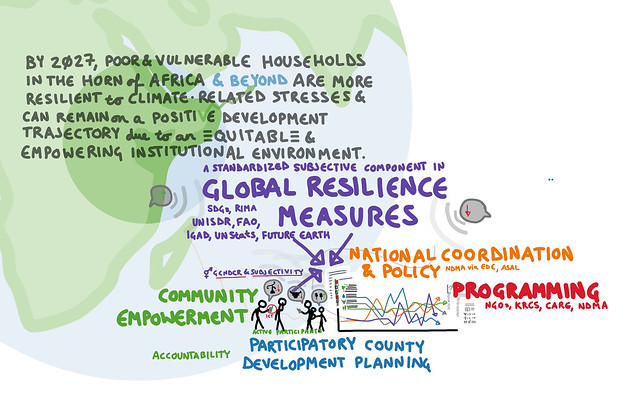
At the end of April I was in Nairobi doing several things related to digital humanitarian response. One of these was a program called Dialling Up Resilience (yes, with two Ls in “Dialling,” because it was a British-centred team), which looks at local indicators of resilience. This blog entry explores why subjectivity is important in measurement, and how technology can help us parse through subjective information and combine it with objective datasets.
Scarcity
It’s possible to exacerbate or alleviate existing inequalities when designing and implementing response programs. As climate change alters the world around us, the people who have been historically marginalized often become even more so as those in power see scarcity encroaching on their livelihoods. When programs distribute resources without taking care with those previously in power, we also see backlashes and resource grabs. But the ability to hold people accountable in new ways through things like social media and community mapping are coupled with an awareness and effort towards the long bend towards justice means there are groups of people seeking new ways to better allocate resources to those most affected by those inequalities. Often, the groups working in this space are also in a post-scarcity mentality — that, when we work together wisely, we can do a whole lot more with a whole lot less. These are folk who think we can reach zero poverty and zero emissions (within a generation). These are the folk who see joy in the world, and possibility in these difficult situations we’ve backed ourselves into.
Resource Allocation
The resource allocation and accountability necessary for transitory steps towards a world that can survive and even thrive won’t happen in a vacuum. The formal and informal organizations of this space alike have entire supply chains, ways of listening (and to whom), and self-reflexive mechanisms to consider. In these are embedded corruption, paternalism, and colonialism. But also in these are embedded individuals who have been Fighting The Good Fight for decades, and have added useful checks, amplifiers, and questions into infrastructure. It’s into this environment we step when we do response work. It is, at its core, like any other environment — it has History.
It’s in this context that Dialling Up Resilience is such a good program. This project supports the need to adapt to climate issues while putting frontline communities at its core, and does so in a way which can be useful in historically convoluted contexts.
Metrics
When various organizations — be they international or local, government mandated or radical, formal or informal — wish to change a circumstance, having metrics can help show if success is being approximated. Hopefully, those metrics can also hint at where and how we’re failing. To adapt to climate change and other issues, we need to be able to see how initiatives are doing over time. We can then better allocate resources or attention. The way this is done now is primarily through “objective” measurements such as education level and income. These don’t work for everyone, whether because they are pastoralists or anti-capitalists (or both). In the same way that some schools shift away from standardized testing into more subjective ways to measure learning, Dialling Up Resilience re-focuses the evaluation of success more locally. This is how the frontline community is at the core — they’re determining what makes them resilient, as well as how they feel they’re doing in relationship to those self-defined indicators.
These metrics are then visible to the community (often we’re our own calvary, afterall), and the aggregate is visible to organizations acting in the area. What are needs they may have missed? Is a program having the desired impact? Because of the flow we set up, the information is even fast enough to potentially be for rapid response, with people in a region indicating a flood-related need then triggering alerts for response organizations to deploy those materials in time.
Working with Existing Communities and Initiatives
We worked with a few different groups directly working in Kenya, including the National Drought Management Authority (and their Ending Drought Emergencies program) and UNDP on their existing surveying initiatives and Climate Change, Agriculture and Food Security, as well as extending those survey abilities with international groups like GeoPoll (SMS), Taweza (call center), and Kobo (household) to assess how communities establish and track their own resilience. While we didn’t get the second round of funding, we hope in future to also work more directly with communities using tools like Promise Tracker and Landscape (a digitized version of Dividers & Connectors) to better expose a community’s data back to themselves, and to subsequently be able to have more agency over their own improvement as well as accountability.
What’s also exciting is that our means and our ends matched. I was again in Nairobi for a stakeholder workshop with not only the project partners, but also with the organizations which would eventually make use of the data. We conducted community workshops to test our basic assumptions and methods against reality, as well as to be sure community voice was at the core of each component we consider. We threw a lot out… and added some amazing new things in. We hoped to break down the gatekeeper dynamic of accessing communities in the Horn of Africa, and we wanted to be coextensive with existing programs (rather than supplanting them). It’s feminist and it’s development and I’m kind of super thrilled that we got to try this idea out, even if we don’t get to do it in earnest (yet). We’ll keep looking for opportunities to carry the idea forward, and the design principles will remain at the core of what we do. You can read more about the proposal and stakeholder workshop here, including that side comment about feminism around page 7.
This blog entry written with substantial input and support from Meredith L. Patterson.
Aspiration has taken on Weaponized Social as an extension of our commitment to solidarity with our community and to equality in our interactions with and through technology.
Better Tools for a Better World
Our work to support more people in their existing efforts by making use of technology has a peripheral effect of bringing historically marginalized populations into online space. And as the ever-larger online community welcomes new people, we have not only an opportunity, but also an obligation, to do so with more intent and understanding than society has tended towards in the past. When we speak of online intimidation or harassment, regardless of the perpetrator or recipient, culturally we struggle with issues of accountability, enforcement, and identity.
It’s a Disaster
We’ve had a few events (NYC, Nairobi, and San Francisco). From these, and ongoing conversations on the mailing list, the wiki has been expanded and cleaned up. It now includes clearer indicators of how to make use of it, as well as a restructuring into the same framework as the disaster cycle. The disaster cycle falls into preparedness, response, recovery, and mitigation. More details on these, along with the added aspect of being an extreme event, can be found on the wiki, with projects and resources listed below each aspect of the cycle. Event notes and project specs continue to also be hosted on the wiki. What are not found on the wiki are academic resources (which can be found in this literature review compiled by friends), nor organizations and initiatives (which Tactical Tech recently curated here).
This approach was taken because many conversations in this space are derailed when discussion of intentions and tactics are conflated. For instance, #hoodsoff revealed the identity of those both in positions of political power AND who were members of the KKK using the same tactics which those same activists might find untenable in regards to doxxing of visible feminine gamers. Or that the tactics used against Brianna Wu and Chris von Csefalvay match at a pattern level that goes beyond that specific instance of escalation. This is where Weaponized Social seeks to explore and intervene, because human rights apply to everyone, including ourselves and whoever we might perceive to be our enemies. “Lead by obeying,” as the Zapatistas say.
Who Watches those Watching the Watchmen?
On the same note of rules applying to everyone equally, including the rulers, and of making the conversation clearer, the Weaponized Social crew has also been ruminating a fair amount recently on how accountability and enforcement factors into all this. When people treat each other in unethical ways, our current social systems indicate bringing the law (and associated enforcement) to bear on those breaking the rules. But we are currently facing a long-overdue distrust in enforcement, especially in police. So just as we’re running into the network effects of negative human interaction, we also have no successful foundation to build upon to mitigate through enforcement. The conversation is therefore further confused by asking who should be holding whom accountable, how do we know that’s being done fairly, and how does enforcement happen? Some are turning to community, some to law, some to software platforms, some to police, etc. Each of these may become a viable option. It’s more likely to be a combination therein, and it’s important to think about the historical patterns of enforcement as well as the repercussions of unchecked social errors.
What’s Missing?
The glaring hole which was surfaced by restructuring projects and pieces into this framework is a complete lack of recovery (it’s also totally possible that I’m just not aware of it. If you know of any, please send them our way!). Preparedness and response are necessary and worthwhile aspects to cover, but we offer no long term support or recompense to those who have been affected by the weaponization of social so as to make them whole again. Even legal and policy interventions seem to linger in only half of the cycle, when arguably institutions are responsible for longer term stability (leaving the network to adaptation). This is heartbreakingly familiar, as it’s the same in response to offline disasters.
Additionally, as the conversation expands and deepens, more individuals and organizations are beginning to see their responsibility in encouraging healthy interactions. A few requests have now come in for guidelines in making tools and platforms which take into account these issues. We’ve started to describe the various vectors of online communication which might be fiddled with, and we welcome your feedback!
What I’m excited about is how much of the Weaponized Social crew (most notably, Meredith and TQ) has focused on the mitigation aspect of the disaster cycle. How can we change the very way we do things, to become more pro-social for everyone? We welcome your perusal and contributions to any of the projects on the WeapSoc wiki, but these are the ones I’m most excited about.
What’s Next?
What’s up next is a discussion with Meredith et al to historically, theoretically, epicyclically, technically explore the weaponization of social interaction, such that we can arrive at better interventions. To start, we might discuss the history of liberal social justice and identity politics social justice, cognitive biases, and network effects. You can tune in December 18th at 11a PT / 2p ET by registering here.
We’re also starting to explore a code sprint on some of these tools. If you’d like to get involved, please let us know!
This post is a collaboration between Margaret Killjoy and yours truly. If you find yourself in need of a co-author or ghostwriter, or just generally like to be challenged and your hopes dashed and lifted at the same time, please reach out to them.
“If you are neutral in situations of injustice, you have chosen the side of the oppressor. If an elephant has its foot on the tail of a mouse and you say that you are neutral, the mouse will not appreciate your neutrality.” Desmond Tutu
Four years into the Syrian Civil War, with no end in sight, the Syrian refugee crisis is just getting worse and worse. More than four million people have fled their homes and sought refuge in Turkey, Europe, and throughout the world.
There are wonderful grassroots initiatives (most too informal to even call “organizations”) who are on the ground in Europe helping Syrian refugees navigate the nightmare they’ve been thrust into (bureaucracy and xenophobia) after the nightmare they’ve escaped (the Syrian civil war). But as crucial as it is to meet these people’s immediate needs, it will take more than emergency aid to solve the source of this crisis and ones like it. It will take radical, political solutions.
Relief organizations and related nonprofits could position themselves to advocate and act towards / in alignment with those solutions. Which is to say: we need humanitarianism, yes, but if we’re going to find long-term solutions, we also need politicized humanitarianism.
When we speak of people and groups being politicized, we don’t mean campaigning and/or voting for elected officials every few years. Instead, to be political means to do work that addresses the very way our society—and its decision-making—is structured. For many of us, to be political also means to embrace the feminist concept that the personal is political—that the way we interact with one another one-on-one cannot be divorced from the broader structures of social control. Continue reading →
This is a draft of a blog entry. The idea needs further refinement, and we welcome your feedback!
When a disaster occurs, whether fast like an earthquake or slow like a drought or war, people go missing. As outsiders wishing to contribute to restoring the stability of our worlds, the desire to reunite friends and loved ones through the technology we know so well can be tempting. Making use of our knowledge of social platforms, geotagging, and databases is far easier than addressing the long-term systemic injustices which allow these crises to affect entire populations in the way they do, afterall. But let’s say a typhoon has just made landfall, or that there’s a sudden influx of refugees from a drought-blighted country, and you and a group of your friends have gathered to see what you can do about it. This is beautiful — we need to learn how to work in solidarity with those in other geographies. But it’s also a delicate space. This particular post is about whether or not you should build that missing persons app, or spend your time contributing to something like Google Person Finder, OpenStreetMap, Sahana, or Standby Task Force instead.
The missing persons/reunification domain of humanitarian response is not just about people logging themselves so as to be findable by those missing them. It’s also about those individuals being protected during the process, having support in finding those they’ve been separated from, and the infrastructure which surrounds these actions. Software has a lot to contribute to connection, information security, and sorting through indexes, but missing persons is a delicate space with real humans in the mix.
This is an inhabited space
The decolonized mind starts from:
1) others have always been here, working on this
2) my task is to find them &
3) amplify
There are already missing persons tools and organizations which have been vetted for capacity and integrity for follow-through and security. Here are the few most successfully used ones: American Red Cross’ Safe and Well, Google Person Finder, Sahana, Refugees United, International Committee of the Red Cross’ Restoring Family Links, National Center for Missing & Exploited Children. Please offer to help improve and maintain these existing tools (code repos and communities are linked to from each name)! If you are uncomfortable or unsure of how to contact them, please let me/Tim know!
However, we also understand that the world changes. We gain access to new technologies, there are new clever people in the world, and our understandings of situations change. There is *always* room for improvement in this space, just as any other. Want to do something substantively “better” or different than what the existing tools and organizations already do? Here’s what you need to know:
A component, not a solution
The software-based frontend and backing database are a TINY FRACTION of the overall system of missing persons reunification efforts. People are often missing for a *reason*, possibly because of political unrest, domestic violence, or displacement. If your platform publishes photos of someone or their geographic location, will someone try to come after them? Can you protect their physical and emotional wellbeing? There are national and international laws in place to protect such individuals, especially children, and your component of the system must be in alignment with those laws (or have a damn good and intentional reason for not being as such). Ethically, you should also respect an individual’s desire or need for privacy. In the Missing Persons Community of Interest, organizations handling missing persons data are reviewed by external parties for their ability to perform long-term maintainence and protection of said data. You and your tool will need to undergo the same rigor before being launched.
Complications versus easing interaction
Your goal is to make finding loved ones easier, right? Think about how many tools are already in play (see “This is an inhabited space” section above), and what adding one more to the mix would be like. Every new missing persons platform is another point of decision-making stress on the missing persons and those seeking them. Imagine being asked for personal information about yourself while under extreme duress over and over and over again.. or having to repeatedly enter in the details of someone you love and are deeply worried about while on a desperate search for them. The listed existing tools have gone through (and in some cases, are still working out) data sharing flows to reduce these stressors while still maintaining their committments to privacy and security of the data they hold. If you launch your tool, you’ll need to adhere to the same levels of empathy, respect, privacy, and sharing. (Side note, please don’t start a “uniting platform,” either, lest we get here. That’s what sharing standards are about.)
We look forward to your heartfelt, well-thought out contributions to this space.
At Cascadia.JS in 2014, I picked up a tshirt from the freebie pile. It’s pink. I know — I was also shocked about this, but the quote on the front was so good I had to go for it. “We don’t know what we’re doing either.” On the back is a subtle “&yet” which I learned was an open source consulting company (ish). Neat! — humility, a culture that accepts shirts which are both pink and comfortable, and a nuanced logo. I especially love wearing this shirt in academic and tech-centric situations.
A few months ago, Case asked my consent to be put in touch with someone on the &yet team — they had a conference coming up, and had suggested I speak. Our phone conversation was brief, but it sounded both fun and values-based, so I said yes (a rarer and rarer thing for me these days), and so I spent Wed/Thurs/Fri of last week in Richland, Washington. If interested, here are my drawings of others’ talks, my slide deck, and the paper I referenced.
It is now easily one of my favorite large social experiences. Music, art, and story were woven throughout the conference, all evoking self-reflection on our role in the path the world takes. It was already populated by some of my favorite people in this space (the aforementioned case, plus ben, jden, kawandeep, etc), and the textcapade starting weeks in advance, recieving letters from another character in the story by mail, all playing through these struggles, had me jazzed up long before the event.
The talks were a beautiful mix of art demonstrations, hopeful distribution structures, empathy arcs, and design philosophies. Inclusion was constantly present, and never for its own sake, but rather from a deep understanding that these are the voices that make up the world. The care &yet took of attendees (and encouraged us to take for each other) opened space for some rather heart-wrenching moments. Please, check out the talks when they go up.
While all of this is amazing, I want to talk about the trust and responsibility that &yet placed in the attendees. The storyline was a surprisingly nuanced version of one of my own ongoing internal battles — burn it all down, or patch to save what we can. (The mixed-mode system work is my attempt at making these transitions graceful, by the by). At no point was a clear value judgement imposed upon the story, or implied to the players. The textcapade transitioned into a sort of backchannel for actors in the parts of those sending the messages at points during the conference, and this archetypical internal battle continued to be played out there as well as by stage actors between talks. Continue reading →


 It is now easily one of my favorite large social experiences. Music, art, and story were woven throughout the conference, all evoking self-reflection on our role in the path the world takes. It was already populated by some of my favorite people in this space (the aforementioned case, plus