Reporting Back from Weaponized Social in NYC

Originally posted on the Aspiration blog

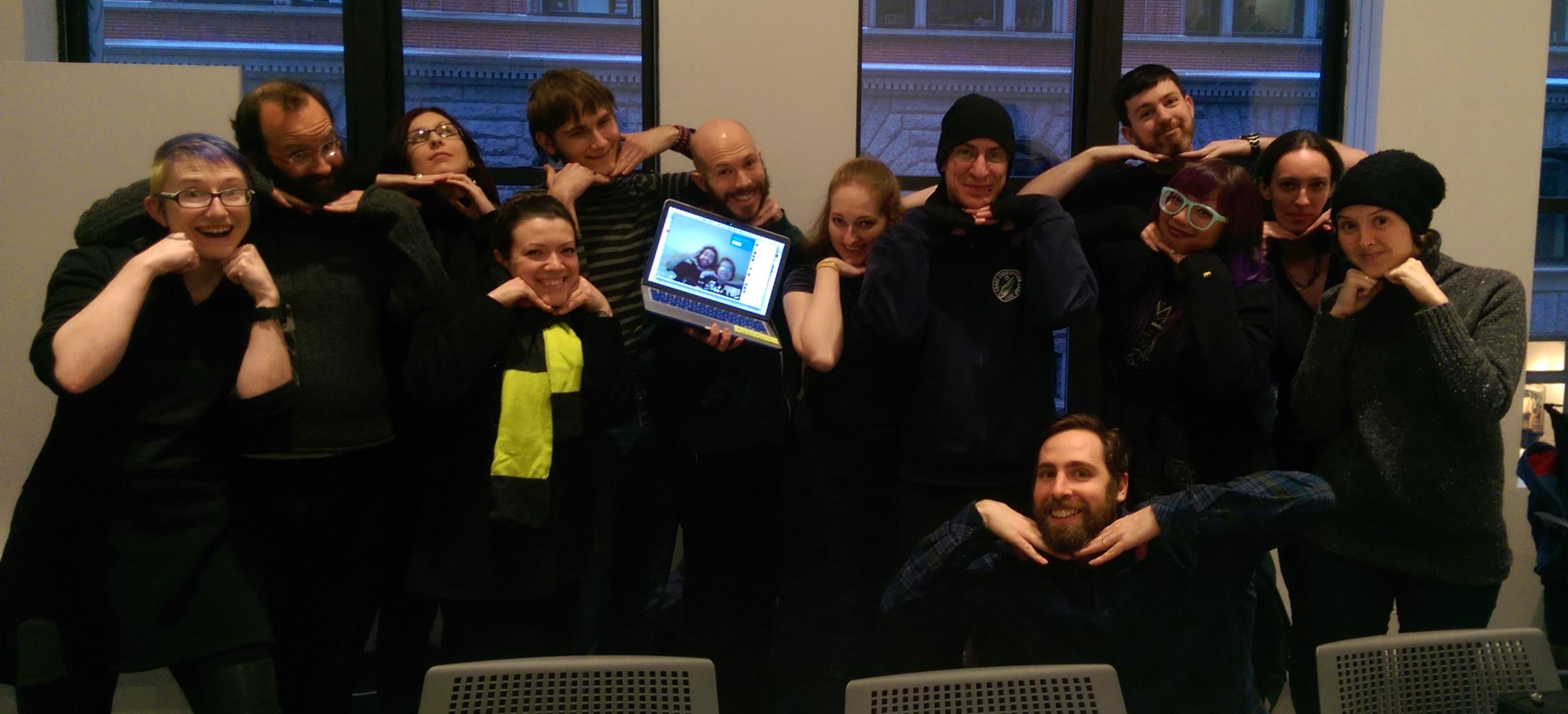
A group of fifteen participants gathered in New York City on February 13 and 14 to discuss the idea of Weaponized Social: the notion that social harms resulting from digital interactions can become dangerously amplified online by the network effect. We discussed what might be done to rethink the ‘social scripts’ that trigger conflict, and how to mediate conflicts as they arise in digital spaces (visit this post to learn more about “social scripts”).

At the event, we recognized that while online interactions can enact harmful consequences, this is a tractable problem; we are in a position to make changes to social scripts in our parts of the world and corners of the web. We understood that many of the things we love most about the internet (e.g., the ability to ambiently connect with long-time friends, to interact (and fall in love with!) strangers, and to vocalize your causes) are also what can make it seem like a dangerous place, where we may be susceptible to harassment or having private information leaked by known or unknown entities.
Weaponized Social NYC

We took the first half of day one to co-create an agenda and to participate in an idea spectrogram in order to challenge assumptions of agreement and convey the diversity of world views in the room. We then dedicated the second half of the day to the common threads across the various issues we were working in. One such shared belief was that rather than creating one-size-fits-all content (e.g., a single deescalation guidebook), we should instead embrace many versions of the same idea being present, for various levels of knowledge, language, and learning styles (think of things like “Drawing for Scientists“).

We also considered how the ways people connect to one another influences their interactions. Calling this session “structures,” it included graph and network visualizations coming into beautifully-illustrated play. We then explored ways of forming and maintaining healthy communities, creating general guidelines to create safe space within defined communities, and to recover if a community has become unsafe.

On the second day, we discussed the more tangible aspects of online scripts, such as:

  • nonviolent communication
  • historical trolling (i.e., trolling pre-online harassment)
  • recovering from unintentional mistakes (yours or someone else’s)
  • nonverbal communication online
  • constructing bridges between disagreeing people
  • solidarity in nebulous groups (what is it to have someone’s back when you’re not technically in a community together? What about if it is an open chat room anyone can join?)

Throughout these discussions, we recognized that echo chambers are to be avoided, but that safe space is also needed for reconciliation, adaptation, and learning. Assuming that a perfectly safe space is also one in which freedom to act is incredibly constrained, we now advocate creating “safe foyers” rather than blanket “safe spaces” (i.e., “Please step over here with me so we can figure out where things went wrong”).

In this model, the safe foyer being unsuccessful would mean bringing in more community members to escalate conflict resolution. We are painfully aware that many abusive people will use back room conversations to quietly continue antisocial behavior, while still seeing that back room conversations are a valuable channel of support for conflict resolution, and we look forward to further examining this tension.

There were many common threads and themes here as well. Such as:

  • Intended audience matters (see also: “Context Collapse“.)
  • Translators between world views are a valuable and necessary (and should be celebrated and rotated in order to prevent fatigue and burn-out)
  • Both historical trolling and non violent communication strive for exploration and emotional maturity for all parties involved (albeit by incredibly different methods)

In each of these, we aimed to include and support neurodiversity, such as those with autism spectrum disorders or with scrupulosity.

The question we will continue to carry forward is: How do we inspire change and self-reflection in our selves and the communities we engage with? To this end, we have a few projects started:

  • Guide for supporting activists
  • Guide in how to ask for critique in a way you can best hear it
  • Self-awareness checklist
  • Guide to wielding the privilege sword
  • Checklist for making safe space (and path-correction when things are going poorly)
  • Guide to expressing nonverbal cues in text-based space
  • Guide to using nonviolent communication among people who use differing empathic styles

These conversations required trust and comfortable space, and we were honored to be housed by the newly opened Civic Hall in NYC’s Flat Iron District. We thank Micah Sifry, a long-time Aspiration friend, who offered this newly established community space around civic tech for the Weaponized Social event. We couldn’t dream of a more appropriate space. Please do welcome them to the geographic and interest neighborhoods when you have a chance.

As we continue moving forward on these projects, we hope you’ll contact us and let us know if you’d be interested in participating in (or hosting!) a future event by contacting weaponizedsocial@aspirationtech.org
Adventures with the TSA

In the last month, I’ve had two interesting experiences with the TSA. Both times, the airline ended up saving the day. I’m writing this not as a “LOOK HOW BAD THIS HAS BECOME!” as I have friends in targeted demographics as well as friends on lists who consistently get detained, and they already write far more eloquently and intimately about that side of things than I could wish to. This is more a “look at what this is like, for someone who is socially aware but also not in a tracking system” (that I know of).

What’s in a Name?

The back issue on my end is this: I like my first name, but it’s not my social name – that’s “Willow,” my middle name. I have no desire to change my names, especially not to simply make the job the state has taken on easier. This means, when I travel internationally, my full name is listed with the airline from my passport, which also means my frequent flier programs have FIRST MIDDLE LAST. Which means when I book an intra-continental flight, my FIRST LAST shows up, while MIDDLE LAST are on all of my locally-relevant IDs (driver’s license, credit cards, academic IDs, etc). I have usually just brought an ID which indicates my first initial, and everything’s dandy.

This hasn’t been an issue until the last two months, when it has suddenly become enough of a red flag that merits extensive measures be taken that I’m not a dangerous person. Which means going through all of my stuff and a thorough pat down. Which is often used as a threat, not as a heads up. As someone who has consistently opted out of scanners which can store and transmit images of your body (and therefore into pat-downs) for the past 5 years of heavy travel, I’m pretty acquainted with the less aggressive version of this process. I asked to see the policy stating that they had a right to touch me, based on my name. TSA informed me that no one is allowed to see their policies, and to please wait on a supervisor.

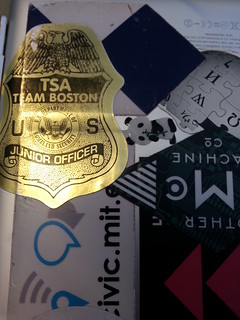
A gold sticker replicates a TSA-agent's badge and reads "TSA Team Boston, Junior Officer" with the Department of Homeland Security emblem and eagles all over the place.I waited. And waited. My flight began to board. I was still on the other side of security. Finally, I went to the airline desk and told them what was going on, and they changed the name on the ticket to match the ID I had on hand. I made my flight. I’m not sure if the airline did a legal thing, so I’m not naming them, but holy shit am I grateful.
Victory point: the TSA staff felt so badly about their process and supervisor being so shitty that they gave me a junior TSA agent sticker. To which Jenbot responded “You’re just two more pasties away from the world’s funniest private screening.”

Nonconsensual Pat Downs!

Last night had significantly less humor. I, for once, went for the full-body scan thing. My emotional fortitude to opt out of every process is slowly being worn down, which just pisses me off even more. I hate rolling over and showing my belly, but I also hate being touched by strangers who think I’m a fucking villain 3+ times a month. The scan showed an “anomaly in my pants” (lulz), and the female-identified TSA agent started patting me down before verbal acknowledgement nor even eye contact were made. I stopped her, saying I hadn’t consented to a pat down, at which point she indicated the anomaly and stated a pat-down needed to happen. I said I understood, but I hadn’t yet consented. She asked if there was going to be a problem, I said “with you touching me without my consent? Yes.” She then deployed the mantra of “going through all of my stuff and a thorough pat down,” but this time with about 3 additional TSA agents, a manager, and 2 federal officers around me, with them holding onto my stuff.

I balked. I’d rather spend another night where I was than deal with this (I was in a lovely place with lovely people). They tried to take my ID to scan it for a report I wouldn’t see. I instead put on my boots, got my bags (they didn’t resist my taking my things, but they also didn’t make it clear in any way it was possible), and walked towards the airline counter to sort things out. As I was walking away, one of the federal officers told me in a surprisingly friendly tone that if I attempted to make it through a different security line that night, I would be arrested and criminal charges pressed against me.

The airline informed me that I could use the ticket’s cost towards a future flight, but that they couldn’t book me on another flight the next day free of charge. That was between me and the TSA. I went back to the security line and talked with state officers, the TSA manager, and their manager about my general work, large-scale conflict resolution, sexual assault survivors, trans friends, and the TSA’s lack of empathy and effectiveness. I should have left the last part out, but I was pissed off. They allowed me to go through the process that night, if I were willing to go through the pat-down and stuff-going-through. And fuck it, my going home was more important in that moment than my civil liberties. And yes, I’m also well aware that basically no other demographic would have been able to have this privilege (because while it was personally deeply uncomfortable and not ok, it was still a systemic privilege to be able to have a re-do).

A friend who happened to be in the airport at the same time (small world is small) had seen some of this happening, and waited past security for me to be sure everything was all right. I’m deeply thankful for this act of kindness and manifestation of social fabric. Also that the TSA manager enacted the pat-down, as a personalized moment of “I know I’m a part of a fucked up system.” I made it through security at the core of the airport just as my flight was meant to be taking off in a peripheral gate, but I jogged to my gate anyway. And the goddamn airline held an entire flight for 15 minutes just so I could still get out that night. So much gratitude.

Internal Consistency is How the Terrorists Win, Apparently

It’s worth noting here that I fly a fair amount. I also tend to detect patterns and systems fairly well. I dread the inevitable next agent-splaining of how TSA policies work, which are always attempts to be kind and to let me in on “how things work,” but are never remotely consistent. Fuck you. The haphazard nature of enforcement has little to do with “let’s keep ’em guessing!” and far more to do with “what equipment is working today and what rules we’ve been chop-busted about most recently.”

Which Just Adds To…

The cycle we’re caught up in right now does little to nothing to “catch the terrorists” (which is also just slapping a band-aid on a gaping wound of systemic problems) and a whole lot in further ostracizing and demeaning historically marginalized demographics.

I have no idea what to do with this – the work I can’t not do (for passion, for frustration, for specialization) merits traveling a fair amount. The people I love are a distributed lot. But I also can’t handle instances like this happening too much more before… something has to change. Me, or it.

Here’s something I used to do a lot more, and which now I’ve been worn down out of doing, so I can still have emotional capacity for other things I care about. And that also pisses me off.

NECSI Salon: Ethnic Violence

On January 28th, the monthly salon gathered at NECSI to discuss ethnic violence from the lens of complex science. Yaneer Bar-Yam, president of NECSI, gave a brief talk about NECSI’s paper about modeling violence. Marshall Wallace, past director of the Listening Project, also gave a quick talk about his field experience with communities who opt out of violence. Again on Feb 4th, NECSI hosted an informal discussion around the case study of Libya. What follows are my big take aways and Sam’s asides, embedded into the fairly rough live notes from the salon. I call out these take aways and asides specifically because note takers often are lost in the notes, just as a photographer is never in the picture.
We hope you’ll join us on Wednesdays of this month to begin exploring medical systems, on ensuing fourth Wednesdays for structured discussion, or on other Wednesdays for more informal times.
wednesdays
Register for this fourth Wednesday here.

I am primarily left with a sense of purpose towards fostering collective intent towards alleviating suffering. In this entry, you’ll see a few ways large-scale violence is posited to be avoided. It is my personal opinion (of which I will opine at the end) that diversity is the key to equality as well as dignity, based on both the complex systems modeling and field experience framing these discussions.

But first, what do we even mean by “violence”? We’re referring to violent events occurring at level of massacres or bombing. These levels do seem to be slightly contextual based upon general violence levels in the area. Continue reading

Weaponized Social: Rethinking Online Scripts

Originally posted on the Aspiration blog

In the Aspiration ethos, using tools comes second to cultivating and understanding the ecosystem where the tool would live and grow. In practice, this means creating organizational processes, positive feedback loops, conventions, etc., so that when technology is implemented, it is overlayed on existing modes of healthy and sustainable interaction. This year, we began exploring one of the broader and more nebulous ecosystems as it relates to the technology of the internet: the ‘social scripts’ that mediate online interactions.

In February in New York City, participants at the first Weaponized Social collaborated to rethink the scripts that mediate behavior and interactions online. A social script is a way of interacting which is learned and internalized. It is similar to a software script (e.g., “if X, then Y”), but it takes place in the brain and is externalized in social situations. For example, when you walk into a restaurant, a social script is enacted:

  1. A host leads you to your seat and asks what you’d like to drink.
  2. The server brings your drink order, and asks if you’re ready to order food.
  3. You say, “No, not yet.”
  4. You are given more time to explore the menu.

…and so on and so on. If the server firsts asks for a dessert order or if you want to refinance your home, confusion follows as a result of going off-script. One is not born with innate knowledge of ‘how to go to a restaruant’. The script is learned. Although persistent, social scripts are transient and always evolving.

However, social scripts for online courtesy and critique have not kept apace with the rapid evolution of online technology over the past twenty years. The harms of scripts that played out in small groups offline have become dangerously amplified via the network effect. The potential to cascade and amplify makes the harms of scripts more potent. In extreme cases, a social interaction can become weaponized, triggering a negative script that brings life-threatening consequences (think social media comments escalating to harassing death threats and forcing someone to leave their home).

Weaponized Social seeks to explore ways to diminish harmful social scripts through workshops, dialogue, and the creation of actionable and shareable content. On the other side of the coin, we have the opportunity to enforce positive social scripts. It is possible to amplify the healthy, joyful, and serendipitous aspects of online connections.

How to get involved:


Special thanks to Meredith (@maradydd) Sam (@metasj), and the Berkman Center (@berkmancenter) for help in parsing all these ideas.

You belong to society

I’ve been unable to continue ignoring a notion that most people I see in online debates about gender1 carry, which is that those in these debates do not think they impact society, and subsequently have no individual responsibility towards it. It is simply a soup of which they are a part, where they are a stone — immutable to the broth around them, of no consequence to the overall flavor.

Let’s talk about emergence, here from the Complex Systems perspective, as the interaction between the parts and the whole. “Can’t see the forest for the trees,” as not being able to see the big picture because one is so focused on the next-scale-down of units (trees), despite these composing the next-larger-up scale (forest). Each has different behaviors, which slightly or drastically effects the other. Or, “the devil is in the details,” in which the opposite happens, the smaller-scale being skipped over while the next-larger-scale is focused on. You’ll note that these things matter to each other. They influence each other. In many circumstances, these two scales are caught up in creating each other in at least some small way2. To claim that one is more important than the other glazes over this connection. Plus, the math doesn’t work out right.

Let’s talk about values. I would like a just and equal world. I bet most of the people I talk to would also like some version of this. Some folk hold other amazing core values such as inclusion or empowerment. Here’s the thing to understand: anyone you interact with3 will be holding something like this inside of them. Maybe not so explicitly, maybe not as an active part of their interactions, but it is there.

Let’s talk about fault. The people that got us to where we are now were doing the best they could under the circumstances. Maybe some were malicious, but generally. they were just surviving. People in power tend to want to continue doing well. People who are out of power generally make do, though they’re likelier to have a generally more shitty time. Inequality makes both sets unhappy. It’s not the fault of the people in power that the structures which allow them to be in power exist; it’s not the fault of those out of power that they were born into a setting that keeps them out of power.

Let’s talk about responsibility. While no one currently alive is to blame for history, we are currently building the next generation’s history. Hell, we’re building our own. And we have a responsibility to act in a way which upholds our values, rather than shirks responsibility as bizarrely tied to fault. I don’t want to take the responsibility to respond kindly to this person because their upset is not my individual fault. I don’t want to help clean up after dinner because not all the plates are my fault. I don’t want to take responsibility for mending the rifts in society because they’re not my fault4.

In each of these, it is not just what you are asking for yourself, but what you are changing in the people around you. When a child is being surly, and a parent reacts badly because a nerve got struck5, the wrong lesson is being imparted. It’s not about the parent’s feelings in that moment. It’s about how the child learns how to react to someone expressing their feelings in a not-yet-eloquent way6.

Sometimes taking on this responsibility to society means shutting up, even when you’re right. Sometimes taking on this responsibility means speaking up, even when your voice trembles. Sometimes this means cleaning the common area, even though you haven’t even been around for the past week. It means having differences and resolving them in a way that makes sense for future generations to also resolve them, even if you’re not happy with the results.

When anyone says “my individual experience matters more in this moment than how we as a society deal with moments like these” I see them as throwing a tiny tantrum rather than building a better world. It’s not their fault. Why should they have to do anything to fix it? This is why I continue to think Laurie’s piece is so great and I get filled with rage and bile at StarSlateCodex. This is why I find GamerGaters outright laughable7. This is why I find some of my geek feminism friends so aggravating at points7. In all of this, I see why they’re saying what they’re saying. Of course those feelings are valid. But that’s not the whole point, is it?

Get our shit together. Focus on where we want to be, and manifest that in each interaction we have. This is what I assume most people are doing, and why I’m now so comfortable saying “I don’t like how we’re doing this, can we try another way?”

I don’t like how we’re doing this. Let’s find another way.


1. And race, now, too!
2. Exceptions of pragmatic lock-and-key example, and the theoretical molecule representation of same self model.
3. With incredibly rare exception, not based on if you get along with them or not.
4. Are you fucking kidding me, this is how we get ants.
5. children can be astute little fuckers
6. I am in no way claiming to be amazing at this, merely that I am aware of, and subsequently actively working on, it.
7. “You need to listen to me!” they say, while not listening.

Complexity Salon : Ebola

These notes were taken at the 2014.Dec.18 New England Complex Systems Institute Salon focused on Ebola. Sam, Willow, Yaneer contributed to this write-up, and 20 people were in attendance. We hope you’ll join us in future. We’ll have unstructured meetings each Wednesday from 18:00 to 20:00 (6p-8p) starting Jan 21st, with the fourth Wednesday of each month structured towards contribution towards a global challenge. The next such structured event will be on January 28th, on the subject of ethnic violence. You can see notes on this and potential future subjects here, and can register here.

About Ebola at NECSI [briefing by Yaneer]

NECSI has a history of studying Ebola models, and has predicted something similar to what is currently going on in West Africa for some time now. NECSI started with a model of pathogen evolution in which the most aggressive stable state has virus constantly passing slowly through populations, creating islands, dying out as people expand into areas with no disease.

Aggressive diseases plus long-range transport

Then if you add long-range transport, you get more and more aggressive strains. The more long-range transport you have the more aggressive the strain can be without dying out; and eventually could kill an entire global population. Paper published in 2006, mentions risk of Ebola.

As transportation becomes more pervasive, vulnerability increases.

Early warning and preparedness

Presented to the WHO in Jan ‘14. They were respectful and excited by the work. Discussed other public health issues faced by WHO, however didn’t return to pandemic models.

Since then: outbreak happened. Lots of discussion. Why don’t we engage in risks in a more serious way? Everyone thinks their prior experience indicates what will happen in the future.

  • Look at past Ebola! It died down before going far, surely it won’t be bad in the future.
  • Models of outbreaks look at existing conditions, which prove to be too limited here.

Example: with flu, people take exactly that disease and known circumstances, and simulate an outbreak, ignoring changes in the disease or in the conditions (and: nothing has to change in order to have huge risk). the same properties could remain, but a low-probability event could unfold, “fat tail distribution” – past experience isn’t necessarily a predictor of what will happen in the future.

Individual and community

Contract tracing, the standard public health method, doesn’t work well when there are more than just a few cases. Stop thinking about the contacts of the person, think about the community. Travel restrictions so new communities aren’t infected. Now that people go door to door for symptom screening, the cases have decreased dramatically in Liberia.

People were saying: “The beds are empty!” Authorities responded: “We can’t figure out why. We think people are still sick!” Why are the hospitals and authorities waiting for the sick to show up? Going door-to-door in the neighborhoods shows what’s going on, and is what is effective.

Once you know the right question, the answer is clear.

Interests

We then stated our interests – each person said one thing about the topic or intro talk they’d be interested in diving into more during breakout groups Continue reading

Expressions of Solidarity

Aside

I wonder if, what Scott means, in this whole storm recently, is actually:

“Your struggle is my struggle. While I had a really rough time growing up, it must have been just as hard for people like me, and even harder for those facing structural oppression. I want to fight these systems with you. When you say I’m ‘privileged,’ I feel like my experience is being discounted and it makes it difficult for me to be in solidarity with you.”

I feel like this is what Laurie is asking for. I know it’s what I would ask for.

Museo aero solar

Years ago, after Chaos Congress, Rubin insisted we go to some art show. I, as always, preferred to stay at home — whatever continent, country, city home might be in that day. But Rubin can be lovingly persistent. It would be worth it. It would be beautiful. We went, mere hours before I boarded a plane from somewhere to somewhere else.
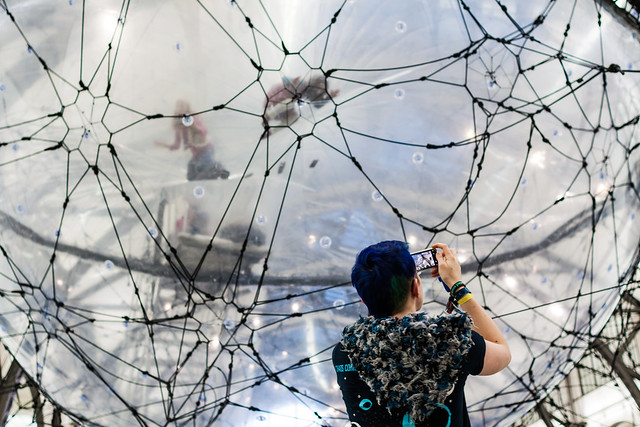
blue-haired willow has her back to the camera, focused on a large transparent orb. Children play in the orb, suspended on a clear sheet of plastic. black lacing holds the orb in place. Rubin took this picture, and Willow is fond of Rubin.
Biosphere was a study in liminality to me, suspended spaces tethered to more commonly understood as habitable floors and walls. Perfectly clear water in heavy plastic and vast space define in clarity and iridescence. It was a liminal future, an in-between home, the moment the wheels leave the runway. The terror of my anxiety and the complete love for the possibility of Something Different, wrapped up in the moments of stepping into the future. In short, Rubin was right.

Jump forward a few years.
When Pablo invited me to Development and Climate Days in Lima, I was glad to go. Even before the deeply pleasurable and productive Nairobi gig with Red Cross Red Crescent Climate Centre and Kenya Red Cross, I trusted Pablo to have spot-on inklings of the future. Maybe all that climate forecasting has gotten into his social forecasting as well. His efforts around serious games resulting in their now being generally accepted, he told about an art-involved step to get people to think about the future differently. Something about plastic bags, and lighter than air balloons. Would I be willing to, in addition to my talk, document their process of creating a Museo Aero Solar for others to participate and replicate? Of course – distribution of knowledge, especially with illustration and technology is kind of my jam. It would also help me venture into the city.

I arrived at 2a to a deserted city and a vast and rolling Pacific out the cab window. I cracked jokes with the driver based on my poor grasp of Spanish (“ehhhh, Pacifico es no muy grande.”) He humored me. And in the morning, mango that tasted like sunlight, and instant coffee, and the Climate Centre team of whom I am becoming increasingly fond. And a new person – the artist Tomas, with whom Pablo and I ventured to an art space to join the already-started process of community building and art creation, large bags full of plastic shopping bags ready for cutting and taping. Pablo eventually had to go spend time at COP20, I relished not going.
a phone-camera captured image of a pamphlet instructing how to create a museo aero solar. it instructs the collecting, cutting, taping, and combining of plastic bags.
I took such specific, ritualistic care with each plastic bag. Cut off the bottom, cut off the handles, cut a side to make a long rectangle. Lay it gently on top of the pile, pressing down to smooth and order. Pick up the next bag. Feel it on my hands. The crinkle, the color. Smooth it out. Cut. Place. The sound of tape being pulled, torn, applied, and stories told in Spanish. The slow joining of each hand-cut rectangle. I smiled, to dedicate so much care to so many iterations of things which are the detritus of life. Francis laughed with me, saying she felt the weight of each one. A heavy statement for something so light. Tomas walking around, constantly seeming to have attracted a bit of plastic bag handle to his heel, no matter how many he peeled off, a persistent duckling of artist statement.

We went to the Lima FabLab to speak to a hackathon about making a GPS and transponder so we could let the creation fly free without endangering air traffic. And this time I saw it from the outside – seeing Tomas speak to a group of self- and community-taught Peruvian coders, and seeing their faces display disbelief and verge protection against the temporal drain of those outside your reality. Then, as he showed step by step, and finally an image, that these can fly, their cousins can lift a person, grins break out. Peoples’ hearts lift, new disbelief replaces the jaded. There is laughter and a movement to logistical details.

And then we took it to the D&C venue, and it worked.

I imagine what Pablo must have gone through, to get bureaucratic sign-off on this. No metric of success. No Theory of Change. Him, fighting tooth and nail for a large and hugely risk-adverse organization to trust fall into the arms of a community, an artist, a facilitator, and a game maker. And they did. And it changed the entire event. People in suits crawling into this cathedral made of plastic bags, each individually cut and added with love to the whole. A pile of fancy shoes outside the entrance, like a ballroom bouncy castle. People’s unabashed joy watching art some of them had made become a room, and then lift off to become a transport.

This future we want — it’s hard work, it can seem impossible. But it’s right here, we made it. It works, and it is beautiful.

I brought up ways for other people to participate. In a beautiful act I would associate with Libre ethics, the Lima crew have opened up not only our stories, but our process. We want you to join us. We want you to be a part of this future, and it means hard work. The fledgling wiki and mailing list can be found here. I hope you hop on.

Networked Mortality


Death is different now. In a time of networks and social media, it’s not just having a song remind you of your deceased loved one anymore, it’s Spotify suggesting you listen to their playlists. It’s scrolling just a bit too far too soon and seeing their last shares on Twitter or Facebook. It’s not just figuring out funerals and atom-based belongings granted through wills (or figuring things out there wasn’t any pre-planning), it’s a faceless mass of internet informing you that your friend has died. It’s not just compiling half-finished scrawled songs and old love notes, it’s debating cracking the password for a laptop full of memories. Because the internet and technology haven’t just changed how we live – it’s changed what happens in death. And we can simply be awash in tragedy in these new ways, or we can use those new connections to show our care and values, even through death.

Today the spontaneity of planning, which makes it possible to search for a place to eat with your incoming friend while already out the door, forms habits making the avoidance of planning for death even easier. But after working through the unexpected deaths of a number of networked friends, I have started explicitly planning for the eventuality of my own death, to ease the burden on others. I’ve set up a living will (detailing things like whether I want to be kept on life support — I don’t), a will (what to do with my corpus and my corpse — open them up and share the contents), and mechanisms for notifying the many communities I inhabit, helping them find each other for support. The compartmentalization of online selves otherwise makes discrete and care-full notifications difficult, and sadly the current viable option is mass broadcast.

Because I’m also from the parts of the internet that care about open access and free software, friends and I have taken my death preparations and formed a guide for the bits of postmortem planning other guides may have missed. Based on ideas from open access and information security, it includes topics like how to deal with passwords, contact lists, plans for account deletion while archiving information, and donating one’s body to science in ways that support open research.

This living documentation is called NetworkedMortality, and I hope it helps others to start thinking about and planning for the inevitable, either privately or in this wiki-based and public place. Just as the internet is about creating, storing, and transmitting knowledge, this guide is about contributing to something larger than the individual. It’s about continuing to build the commons, establishing protocols for death in the digital. The sorrow of death need not also be accompanied by confusion over what intentions would have been or who should know what. Funeral home directors and lawyers have helped guide us through the protocols of death in the better-known world. In this new space those steps are considered by Twitter, Facebook, and Google, but I at least would prefer to trust people I know to deal with my wishes more accurately and with more love. We’ll be hosting a “death drill” to test out these new protocols on December 13th from 2p-5p at the Berkman Center.

Too often, we think only about the short term – this quarter, this school year, this laughably short short life span – when considering how we plan as well as what we build. We must instead intentionally look to the public future, and our responsibility as members of that shared story. We must contribute to freely available knowledge which lasts beyond our brief moments. An unavoidable part of life is death. Let’s care for each other, and hold true to our values, through the entirety. Let’s network our mortality, together.

P.S.
It is possible to speak about death without fear – I hope you can act from this place.  If you are in danger of harming yourself, please get help, rather than indirectly indicating through things like estate planning.