Humanitarian Technology Festival

I came on with Aspiration back in January as the Community Leadership Strategist, to merge the work I’ve been doing in the humanitarian and disaster response space with Aspiration’s practices and team. It’s been a *blast* so far, and continues to be.

Most of the work I’ve done in the last 5 years has been about what social justice looks like when we’re doing response, with a focus on technology (as that opens up paths to conversations we otherwise quit having). With Geeks Without Bounds, we did hackathons all over the world, including Random Hacks of Kindness and SpaceApps Challenge. I’ve been a coordinator for the Digital Humanitarian Network, keynoted the IEEE Global Humanitarian Technology Conference, was invited to the White House to talk about Sandy response, facilitated the first hackathon IN (not just for) Haiti, etc etc etc. I’ve also had a huge organizational crush on Aspiration since my first DevSummit in 2013, attending as many Aspiration-connected events as possible. When I was able to join Team Aspiration, I was overjoyed — even while much of the work I’ve continued to do on response had already existed, it’s been a slow shift to get those previously-defined objects to be a bit more Aspiraiton-shaped.

The Humanitarian Technology Festival in Cambridge May 9+10 is the first event that is both committed to response and framed on Aspiration ethos. I am SO EXCITED about this it hurts. Let me explain why.

The very way we deliver aid perpetuates the need for more aid, both for fast- and slow-onset disasters (or “extreme events” or “humanitarian issues” or “earthquake” or “famines” or whatever you’d like to say). When people need lodging after a hurricane, they’re either told to evacuate and/or they’re put into temporary homes, away from neighbors and family. There is little impetus to return and rebuild both social and tangible structures. People are uprooted, and must start from scratch. When, instead, we see that people don’t just need lodging but in fact need social fabric, responders (and the technologies used for response) can focus on how to maintain family and neighborhood ties. People are then less stressed as well as being more likely to take their own actions to return and rebuild.

For humanitarian aid, this is even more paternalistic and stratifying… while not actually “fixing” any of the things it aims to. Aid is primarily about making the giver feel better. But like Tom’s Shoes picking up on the “buy one, give one” idea that OLPC actually handled with cultural grace and systems thinking, instead Tom’s put some people out of work while trying to provide something THEY thought others needed. Even if it had been delivered in a less-jerky way, aid often ends up with locations dependant on that aid, rather than internally strengthened. This is one way we keep extracting resources out of other places without actually contributing to those locations. See also this bit of the paper I’m still working on. This allows the worst parts of globalization (erasure of cultures, consolodation of wealth, etc) to continue.

Some might say “fine, let them fend for themselves,” but that’s not ok either. When we don’t have to look at our neighbors (when we build walled housing complexes, or segregated schools), we can ignore how bad things are for them. And that’s also not an acceptable answer.

What we need are ways to listen to what people can offer, and what they need, under the assumptions that we are equals. This is why I’m so excited to see how the participatory methods I associate so strongly with Aspiration come to bear on this space. Just do a search-and-replace for “Nonprofits” to “Affected Communities” on our Manifesto and Participant Guidelines. People in these fragile situations are NOT a population to playtest new tools. Not only do failures have a larger impact in these spaces, but to think of another location and its people as “demo” space is undignified and unjust. We need better ways (not just better tools) for life EVERYWHERE, and to assume that we WEIRD (Western Educated Industrialized Rich Democratic)-o’s have all the answers is downright arrogant. By instead, as we do at Aspiration events, speaking to each other in easy-to-understand language, under the assumption that everyone is bringing something meaningful to the table, and that together we’ll figure it out; we can shift not only how we do response, but the after-effects of that response.

I’m especially excited to speak to people about distributed response, and how the tools we build for ourselves can be welcoming to others using as well. Check out NYCprepared and Taarifa to see what this can look like.

NECSI Salon: First Day Celebration

NECSI’s action-based 4th Wednesday Salon focused on First Day. This is an event which provides the resources, framing, and impetus to take personal responsibility for community health. It is not a fix-all, but is it an important, missing piece in the US health care debate, and a fulcrum for connected shifts to a healthier society.

On Wednesday, March 11th, we will hear talks from Deb Roy from the MIT Media Lab, Devin Belkind from OccupySandy, and Sam Klein from Wikimedia on Distributed Organizations. Register here.

First Day is about taking personal responsibility for your own wellbeing at personal and global level. Inspired from the idea of regeneration and new year resolutions, First Day wants to create a community level engagement at a personal level and community level.


Deck created by Catalina Butnaru

Deck created by Catalina Butnaru

We assumed those attending would be both in a position to, and have a desire to, act. The Wednesday before had provided space for folk to ramp up to this state, including review of readings about a similar Wal-Mart initative. We were additionally inspired by Boston’s own First Night and City Awake.

After very short reminders of what we were there to accomplish for the day, each person introduced themselves and what they were interested in specific to First Day. From these, we pulled out a few break-out sessions tasked with creating an actionable list or guidelines for organizers to work with. The overarching points we ended with were an appreciation of the need of safe space for people to ask questions which might otherwise be taboo (especially around health), comfort in complex problems having interventions (especially with a light hearted attitude!), an appreciation for existing cultural events (Days of the Dead as well as Chinese, Tibetian, and Indian celebrations of new cycles and health), and holistic approaches to mental and physical health.

Slightly curated notes follow: Continue reading

Reporting Back from Weaponized Social in NYC

Originally posted on the Aspiration blog

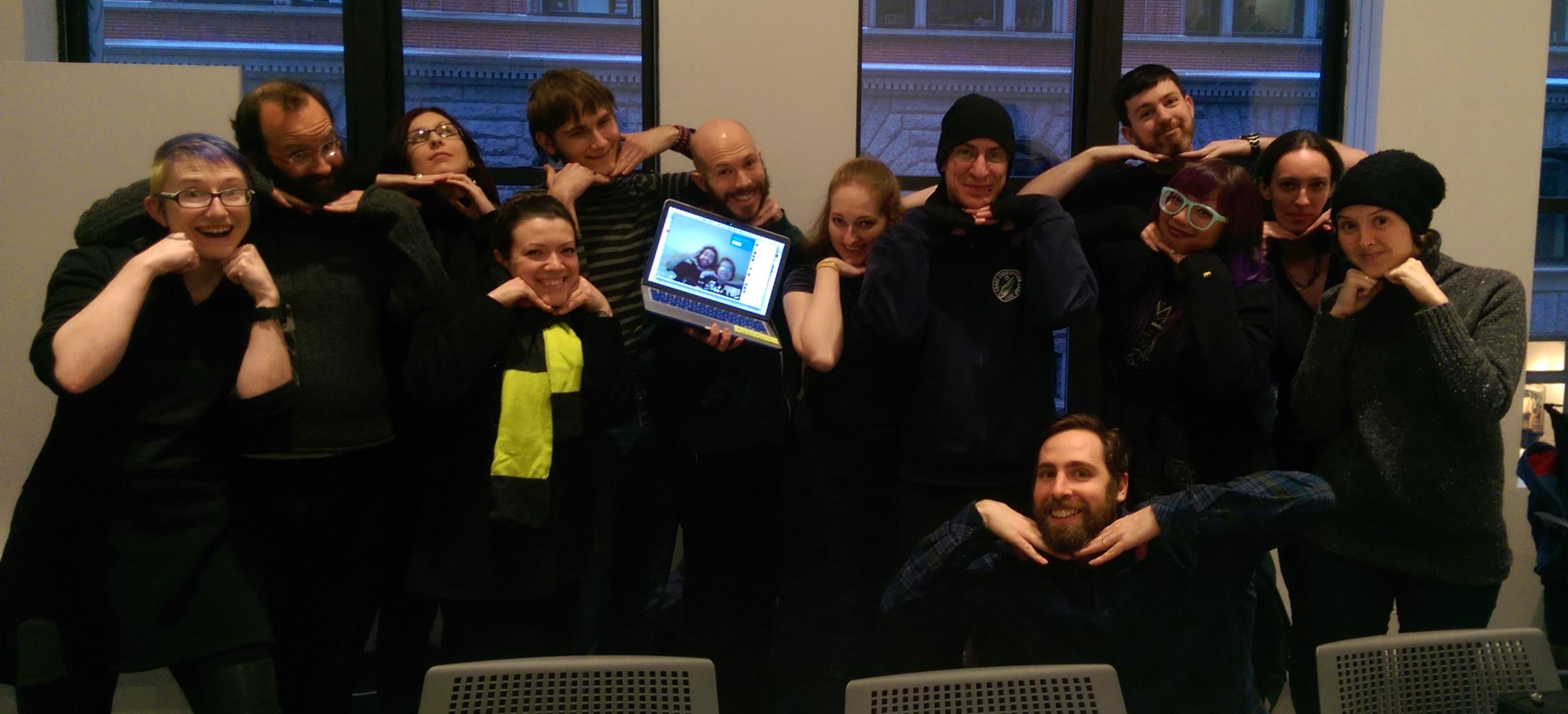
A group of fifteen participants gathered in New York City on February 13 and 14 to discuss the idea of Weaponized Social: the notion that social harms resulting from digital interactions can become dangerously amplified online by the network effect. We discussed what might be done to rethink the ‘social scripts’ that trigger conflict, and how to mediate conflicts as they arise in digital spaces (visit this post to learn more about “social scripts”).

At the event, we recognized that while online interactions can enact harmful consequences, this is a tractable problem; we are in a position to make changes to social scripts in our parts of the world and corners of the web. We understood that many of the things we love most about the internet (e.g., the ability to ambiently connect with long-time friends, to interact (and fall in love with!) strangers, and to vocalize your causes) are also what can make it seem like a dangerous place, where we may be susceptible to harassment or having private information leaked by known or unknown entities.

Weaponized Social NYC

We took the first half of day one to co-create an agenda and to participate in an idea spectrogram in order to challenge assumptions of agreement and convey the diversity of world views in the room. We then dedicated the second half of the day to the common threads across the various issues we were working in. One such shared belief was that rather than creating one-size-fits-all content (e.g., a single deescalation guidebook), we should instead embrace many versions of the same idea being present, for various levels of knowledge, language, and learning styles (think of things like “Drawing for Scientists“).

We also considered how the ways people connect to one another influences their interactions. Calling this session “structures,” it included graph and network visualizations coming into beautifully-illustrated play. We then explored ways of forming and maintaining healthy communities, creating general guidelines to create safe space within defined communities, and to recover if a community has become unsafe.

On the second day, we discussed the more tangible aspects of online scripts, such as:

  • nonviolent communication
  • historical trolling (i.e., trolling pre-online harassment)
  • recovering from unintentional mistakes (yours or someone else’s)
  • nonverbal communication online
  • constructing bridges between disagreeing people
  • solidarity in nebulous groups (what is it to have someone’s back when you’re not technically in a community together? What about if it is an open chat room anyone can join?)

Throughout these discussions, we recognized that echo chambers are to be avoided, but that safe space is also needed for reconciliation, adaptation, and learning. Assuming that a perfectly safe space is also one in which freedom to act is incredibly constrained, we now advocate creating “safe foyers” rather than blanket “safe spaces” (i.e., “Please step over here with me so we can figure out where things went wrong”).

In this model, the safe foyer being unsuccessful would mean bringing in more community members to escalate conflict resolution. We are painfully aware that many abusive people will use back room conversations to quietly continue antisocial behavior, while still seeing that back room conversations are a valuable channel of support for conflict resolution, and we look forward to further examining this tension.

There were many common threads and themes here as well. Such as:

  • Intended audience matters (see also: “Context Collapse“.)
  • Translators between world views are a valuable and necessary (and should be celebrated and rotated in order to prevent fatigue and burn-out)
  • Both historical trolling and non violent communication strive for exploration and emotional maturity for all parties involved (albeit by incredibly different methods)

In each of these, we aimed to include and support neurodiversity, such as those with autism spectrum disorders or with scrupulosity.

The question we will continue to carry forward is: How do we inspire change and self-reflection in our selves and the communities we engage with? To this end, we have a few projects started:

  • Guide for supporting activists
  • Guide in how to ask for critique in a way you can best hear it
  • Self-awareness checklist
  • Guide to wielding the privilege sword
  • Checklist for making safe space (and path-correction when things are going poorly)
  • Guide to expressing nonverbal cues in text-based space
  • Guide to using nonviolent communication among people who use differing empathic styles

These conversations required trust and comfortable space, and we were honored to be housed by the newly opened Civic Hall in NYC’s Flat Iron District. We thank Micah Sifry, a long-time Aspiration friend, who offered this newly established community space around civic tech for the Weaponized Social event. We couldn’t dream of a more appropriate space. Please do welcome them to the geographic and interest neighborhoods when you have a chance.

As we continue moving forward on these projects, we hope you’ll contact us and let us know if you’d be interested in participating in (or hosting!) a future event by contacting weaponizedsocial@aspirationtech.org

NECSI Salon: Ethnic Violence

On January 28th, the monthly salon gathered at NECSI to discuss ethnic violence from the lens of complex science. Yaneer Bar-Yam, president of NECSI, gave a brief talk about NECSI’s paper about modeling violence. Marshall Wallace, past director of the Listening Project, also gave a quick talk about his field experience with communities who opt out of violence. Again on Feb 4th, NECSI hosted an informal discussion around the case study of Libya. What follows are my big take aways and Sam’s asides, embedded into the fairly rough live notes from the salon. I call out these take aways and asides specifically because note takers often are lost in the notes, just as a photographer is never in the picture.
We hope you’ll join us on Wednesdays of this month to begin exploring medical systems, on ensuing fourth Wednesdays for structured discussion, or on other Wednesdays for more informal times.
wednesdays
Register for this fourth Wednesday here.

I am primarily left with a sense of purpose towards fostering collective intent towards alleviating suffering. In this entry, you’ll see a few ways large-scale violence is posited to be avoided. It is my personal opinion (of which I will opine at the end) that diversity is the key to equality as well as dignity, based on both the complex systems modeling and field experience framing these discussions.

But first, what do we even mean by “violence”? We’re referring to violent events occurring at level of massacres or bombing. These levels do seem to be slightly contextual based upon general violence levels in the area. Continue reading

Museo aero solar

Years ago, after Chaos Congress, Rubin insisted we go to some art show. I, as always, preferred to stay at home — whatever continent, country, city home might be in that day. But Rubin can be lovingly persistent. It would be worth it. It would be beautiful. We went, mere hours before I boarded a plane from somewhere to somewhere else.
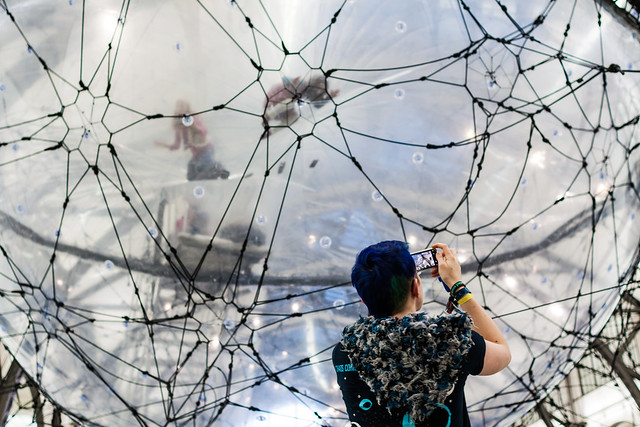
blue-haired willow has her back to the camera, focused on a large transparent orb. Children play in the orb, suspended on a clear sheet of plastic. black lacing holds the orb in place. Rubin took this picture, and Willow is fond of Rubin.
Biosphere was a study in liminality to me, suspended spaces tethered to more commonly understood as habitable floors and walls. Perfectly clear water in heavy plastic and vast space define in clarity and iridescence. It was a liminal future, an in-between home, the moment the wheels leave the runway. The terror of my anxiety and the complete love for the possibility of Something Different, wrapped up in the moments of stepping into the future. In short, Rubin was right.

Jump forward a few years.
When Pablo invited me to Development and Climate Days in Lima, I was glad to go. Even before the deeply pleasurable and productive Nairobi gig with Red Cross Red Crescent Climate Centre and Kenya Red Cross, I trusted Pablo to have spot-on inklings of the future. Maybe all that climate forecasting has gotten into his social forecasting as well. His efforts around serious games resulting in their now being generally accepted, he told about an art-involved step to get people to think about the future differently. Something about plastic bags, and lighter than air balloons. Would I be willing to, in addition to my talk, document their process of creating a Museo Aero Solar for others to participate and replicate? Of course – distribution of knowledge, especially with illustration and technology is kind of my jam. It would also help me venture into the city.

I arrived at 2a to a deserted city and a vast and rolling Pacific out the cab window. I cracked jokes with the driver based on my poor grasp of Spanish (“ehhhh, Pacifico es no muy grande.”) He humored me. And in the morning, mango that tasted like sunlight, and instant coffee, and the Climate Centre team of whom I am becoming increasingly fond. And a new person – the artist Tomas, with whom Pablo and I ventured to an art space to join the already-started process of community building and art creation, large bags full of plastic shopping bags ready for cutting and taping. Pablo eventually had to go spend time at COP20, I relished not going.
a phone-camera captured image of a pamphlet instructing how to create a museo aero solar. it instructs the collecting, cutting, taping, and combining of plastic bags.
I took such specific, ritualistic care with each plastic bag. Cut off the bottom, cut off the handles, cut a side to make a long rectangle. Lay it gently on top of the pile, pressing down to smooth and order. Pick up the next bag. Feel it on my hands. The crinkle, the color. Smooth it out. Cut. Place. The sound of tape being pulled, torn, applied, and stories told in Spanish. The slow joining of each hand-cut rectangle. I smiled, to dedicate so much care to so many iterations of things which are the detritus of life. Francis laughed with me, saying she felt the weight of each one. A heavy statement for something so light. Tomas walking around, constantly seeming to have attracted a bit of plastic bag handle to his heel, no matter how many he peeled off, a persistent duckling of artist statement.

We went to the Lima FabLab to speak to a hackathon about making a GPS and transponder so we could let the creation fly free without endangering air traffic. And this time I saw it from the outside – seeing Tomas speak to a group of self- and community-taught Peruvian coders, and seeing their faces display disbelief and verge protection against the temporal drain of those outside your reality. Then, as he showed step by step, and finally an image, that these can fly, their cousins can lift a person, grins break out. Peoples’ hearts lift, new disbelief replaces the jaded. There is laughter and a movement to logistical details.

And then we took it to the D&C venue, and it worked.

I imagine what Pablo must have gone through, to get bureaucratic sign-off on this. No metric of success. No Theory of Change. Him, fighting tooth and nail for a large and hugely risk-adverse organization to trust fall into the arms of a community, an artist, a facilitator, and a game maker. And they did. And it changed the entire event. People in suits crawling into this cathedral made of plastic bags, each individually cut and added with love to the whole. A pile of fancy shoes outside the entrance, like a ballroom bouncy castle. People’s unabashed joy watching art some of them had made become a room, and then lift off to become a transport.

This future we want — it’s hard work, it can seem impossible. But it’s right here, we made it. It works, and it is beautiful.

I brought up ways for other people to participate. In a beautiful act I would associate with Libre ethics, the Lima crew have opened up not only our stories, but our process. We want you to join us. We want you to be a part of this future, and it means hard work. The fledgling wiki and mailing list can be found here. I hope you hop on.

The “Make the Breast Pump Not Suck” Hackathon

Author’s note: I go to, organize, and facilitate a *lot* of hackathons, and while I’m thrilled about most of them as chances for people to learn and get involved in a field of research, I’m also fairly skeptical of them. So I’ve limited myself lately to events that can really make a difference, not only for the participants, but for the people who would benefit from the things they work on. Most recently, I’ve been doing events in Dar es Salaam with Taarifa and Geeks Without Bounds around water point mapping. I think this event has an opportunity for significant impact as well – this event especially in the arenas of health and gender equality. The following post was written by the hackathon team, of which I’m honored to nominally be a part.

Why Breastmilk and Breast Pumps?

Breast pumping is an experience many women dislike, yet it saves the lives of premature babies and permits working women to continue a nursing relationship with their babies. The health benefits of breastfeeding for both mother and baby are numerous, and include reduced risk of type 2 diabetes, hypertension, female cancers, heart disease, and osteoporosis. Despite the overwhelming data and worldwide endorsement of breastfeeding for the first two years of life, many women do not breastfeed at all or wean after several months. In particular, low-income, working women are rarely able to take extended maternity leave, afford the cost of a pump, or pump breastmilk at their workplace. In emerging economies around the world, women who go back to work wean their babies rather than using a breast pump.

breastpump1

The breast pump is the rallying cry for the event because it is a symbol of a technology that could be better integrated into people’s everyday lives in order to save lives, save money, and lead to healthier and happier families. At the same time, our goal is to make space for innovation in family life more broadly, and to support a wide variety of different kinds of projects at the hackathon- and beyond.

This is the second of these events, with a writeup of the first here. Check out some challenge definitions and inspirations on the Tumblr, and join us if you can!

When: Saturday, September 20 & Sunday, September 21, 10am-6pm

Where: MIT Media Lab

Win! World-class judges will be giving cash prizes to the best ideas

Register Now (Registration is free but space is limited)

Bringing together parents, medical professionals, designers, policymakers, MIT students, and engineers to radically redesign the breast pump, as well as explore other innovations in maternal and pediatric health to improve the lives of families and children around the globe.

Our generous supporters of this event include Vecna TechnologiesMedela and Naia Health.

Presented by the MIT Media Lab with organizational support of iKatun.

Pre-Hackathon Movie Screening

Join us for a free public screening and discussion of Breastmilk: The Movie on Wednesday, September 10, at 7pm at MIT Bartos Theater, 20 Ames Street, Building E15, Lower Level, Cambridge, MA.

No RSVP required! Babies welcome.

Questions? Check out our website or contact us at breastpump-organizers@media.mit.edu.

A Week of User Rights and the Tools to Support

What a crazy week. This has mostly been typed on a plane back to Boston, where I get to be for a few days before heading to DC and then home to visit. When I landed to SF a week ago, I had plans to see friends, to lounge a bit, to enjoy a city I love so much. Instead, and just as happily, it was a whirlwind of jam-packed braining and action around user rights and the methods and tools to support those rights.

Countersurveillance DiscoTechs

With the Codesign Studio I TA with the Media Lab, a series of Discovery Technology (DiscoTech) Workshops were put on. The ones in Bangalore, Ramallah, Mexico City, Boston, and San Francisco were all inspiring. You can see more about the projects, art, and progress over on our hackpad. Some examples were stories from Venezuelan activists, face painting to deter facial recognition (so hard!), long-time surveillance on poor communities in America, and spoofing DNA.

And seriously. Take a few minutes to go through the partner pages for this. Need a bit of morning outrage? Think everything’s going pretty ok in the world? Nope!

UI/UX for Crypto Tools Hackathon

The second usability hackathon with OpenITP went incredibly well, and repped as the San Francisco DiscoTech as well as its own thing.

It was utterly luxurious to work on large team of people. Ciprian had logistics covered, solidly. Gus knew the projects inside and out. Bex had notes and tone in beautiful competence. Anytime I would think “oh, we should..” it was already in progress. All I had to do was herd the kittens, which was absurdly fun.

RightsCon

It was really nice to completely surrounded by the people I usually see when we all jam into the one or two sessions at any tech or policy event which involve both. But that overlap was the whole conference, so we were able to dive in much deeper, see more nuance, and see next steps. I learned about funder motives, and the initiatives which backed tech in atrocity prevention/detection/accountability, and about many many tools used to amplify the voices of marginalized people. I drew a lot, and I hugged even more.

VizNotes

Full set on bl00viz.

Typed Notes!

I typed notes for two interactive sessions for sake of formatting. One was a review of the the UI/UX hackathon the weekend before, the other was stories from the field and suggestions for how to be better trainers. Those can be found over on the Civic blog.

Responsible Data Forum

Thursday I trekked out to Oakland to participate in Engine Room‘s Responsible Data Forum, as hosted by the inspirational Aspiration Tech. Again, I was spoiled by being surrounded by an impressively diverse set of people interested in the same fulcrum of concern and change. We skeletoned out plans for checklists before collecting data, and workflows that include project death, and illustrated how data moves through a company. We talked hosting and coercion resistant design and informed consent. We also talked about context-based privacy in disasters. I’m looking forward to seeing what comes of the day.

Projects from the Boston Aaron Swartz Hackathon

Written with Erhardt GraeffSJ Klein

Intro Talk Ethan led us out by talking about the breadth of Aaron’s work, and what it is to be an “effective citizen.”

https://youtube.com/watch?v=1Pn3mm3bK6U

(Second day’s talks are written up already on the Civic blog here.)

Projects We Worked On We are deeply appreciative of all of the hard work done at the event, and about the social bonds built in our time together.

Ableson Report TL; DR Distillation and restating the Report to the President on MIT’s role (or lack thereof) in the arrest and suicide of Aaron Swartz, such that more people can join in the conversations around the issues specific to MIT.

https://youtube.com/watch?v=cJxP3jOdO-I

Finished with: Prioritized and referenced questions for the FAQ doc, this prezi (which can still be expanded upon, but this is a start), and a super pretty interface to put it all into as we work.

http://prezi.com/embed/9r2agd3u8ule/?bgcolor=ffffff&lock_to_path=0&autoplay=0&autohide_ctrls=0&features=undefined&disabled_features=undefined

Emerson Working with Mozilla’s web API structures to to wrangle control of personal data across the web back into the hands of users.

https://youtube.com/watch?v=VFjmcoWufRk%3Flist%3DUUbqhCwZfmeKwMhaXyW4tUtw

Repeal the CFAA Repeal the CFAA: The CFAA is broken; no one but prosecutors like it. Building a constructive, normative replacement, and strategies for getting support at all levels: executive, policy, law, prosecution, activists, cyberwar. Cooperating with Aaron’s Law and EFF work; but also tackling. Most discussions of “CFAA reform” have been incremental, in a framework of discussing what changes to current law are possible and would help fix recent problems; as opposed to describing why CFAA is broken and what proportionate and moral laws in that space wold look like. We’re trying to describe what effective policy would look like, starting from scratch. Policy, Legal, Social, Tech/Security, and Prosecutorial norms which make sense. Project details and analysis

https://youtube.com/watch?v=tr1g9MmOXZM

Strong Box A platform for whistleblowers to transfer documents to newspapers directly. Initial code by Aaron Swartz.

https://youtube.com/watch?v=SAGoft_e-PY

This gentleman fixed a bug in how to delete files which a journalist may no longer find relevant.

Tor2Web Set out to work on tor2web, which makes it possible for internet users to view content from Tor hidden services. It’s online in a (mostly) functioning form at http://tor2web.org. Worked on by Aaron Swartz.

https://youtube.com/watch?v=wzs-TScDqk0

Finished with: a WORKING simple anonymous editable pastebin (no public code yet; on AWS w/ sponsorship). Hot damn!

What’s Next? Keep going, of course!

Recurring Calls We’ll have an ongoing call—once a week on Mondays for November, then monthly. These are to touch base about our work, to help solve issues and celebrate successes. If you’d like to be added to the calendar, invite, please leave a comment or email Willow

Open Atrium We’ll track our progress and objectives on this open source project management platform. It’s a way for us to remain ambiently aware of each other while still being accountable. If you’d like to hop on a project, or be aware of how projects are progressing, check out atrium.aaronswartzhackathon.org

IRC As always, you can join us in the OFTC IRC room #aaronswhack

CatCon

CatCon happened last weekend. An unconference for systems thinkers from varied disciplines, it was an experiment in format as well as in topic. The invite list was small, and it was not publicized outside of that group. Invitees were encouraged to invite another 1-3 people, but a very small percentage of the attendees were new to me. The Media Lab provided the 6th floor for a relatively small fee (custodial and set-up services), and attendees chipped in for food.

Of course I second guess how it went. Of course I over analyze what could have gone better. But the one thing that someone said during closing appreciations made me think that maybe we’re on the right track:

This is the only time I’ve seen the web of trust work.

Unionizing the Revolution / Web of Trust

We read about inspiring things that people are up to fairly often. But rarely do we know the folk behind it, nor do we see how what we do can bolster them (and visa versa). If we’re going to “win,” as I think we should, we should be supporting each other. We should have each other’s backs, and we should call each other (lovingly) on bullshit. We should have focus on what we do, but we should know who else is on our team. The problems the humans on this planet face are huge and complex, and so our responses to them must be as well. This event was an experiment in that.

Structure

We took the first day to get to know one another, lots of ice breakers and running around. We asked questions of each other, and tried to get a feel for what the weekend would be like. Some hadn’t been to an unconference before, and I haven’t been lead on facilitating one before. But everyone was patient and good natured, and we made it through. The sessions for Saturday were curated, based on a conversation I had with Gunner (who has agreed to mentor me in facilitation, zomg!). The arc went over the course of the day from big picture, to meta endeavors, into focused projects, into designing projects. Tracks tended to be in education, interpersonal, economics, security, and co-ops. The goal was to get to know what everyone was working on, and share brain juices. Sunday was dedicated to work, to getting started on linking projects together.

Code of Conduct

So much of this event was about attendees getting to know one another. We needed conflict, and love, and trust. So we had a Code of Conduct. I kind of love writing these. Here’s one of my favorite parts:

Human being are sexual organisms, just like anything else. Harassment happens where there is a lack of consent. At Catalytic, that extends to enthusiastic consent. Act like adults.

Stages of Attendees’ Projects

One thing which was difficult was having such a wide range of expertise in the room. This was further complicated by having many different stages of projects. At most events, you share a common language of discipline with other attendees. Here, we had to learn what people were saying as well as where they were at. From a conversation with Ella Saitta, most boiled down into the following four groups:

  • Full-steam-ahead: I have a few questions that the expertise in the room can help answer, but really not up for shifting what they’re up to nor taking on new tasks.
  • Looking to scale: Project is plugging along, but could use some tweaks or some links.
  • Planning stages: I think my project looks a certain way, but need feedback, advice, assistance.
  • Open to signing on: I am super awesome! I have skills, but don’t currently have a project. How is yours?

What’s Next?

So next is figuring out if it should be done again. The rest of it is solidly in the hands of the attendees – disseminating notes and figuring out what (if anything) to publish for public review and feedback. But I’m considering if it’s worthwhile to do again, and will base that mainly on the feedback of the attendees. Also talked to Tim Maly about different formats, based mostly off of the Toronto Theater unconference. A bit more structured. Excited to try them out.

Diversity, Nepotism, Inclusion, and Quality Control

The thing is, if this happens again, of how to do the invite list. My own wariness of nepotism and ego have been rebutted throughout the past few days with conversations in good faith because “I knew the person I was talking to was awesome and kind because Willow had invited them.” But most of the people I know are fairly well-off white dudes (whom I adore), and that’s not a revolution I want. So, I’m thinking about how to handle that. Suggestions are requested. The last thing that this world needs is another echo chamber. Well, it needs other things far less, but this is pretty present in all of those issues.

Growing a Community

One thing I think about is, if this takes off and grows into a Thing, is how to maintain accountability in a growing group of people. Nothing drastic went wrong at CatCon (except for when we ran out of coffee), and those failure points are when you see how strong your community and its standards are. I worry about the first time accountability has to be maintained. But I also trust in the links being made to withstand and facilitate that.

RHoKNOLA and Capes

In an impromptu flurry of activity, Random Hacks New Orleans was official 10 days before the event. I had never been to New Orleans before, but the components were in order and we were go for launch – at LaunchPad! Some lovely folk I had barely met offered an amazing amount of assistance. Datawind sent us some tablets to work on their AppsToEmpower project. LaunchPad offered to host and promote. CODEMKRS reached out to offer to help with PR. Lanyap and Susco offered sponsorship. Katy, and Kate, and Travis were especially amazing in all this. It was pretty incredible, especially as I was at wit’s end from the first organizing team rescinding their ability to help – in an email written in comic sans 11 days before the event.

And then something new happened. People got pissed off.

New Orleans has a long and torrid history. Many parts of it are downright ugly and awful (with of course the strange beauty that only emerges out of such awfulness). And one of the current, deep concerns is around the gentrification of the city, including the entrepreneurial scene. That, coupled with the long history of people coming in, capes on, to “save” the locals, means there are some pretty sharp tensions to be navigated. I morally and academically understand and advocate for the listening to the affected population, the designing for the end user. We’ve done a pretty good job of it in the past, and in helping other groups do this. I hadn’t messed this up before (or heard about it, if I had). But I had become arrogant, at least to some degree, and I hadn’t noticed (which I assume is a key component for arrogance). This was amazing in that it was reflected back in my face (and of the whole National Day of Civic Hacking) with humor and assertion via National Day of Hacking Your Own Assumptions and Entitlement.

We have the ability to use new tools in service. As technologists, we are not here to solve problems, we are here to help people help themselves and each other, if they want our help. As amazing person and dear friend Dr Eric Rassmussen says, “there are no solutions, we can only hope to leave things less messed up than when we came.” Technology is not a band-aid to be slapped on human problems and history. It is a tool with which we can bridge long standing gaps and address inequality. It can also be use to aggravate those issues. Appallingly often, we do the latter while thinking we are doing the former.

The Event


Pitches!

The attendees of #RHoKNOLA have done a great job of building a tool for NOLAforLife, pushed forward by members of CODEMKRS. It’s called StopBeef, and it’s about linking people trapped in a cycle of violence with someone they both respect, who is willing to mediate. This is an initiative that has happened on a small scale, and the hope is to make it propagate further by digitizing the matching aspect. It’s lovely to see people apply their skills towards something they think will make the world suck less. I’m still not sure it’s what’s needed, or that it will actually help. I’m worried about the security they have with it, but am glad they have long-term implementation plans for that as well as the platform itself. But I do know that people feeling empowered, and that new people learning to work together means we’ll have an easier time of helping ourselves in the future. Let’s just be sure we’re helping those around us as well.

If the platform works out well, it can also be deployed as a part of the Apps To Empower platform. Conflict resolution is something which is useful in many places. Another question for another entry is around local productions being transferred or scaled to other locations. What can be considered here is the template of the idea, and if it is usable in other places. But always, always, only if people want it.

And while you’re at it, do please follow @NOLAtrep. Utterly amazing.