Natural Disasters and Environmental Justice

This post was collaboratively written by Liz Barry, Greg Bloom, Willow Brugh, and Tamara Shapiro. It was translated by Mariel García (thank you).

Every year, communities are affected by “extreme environmental events.” These might include hurricanes, earthquakes, tornadoes, or floods. There are, of course, official response agencies with mandates to rescue, feed, heal, and rebuild; however, the true first responders are always people who live in the affected regions — neighbors and community leaders.

The matter of who responds — and who is supported by formal institutional response — is complicated by patterns in which historically marginalized people are often ignored or unseen by outside actors.

These patterns have been further complicated in the aftermath of recent disasters during which spontaneously-forming networks have “shown up” to assist in ways that are more rapid and distributed than is typical of the formal disaster response sector — yet without any of the accountability that formal institutions (supposedly) uphold.

During these experiences, we’ve seen clearly both the promise and the peril of modern digitally-enabled and network-led crisis response and recovery. After 2017’s alarming hurricane season, a network of people formed with interest in improving the capacity for disaster response to more effectively support local priorities and leadership in times of crisis. We are now calling for the convening of people who have worked together through crises such as Sandy, Harvey, Irma, Maria, and the like. At this “Crisis Convening,” we will share experiences and skills, explore ways to promote equity and justice through modern crisis response, and build resources for the type of assistance that we offer.

Here is our key question: in times of climate crisis, how can outsiders — formal ‘disaster response institutions,’ grassroots community organizers from other locations, emergent networks of volunteers on the ground, and ‘digital responders’ — most effectively engage and support community-based responders to achieve a more accountable, humane, and adaptive response?

At this ‘Crisis Convening’ event, we will converse and take small, actionable steps towards addressing some of the following questions, and many more we haven’t considered:

  • How can formal institutional responses best support those who are most impacted by a crisis?
  • How can spontaneously forming networks provide assistance in a way that centers the needs, interests, and leadership of people who are experiencing the crisis?
  • How can we ensure that data about a community stays in that community’s control?
  • In what ways are environmental justice and disaster response related?
  • How can outside intervention support recovery as well as response?

We hope you’ll join in this conversation with us here, or (better yet!) at the event. If you are interested in participating in the convening, please fill out this form to let us know – and we’ll be in touch.

About the Event

We’re excited to announce that we’ve been invited by Public Lab to host this convening during their upcoming network gathering on July 13-15, in Newark, NJ.

Public Lab is an open community which collaboratively develops accessible, open source, Do-It-Yourself actions for investigating local environmental health and justice issues. Twice a year, they convene in an event called a “Barnraising” in the spirit of coming together to achieve something larger than can be achieved alone. At a Barnraising, people share advocacy strategies through telling stories from their lived experience, build and modify tools for collecting data, deeply explore local concerns presented by partner organizations and community members, and connect with others working on similar environmental issues across regions.

During this convening, we will gather between 30-60 people from areas that have been hit by climate crisis in the past 15 years to discuss real-world scenarios and discuss actionable steps to help ourselves and others practice more effective community-centric crisis response.

Here’s how we hope to do that:

Dedication to local voices and representation

The impacts of crisis often fall heaviest on those who are already struggling. We hope to include those most impacted, though we also understand such folk might have a diminished capacity to engage. To address this, we are inviting an intentionally broad set of people, actively supporting child care at the event, and offering scholarships to those who express interest and need.

We will need all kinds of help to make this happen. Will you sponsor a participant who wouldn’t otherwise be able to afford to participate? Click here to contribute to travel and accommodation costs.

An advance day for Crisis Convening

On Friday, July 13th we will gather to focus on the matter of crisis response. Attendees are encouraged to have a quick conversation with the facilitator in advance to shape the agenda. We might share skills, contribute to a resource repository for communities entering a time of crisis, or further explore how inequality plays out (and can be counteracted) in response.

Public Lab Barnraising

Building on the energy coming out of the Crisis Convening, we can continue our conversation in the same location Saturday and Sunday as more people join for Public Lab’s Barnraising. On the first morning of the barnraising, all participants, including those from Crisis Convening, will collaborate to create the schedule via an “Open Space” approach. This process will ensure that the agenda speaks directly to the interests of the people present. Crisis Convening delegates will be welcomed to add their topics to the schedule. The Code of Conduct applies here as in all other Public Lab spaces.

Please Let us Know What You Think

  • In comments
  • Reach out to discuss directly
  • Join us at the event.  If you are interested, please fill out this form to let us know.  We will follow up with an official registration form shortly
  • Sponsor a participant who wouldn’t otherwise be able to afford to participate. Click here to contribute to travel and accommodation costs

Together, we hope to discover small, actionable projects together which will equip community-first response, whether through organizing, technology, institutions, or things we have yet to discover. We hope you will join us.


Este post fue escrito en colaboración por Liz Barry, Greg Bloom, Willow Brugh y Tamara Shapiro. Fue traducido por Mariel García.

Cada año, hay comunidades que son afectadas por “eventos ambientales extremos”. Éstos pueden incluir huracanes, terremotos, tornados o inundaciones. Por supuesto, hay agencias de respuesta oficial con mandatos para rescatar, alimentar, reconstruir, etcétera; sin embargo, los verdaderos primeros intervinientes siempre son personas que viven en las áreas afectadas: vecinos, líderes comunitarios, etcétera.

La cuestión de quién responde, y quién recibe apoyo por parte de la respuesta institucional formal, es complicada por los patrones en los que poblaciones históricamente marginadas tienden a ser ignoradas o no vistas por actores externos.

Estos patrones se han complicado aun más en las secuelas de desastres recientes a lo largo de las cuales redes de formación espontánea han “llegado” a asistir de maneras que son más rápidas y distribuidas de lo típico en el sector de respuesta formal a desastres, aunque sin la rendición de cuentas a la que las instituciones formales (supuestamente) están sujetas.

A lo largo de estas experiencias, hemos visto con claridad la promesa y el peligro de la respuesta a y recuperación de crisis modernas, habilitadas por tecnologías digitales y redes. Después de la alarmante temporada de huracanes en 2017, se formó una red de personas con interés de mejorar la capacidad de respuesta en desastres para apoyar liderazgo y prioridades locales de manera más efectiva en tiempos de crisis. Ahora estamos llamando a personas que hayan trabajado juntas en crisis como Sandy, Harvey, Irma, María, y otras similares. En esta “Reunión de crisis” compartiremos experiencias y habilidades, exploraremos maneras de promover equidad y justicia a través de la respuesta moderna, y construremos recursos para el tipo de asistencia que ofrecemos.

Aquí está nuestra pregunta clave: En tiempos de crisis climática, ¿cómo pueden los extranjeros (las instituciones formales de respuesta a desastres, líderes de desarrollo comunitarios de otros contextos, las redes emergentes de voluntarios y las personas que hacen respuesta digital) involucrarse y apoyar a los respondientes locales de la manera más efectiva para promover la respuesta más humana, adaptativa y responsable?  

En esta “Reunión de crisis”, conversaremos y tomaremos pasos pequeños y accionables para abordar algunas de las siguientes preguntas, y otras más que aún no hemos considerado:

  • ¿Cómo pueden las instituciones de respuesta formales apoyar de la mejor manera a aquéllos que son impactados por una crisis?
  • ¿Cómo pueden las redes de formación espontánea proveer asistencia de una manera que se centre en las necesidades, intereses y liderazgo de quienes están experimentando la crisis?
  • ¿Cómo podemos asegurarnos de que los datos de una comunidad queden bajo el control de esa comunidad?
  • ¿De qué maneras están relacionadas la justicia ambiental y la respuesta a desastres?
  • ¿Cómo puede la intervención externa apoyar tanto la recuperación como la respuesta?

Esperamos que te unas a esta conversación con nosotros aquí, o (mejor aun) en el evento. Si estás interesado/a en participar en la reunión, por favor llena esta forma para comunicarlo, y nosotros nos pondremos en contacto contigo.

Acerca del evento

Nos emociona anunciar que nos invitó Public Lab a ser anfitriones de esta reunión en la próxima reunión de su red del 13 al 15 de julio en Newark, NJ.

Public Lab es una comunidad abierta que colabora para desarrollar acciones accesibles, de código abierto en el espíritu de “Hágalo usted mismo” para investigar salud ambiental local y temas de justicia. Dos veces al año, se reúnen en un evento llamado “publiclab.org/barnraisingBarnraising” (“construcción del rebaño” en inglés) en el espíritu de juntarse a lograr algo más grande de lo que se puede lograr en soledad. En un barnraising, la gente comparte estrategias de defensa a través de contar historias de su experiencia vivida; la construcción y modificación de herramientas para recolectar datos; la exploración de preocupaciones locales presentadas por contrapartes organizacionales y miembros de la comunidad; y la conexión con otras y otros trabajando en problemas ambientales similares en distintas regiones.

Durante esta reunión, juntaremos entre 30 y 60 personas de áreas que han sido afectadas por crisis climáticas en los últimos 15 años para discutir escenarios del mundo real y pasos accionables para ayudarnos a nosotros y a otros a practicar respuesta de crisis centrada en la comunidad de manera más efectiva.

Esperamos hacerlo de la siguiente manera:

Dedicación a voces locales y representación

Los impactos de la crisis seguido caen con mayor peso sobre aquéllos que están de por sí batallando antes del evento. Esperamos incluir a los más afectados, aunque también comprendemos que estas personas podrían tener una capacidad disminuida para involucrarse. Para abordar esto, estamos invitando a un conjunto intencionalmente amplio de personas, activamente apoyando el cuidado infantil en el evento, y ofreciendo becas a quienes expresen su interés y necesidad.

Necesitaremos todos los tipos de ayuda para lograr este cometido. ¿Podrías patrocinar a un participante que de otra manera no podría costear su participación? Haz clic aquí para contribuir a los costos de viaje y estancia.

Un día de preparación para la Reunión de crisis

El viernes 13 de julio nos reuniremos para enfocarnos en el tema de respuesta de crisis. Se alienta a las y los participantes a que tengan una conversación rápida con el equipo de faclitación con antelación para influir en la agenda. Podemos compartir habilidades, contribuir a un repositorio de recursos para comunidades que entran a un tiempo de crisis, o explorar más cómo las inequidades operan (y pueden ser contrarrestadas) en la respuesta.

Barnraising” de Public Lab

Para aprovechar la energía resultante de la Reunión de crisis, podemos continuar la conversación en el mismo espacio el sábado y el domingo con las personas que lleguen al Branraising de Public Lab. En la primera mañana del barnraising, todas las personas que participen, incluyendo a las de la Reunión de crisis, colaborarán para crear la agenda a través de la técnica de “espacio abierto”. Este proceso ayudará a que la agenda apele directamente a los intereses de las personas presentes. Las y los participantes de la Reunión de crisis serán bienvenidos a añadir sus temas a la agenda. El Código de conducta aplicará en éste y todos los demás espacios de Public Lab.

Por favor dinos qué piensas

  • En los comentarios
  • Contactándonos para platicar directamente
  • Viniendo al evento. Si te interesa, por favor llena este formulario para informarnos. Te contestaremos con una forma de registro oficial.
  • Patrocina a alguien que de otra manera no podría costear su participación. Haz clic aquí para contribuir a los gastos de transporte y estancia.


Juntas y juntos, esperamos descubrir proyectos pequeños y accionables que equipen respuesta donde la comunidad esté adelante, ya sea a través de la organización, la tecnología, las instituciones, o mecanismos que tenemos aún por descubrir. Esperamos te unas a nosotros.

How Could This Have Been Prevented? The Art of the Pre-Mortem

Originally posted on the Truss blog

In the world of disaster response, teams engage in something called a “hot wash” after each deployment. If something went wrong, we ask ourselves: How could this have been prevented? It’s a question that helps us mitigate crises rather than simply respond to them. Sometimes, if a responder is about to do something particularly ill-advised, say in a social context, another responder will ask them, “How could this accident have been prevented?” as they walk towards potential harm or embarrassment.

As someone who has done crisis response for the past eight years, the pre-mortem we held on my third day at Truss made me feel right at home. It was the last day of an intensive kickoff event for our DOD project (more about how we won that here). Our engineering architect Nick Twyman led the assembled team in a session to brainstorm issues which might be severe enough to tank the project. He opened with the prompt, “Imagine you’re presenting to the entire company 12 months from now and must explain why this project completely failed.”

Engaging in this practice:

  • Surfaces potential issues before they become problematic.
  • Prevents team members from suffering in silence or needlessly worrying.
  • Replaces reaction with strategy.

We’ve already benefited immensely from this practice. For instance, we learned to identify and engage early with stakeholders who otherwise might have been invisible until too late. This has allowed us to pay attention to serious concerns while also staying focused on the emerging roadmap for the project.

Where did this idea come from?

Our CTO, Mark Ferlatte, learned about the practice from Daniel Kahneman’s book Thinking Fast and Slow. He noted that it “felt incredibly weird the first time you do it.” The book covers different modes of thinking and responding to what feels immediate versus the strategic, tricks to help you move from reacting to planning, as well as how to be self-aware when in difficult conversations.

We’ve developed our own flow for pre-mortems, and have benefited in various ways.  In one instance, the team indicated that they were feeling unsure about being able to track things properly. This feedback resulted in an ad hoc training session on our task tracking tool with positive results.

How do I do it?

You, too, can avoid delays, derailments, and failures by following this process. Whether you refer to it as “forecasting” or “generalized anxiety,” there are a few simple steps.

First, think about when it makes sense to have a pre-mortem. We do ours at the end of a project kickoff (when folks have the project fresh in their minds but haven’t yet started building habits and opinions about how things “should” be). You can also run more than one for any given project. It’s particularly helpful to do during sprint planning sessions or prior to irrevocable commitments (before we sign the contract, before we begin execution on the contract, before we go live with the product).

Don’t lead the session by asking a broad question like: How might this go wrong?  Instead, be very specific. We used the prompt mentioned above, emphasizing two important factors. “Imagine you’re presenting to the entire company 12 months from now and must explain why this project completely failed.” These two aspects helped people move beyond generalized anxiety and into thinking strategically about what they are unlikely to be able to adapt to themselves. In a larger group, give everyone sticky notes and about five minutes to write down their thoughts, then group their ideas into categories while reading them out loud. In a smaller group, take a minute or so to think about it, and then go around in a circle to hear what folks came up with.

Some of the concerns raised might not surprise you. Ideally, you’re already mitigating risk around the topics some people bring up. Sometimes, though, someone will say something new or extremely obvious and scary (for example: “None of us have ever published a book” when the project is to write a book). Mark treats these concerns very seriously and attempts to mitigate them as quickly as possible (for example: hire an agent to help us navigate book publishing).

We found that those obvious and scary observations were more likely to come from junior rather than senior employees. Senior people often overlooked obvious risks because they had “always managed before.” Junior team members were justifiably concerned when they felt like the project was missing key factors, but they wouldn’t speak up if their concerns were dismissed. Yet another reason to be sure your environment is open and safe for employees to voice their concerns.

Good luck out there!

Pre-mortems are a tool to start thinking about the future and to do so strategically rather than reactively. This helps teams avoid pitfalls and focus their work. Pre-mortems are easy to hold and can happen at multiple points during a project’s lifespan.

May all of your difficulties be novel, and good luck out there!

Rights Based and Needs Based Response

The humanitarian aid groups I work with are “needs based.”

The advocacy groups I work with are “rights based.”

These are useful frames which mean different things, and while a person can operate with both of them in mind, it is not possible for an organization to operate under both pretexts. Let me explain.

Rights Based

Rights based groups include the United Nations, Amnesty International, the ACLU, HURIDOCS, Islamic Human Rights Commission, and International Work Group for Indigenous Affairs. Find more listed on Wikipedia.1

The UN was born out of the aftermath of WWII. One of the things the UN immediately2 did was to adopt the Universal Declaration of Human Rights in 1948. These include both freedoms from and freedoms to, such as the right to “rest and leisure,” “life, liberty and security of person,” and “no one shall be subjected to arbitrary arrest, detention or exile.”3 Sounds dreamy.

From the UN Populations Fund on why the UN decided to go with a rights based, rather than a needs based approach:

an unfulfilled need leads to dissatisfaction, while a right that is not respected leads to a violation. Redress or reparation can be legally and legitimately claimed.

The rights based approach states a baseline expectation of how humans should be treated. However, if a government, group, or individual is violating that baseline, public opinion are used against the perpetrator to change behavior. While countries may base some of their laws on the UDHR, the international courts use them as customary law, rather than anything more rigid.

But what about in unusual circumstances, such as conflict? Rights based organizations do not care about the unusual circumstance–rights are rights–and so rights based groups are rarely “allowed” access to conflict zones, although they may go regardless.

Needs Based

In war, the Geneva Conventions apply, which

are international treaties that contain the most important rules limiting the barbarity of war. They protect people who do not take part in the fighting (civilians, medics, aid workers) and those who can no longer fight (wounded, sick and shipwrecked troops, prisoners of war).

These are also enforced through a special international court called the International Criminal Court.

While there is a neat and tidy list of rights based organizations on Wikipedia, there is instead a category of humanitarian aid organizations. The only organizations founded on the Geneva conventions are the International Committee of the Red Cross and International Federation of Red Cross and Red Crescent Societies which operate under the full set of humanitarian pricinples, including neutrality.4

Neutrality is the hard one which is often forgone by groups which call themselves “humanitarian”5 because of how difficult it is to maintain. It means laying aside a personal sense of justice (related to rights) in order to provide for human needs. It means fixing up the wounds of a militia with the assumption that the wounds of the civilians and the “other side” will also be fixed up.

This means needs based groups are allowed access to regions which rights based groups are not. But if that neutrality is ever called into question it is hugely detrimental to all people in conflict zones everywhere. A needs based organization can never act as if it is rights based.

Making Choices

It is from this background that I asked a question of Twitter about a project I’ve been working on called Do No Digital Harm.

Should the people who help secure an ICT6 network in use by groups in conflict align/organize themselves with/like a group like Amnesty, or a group like the Red Cross? The first allows for a much broader conversation and pushing of an agenda. The latter allows access to places otherwise inaccessible.

As always, one of the key groups I continue having a massive crush on is Médecins Sans Frontières (Doctors Without Borders). Even in their founding is the combining of a rights and needs based approach, and though comprised of many fiercely rights based individuals, the organization itself remains needs based and trusted to be neutral in conflicts of all severities.

I’ve talked before (with the amazing Margaret Killjoy) about how humanitarianism needs to be politicized. But that political action can happen by other groups to those which are needs based, in different arenas. We must be strategic in meeting needs while also increasing access to rights in the future.

Footnotes

  1. Bless you, Wikipedia. Have you donated to them, or called your rep about Net Neutrality? If not, please do so now.
  2. well, for them… it took 3 years
  3. If you’d like to feel inspired and crushed all in one go, visit the UN Human Rights Office of the High Commissioner website to see what they’re up to.
  4. Yes, IFRC and ICRC are different, I’m so sorry.
  5. Also sometimes Proselytism because people gonna people.
  6. information communication technology

The Contributions of Grassroots Technical Communities

The Haitian Earthquake saw the first significant uptick in responding entities. Gisli Olafsson brought this up the first time we’d met, at a talk of his at the Wilson Center. I was just starting to visually take notes (having broken my arm), and I was a year into leading a group called Geeks Without Bounds, one of the many technical response groups which had emerged and then stuck around. It was hard to know what we would be good at, where we fit in. Disaster response has such a long and complicated history, and the culture of technology is so used to being new, shiny, and the Fixer of All Things.

Seven years later, and the patterns of digital response are becoming so well ingrained in my soul that I can use the Socratic method to help new groups as they spin up without becoming frustrated, and insist on things like self care. There’s still a lot to learn – especially as our physical and digital environments are changing all the time – but here is what I have figured out about where digital/technical/whatever response fits into the larger response ecosystem: crowdsourcing (and microtasking), increasing everyday capacity, information communication technology, and easing collaboration through standards.

Because each of those is a hefty thing to speak about, this entry covers crowdsourcing and microtasking.

What’s the difference between crowdsourcing and microtasking?

Crowdsourcing is about gathering data, microtasking is about parsing through data. Both are predicated on a very large task being broken down into many tiny pieces, which can can then be done by relatively unskilled/untrained labor. Then all those individual contributions need to be able to re-combine into a logical Whole again without too much overhead. Because of the need for a very clear workflow, the problem-solving creativity of in this process exists in the creation of the workflow, the systems on which it runs, and the creation of the experience for the individual participant.

What follows is an example of an emerging crowdsourced practice and one with a smoother flow and two examples about microtasking. A later entry will cover how citizen science exists in the overlap between crowdsourcing and microtasking,

Crowdsourcing

Rescue Requests and Dispatch

The way I’m used to seeing rescue requests happen is through an overloaded emergency response system asking people to stay in their homes and wait it out. It’s never sat well with me, but I’ve been at a loss as to how, as a remote responder, assist. During Harvey, the Coast Guard activated the Digital Humanitarian Network to help go through rescue requests on social media to provide them with summaries every 12 hours which they could then respond to. 12 hours is a long time to wait, even if it’s a quick cycle for the formal sector. Locals started using Zello to request and offer help via the Cajun Navy. (Let’s return to a rant on redundancy in dispatched resources based on a lack of sharing another time, yes?) Rescue.fm has since started working on ways to coordinate dispatch beyond scribbling on pieces of paper and spreadsheets. Good work, Zello, Cajun Navy, and Rescue.fm! I’m excited to see how this evolves over time, and to see such clear improvements to systems for mutual aid.

Shelter Information

During Harvey response (and then again for Irma), Sketch City set up a workflow for volunteers to call shelters to ask for their capacity, available beds, location, etc. That information was then entered into a data structure which could be queried via SMS through code built by the HarveyAPI team.

Eventually, something like a data standard for health and human services could automate much of this process. But until and unless that happens, this sort of information doesn’t become available to people under stress unless folk are chipping in to make those phone calls and enter the data. Good work, Sketch City!

Microtasking

Mapping Infrastructure

The remote mapping of regions (whether in crisis or not) is something that Humanitarian OpenStreetMap Team has been doing as a core component of digital response since before their mapping of Port-au-Prince in less time than it would have taken to set up a contract through a response agency. Their Tasker is a beacon of how anyone can get involved in helping a response (or “Putting the World’s Vulnerable People on the Map“). Those maps are then used by responders and locals to allocate resources, find useful paths across treacherous ground, or focus restoration efforts. This most recent round of hurricane response was no different, and for that we thank you.

Translation

People should be able to ask for, and offer, help in whatever language they are most comfortable in. Areas affected by extreme environmental events will always be home to multilingual populations, whether or not they are visible. The incoming and outgoing information is often so varied as to mean blanket translations won’t work. Thankfully, Meedan stepped in with their Bridge tool and community to create a workflow around translating individual messages, announcements of services, and some documentation of products. Without them, we would have been even more colonial than usual (another rant for another time).

Closing

In short, there are many people in the world who want to help, and many who need help. Often, they’re one and the same. Our role as remote responders and system-builders is to help them find each other and to interact with fewer things in the way. A good first step for many people wanting to help is to have a quick, easy way to contribute – often through crowdsourcing or microtasking. A next step to plug in for more complex and longer-term efforts is ethically desirable as well.

If we work together to build an ecosystem around different ways for people to contribute and request, we strengthen our social fabric and become more resilient.

With thanks to supporters on Patreon, who made it WAY less stressful to take the time to write all this down, and to Greg, Jeff, and others who reviewed the post.

Looking for Help

Want to help me survive while I help with crisis response? Now there’s a way! I launched my Patreon recently. I’m excited to do community response as backed by the community.
Screen shot of my Patreon page

I still feel a bit strange, asking the community to support my work in this as I’m also looking for more regular work gigs. If you see any program, project, or product management positions that I might be a good fit for, please do let me know. My work portfolio website, designed by the amazing Jen Thomas, has been live for a bit.
Screen capture of my work website. Includes types of work such as facilitation and teaching, as well as logos of organizations for which I have worked, including the Digital Humanitarian Network, Aspiration, NetHope, and Aspiration.You can also contract me for facilitation gigs specific to employee retention through Vulpine Blue.

An Open Letter From Civic Hackers to Puerto Rico & USVI in the Wake of Hurricane Maria

We are a group of civic developers committed to supporting Hurricane victims for relief & recovery who have helped with the software development and data analysis of Hurricane Harvey and Hurricane Irma primarily in Texas and Florida. In the wake of Hurricane Maria, we want to help Puerto Rico and the U.S. Virgin Islands in the same way. Devastation has already occurred in Puerto Rico and the USVI, and we’re here to help in the response and recovery pending from Maria.

But, we won’t jump in without your permission. These places have a long history of imperialism, and we refuse to add tech colonialism on top of that.

Here’s how we might be able to help:

Rescue

Sometimes emergency services are overloaded fielding calls and deploying assistance. Remote grassroots groups help take in additional requests through social media and apps like Zello and then help to dispatch local people who are offering to perform rescue services (like the Cajun Navy in Houston after Hurricane Harvey).

Shelter updates

As people seek shelter while communication infrastructure remains spotty, having a way to text or call to findt the nearest shelter accepting people becomes useful. We can remotely keep track of what shelters are open and accepting people by calling them and scraping websites, along with extra information such as if they accept pets and if they check identification.

Needs matching

As people settle into shelters or return to their homes, they start needing things like first aid supplies and building materials. Shelter managers or community leaders seek ways to pair those offering material support with those in need of the support. We help with the technology and data related to taking and fulfilling these requests, although we don’t fulfill the requests directly ourselves.

If you are interested in this, please let us know by emailing me (willow dot bl00 at gmail) or finding us on Twitter at @irmaresponse and @sketchcityhou.

Here are other groups lending aid already (maintained by someone else).
If you’re looking to jump in an an existing task, Humanitarian OpenStreetMap Team already has a tasker active for helping to map the area for responders and coordination.

An Open Letter From Civic Hackers to Puerto Rico & USVI in the Wake of Hurricane Maria

I am working with a group of civic developers committed to supporting Hurricane victims for relief & recovery who have helped with the software development and data analysis of Hurricane Harvey and Hurricane Irma primarily in Texas and Florida. In the wake of Hurricane Maria, we want to help Puerto Rico and the U.S. Virgin Islands in the same way. Devastation has already occurred in Puerto Rico and the USVI, and we’re here to help in the response and recovery pending from Maria.

But, we won’t jump in without your permission. These places have a long history of imperialism, and we refuse to add tech colonialism on top of that.

Here’s how we might be able to help:

Rescue

Sometimes emergency services are overloaded fielding calls and deploying assistance. Remote grassroots groups help take in additional requests through social media and apps like Zello and then help to dispatch local people who are offering to perform rescue services (like the Cajun Navy in Houston after Hurricane Harvey).

Shelter updates

As people seek shelter while communication infrastructure remains spotty, having a way to text or call to findt the nearest shelter accepting people becomes useful. We can remotely keep track of what shelters are open and accepting people by calling them and scraping websites, along with extra information such as if they accept pets and if they check identification.

Needs matching

As people settle into shelters or return to their homes, they start needing things like first aid supplies and building materials. Shelter managers or community leaders seek ways to pair those offering material support with those in need of the support. We help with the technology and data related to taking and fulfilling these requests, although we don’t fulfill the requests directly ourselves.

If you are interested in this, please let us know by emailing me (bl00 at mit) or finding us on Twitter at @irmaresponse or @sketchcityhou.

Here are other groups lending aid already (maintained by someone else).
If you’re looking to jump in an an existing task, Humanitarian OpenStreetMap Team already has a tasker active for helping to map the area for responders and coordination.

Interfaces between formal and informal crisis response

I’ve long been interested in the question of how formal and informal groups interact in crisis. It is my proverbial jam, as no one ever says.

Basically, it boils down to this: official agencies are resourced and have predictable structures, but are slow and lack visibility to an affected population’s needs. Emergent groups in an affected region are by definition beyond their capacity to respond and are not trained in response, yet they have acute knowledge of their neighbors’ needs and can adapt to dynamic environments. While I’m still working on the long-form expression of these ideas, an opportunity to prototype an interface came up recently through the Naval Postgraduate School, Georgia Tech Research Institute, and a place called Camp Roberts.

Camp Roberts

There’s this decommissioned Air Force base near Paso Robles called Camp Roberts, where interoperability experiments are conducted quarterly. Only the engineers/implementers are invited to attend – no C-level folk, no sales. Each year, one of those four is focused on what the military calls “Humanitarian Assistance & Disaster Response” (HA/DR). I have some deeply mixed Feelings about the military being involved in this space. I respect my friends and cohorts who refuse outright to work with them. I see the military as an inevitable force to be reckoned with, and I’d rather take them into account and understand what they’re likely to be up to. Finding this place to plug different pieces of a response together without the sales folk or directors present, to actually test and play and fail is a glorious opportunity.

A Game

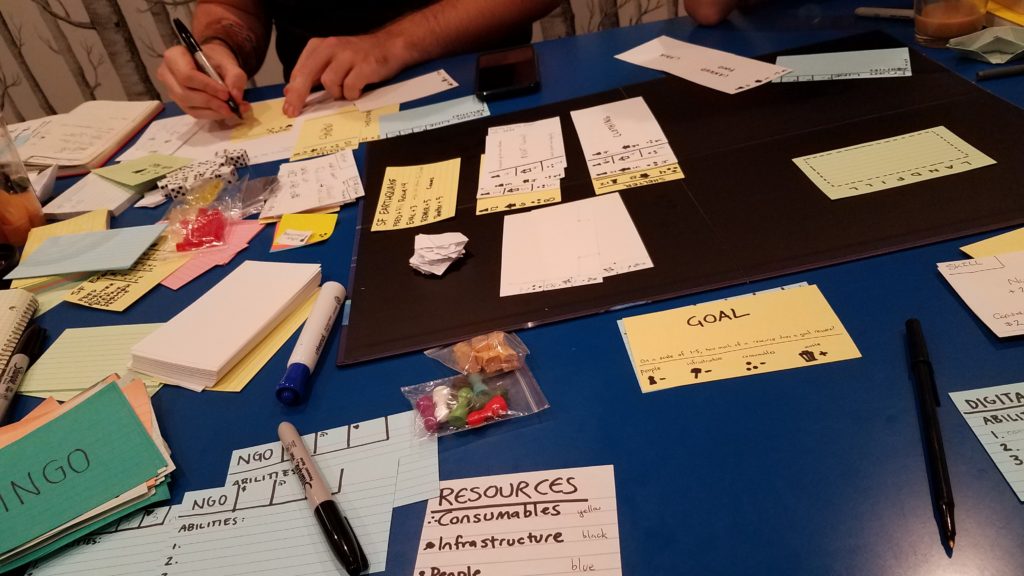
I’ve been working on the opportunity to build a game around a formal/informal interface for years as a way to explore how collaboration would fill gaps for these different actors. This project is called “Emergent Needs, Collaborative Assessment, & Plan Enactment,” or ENCAPE. The idea is this: both sides to that equation lack understanding of, and trust in, the other. A game could externalize some of the machinations and assumptions of each side, meaning a demystification; and creating things together often leads to trust building (that’s a reason why I’ve invested so much in makerspaces and hackathons over the years).

My informal friends were into it. So were my formal friends. But in order to know we could have any impact at all on organizational change, support had to be official from the formal sector. This took years (the formal sector is resourced but slow, yeah), but the pieces fell into place a couple months ago and the chance to build a game was born.

The People

It was of course vital that a wide range of viewpoints be represented, so the call was broad, but still to folk I knew would bring their whole Selves, be able to trust each other, and would be interested in the results of the game research. Folk from informal response, official agencies, nonprofits, and private sector were all invited. In the end, were were joined by Joe, Galit, Drew, Katie, Wafaa, John, Seamus, and Conor. Thank you all for taking time for this.

What We Did

We actually ended up meeting in San Francisco for our 3-day workshop for hilarious reasons I’ll disclose in private sometime.
On Sunday night, some of us got together to get to know each other over beverages and stories.
On Monday, we went through a Universe of Topics and visualized the workflows for our various user types. I did one for the Digital Humanitarian Network, Wafaa did one for Meedan’s translation and verification services, Katie covered a concerned citizen, etc. What were our pain points? Could we solve them for each other? We overlapped those workflows and talked about common factors across them. Different personas have access to different levels of trust, finances, and attention. They use those to build capacity, connections, and decision-making power. How could we use these common factors to build a game? How could we explore the value of collaboration between different personas?

Participants broke down workflows into one component per sticky note, laid out in linear fashion. Wafaa and Willow stand at the board while others talk through potential overlaps.

Drew took this

On Tuesday, we reconvened and started the day off with a game: Pandemic. This got us thinking about game mechanics, emergent complexity based on simple rules, and how to streamline our game. Individuals presented on what their game might look like, if left to their own devices. We explored combining the most compelling parts of those games, and started a prototype to playtest. It ended up being a counting game. Hm. That can’t be right.
A very few sticky notes indicate various steps in the game. These have all since become wrong, although we wouldn't have been able to arrive where we are now without first having gone through this.
On Wednesday, we drew through what the game play might look like and troubleshot around this shared understanding. It was closer to modeling reality, but still took some counting. We drafted it out to playtest, narrated through parts which didn’t yet make sense, and took notes on where we could improve. The last bit of the day was getting a start on documentation of the game process, on the workshop process, and on starting some language to describe the game.
Cards and arrows are hand-drawn onto a whiteboard in order to visualize the logical steps or game mechanics necessary to move through one round of the game. Cards scatter the tabletop in a variety of colors, and with drawings on them. We’ve since continued cleaning up the documentation and refining the game process. And so dear readers, I’m excited to tell you about how this game works, how you can play, and how you can (please) help improve it even more. Continue reading

Attention and Atrocities

Every year, Canada’s Médecins Sans Frontières (AKA Doctors Without Borders / MSF) meets for their Annual General Assembly. I know about this because two years ago their topic was “Is MSF missing the technology boat?” to which I was invited to speak about Geeks Without Bounds and community technology projects with the talk “Technology as a Means to Equality” (video broken because of issues with GWOB YouTube account, and with my apologies). I went back this year because my organizational crush on them maintains, and because Aspiration (my employer for teh past 2 years, a technology capacity building organization for nonprofits) has been working on an ecosystem map of the digital response space. The real-world and values-driven experience of MSF provided valuable insights and data points for that map, and so I went seeking their input. I spent the first day at their Logistics Day hearing about 3D printing for manufacturing and prosthetics, telemedicine, and use of smart phones. My second day was for the Annual General Assembly again, this time as an attendee. The first half of the day focused on how to deal with the bombings of hospitals in war zones, the second half on mental health for patients and for field practitioners. I’d like to speak to you here about the first half of that day, how it overlaps with things I’ve learned here at the Center for Civic Media, things I was reminded of during bunnie and Snowden’s announcement at Forbidden Research, and things which have sadly continued to be relevant.

#NotATarget

There are certain things that humanity has learned we find untenable from past experience. Some of these lessons are most notably codified in the Geneva Conventions, ratified by the UN and its membership. Among other things, the Geneva Conventions cover how noncombatants should not be involved in conflict, the right to bring someone to trial for war crimes, and the right to access to medical treatment. This last is of most concern of MSF, namely in that more and more hospitals in war zones are being bombed. These bombings are happening without the external accountability which the Geneva Conventions and the UN Security Council claim to uphold (then again, 4 of the 5 permanent seats on the UN Security Council are held by countries linked to these bombings, so that’s maybe a conflict of interest and integrity). So, maybe this is not a system of accountability we can necessarily depend on any longer. How can the bombings be stopped? Who can (and should) hold those doing the bombings accountable, if not the long-standing (albeit imperfect) Geneva Convertion mechanism? MSF has been maintaining a campaign for public visibility, hoping this will lead to some level of accountability via #NotATarget.

The question that I remembered during bunnie and Snowden’s announcement at Forbidden Research was: are these individual blips of horror across many different countries, or is this a new norm? bunnie and Snowden were referring to the subtle but systemic targeting and killing of journalists. MSF panelists spoke of the picking off of hospitals in conflict zones, sometimes when nothing else around them has been attacked. There are two things at play here: a technological way to do the targeting, but also the acceptance of this happening. One speaker at MSF AGA, Marine Buissonniere, spoke to both of these points by indicating that we should be able to hold both highly contextual circumstances and overall trends in mind at the same time. Perhaps the bombing of one hospital happened in a silo of decision making for one military, but the fact that it is deemed acceptable by so many at the same time indicates a deeper shift in global cultural norms. She and the other panelists also spoke to how this is an ongoing attack on civic life, that hospitals are the last refuge in times of war, and to make them unsafe is to remove the provision of basic needs to entire regions. Whether a subtle cultural shift or a concerted effort to errode transparency, accountability, and safety; both the cases of hospital bombings and targeted journalist killings come from a similar place of disregard for human life and for accountability. It is our responsibility to hold those taking these actions accountable.

It can be difficult to understand what this sort of thing means. It is difficult to build empathy, a huge component in bringing sufficient public attention on those trampling human rights to hold them accountable. The panelists acknowledged “outrage fatigue” coupled with the failure to act from enforcement agencies and courts. When our attention wanes, so too do the mechanisms of accountability. Similar to the work already done around Media Cloud and Catherine’s work on location of the news, a question emerged: would people have cared differently if these bombings were happening a part of the world other than the Middle East and North Africa? Regardless, those perpetrating these violences are benefiting from our outrage fatigue. How can we take care of ourselves and each other while balancing our areas of influence with our areas of concern? How do we choose which actions to take?

Journalism and Medicine

This is in part why I think MSF is so amazing. They act both to respond to a basic human need (access to medical care) in places often abandonded or never paid attention to begin with, and they speak truth about the circumstances in which they do so. To publicly statewhere a hospital is both puts them in immense danger and also protects them through public outcry against that danger… but only if those outcries continue to occur. To seek justice for infractions to human rights can be seen as non-neutral, which would then put MSF deeper in harm’s way.

One way to navigate this might be divvying up parts of this ecosystem. Diederik Lohman from Human Rights Watched joined the panel to speak about documentation and accountability — documentation which MSF practitioners are not trained to create, and the creation of which might jeapordize their status as neutral parties. If instead someone from Human Rights Watch were to document, could MSF better maintain their role as a humanitarian, and therefore neutral, party?

Truth is the first casualty of war

Many of the atrocities associated with #NotATarget remain unaccounted for due to politics. But some have to do with a lack of visibility of the incidents and others of the context of the incidents. MSF often doesn’t disclose the nationalities of their clinicians as a way to emphasize that all tragedy is human tragedy, rather than allowing countries to cherry-pick reporting based on what seems connected to them. But they’re also not great at indicating how many different demographics across civilians and combattants they’ve served on a given day. The impartial nature of their service delivery is invisible to both local and international crowds. What would documentation look like which helped MSF do its job, made disruptions of that work visible in a trusted way, and wouldn’t add to the reach of the surveillance state?

I came away from both of these sessions with more questions than I arrived with, but also greater trust and awareness of the others doing work in these spaces. All my best, in solidarity and hypoallergenic kittens, for all that you do.

local San Francisco neighborhood preparedness

One of the hardest lessons and ongoing challenges in digital disaster and humanitarian response is how to connect with a local population. While many digital response groups deal with this by waiting for official actors (like the affected nation’s government, or the United Nations) to activate them, this doesn’t always sit well with my political viewpoints. Some of these affected nations have governments which are not in power at the consent of the governed, and so to require their permission rankles my soul. But to jump in without request or context is also unacceptable. So what’s to be done? It’s from this perspective that I’ve been diving into how civics, disaster, and humanitarian tech overlap. And it’s from this perspective that I’ve been showing up to Bayview meetings for San Francisco city government’s Empowered Communities Program. ECP is working to create neighborhood hubs populated by members already active in their communities. Leaders in local churches, extended care facilities, schools, etc gather about once a month to share how they’ve been thinking about preparedness and to plan a tabletop exercise for their community. This tabletop exercise took place on October 20th in a local gymnasium.

The approach of ECP is generally crush-worthy and worth checking out, so I won’t dive into it too much here. In brief, it is aware of individual and organizational autonomy, of ambient participation, and of interconnectedness. It has various ways of engaging, encourages others to enroll in the program, and lightens everyone’s load in a crisis by lightening it in advance. I am truly a fan of the approach and the participants. It’s also possible to replicate in a distributed and federated way, which means digital groups like the ones I work with could support efforts in understood and strategic ways.

Here is what doesn’t necessarily show through in their website: how grounded in local needs and social justice these community members are. There is a recognition and responsibility to the vulnerable populations of the neighborhood. There is a deep awareness of what resources exist in the community, and of historical trends in removing those resources from a poor neighborhood in a time of crisis. We’ve had frank conversations about what they’ll do about debris, and how the Department of Public Works parking and storage in their neighborhood is suddenly a positive thing. About what to do with human waste, and what a great boon it will be to have the waste water plant in their neighborhood. The things that wealthier parts of the city have vetoed having near them because of noise, pollution, and ugliness (NIMBY, or “not in my back yard”) will make Bayview resilient. They’re preparing to take care of themselves, and then to take care of other neighborhoods.

There’s a plan in NYC now to knock on every. single. resident’s door in the next crisis. It’s an approach other cities might also consider. But it’s one which is nearly impossible to implement. Who is doing the knocking? What are they doing with the information they gain? ECP’s approach is to apply their own oxygen masks first, and then to check on their neighbors, to know what the local Hub can take care of and what is needed for external support. When/If a city employee comes knocking on their door, they can then speed up the process of getting aid to where it’s needed (“I’m ok, but Shelly up the street has our 7 disabled neighbors there and they need a wheelchair, medication, and no-sodium food.”)


The end of the tabletop exercise had Daniel Homsey, the gent who heads up this program, talking about how we didn’t devise plans while together, but we did learn how to suddenly have to work at another role with people we’d barely or never met before. And I, as a digital responder, listened to what the community’s needs were, how they organized themselves, and considered the smallest interventions which could be maximally applied.