Token Aikido

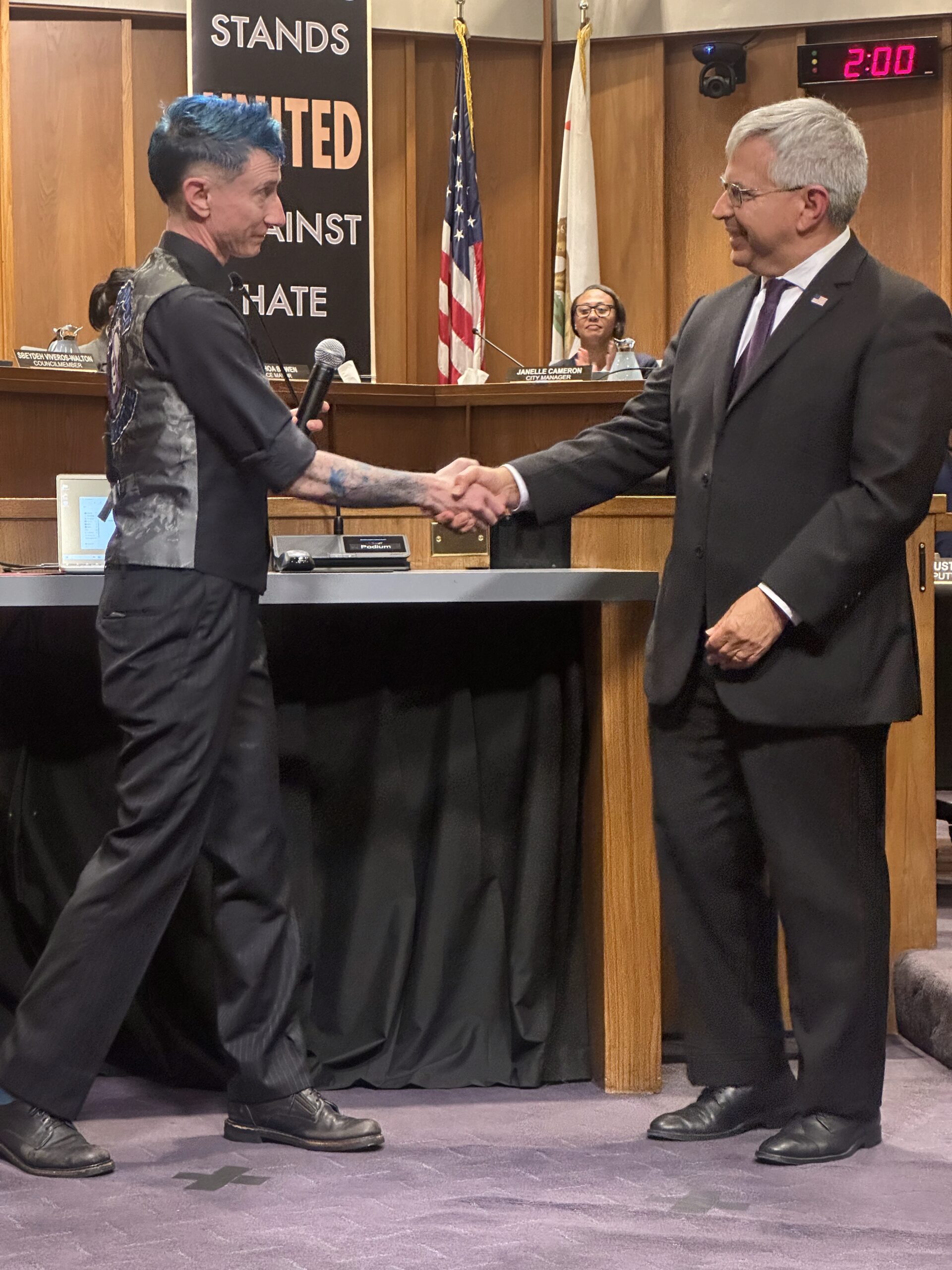
A couple weeks ago, a neighbor reached out to me to ask me if I’d like to be visible for the city. Our little suburban home resides in a sanctuary city, for which I am endlessly grateful and also wish had significantly more teeth. For Trans Day of Remembrance, the mayor wanted to recognize a local trans person. I’m from the midwest, and have often been seen as the only trans person in a social group, on a team, and sometimes even at a whole organization (until, of course, people see me and start feeling confident enough to come out themselves). So sure, if you are willing to give me the mic for 2 minutes, I’m happy to do The Thing.

Willow speaks about trans visibility to their city’s City Council. Transcript follows in blog post.

Here’s roughly what I said:

Hello, and thank you so much for this step in standing with trans people. I’m honored to have become a San Leandran 5 years ago, to raise my 4 year old here with my spouse, and I look forward to (hopefully) spending the rest of our years here. I am agender and queer, and use they/them pronouns.

The few trans friends I have made in San Leandro are moving away, because standing with us in a safe room is not the same as standing with us in the streets. Standing with us in the streets also means standing with the other scapegoats of this authoritarian regime, our immigrant neighbors. Some immigrants are trans folks who escaped countries unsafe for them only to find this country becoming the same. We believe this unaccountable ICE presence rounding up our immigrant neighbors could come for others next. 

When the country doesn’t have our backs, our state must. Disappointingly, Gavin Newsom is throwing us under the bus. When our state doesn’t have our backs, our city must. I’m must report that our city refuses to stand against ICE when they actually show up, leaving our militarized police force only militarized against its own citizens and not against a reckless federal takeover in our neighborhoods. 

So what can you do? Look at ways to demilitarize our police force— especially if they are not willing to stand with us to protect our neighbors. Stop storing sensitive data about us via things like Flock cameras that can be hacked or forced to be shared with a reckless federal force rounding up long-term residents, regardless of if they have us citizenship, kids, or are strengthening our community. Consider hiring a sanctuary consultant to figure out how to live up to our sanctuary policy with real action, not just this talk – although the talk does mean something. 

I know these are medium-term actions, so here is something you can do tonight, when you get home, to promote solidarity with your trans neighbors: start using your pronouns consistently in public emails and writing. Add them to your email signature lines. Tomorrow, add them to the city website. 

A reckless force has come to our city. Soon, they could be knocking on my own family’s door. With this limited official support, I continue to build solidarity with my neighbors. My neighbors have my back as I have theirs. Neighbors, please check on each other. I believe we will get through this and build something more beautiful together. United we will. Thank you.
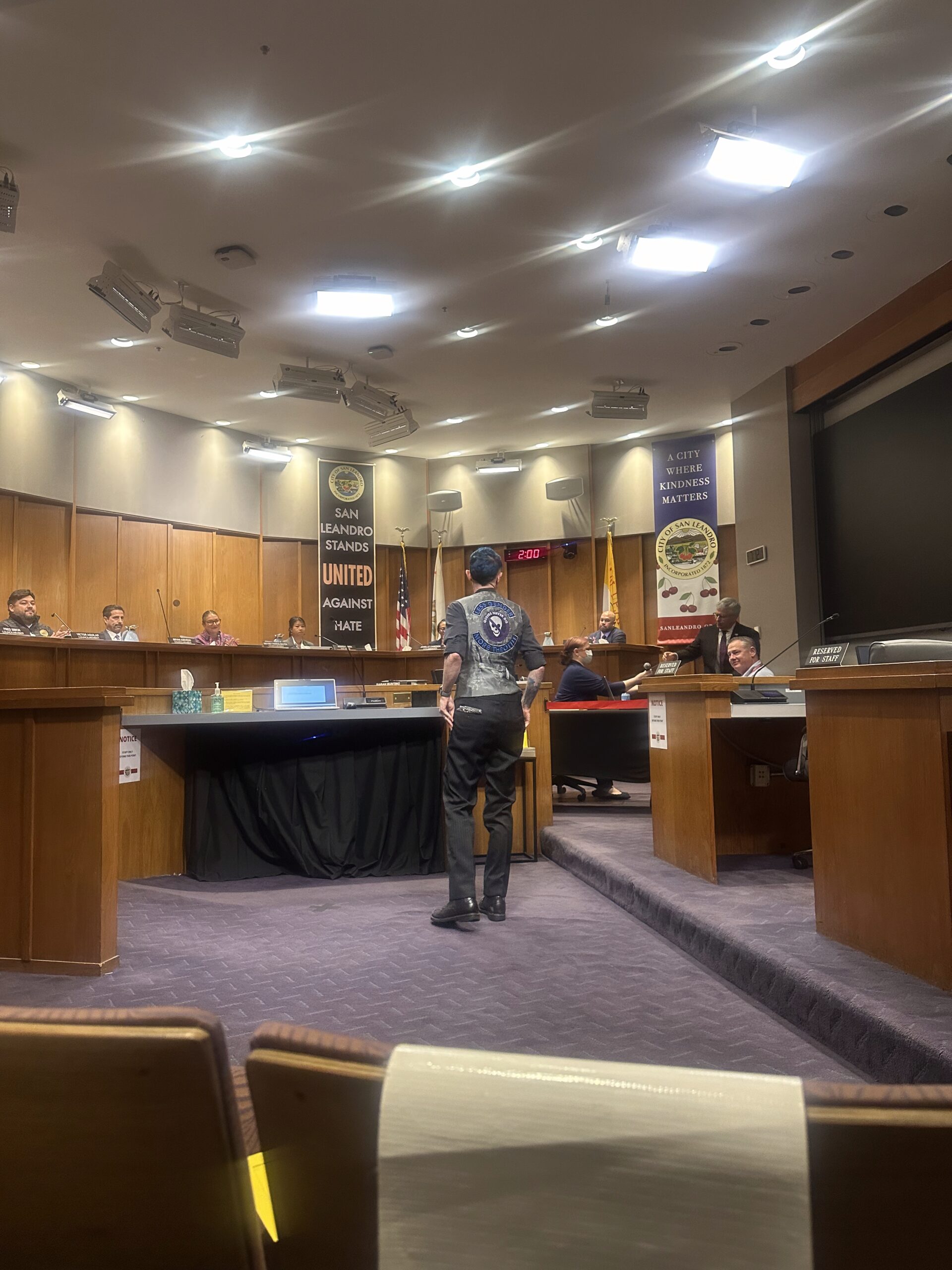
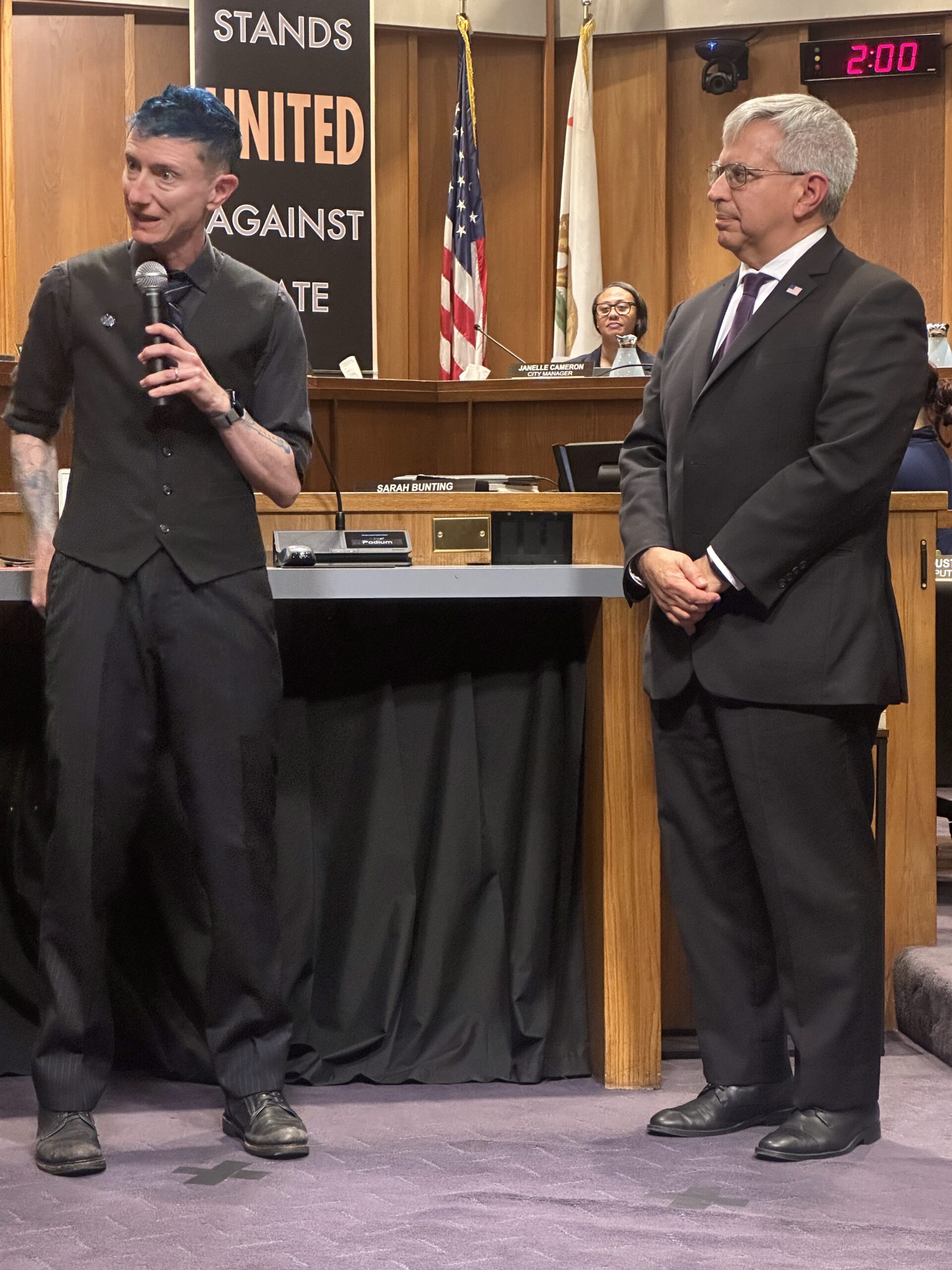
The back of my vest reads "Less Gender. More Throttle." And "Queers Never Die" around a skull. My button reads "fix shit up." The suit pants, vest, and shirt are bespoke from Crown Tailor, the shoes custom from Al's Attire, the tie I forget. I am also wearing secret purple suspenders from Dashing Tweeds. The fade is from a local barber shop, the dye I did myself.

I worked on this for nearly a week and a half, getting feedback from neighbors who know more about our local politics, about local concerns, and about speech writing. I am forever grateful to them for helping shape this into something that calls for responsibility without setting everything on fire (like the first draft). Thank you also to my sweetie Mark for capturing the photos and neighbor Whitney for capturing the video. The official video, including comments I made later in the session, will soon be available on Video Central.
Empathy without Responsibility

At the end of each year, I pick a word or phrase to guide the following year. Sometimes it’s really impactful, and other times I barely remember it, and sometimes I even miss the mark. Last year’s was one I was particularly nervous about.

My phrase for 2025 will be something I’ve already begun working on – empathy without responsibility. I was exhausting myself by always wondering if I was focused on the right thing, always doing triage on what might be a better use of my time. Instead, I’m going to focus on what is in front of me and what I have some influence over. I can send money to Translifeline and if a trans kid from Florida shows up on my porch I can house them. But I cannot drop everything in my life to move to Florida to fight the good fight. What I am already doing matters, and I should focus on it.

This is something I had even begun thinking about months before the end of 2024, and realized I needed to pin my year to it. One of the conversations I have had with Reed is about how having a drink helps me give myself permission to disengage from the world. “I am now off duty” I am broadcasting by imbibing. And as someone who is nearly always “on,” that is a useful tool. However, learning to turn down if not off is a skill worth acquiring, and so I set out for the year.

I’m working two approaches: classifying and trusting.

For classifying, I’m determining if something is actually classed into a category that I do have responsibility for. Ends up this is a much smaller set than I initially felt it was. I’m still responsible for a lot — my role in the household, being a parent to my child, an organizer for my neighborhood, the steward of some extra cash to give to others, etc. I am NOT the responsible party for getting an unhoused neighbor on their feet, but I AM responsible for being kind to them and being sure they know about nearby resources and maybe helping them get to those resources. I can also be responsible for making sure that nearby resource knows I have their back, volunteering occasionally, and donating when I have extra. I am not responsible for how Locke does in the classroom, but I am responsible for guiding his behavior when he is at home, and making it clear to the school that I have their back while also having his. Etc.

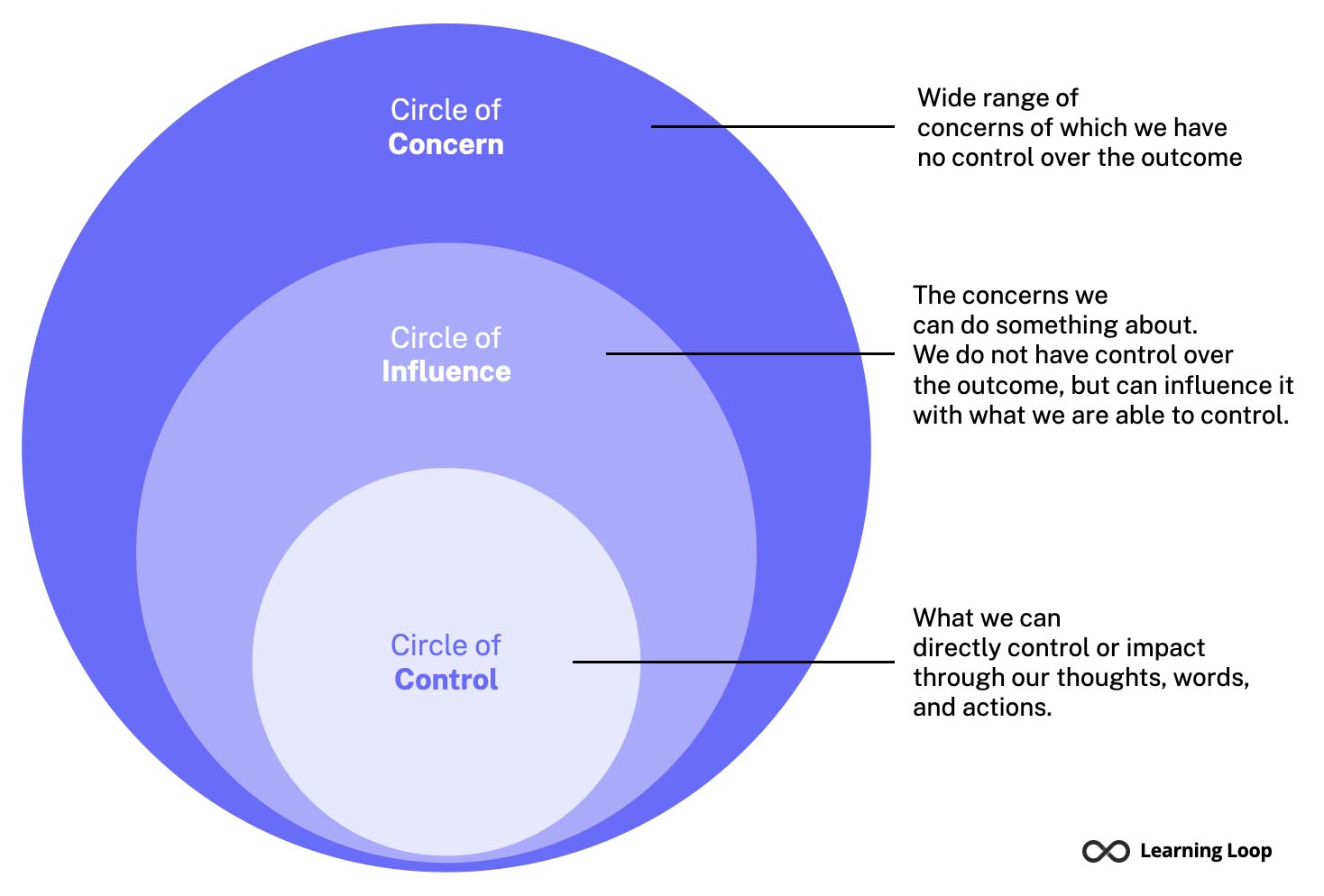
The smallest circle is the lightest in color, and reads "circle of control" with a pointer that continues "what we can directly control or impact through our thoughts, words, and actions."
The next circle, which encompasses the smallest circle entirely, is slightly darker and reads "circle of influence" with a pointer that continues "The concerns we can do something about. We do not have control over the outcome, but can influence it with what we are able to control."
The final, darkest circle encompasses the other circles and reads "Circle of concern." with a pointer that continues "Wide range of concerns of which we have no control over the outcome."
Screenshot

For trusting, that means I am also trusting the other people in my network and neighborhood to do what they are responsible for. I stay out of their way except for when I have something to offer that might help. I build unlikely friendships with people who have very little practical overlap with me but with whom I am ideologically aligned. I deepen friendships with people similar to me but doing their things further afield so we can align with and learn from each other.

But! I am still looking for tools to deepen this practice. A very dear, very long-time friend of mine is also an exceptional facilitator and is doing a free session on just this thing on Tuesday, November 25th from 9:30a-12 PT. You could come learn with me if you struggle with similar things. It would be great to see your faces there.

April Joy : Waffles and dress up

April has been a really nice month. I went and got two tattoos finished (more on that soon) and visited with friends while there. Locke has been thriving. We’ve gotten some clarity on what’s happening with my brain (also more on that later).

But my April Joy was quite a lot closer to home. A few weeks ago I decided I wanted to do something ad hoc and silly for my birthday party. I wrote a few sentences, made a calendar invite, and fired off an email to a bunch of folks.

My birthday is in April, and I’d like to invite y’all over for kids, chaos, and waffles in the morning. Please 1/ wear something ridiculous that you’ve been looking for an excuse to wear but haven’t found an opportunity to do so, 2/ bring your kiddo(s), 3/ bring a waffle iron and/or toppings and/or something sparkly to share. Maybe we’ll play some board games.

Estee even flew in from Portland! Something like 30 mostly-neighbors but some further away folks showed up and it was exactly what it said on the tin. With so many adults around, the kids were able to run around lightly supervised and got into all sorts of fun times. I loved two sets of friends whose kiddos are within weeks of each other catching up while the younguns played with magnets on the fridge. Reed even set up his retro video game systems so kids could play old games.

Forced perspective of a neighborhood kiddo playing Super Mario Brothers on an old CRT TV while three little kids and one medium kid watch on. North the white cat enters the room with an upright happy tail.

I made something like 4 bowls of waffle batter, plus Reed’s mom made gluten free batches, and one neighbor showed up with this amazing mix already in a bowl with impeccable timing! Something like 7 neighbors brought waffle irons to help out; one brought a big French Press to speed up our coffee making, and we made a mess of toppings on the dining room table. And I got to just hang out in the kitchen making waffles while other people socialized and got to know each other! I learned we can have two high-energy things on the kitchen circuit at a time, so we had a precarious workflow of mixer, microwave, and irons going at all times.

And so many fabulous outfits! Even some of the kids dressed up. Sad I forgot to offer people name tags, but so stoked that people will know each other while walking around outside just a little bit more, and that the kids know to look out for each other. And one neighbor saw that we were not quite complete on our LEGO D&D minifigs and brought us the ones we were missing. How fabulous is it to be in community?! So fabulous.

Approaches to Conflict

We’re already seeing people being disappeared. I think we’ll see more of that, and people fighting back, and a possible escalation of violence between civilian factions, and between civilians and the government. I think things will get kinetic soon. I think it’s important to be deliberate in how we approach the incoming conflict, to not be swept up in it. So I’ve been having conversations with friends and neighbors about what this might look like, and how we want to approach things. This blog post is inspired by those conversations, but I’m not going to name everyone here because that would be bad opsec. These are friends with direct experience with conflict, and/or are deeply researched about it.

So first, to set the tone, there are already groups saying we’re lined up for a genocide against trans folks in the US. People who know how these things go say we’re headed there. We need to be aware of this and fight it, not “wait it out.” It will only get better if we make it better. So this is a post not about theoreticals, this is a post about how I’m approaching something that seems certain at this point. Friends say we’ll probably look like Columbia, and suggest Lederach as a person to read, although I haven’t yet.

I’m balancing two views here, both from people I have direct contact with, and both of which are born of deep experience. One is about how some communities decide to opt out of conflict despite it happening all around them, and the other is about being willing to be in conflict with bullies scaring the bullies away in post-disaster zones. From that, I’ve decided my goal is to not be in conflict, and to be ready to defend myself if that approach doesn’t work. And I know you can’t prepare for peace and war at the same time, but also I’m not setting strategy for a country. The Quakers would disagree with this approach, and point out that nonviolence does not mean passivity, and that putting violence on the table tends to optimize for violence and limit approaches to responding to violence. Regardless of how you choose to engage, hold close to the fact that violence isn’t the norm, and we should work to return to a peaceful baseline. Be loud about violence being abnormal and not acceptable. If you go a nonviolent route, make it clear that fighting, if it’s going to happen, happens outside of your space. The people being violent can do it in their own spaces. 

Most of the ways communities have approached opting out of conflict had to do with being connected with their neighbors and always welcoming more people in (if they adhere to the nonviolence). That’s harder after eviction culture and being hyper individualistic — I will forever beat the drum of bringing unknown neighbors baked goods to try to get to know them. Maybe go talk to your local security forces about how they’re thinking about the incoming conflict and what they see their role as — some have already started making statements about never working with ICE. Further afield, having such far-flung communities means having early warning systems for where the violence WILL start, so stay in touch with those loved ones who live in other places and talk about what the local happenings are. 

When Marshall, author of Opting Out of War, came to talk to a small group of us about his research, he told us about the differences between Sarajevo and Tolisa in Bosnia, and how Sarajevo buttoned down in neighborhoods and fell into local violence, and Tolisa united and welcomed others and avoided much of the violence. An impromptu peace demonstration in Sarajevo was fired upon, killing some protestors, and the movement fell apart and so did the city. Marshall focused on holding a broad circle, anticipation, communication, and relationships with security forces to help stave off conflict. In his book, he also talks about throwing a good party as part of the trends in communities that opt out of conflict. 

In that conversation, we also talked about how we need to only persuade a few percentage points of the population to oust Trump. But that means talking to people who might not be aligned with you politically, and what that might look like. I’d recommend the Better Conflict Bulletin for thinking on how to approach those conversations. I’ve started making bets with people online — define thresholds and timelines and check back it. It forces people to acknowledge risks to their world view, a clear story, and a bid for connection. Offering to build bridges can also be seen as traitorous by either end of the spectrum, and that’s problematic to avoiding armed conflict. 

I’ll still be going to the range with neighbors because shooting is meditative and fun, and because I won’t tolerate people bringing violence to my neighborhood. But I will do so while putting 90% more time and effort into nonviolent approaches, and hoping desperately that path is the one I’m allowed to take.

How are y’all thinking about these things?

Additional reading from Marshall:

  • Erica Chenoweth and Maria Stephan, Why Civil Resistance Works
  • Chenoweth, Civil Resistance: What Everyone Needs to Know
  • William Ury, The Third Side
    • He describes 10 roles for people to play in reducing conflict. It’s an interesting way to think about tapping into people’s strengths and finding the gaps in your organization or your work.
  • Gene Sharp, From Dictatorship to Democracy
  • Sharp, 198 Methods of Nonviolent Action
  • Peter Ackerman, Strategic Nonviolent Conflict
    • Sharp and Ackerman’s organization: The Albert Einstein Institution (https://www.aeinstein.org/). Gene Sharp was instrumental in moving the ideas of nonviolence into secular language from religious. Here in 2025, he’s probably more intellectually influential than King or Gandhi.
  • Srdja Popovic, Blueprint for a Revolution
    • Popovic’s organization: CANVAS (Centre for Applied Nonviolent Action and Strategies) (https://canvasopedia.org/). The publications page has good resources that are also, dare I say it, fun. 
  • Martin Luther King, Jr, Letter From a Birmingham Jail
    • In my opinion, one of the finest strategy documents ever written.

What I’m doing to prepare

I realized on Friday that all my experience in organizing marginalized frontline populations in times of crisis is really going to come to bear on the upcoming years. This time, we even have some time to prepare, and lots of foundational work has already been happening in our communities by those who haven’t been served by ANY administration that’s been in power.

Find your people

Ideally, you already know some of your neighbors. But maybe you don’t! Capitalism and eviction culture lead to not knowing who’s around you. It means we have less solidarity and less strength against the ruling class. If you don’t already know your neighbors, start getting to know them! Get comfortable knocking on doors with cookies. Be open to who you meet. More and more people are uncomfortable with the status quo, even if they voted differently to you. Remember that the uniting cry of the Zapatists was “¡Ya Basta!” (“enough!”). You may end up with strange allies, but they will be allies nonetheless.

Have a good sense of who you can trust with what. Some folks are excellent at helping people feel welcome, but also don’t have a good gauge of how discrete a new person can be. Some folks are good in a crisis but otherwise aren’t dependable. Etc. There are many things you can trust someone with, have a good sense of who to trust with what.

Be open to new folks showing up, but also be aware that there will be lots of attempts at infiltration as time goes on, especially as you become more known. Each person having a story and a personal contact who can vouch for them goes a long way, but also just behave as if you’re already infiltrated.

Scope your focus

I have chosen to focus on my state and county. If a trans kid from Florida shows up on my porch, Reed and I will talk about housing them. However, I can’t do anything about trans kids in Florida at this point. I can keep giving money to Planned Parenthood in the Midwest and the South, and I can keep giving money to Translifeline, but other than that, I need to hone my focus close to home. Maybe you’ll pick a specific cause to focus on rather than a geographic one. But regardless, pick something that matches your area of influence and stick to it. Else we all go mad and burn out.

I also really liked this article that’s being passed around, that has four areas of focus: protect people, disrupt and disobey, defend civic institutions, and build alternatives. I think it’s good to know which frame folks are using when they’re asking for action. I also think it’s important that all four of these bases be covered (or intentionally left out) when organizing a broader group.

Continue reading

Living honestly

I’ve got the resources, so here’s how I live as honestly as I can in this late-stage-capitalism hellscape. Not a judgement on whatever setup works for you, just a nudge to see where you can be more in alignment with your goals and ethics.

Side projects – since always

Despite being employed in the private sector for 40+ hours a week, plus having a toddler and robust local organizing life, I have been dedicated to seeing meaningful side projects through. Right now, that’s working on getting a book about sex workers and kinksters fulfilled (do you know anyone who does fulfillment, btw??) shipped out, and working on a disaster response zine. I get a moment here and there to push them forward, and spend my Sunday mornings working on these. They are of and by my community, and I will do my part in logistics and some writing. I have always prided myself of being the person in the group of artists who gets rewards shipped, why would that change now?

No car – since 2008

While facilitated by living in the hearts of cities for most of that time, since 2021, I’ve lived in the suburbs. However, I think cars (and specifically, the lengths we go to for car infrastructure) are a big part of what have destroyed America and our local communities. I refuse to partake. Even having a child, I still refuse. We will take him to the ER in our cargo bike, thank you very much. Reed and I were even downed on my motorcycle when I was 9 weeks pregnant, and I hold to this: the problem is not me being outside the vehicle and prone to damage, it is the person operating a 2+ tonne murder machine while stressed and/or looking at their goddamn phone.

I have the luxury of a shuttle to/from work the 3 days I go in. But also, we picked where we were willing to live and work based on a setup availability like this. And yes, I sometimes take a Lyft or borrow a car from a neighbor. We still live in this (car-centric) world, after all. But I do make a conscious effort to not be in cars.

Eating less meat, and locally sourced food – this year

When Reed was able to go off keto, the first thing I asked was if we could eat less meat. He is now totally invested in researching the best places to get our eggs etc from, and has the space to go to the farmers’ markets. Truly, having extra income for local supplies and a house husband who hyper fixates on feeding the family good food is the absolute best and I’m mostly just along for the ride here. We even got a rice cooker and I can pull off a pretty good tofu stir fry! Pretty good for this protein-shake-consuming food-unit-optimizer!

Buying locally – since 2022

I hate Amazon, and also it’s so convenient. I still order from them sometimes. However, whenever possible, I try to buy locally, even when it’s a pain. I’ve found a local bike shop and a local book shop that I adore and am willing to suffer the inconvenience and slightly higher prices for. Plus, deep discussion whenever I go in about how our neighborhoods are doing and how to support each other! And, not making Bezos richer.

Non-main services – this year

I’ve been off Facebook since 2011, and left Twitter when Elon Musk took over. I’m on Mastodon, but frankly I’ve been getting way more into group chats on Signal, Slack, and Discord grown organically from people meeting each other in person. I miss the heydays of Twitter, but doomscrolling just got to to be too much. Although now I might have to re-join Facebook to deal with local politic stuff. Blah.

So other ground I’m trying to figure out here instead is search (using Kagi to great success) and a recent switch to Proton for mail (and calendar?). This has been some lifting to get things set up, but I have friends who are well acquainted with this setup and have been willing to help me through the process when I get stuck (despite very good documentation). We’ll see how far down this hole I go.

What’s next?

I’ll keep looking for ways to live honestly that I have capacity to support. Again, no judgement in any of this. We all have different constraints and goals. The only pressure here is to live intentionally. 💙

Preparing the neighborhood

As y’all probably know, I got married, moved to the suburbs, and had a kid. Because I’m figuring out how to be involved in local politics, I joined the neighborhood association (not an HOA). But I’m still thinking about crisis response. So the natural combination of these things was to get involved in preparedness in my neighborhood. The association has an open meeting twice a year, and I requested that the one last month be focused on disaster preparedness.

We first heard from the city emergency manager. We’re a mid-sized city in the shadow of both SF and Oakland. We have about 100k people who live here, and have 5 public works employees and 80 police. Our fire department is “on lease,” whatever that means (I didn’t want to completely derail the presentation with a deep dive into this) (also, why we prioritize having our own police but not our own fire people is beyond me). The message in this presentation was the same that I’ve heard elsewhere: folks really need to be able to fend for themselves for the first 72 hours. We were told about a risk map (state and neighborhood) and the basics of being prepared (have predetermined emergency contacts; store water, food, and other supplies). The city representative told us about their main issue being how to get the word out – emergency alerts don’t seem to be getting the job done (again, I want to know more about that), so she suggested we sign up for a thing called NIXLE alerts (text your zip to 888-777) that works if the cell towers are up. Radio is still used. We have sirens in my town, but they don’t work. 

We also have resilience hubs in my town, and we heard about them from a college intern for the program. These centers keep racial equity in mind when approaching quality of life year-round. The disparity even in the urban tree canopy was called out – more affluent neighborhoods have more trees, which also means they’re cooler in heat waves. Their goal is to help groups “bounce forward” in climate adaptation. Their programming has a few arms – Community Care and Belonging, Disaster Preparedness, Climate Solutions, and Equity – during everyday, disruption, and recovery times. They also strive to have great buildings that can be useful in crisis; plus communications, power systems, and operations abilities (including conflict resolution protocols). I am clearly stoked about all this.

After hearing from the two speakers, I asked attendees to break into smaller groups and talk about what they would like to see happen in our specific neighborhood, and what questions they still had. This was amusing – the attendees hadn’t been asked to be participants beyond taking a mic to speak to a board in the past – but we got some good results! Based on the feedback folks had, I’m going to work with a small group to put together a risk and resource map of our neighborhood for our next Chili Cookoff and BBQ in August, which folks can add themselves to as resources. I’d also like to privately start collecting names and addresses of at-risk neighbors for block captains to check in on during the next heat wave or earthquake or whatever. At the same event, we’ll probably do a prize for the best go bag, and hawk this phenomenal guide another neighbor has put together for preparedness called Here Comes the Apocalypse. I am delighted by this fun visual guide and hope you check it out. I hope Jen and I get to be friends, because she’s brilliant for this.

It’s exciting to merge two things I’m so passionate about – the disaster cycle and my neighborhood. Fingers crossed we never need it, but if we do, we’ll be more ready than we would have been otherwise.