These notes were taken at the 2014.Dec.18 New England Complex Systems Institute Salon focused on Ebola. Sam, Willow, Yaneer contributed to this write-up, and 20 people were in attendance. We hope you’ll join us in future. We’ll have unstructured meetings each Wednesday from 18:00 to 20:00 (6p-8p) starting Jan 21st, with the fourth Wednesday of each month structured towards contribution towards a global challenge. The next such structured event will be on January 28th, on the subject of ethnic violence. You can see notes on this and potential future subjects here, and can register here.
About Ebola at NECSI [briefing by Yaneer]
NECSI has a history of studying Ebola models, and has predicted something similar to what is currently going on in West Africa for some time now. NECSI started with a model of pathogen evolution in which the most aggressive stable state has virus constantly passing slowly through populations, creating islands, dying out as people expand into areas with no disease.
Aggressive diseases plus long-range transport
Then if you add long-range transport, you get more and more aggressive strains. The more long-range transport you have the more aggressive the strain can be without dying out; and eventually could kill an entire global population. Paper published in 2006, mentions risk of Ebola.
As transportation becomes more pervasive, vulnerability increases.
Early warning and preparedness
Presented to the WHO in Jan ‘14. They were respectful and excited by the work. Discussed other public health issues faced by WHO, however didn’t return to pandemic models.
Since then: outbreak happened. Lots of discussion. Why don’t we engage in risks in a more serious way? Everyone thinks their prior experience indicates what will happen in the future.
Look at past Ebola! It died down before going far, surely it won’t be bad in the future.
Models of outbreaks look at existing conditions, which prove to be too limited here.
Example: with flu, people take exactly that disease and known circumstances, and simulate an outbreak, ignoring changes in the disease or in the conditions (and: nothing has to change in order to have huge risk). the same properties could remain, but a low-probability event could unfold, “fat tail distribution” – past experience isn’t necessarily a predictor of what will happen in the future.
Individual and community
Contract tracing, the standard public health method, doesn’t work well when there are more than just a few cases. Stop thinking about the contacts of the person, think about the community. Travel restrictions so new communities aren’t infected. Now that people go door to door for symptom screening, the cases have decreased dramatically in Liberia.
People were saying: “The beds are empty!” Authorities responded: “We can’t figure out why. We think people are still sick!” Why are the hospitals and authorities waiting for the sick to show up? Going door-to-door in the neighborhoods shows what’s going on, and is what is effective.
Once you know the right question, the answer is clear.
Interests
We then stated our interests – each person said one thing about the topic or intro talk they’d be interested in diving into more during breakout groupsContinue reading →
Years ago, after Chaos Congress, Rubin insisted we go to some art show. I, as always, preferred to stay at home — whatever continent, country, city home might be in that day. But Rubin can be lovingly persistent. It would be worth it. It would be beautiful. We went, mere hours before I boarded a plane from somewhere to somewhere else.
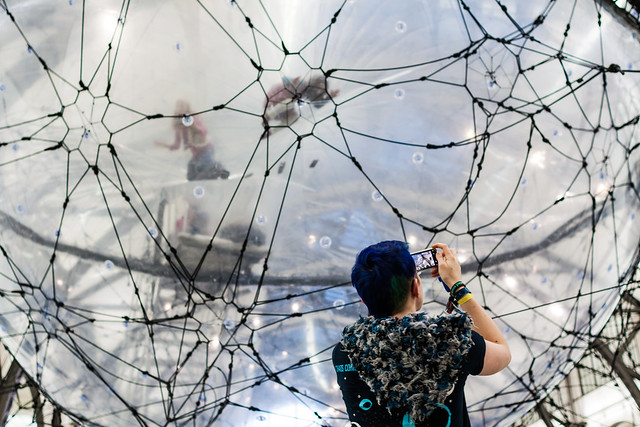
Biosphere was a study in liminality to me, suspended spaces tethered to more commonly understood as habitable floors and walls. Perfectly clear water in heavy plastic and vast space define in clarity and iridescence. It was a liminal future, an in-between home, the moment the wheels leave the runway. The terror of my anxiety and the complete love for the possibility of Something Different, wrapped up in the moments of stepping into the future. In short, Rubin was right.
Jump forward a few years.
When Pablo invited me to Development and Climate Days in Lima, I was glad to go. Even before the deeply pleasurable and productive Nairobi gig with Red Cross Red Crescent Climate Centre and Kenya Red Cross, I trusted Pablo to have spot-on inklings of the future. Maybe all that climate forecasting has gotten into his social forecasting as well. His efforts around serious games resulting in their now being generally accepted, he told about an art-involved step to get people to think about the future differently. Something about plastic bags, and lighter than air balloons. Would I be willing to, in addition to my talk, document their process of creating a Museo Aero Solar for others to participate and replicate? Of course – distribution of knowledge, especially with illustration and technology is kind of my jam. It would also help me venture into the city.
I arrived at 2a to a deserted city and a vast and rolling Pacific out the cab window. I cracked jokes with the driver based on my poor grasp of Spanish (“ehhhh, Pacifico es no muy grande.”) He humored me. And in the morning, mango that tasted like sunlight, and instant coffee, and the Climate Centre team of whom I am becoming increasingly fond. And a new person – the artist Tomas, with whom Pablo and I ventured to an art space to join the already-started process of community building and art creation, large bags full of plastic shopping bags ready for cutting and taping. Pablo eventually had to go spend time at COP20, I relished not going.
I took such specific, ritualistic care with each plastic bag. Cut off the bottom, cut off the handles, cut a side to make a long rectangle. Lay it gently on top of the pile, pressing down to smooth and order. Pick up the next bag. Feel it on my hands. The crinkle, the color. Smooth it out. Cut. Place. The sound of tape being pulled, torn, applied, and stories told in Spanish. The slow joining of each hand-cut rectangle. I smiled, to dedicate so much care to so many iterations of things which are the detritus of life. Francis laughed with me, saying she felt the weight of each one. A heavy statement for something so light. Tomas walking around, constantly seeming to have attracted a bit of plastic bag handle to his heel, no matter how many he peeled off, a persistent duckling of artist statement.
We went to the Lima FabLab to speak to a hackathon about making a GPS and transponder so we could let the creation fly free without endangering air traffic. And this time I saw it from the outside – seeing Tomas speak to a group of self- and community-taught Peruvian coders, and seeing their faces display disbelief and verge protection against the temporal drain of those outside your reality. Then, as he showed step by step, and finally an image, that these can fly, their cousins can lift a person, grins break out. Peoples’ hearts lift, new disbelief replaces the jaded. There is laughter and a movement to logistical details.
And then we took it to the D&C venue, and it worked.
I imagine what Pablo must have gone through, to get bureaucratic sign-off on this. No metric of success. No Theory of Change. Him, fighting tooth and nail for a large and hugely risk-adverse organization to trust fall into the arms of a community, an artist, a facilitator, and a game maker. And they did. And it changed the entire event. People in suits crawling into this cathedral made of plastic bags, each individually cut and added with love to the whole. A pile of fancy shoes outside the entrance, like a ballroom bouncy castle. People’s unabashed joy watching art some of them had made become a room, and then lift off to become a transport.
This future we want — it’s hard work, it can seem impossible. But it’s right here, we made it. It works, and it is beautiful.
I brought up ways for other people to participate. In a beautiful act I would associate with Libre ethics, the Lima crew have opened up not only our stories, but our process. We want you to join us. We want you to be a part of this future, and it means hard work. The fledgling wiki and mailing list can be found here. I hope you hop on.
Hugs and thanks to Lindsay Oliver and the Kenya Red Cross team for their contributions to this entry.
On November 15th, I helped facilitate the Red Cross Crescent Climate Center’s HeatHack 2014, a gathering of amazing people to collaborate on solutions to climate-related challenges. This event focused on the risks and impacts of heatwaves, and how to provide community care and safety nets for at-risk people during extreme weather episodes.
In case you wonder what a hackathon is:
A hackathon is a gathering of diverse people who form teams to work on addressing challenges over a short period of time. These challenges can be technical, physical, resource-based, or even social. During HeatHack, participants learned about heatwave challenges from climate experts and people who have experienced heatwaves firsthand. Teams formed around potential ways to address these challenges, and worked together to come up with solutions to present to the judges. Prizes were awarded based on innovation, documentation, usability, and inclusiveness.
Why “HeatHack”?
Heatwaves can cause power outages, wildfires during a drought, buckling and melting roads, burst water lines, and serious health effects such as severe sunburn, heat cramps, heat exhaustion, heat stroke, and death.
According to NASA, when the temperature hits 95*F (35*C) your ability to function drops by 45%. Your loss of accuracy is 700%.
MPR News reports that body temperature can rise to 105*F (40.6*C) if working outside in a heatwave. Death occurs usually when a body temperature reaches 107.6*F (42*C).
Despite the severity of heatwaves, the health risks often go unnoticed because the people most affected are easily overlooked in a large population, especially if they are poor. We need to create ways of responding to these challenges to care for people who are currently at risk and to prepare for future heatwaves. As the effects of climate change become more severe, the number, length, and temperature of heatwaves will increase – including in Nairobi! Climate change affects the entire globe, and Kenya can lead the way in creating solutions that help as many people worldwide as possible. Continue reading →
I met this guy named Pablo Suarez in a pub in Boston, when our mutual friend John Crowley insisted I leave my introvert-hole. When John insists, I tend to listen. And as always, it was totally worth it. Pablo plays games. As a climate scientist, he got tired of people falling asleep in meetings. He was aware of the direness of the situation, but no one else felt the same urgency. So he started expressing probability and costs and delays through dice, and beans, and objectives. He’s played these games with people who live in disaster-prone areas on through people at the UN who make policy about resource allocation. He’s created actual, connected change through an entire system. We’ve since embarked upon a few event adventures together, and I’m glad to call him friend and cohort.
My experience with KRCS
And so I met this guy named Dr James Kisia, when Pablo suggested I take a gig at the Kenyan Red Cross. In a continuing trend, when Pablo suggests things, I tend to listen. James has become well known as an innovator in the NGO/innovation space. As an example, reframing the understanding and practice of social entrepreneurship in resource-poor settings. Exploring sustainable resource mobilization for an organization whose relevance in disaster-prone Kenya is increasingly becoming apparent. The KRCS runs 3 hotels in Kenya, taking advantage of the fact that conferencing is a major business in Kenya, and in Nairobi particularly. It might seem paradoxical, having a five star facility on the campus of the a humanitarian organization, but the money the hotels make is ploughed back into the humanitarian work of the organization — including non-funded sudden onset disasters.
Based entirely on good faith, shoe strings, and a few well-placed calls, James and I embarked upon a trust fall with each other, based entirely on Pablo’s word. The Web of Trust in real life. I arrived to Nairobi for 4 weeks of work with little guidance beyond to lay groundwork for a Dadaab-focused intern or contractor, as specific to what would be applicable to climate change issues as well. Continue reading →
Early this year, yet another friend of mine up and died. There was of course a mess of things that had to be figured out. It wasn’t just the traditional things of cleaning out her house (I wasn’t around for that part) or figuring out the funeral (Viking in variety). It was new and interesting technical and moral turmoil of getting into her hard drive, questions of “should we even?”- her prolific music and authoring contributions rivaled by her extreme privacy. It was seeking the edges of her far-flung pockets of internet community to notify them personally, racing the deluge of social media notifications, not wanting them to find out about her the same way I found out aboutmy grandmother – before the familial phone tree had reached me, a peripheral friend calling me based on a facebook post from my sister. A morbid seismic wave.
While I don’t have any control over how others plan for (or don’t) their demise, I have a say over my own. I can show my care for people dear to me my own compulsive, facilitating way by being sure they find each other as they find out, and in making sure information and knowledge I have to offer continues to be released under open access, even if I’m not there to do it. From doing humanitarian and disaster response (and just a general “awareness of the abyss,” as my mother used to tell my vast and angry younger self), I have had to face the looming possibility of my own death head-on. The networked reality that brought those strange new questions and moral quandaries for my friends’ deaths can instead be used to carry forward care and knowledge. This is a sort of guide for the bits of postmortem planning the internet and most lawyers have missed. It’s not complete – I’ve run into some interesting blocks and quirks, around which I’m eager to collaborate with others.
It’s called NetworkedMortality, and it needs your help with continuing to build it out. It includes some methods of Shared Secret for passwords, storing instructions in password vaults, and mailing lists for notifications of far-flung internet social groups. But it still needs to be fleshed out around how to best shut down accounts while archiving meta data for posterity and research, how to donate a body to open access science, and more diverity in threat and failure models.
In loving memory of my crypto-loving, open-access enthusiast, and occasionally suicidal friends. We will build more open worlds with our corpses. I just wish you would have held off for more unavoidable causes.
Early this year, yet another friend of mine up and died. There was of course a mess of things that had to be figured out. It wasn’t just the traditional things of cleaning out her house (I wasn’t around for that part) or figuring out the funeral (Viking in variety). It was new and interesting technical and moral turmoil of getting into her hard drive, questions of “should we even?”- her prolific music and authoring contributions rivaled by her extreme privacy. It was seeking the edges of her far-flung pockets of internet community to notify them personally, racing the deluge of social media notifications, not wanting them to find out about her the same way I found out about my grandmother – before the familial phone tree had reached me, a peripheral friend calling me based on a facebook post from my sister. A morbid seismic wave.
While I don’t have any control over how others plan for (or don’t) their demise, I have a say over my own. I can show my care for people dear to me my own compulsive, facilitating way by being sure they find each other as they find out, and in making sure information and knowledge I have to offer continues to be released under open access, even if I’m not there to do it. From doing humanitarian and disaster response (and just a general “awareness of the abyss,” as my mother used to tell my vast and angry younger self), I have had to face the looming possibility of my own death head-on. The networked reality that brought those strange new questions and moral quandaries for my friends’ deaths can instead be used to carry forward care and knowledge. This is a sort of guide for the bits of postmortem planning the internet and most lawyers have missed. It’s not complete – I’ve run into some interesting blocks and quirks, around which I’m eager to collaborate with others.
This post is less about things like wills (what happens to material possessions, who doles it out, and the like) and living wills (if you want to be kept on life support etc) – although I’ve added the templates I used to the wiki associated with this post as it includes digital artifacts and more awareness of gendered pronouns than other bits of the internet. This write-up focuses on specific aspects for Open Access and encryption enthusiasts. Brace yourselves for a morbid entry. Know I’m peachy keen, and being an adult about things, not in danger of harming myself or others. If youare in danger of harming yourself, please say as such directly, and get help, rather than indirectly through things like estate planning. It should be possible to speak about death without fear – that’s what I’m doing here. I hope you can hear it (and act) from a similar place.
I’ve divided components up into documents, accounts, notifications, and people. Documents are centralized with accounts, which are propagated via notifications to people, as triggered by a notification from a person. This means I only have to worry about keeping something up to date in one place — a change to a will or to a website password simply happens in the place of storage, without needing to notify everyone involved. As people become close to me, or exhibit destructive behavior, they can be added or removed from the notification pool. The notification mechanism is the one thing that has to remain consistent in this set up. Continue reading →
I’ve had a few people over the past few weeks make a special point of pointing out how (overly) productive I am. And because part of the way I do things is doing them in public, I figured I’d put together an overview of how I work for The Internets. Much of it is not healthy – I battle with temporal compulsiveness in a way I can only imagine is similar to the exerted control over diets those dealing with eating disorders display. So this is a less a “how to be productive if you find yourself uninspired” and more a “how to funnel your anxieties towards good use.”
This is actively not a way to interact with people you’re Not Working With. This is a constant battle with me, as it’s easiest for me to interact with people around projects. But that’s not fair to people I care about AND work with. It might not even be a way to interact with people you are working with. I’ve tried to have that tension/disfunction show through in this post – the same things that make me really good at productivity are what also make me have unreasonable expectations of carbon-based life forms.
Some of the following advice also has to do with deceiving yourself or other people, primarily about timelines, in exchange for projects being delivered on time. Every person is different – it’s important to ascertain if someone can self-regulate on time and deliverables, or if they need to be managed and reminded. It’s ideal if you can have a frank conversation with someone about this – but I’ve had this go both splendidly (“I’ve got this” or “Yes, please pad my time”) or horribly (“you lied to me? How dare you” (while still delivering late)). YMMV. Informed consent is important. Continue reading →
The Bank booked my tickets for me (yay no financial overhead!.. but–) with an 11-hour layover at LHR. So I popped on the Heathrow Express to Paddington. I’m sitting in a Starbucks, of all places. They’re playing Morrisey. It’s pretty awful, but it’s also a holiday and everything else around here was closed. I was meant to have been back in Boston for the past week, after a long stint of travel, but things got extended by a continent, so here I am.
Cascadia.JS
I gave a keynote at Cascadia.JS, and the event and its people were absolutely wonderful. Even played some pinball with Case (oh, PS, we’re throwing a CyborgCamp at MIT in October and you should come). I was soooo stressed when I gave this talk. Not from the talk itself – this community is lovely! I even wrote about it on the Civic blog – but because of the things surrounding this entry. When I watched the video later, it’s actually pretty alright. They gave me a full 30 minutes, and I wish I had padded it with more information. C’est la vie. Huge huge hugs to Ben and Tracy and the rest of the crew. You made a rough time easier through your care.
The drawings I did for other people’s talks are all here.
Wikimania
This was my first Wikimania, and it was stunning. So so much fun. Many things to think about, frustrations in new light, conversations over cider, and even more stick figures. And! Some lovely person taught me how to upload my drawings to the commons, and so now I’ll be hosting from there instead of from Flickr. Got to spend too-short time with Laurie (who I’ll see more of in Boston! Yay!), AND found out about Yaneer’s work on networked individuals and complex systems which rings closer to true in my intuition than most anything else I’ve run across recently.
Getting to know a neighborhood in London that I actually like, with art in the alleys and a bike repair and tailoring shop with a pub and wifi while you wait that is totally hipster gentrification and I so don’t care. And a strange moment in a Bombay-style restaurant of a half-recognized face, that ends up being the brother of the heart-based Seattle ex-Partner. We hug fiercely (as is the way of his family, and mine), until his manager gets angry. We laugh and promise to catch up.
Thence to Future Perfect, through the too-early fog of morning, and a panic attack, and dear Sam handling the accompanying compulsive need to stick to The Plan, even if it did not make the most sense, with the sort of calm curiosity and fondness which is exactly what is needed in those moments, and jogging through far away airports to finally arrive at our not-even-yet-boarding gate.
Future Perfect
A short flight (slept through) and a longer ferry ride (also slept through) through the archipeligos of Sweden, and Sam and I are on the island of Grinda for Future Perfect. We’re here at the behest of one Dougald Hine, long-time mirror-world not-quite-yet-cohort, to be Temporary Faculty at the festival, and to “difficultate.” It’s a strange thing, to be encouraged to ask the hard questions, and Ella and I are a bit adrift in the new legitimacy of our usual subversive action. “Ella, I think we’ve just been made legible.” “Shit. Quick, act polite!” But there’s an awfully strong thread of Libertarianism and Profiteering From The Future, so it’s not a difficult thing to ask stir-up questions. I sit on a panel called When Women Run the World, and mock the title, and question the assumption of binary sex, and point out matrixes of power. I draw as people talk, and post the print-outs to a large board for all to see, a strange combination of digital and analogue. Another panel I’m pulled onto I advocate for inclusion and codesign on the basis of values – not everyone bites. So then, pulling from Yaneer’s work, I point out that hierarchies fail at the capacity of any individual, whereas examined networks can scale in complexity. They nod. I grit teeth.
We also meet Bembo and Troja Scenkonst and Billy Bottle and Anna and the Prince of the Festival Lucas, and see old friends Ben and Christopher and Smari. We walk through the cow and sheep pasture as a shortcut from breakfast to festival, avoiding dirty boots and communicating via body language to over protective rams. I jump into the half-salt water of the archipelagos after a long sauna stint, and we drink sweet Swedish cider, and we sing Flanders and Swann across our joined repertoires. Ed gives me access to his audio book library, and I’m high on dopamine and scifi for hours to come. Our tiny temporary faculty crew sleeps in adjacent cabins, keeping the floors swept and porches clean.
And another early flight, stomach dropping as the pre-booked taxi service couldn’t find us and didn’t speak English (and Sam doesn’t hold Swedish in his repository of languages), no Ubers showing up on the app as they had the previous night, and finally finding a taxi app that would generate our location and sent a lovely driver for us. Getting to the airport, again, in time, with an uncertainty of how to part ways from this other human-shaped being who moves at high velocities, having been caught up in each other’s orbits for a short period of time, still texting threads and punctuation past gates.
Dar
And then I went back to Dar. And I realize in writing this how worn down my travel-muscle is, exhausted to the core. Less able to appreciate the beauty of a second wrecked ship on a calm sandy beach, unable to see the trying and hurt at the core of some of the people we hear speak. I am frustrated that the workshop I have been flown here to participate in has people reading verbatim from slides, that at the core of this workshop are not the people who are the most marginalized. I am brief, and I am blunt, and I do not show the same care that I expect to be shown to everyone. I become even more blunt with those who are unkind to others, a sort of brute force function into civility, and I and others know it will not work.
But some of the workshop has us figuring out hairy problems like reducing the 16-digit identifier for water points to locally useful and uniquely identifiable phrases for the database lookup table. I listen while the People Who Decide These Things think their servers won’t have the troubles other servers have. And some sections have people talking about appropriate technology and inclusion. It is productive, though differently than I’m used to.
I exchange a quiet conversation in the front of a taxi that waited for us at a restaurant, a practice which I hate, on the long journey home. The driver having not said more than a word or two at a time at first, now sharing anger about high taxes and now visible payout. The roads are paid for by other countries, the buildings, the power grid… where are his tax dollars going? We talk about schools, and his sister, and about how he has no way to speak.
We work with the Dar Taarifa team, who are unfolding and learning to push back, hours into github and strange google searches and odd places to encourage and odder places to encourage disagreement. We pause for translations, and I try to bow out so they’ll operate at full speed in Swahili, rather than moving slower so that I might understand.
Morgan’s research is pretty boss, and Barton did a great job writing.
It looks like I’m going to be in Kenya in parts of October and November playing games around climate change.
This post is apparently in the memory of LJ.
We’re thrilled to announce our first white paper, inspired by the Engine Room’s Responsible Data Forum in Oakland months ago, and with interviews with Heather, Sara, Max, and Lisha!
Responsible Humanitarian And Disaster Response Project Cycles : Embed a “kill date” on your PLATFORM. If people are using that platform, this becomes a part of the community and culture. Alternatively, create a set of stages for the platform. For example, a crisis platform could have the following stages: initial situation awareness, crisis response, early recovery, recovery, and handover. Each of these stages have different information needs and different/progressively more restrictive rules that can be applied. Stages can have expected transition dates relative to each and informed by the unique situation needs. The most important lesson to learn is that there is no easy mandate. Each event will change the needs/time required to complete tasks, and is informed by engaging and communicating with all portions of the community (mappers, in-field deployments, affected populations, etc.).
Mariel (@faeriedevilish) provided this translation, for which we are immensely grateful.
Un panel en la conferencia de Medios Cívicos de MIT y Knight trató sobre la segunda oportunidad de la open web (red abierta), y los problemas a los que nos enfrentamos con el crecimiento de este movimiento. Los panelistas fueron Mark Surman, Director Ejecutivo de la Fundación Mozilla, y Seamus Kraft, Director Ejecutivo de la OpenGov Foundation. Mark comenzó con la historia de la open web, cómo nació Mozilla en 1997 y dónde ve el movimiento hoy. Luego la conversación se dirigió a Seamus, quien hizo su primer login hace 17 años cuando Mozilla fue fundado.
Seamus entró a Internet al final de los noventa por dos razones principales. No como activista, o como desarrollador, sino como un adolescente joven interesado en intercambiar grabaciones en vivo de conciertos de Grateful Dead y Phish… y en conocer y chatear con su género preferido en el Mensajero Instantáneo de AOL. Nos saltamos al día de hoy: Seamus comenzó a luchar por la open web en 2011 cuando, como trabajador (conservador) del Congreso, vio la amenaza de SOPA y PIPA, entonces leyes inminentes, en contra de la Internet que él había aprendido a amar durante varios años. Él es alguien enamorado con lo que Internet le ha permitido hacer, intercambiando música y conocimiento, y conectándose con otros… y ha dedicado su vida a protegerla. Una historia bella – en general, necesitamos más activistas, y, entre más diversos seamos en nuestros orígenes, tendremos más vectores para comprender las problemáticas. Así que fue genial que llegara a hablar de este ideal compartido a una conferencia que es diversa en algunas maneras pero no en otras. Esto me encanta – nuestras ideas adquieren una mayor dimensión cuando se sostienen bajo objetos y fuentes distintos a los que estamos acostumbrados a ver.
Pero la historia del descubrimiento que Seamus hizo de la web no fue contada así. La frase “conectarse para conseguir chicas” se repitió varias veces en en panel. La indignación empezó a hervir en conversaciones paralelas, y luego se convirtió en enojo. Cuando Seamus bajó del escenario, él vio la tormenta en Twitter, entró en shock y terror ante la interpretación, y pasó el resto del día reconociendo su error y ofreciendo disculpas personalmente en Twitter… desde lejos de la conferencia. Yo habría hecho lo mismo. Estoy sorprendida y honrada de que regresó al día siguiente, y más aún de que está dispuesto a escribir esto conmigo.
Seamus dice:
“Cuando me senté fuera de la conferencia a leer cada tuit y comentario, caí en cuenta de cómo mi lenguaje no incluyente había hecho sentir mal a personas, fue como sentir un golpe en el estómago… dado por mí mismo. Fue brutal, abrasador y vergonzoso a la vez. ¿Cómo pude haber sido tan ciego con mi lenguaje? ¿Me había convertido en el chico tecnólogo idiota? Debí haber sabido desde antes, y usar el lenguaje que celebramos como activistas de la open web, en vez del que encontramos en los rincones más oscuros de la Internet. Al leer el hashtag de la conferencia y los tuits dirigidos a mí, sentí que había insultado de manera irreparable a todas las personas que ahí estaban, a todos quienes veían el webcast y a todas las personas que luchan por el Internet abierto.”
“Al contar la historia de cómo me conecté como adolescente, me permití usar el lenguaje de un adolescente. Y al tratar de compartir mi pasión por el creciente movimiento open web, logré precisamente lo contrario. Regresar a la conferencia al día siguiente fue una de las cosas más difíciles que he hecho, pero también estoy agradecido por todas las personas amables e increíbles que dejaron a un lado su enojo justificado, se sentaron conmigo, y literalmente me ayudaron a convertirme en una persona más fuerte, más consciente y –espero– lingüísticamente más incluyente. Me dieron otra oportunidad, una lección de oportunidad y unos abrazos muy necesarios que nunca, nunca voy a olvidar.”
Ahora Willow, en un ejercicio de empatía:
Me recuerda una vez que estuve en Nueva Orleans, tratando de decir que no era una experta – que la gente que vive en la zona es experta en su propia experiencia. Dije: “Claramente, no soy de aquí. Véanme”, como tratando de decir que vieran qué tan quemada por el sol estaba, pues no paso mucho tiempo afuera, y no sé cuidarme cuando lo hago. Pero imaginen cómo fue percibido, y cómo supe inmediatamente que fue percibido. Me mortificó. Lo mejor que se me ocurrió en ese momento fue enrojecerme más y decir: “Bueno, eso sonó mal”.
Pero nadie me dijo nada. No hubo discusión. Y creo que eso es peor. Lo que tenemos en este momento de la conferencia de Medios Cívicos es una oportunidad para aprender y enseñar.
Estoy más inconforme con la reacción de mi comunidad al hecho que con los comentarios de Seamus. Los comentarios fueron inconscientes y torpes, sí. Está bien (y es necesario, diría yo) poner en evidencia esas cosas. Honestamente, creo que si hubiera estado hablando directamente con el público (no en un panel), habría visto esa respuesta inmediatamente. Me molesta que el otro panelista y el moderador no hablaron del tema con tacto cuando sucedió. De hecho, podrían haberlo condonado, o incluso amplificado. Me molesta que una comunidad que se considera abierta llegó al frenesí con comentarios de cierto tipo – y de haber sido culpable de ellos yo también.
Uhhh. Alguien que trabaja en gobierno abierto para “conseguir chicas”. CLARO que suena como algo en lo que estaría cómoda participando. #civicmedia
Es un gran momento para aprender – y no sólo para Seamus. Ésta es la pregunta: Si alguien con buenas intenciones usa lenguaje que causa una reacción de una comunidad cuyas normas aún no se han diseminado, ¿Cómo puede informársele de tal manera que asuma su buena fe y alianza? No sé de ninguna disciplina o acercamiento (incluyendo el feminismo) donde piense que “no regreses hasta que estés a nuestro nivel” es una respuesta apropiada para personas que lo intentan aunque caigan. Especialmente, dadas las intersecciones, y que los valores feministas llegan a nuevos terrenos (¡yuju!) y las personas en ellos no comprenden esos matices aún. ¿Cómo podrían hacerlo?
Me recuerda cómo entrené ballet y gimnasia durante casi una década, y aun así tenía un equilibrio pésimo. No tenía músculos estabilizadores porque, si un movimiento no era perfecto, tenía que rendirme. Con el parkour, practiqué para lograr quedarme sobre una superficie sin importar los movimientos de brazos que fueran necesarios. Las imperfecciones de mantenerse en pie eran más importantes que la perfección de la forma. Y la cosa es que, con este entrenamiento, gané suficiente control muscular para empezar a lograr todo de manera casi perfecta.
Ser un aliadx es DIFÍCIL. Para mí, lo más importante no es nunca equivocarse… lo cual me parece imposible. Incluso los lingüísticamente más precisos cambian de contextos (de manera intencional o a través de colapso de contextos). Lo importante es regresar a una conversación después de un mal paso. Y depende de mí, la persona con quien se alió alguien, asegurar que es seguro tener esas conversaciones después de un error cuando pienso que serán útiles (y tengo los recursos para tenerlas, etc etc). No estoy sugiriendo ni remotamente que no hay que enojarse por algo que es horrible, pues el enojo es por supuesto una emoción humana con mérito, etc. Pero después del enojo… ¿Entonces qué?
Si el punto es la comprensión, y el respeto y la igualdad que vienen de esa comprensión, eso significa que aprendizaje. Y aunque hay excelentes recursos sobre feminismo, igualdad, comportamiento, etc, asumo que todos sabemos que hay una diferencia entre leer un libro sobre cómo hacer algo y hacerlo. Aunque no se trata necesariamente de que nosotras (las mujeres) le enseñemos a los hombres qué pasa, la gente tiene que aprender en algún lado. Si los hombres quieren aprender, y nosotras (las de tipo femenino) no enseñamos, ellos van a aprender de otros hombres. Lo cual está genial, pero quiero estar abierta a preguntas y revisiones (“¿Lo estamos haciendo bien?”) porque sabemos que la cámara al vacío no ha funcionado bien hasta ahora. Y este tipo de intercambios conllevan errores. Y tenemos que saber cómo lidiar con ellos de tal manera que se promueva el crecimiento de la otra persona en el proceso. De eso se trata el aprendizaje. Es mi elección si quiero formar parte de esas conversaciones, pero aquí defiendo que vale la pena y es una responsabilidad hacerlo (aunque no una obligación).
¿Entonces cómo lo hacemos? ¿Cómo podemos decir estas cosas de manera que no puedan ser ignoradas y que se pueda retomar rápidamente (o mostrar que no lo será)? ¿Cómo te gusta que se muestre tus errores sociales? En mi caso, me gustaría que la gente me dijera “¡HEY! ¿En serio?” en el momento, asumiendo buena fe. Yo dejaría todo a un lado para tener esa conversación, o guardarla para más adelante, dependiendo en el nivel de urgencia y transgresión.
Seamus dice:
“En retrospectiva, me habría encantado que se pusiera en evidencia el lenguaje del panel mientras estábamos en el escenario; y, como consecuencia, la oportunidad de tener esa conversación y ajustar en tiempo real. Un “Disculpa, ¿Pero podrías ampliar sobre tu último comentario? Suena un poco sexista” me habría hecho rectificar instantáneamente, así como lo habría hecho la habilidad de poder ver la acción en el hashtag de la conferencia mientras estábamos en frente.
No sé exactamente cómo podemos traducir a la vida real la respuesta lingüística inmediata que se vuelve posible con la open web y las redes sociales. Pero creo que sí es posible. Para mí, la definición de “aliadx” debería incluir la confianza en nuestra comunidad para poner en evidencia el lenguaje no incluyente desde el público, asegurarse de que la gente en el escenario de verdad escucha y entiende, y ayudar a la persona que se equivoca –como yo lo hice– a rectificar sus palabras erróneas y fortalecerse a partir de una experiencia que puede ser dolorosa de una manera positiva para todas las personas involucradas.”