Civics Education and Activism

Hi, I’m Willow, and I’m new to the Center for Civic Media. I’m a research affiliate, which I’m still not clear on the meaning of[1], but I’m looking at how flat organizations scale and I love it here. I used to think it was decentralized groups, but then I read Charlie’s excellent blog post and knew better (Charlie, who has recently shaved his beard and it is freaking me out). Before I was here, I was in Seattle – another Geek Promised Land – working with hackerspaces and education. I still juggle digital disaster and humanitarian response work with a group called Geeks Without Bounds. This is my first blog entry on the Center’s roll, and is flavored with my own ranty-pants tendencies – if you’re looking for the live notes of the event itself, they are linked below or back a few entries on this blog.

A topic which has rightfully taken up a significant portion of my brain cycles since arriving to Boston is, “what does civic engagement even mean?” In this vein, I had the honor of attending Harvard Law School’s Civic Education Conference today, and the sanity of sitting with the Center for Civic Media’s Erhardt. My own #vizthink notes were the usual stick figures, from which I took breaks to transcribe with the slap-stick comedy of co-live-blogging – typing over each other, inserted comments, egregious misspellings. Erhardt absolutely did the lion’s share of the typed live-blogging, and you should check out his entries.

There were four panels, all with prestigious panelees, and all with heart-felt commentary. Everyone agreed that education is broken, including (or especially) civics education. A focal point of the conference was that civics education has gone by the wayside, and that this is a strong systemic indicator of a larger cultural illness, and a cause of future national woes. The discourse of sixties were glorified (but no one talked about the activism), an understanding of balancing testing metrics and classroom autonomy was expressed, and the children were empowered alongside the instructors. Everyone will learn so much! And through that education, everyone will have a chance to speak! Confetti was thrown, and a unicorn manifested by the stage. (But seriously, you can check out the live notes for panels 123, and 4. Finding the unicorn should be cake.)

Let’s take a few steps back for a moment in this handy time machine I have just found in my pocket. The first conversation I had around civic engagement in Boston was with the amazing Jo Guldi, who pointed out that things like townhall meetings are therapy, they are not participation. Participation is striking, is protesting, is making sure you are heard even when those at the top don’t want to hear it. It is the demanding to have an active role in the world which you inhabit. Therapy is talking about what is going on and how it affects you, coming to terms and acceptance to those structures. In therapy, there is no assumption that what you care about will come into play. In response to this conversation, she wrote a great brief history of participation on her blarg, focused on participatory mapping.

This story is strewn with the wreckage of technologies for participation past. … All of them, originally, made similar claims — to create a more informed citizenry, to free expertise from the constraints of disciplinary prejudice, to incorporate the poor and disenfranchised in the political process, and to thereby enliven society.
Remembering the long trajectory of this process is important to discerning the difference between the hopeless reiteration of bad methods past and radical tools for transforming society.

Back to the more recent past[2]. During the panels, there was much talk about the cynicism of youth around civic engagement. Much hand-wringing around “if they only knew how to interact, they would!” Well, maybe, but only for certain demographics. Most of the youth of the day (and I’d argue most of the population of all ages) feel disenfranchised because they ARE, in fact, disenfranchised by that system. External to the traditional systems, there is lots of engagement happening, on platforms that those currently in power don’t fully understand[3]. But their approach is not to empower youth to build their own systems, mentoring them with institutional and historical knowledge. Their approach is to only listen to anyone speaking the right language in the right place (while wearing the right clothes, etc etc) and continue charging forward saying “we would have listened if only they had spoken.” Maybe they just don’t know how to listen, maybe the Illuminati exists and it’s totally intentional.

There was chuckling about how boring civics classes can be. Panelists talked about the sorts of discourse they had in school during the 60s around the Vietnam War. They talked about how having the ability to talk about controversial subjects made them better citizens. They spoke about a current lack of support for instructors in schools who wanted to address hot topics. Those in my row (myself included) wondered if that discourse had actually happened in the classroom, but agreed that controversial subjects are far more engaging and worthwhile to address, including (especially?) in the classroom.

One group which was represented well on the final panel (as well as in my heart) is Facing History and Ourselves, a fantastic initiative around how to speak about difficult aspects of our past. This not only gives a more realistic understanding of context and progression (which then allows us to act more knowingly in the present), but also trains students and instructors in how to communicate about difficult topics. So there are, in fact, people taking actions in the field around difficult discourse.

People spoke on the fear of polarizing classrooms and communities around issues. That most controversies are “vanilla’d” if allowed in at all. That we must learn to disagree without being disagreeable. But how are we to do this without practice? How are we to be exposed to differing viewpoints if not in school, the main purpose of which is exposure to new ideas and to be socialized? The ability to act upon your beliefs, and the ability to have respectful discourse while knowing where boundaries are, is an objective both challenging and utterly worthwhile.

The question I asked of the panel of Justices[4] was about this ability to ACT upon the knowledge gained. Their anecdotes about changing laws (the funny story of Grendel’s liquor license being the closest to home) were highly dependent not only upon their knowlege of systems but upon their access to levers of power. Students at Harvard are maybe not the most indicative of the rest of the US population’s ability to gain traction around their concerns. The answers I got were along the lines of knowledge being empowering enough[5].

Education IS a great place to start to bridge that gap, but what I heard today is doing it wrongTM. What was discussed today (except for the fourth panel, which did a much better job of acknowledging and bolstering current efforts[6]) would simply reify the current, broken system[7]. There was no place for dissent nor even honest discourse in what was proposed. Lip service was paid, but no route to action was offered. If a truly informed and empowered generation came out of a magically formed school system which incorporated these views on civic education, those individuals would be promptly jailed the moment they attempted to put those skills into use.

In short: don’t talk to me about being cynical about your old, busted system when the very way you refer to civic education doesn’t even involve engagement. You belittle the new future we are building, and in doing so you have no part in it. The population the majority of the speakers at this event have the objective of creating is a well informed, but still passive, one. A system which makes no space for being tested and questioned will rightfully crumble from its own rigidity and frailty. So how about you come play with us, instead?

My favorite example of continuum from our current education system into engaged citizenry is with All Hands Active in Ann Arbor, Michigan. They set up a program with a local school, where they went to teach the kids every once in awhile. Ideally, as those children age, they start attending the hackerspace of their own accord, contributing back to the community which helped to support them. They learn how to build more advanced things. And because the hackerspace scene is tinged with politics (please, American spaces, be more so in this), discourse has a route to engagement for all ages. Also, they play with insects and neuroscience.

1. Apparently I just get to hang out and read all day. And write things. Who does that?! I am the luckiest.
2. 

3. Say, for instance, so many of the things the Center has to do with. Go team us!
4. Side note: don’t shout “CHECK YOUR MIC” at a bunch of Justices while being a blue-haired punk-patch wearing kid, nevermind the bowtie. It leads to the same sort of anxiety jumping out of your car at a military checkpoint to get your ID from the trunk causes.
5. Insert privilege rant here.
6. Including the Tribunal Ban system in League of Legends. Be still my geeky heart. This is a game where you are paired with 3 other random people, and if someone on the team treats the others ill, a case can be brought against them. Seriously fascinating, given the utter lack of “civics education” many of the participants have had in any formal system.
7. This is not to say I’m not glad the conversation is being started. But the Cancer Walk isn’t what cures the cancer.


Expectations

There’s something about the fantastic Saving The Hackathon blog post on TokBox, that gets to the crux of the cognitive dissonance around hackathons. People expect the next technological tool or application that will change the world to come out of these. Sometimes they do, but rarely. (Insert side-rant about the expectation of perfectly-formed tools, objects, or people appearing from anywhere; as specifically articulated in my comments to this blog post). As I’m sure we’ve talked about before, I deeply believe that technologies only amplify human intent. I have yet to see anything that contradicts this. When it comes to disaster and humanitarian response hackathons, they get a lot of press. But what is the tangible output? What expectations can we set for ourselves and attendees?

So far as tools which can immediately be deployed in the field, not much. Not to say it doesn’t happen at all, but it is rare. The amount of forethought and digging which must happen to find the specific pain point which tech can help ease or automate is not something the affected population or the responders really have time to deal with while they are also doing response. Even when something appropriate is built, you have to worry about dissemination, training, and failure modes. Thus why the most useful things come out of things like Random Hacks of Kindness and CrisisCamps are awareness building and warm fuzzy feelings.

Yes, both warm fuzzies and awareness are legitimate, useful things. Too often, as technologists, we are separated from our world. We spend time behind screens, acutely aware of crises and issues but detached from the response and ownership of those situations. Civic media is an exceptional example of how technology has helped to close that detachment rather than deepen it. I see the same reclamation of involvement at the heart of the maker movement also at the heart of digital humanitarian work. No, this is not something we can leave up to some organization that we don’t know about, that isn’t accountable to us, and that doesn’t have mechanisms for listening to the very people it claims to serve. This is something we must do ourselves, calling upon the institutional knowledge and resources of those large organizations as needed. The things we create, which work, including processes, need to be codified. Sometimes into consensual hierarchies, sometimes into bureaucracy (both of which can be useful, as painful as that might seem). These assumptions of interaction allow us to operate at the next higher level, just as a language allows us to converse more easily, and a shared word set (for a discipline, say) allows us to have even more specific and deep conversation.

rhythmic tapping will solve everything!

rhythmic tapping solves everything

And on the institutionalized side of another false dichotomy, the awareness and warm fuzzies remove the mysticism of tech. People in traditional sectors all too often see applications and networks as some ruby slippers, easily deployed and perfectly aligned if you just knew the right phrase. And the same fear that goes along with a belief in such power, the misunderstanding of a very real (but also not ultimate) power. It’s not just developers who think the thing they build will be the next big thing – it’s also the people in response-based orgs not knowing that they need one section of a workflow automated, not a geotagged photo sharing platform (we already have those).

So response hackathons are a great place for the amplification of human intent and desire to assist the rest of humanity. That’s great. Now – how do you make those intentions deployable? IE, now that you’ve had the cancer walk, who’s doing the research and implementation? That’s a smaller group of people, who are willing to take the risk of plunging into work that doesn’t pay like the rest of the software world. That’s a small group of people who are willing to suffer the heart break and soul crushing that seeing the horrors of the world can cause, in order to see your tiny steps (maybe) make way against that. That’s an even smaller group of people who also understand how to support and care for themselves while they do that work, to find sustained income (sometimes from the people you are wanting to help most – which is still a cognitively sticky bucket for me), so they can keep going. And the fight isn’t just to make things better, it’s also about how that exists in the current world, with policy and with culture.

Response hackathons absolutely have a place in this system of engagement. But it’s one part. Without the continuation programs like Geeks Without Bounds and SocialCoding4Good, we all just pat ourselves on the back and go home. We start to wonder if it’s even worth going to the next one. But accomplishment takes hard work, and sometimes working on the fiddly bits. And that means deep learning and conversations with the user. That means advance work, and continued work. Which I believe you can do. Don’t just create in response to things going pear-shaped. Build things to better understand them. Create to make the world better. Make with purpose. The disasters and obstacles we face in the near future are unpredictably complicated and massive. We have no way to train for them. But we also have massive untapped resources in the sharing of our brains and hearts, brought out when we create, and share, and build.

It is with all this in mind that I am excited about how Geeks Without Bounds is starting to look at how we will interact with OpenHatch, in an effort to contribute to (and learn from) the open source community. It is with all this in mind that I am excited about DataWind, and AppsToEmpower, and shipping low-cost tablets into developing area pre-loaded with useful tools. It is with these things in mind that I am excited about the continuation of EveryoneHacks, and how it creates space for new creators.

Port-au-Prince

Landed in Port-au-Prince a few hours ago. Have had a nap, and a salad, and a tour of where we’ll hold the hackathon. I waited for Marco, our driver (green car), by the hotel’s road, prolonged looks from passers-by and giggles from children. Marco assures me it’s because my hair is so different, not because I am stumbling blatantly in any social way.

I’m here for a gender-based-violence hackathon put on by Digital Democracy – Schuyler linked us up. The call center which Kovaviv has going for victims of gender-based violence, to get them medical and psychosocial and legal help, is in need of some scaling and shoring up. (We’ll be using #HaitiHack for the event.) We’ve called together an international team and a local team to get the work done, housed out of a university with a charming leader obsessed with perrier. I drank coffee out of a tiny cup while we explored the space we’ll have access to, and ran into some folk from NetHope – the social singularities continue even here.

Everything is bright, and covered in hand-painted advertisements, and it is hot. High ceilings and open windows allow heat to pass through, vast empty rooms cooler than the crowded outside. I feel unhappy but grateful for the luxuries of the hotel they have put me up in – A/C (should I want it), hot water (should I want it), and wifi (definitely want that). There is teasing about my wilted demeanor in the heat, and I tell them about Seattle and the overcast and how people wear all greys and blacks and drink a lot of coffee. The traffic is chaotic but predictable, reminding me of driving in New York, but more so. Taps on the horn for communication, not anger. People walk and ride with assurance tempered with awareness.

Flocks of children recently released from schools, far enough from origin to have their uniforms mix together, some bands still holding strong. We talk about how a school uniform means if a student is found but the parents can’t for the moment, the school is a place to return to for safety and waiting. Marco is incredibly patient with me while I try to ask how attendance is determined – based on the ability to pay, not location. Cognitive leaps I barely get away with among native English speakers will not do here.

Guards with shotguns watch soccer alongside students, everyone piled into the cafeteria, ignoring the vista to cheer their team. It seems all the infrastructure (not just architectural, but also social, and network, etc) are either under repair or being built afresh. I wonder if this leads to a predictability which can be assumed, or means nothing is so stable as to built upon (hearts, dreams, and mortar). I imagine I will be in awe either way.

In a few hours, we’ll go to a restaurant-bar quietly owned by the same folk behind an LGBT advocacy group here. While not a “gay bar” (the backlash here would still be too great and violent), it is a safe space and a welcome meeting place. My utter lack in the language and many of the social cues prevent me from interacting much beyond planned meetings, but those few are with people who express mild curiosity and quick smiles. Tomorrow the rest of the crew arrives, but today I’m still trying to get some kegs picked up in San Francisco and my belongings shipped from Seattle to Boston. It is an interesting world.

Conflict Engagement

Recently I predictably found myself careening towards the 520 by way of 5, my nose in a book, much like the rest of the passengers aboard. During a moment of looking up from my book – to see the sky, which looks remarkably like this some days (tho not that day), or to prevent car sickness, or whatever – I noticed something odd at the front of the bus. Someone standing by the driver, in that hunched way that usually means aggression but can also mean trouble keeping your balance while standing in a bus that’s moving down a highway at more than 50mph. I looked around. Being towards the back half of an accordion bus means there were plenty of people closer – surely if there was something wrong, one of them would have stepped up. Based on their body language, though, most were actually absorbed in their media. Some of that focus was obviously intentional, rather than on whatever was going on at the front. Not a good sign.

bus layout-1

I packed all my stuff away, put my phone and my wallet into my pockets. Asked the person next to me to watch my stuff, and walked towards the front. Walked past maybe 20 people, a few of whom looked up at me while I went by – we’re on an express route, and didn’t have a stop for a ways.

“How’s it going?” I asked, looking at the driver in the mirror.

“It’s.. ok,” he said, making eye contact.

The older, swaying man scoffed, turned to me, and said, “why, what would you do about it?”

“Whatever necessary to return the driver the attention he needs to keep us safe” I responded.

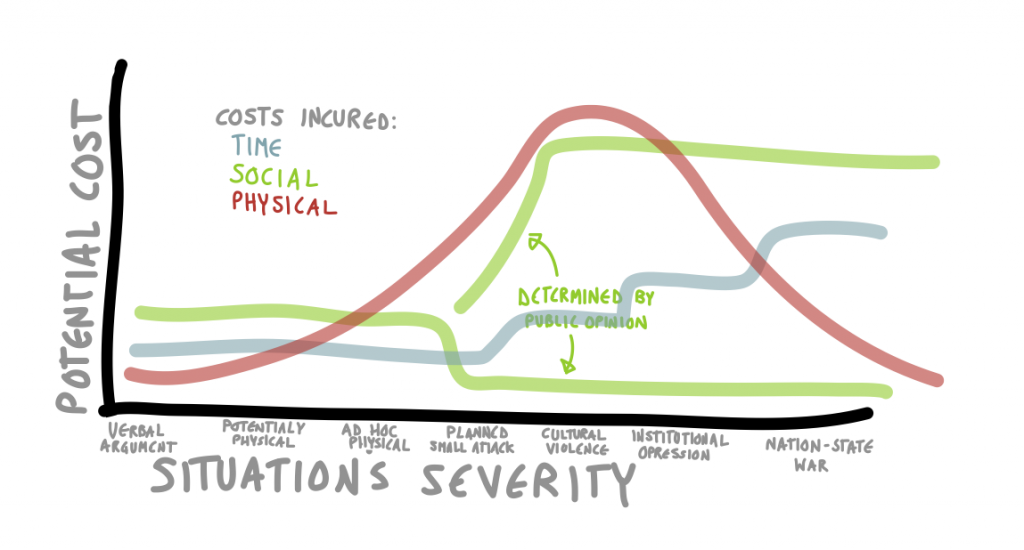
It then became an act of distracting him away from the driver, without having him escalate towards me, while our steersman got us to the next stop safely. The man experiencing angst had missed his stop (a significant thing on an express route), and the driver had not let him off at a non-stop area. Because of safety, and consistency, and because infrastructure does indeed have to adhere to The Rules. But I didn’t ask him about that (he was wrong, and would not have been persuaded otherwise. If he had valid concerns I would have focused on that, and proper channels to deal with complaints), I only kept reminding him that we were ON A BUS ON THE HIGHWAY AND HE WAS DISTRACTING THE DRIVER. I focused on the lives, in a very immediate and pressing way, which were at risk because of this distraction, not his behavior or what had triggered it. Focused only on potential outcome of his current approach. It mostly worked. He tried insults about my hair (heard it), my gender presentation (yawn), his physical superiority (just try). When we had arrived at our stop and he had been booted, I checked in with the driver – does he need my contact in case there is a report? Did he need anything else? – and then returned to my seat. Seething. Why is it an appallingly normal situation that, of all the people in an area, conflict resolution lands on the shoulders of myself and those I keep the company of? I nearly (nearly) had a “sheeple!” moment. And then I took a deep breath and drew a chart instead.

conflict engagement

Physical harm based on proximity to incidence. Of course this graph is subjective.


I started to think about why people don’t engage in situations like these. Things like Diffusion of Responsibility have been studied at great length in the past – the same reason asking someone to watch my bag for me is successful is also why individuals don’t step up to help an individual when a large group is present. See the obligatory reference to Bystander Effect and Kitty Genovese (case taken with grain of salt, but Bystander Effect is well established). But I would hope that the people I associate with would actively dislike being a bystander, and are simply lacking the understanding of how to engage.

Here’s a quick run-down on how I engage with conflict. The base assumption being that you HAVE to, as you’ll be the only one. (Except for when you’re not, and the beauty of a group of strangers coming together around a pressing issue is beautiful. You will be supported, and supporting someone else. Just because one person has stepped up doesn’t mean you shouldn’t as well.) First, you have to assess the situation. These are generalities and non-linear.

  • Assess what is going on, severity, is this for you or “official” response, etc. Who is most at risk? Are you protecting or breaking things up?
  • What is the end goal?
  • Where can you help, if you can? If you can’t help, what needs to happen to assist the situation?
  • What sort of engagement can you do, and what is the backup plan if it escalates past that?

Now that you know vaguely what you’re dealing with and what your limits are, it’s time to engage. Certainly contextual to danger you’re not prepared to deal with.

  • Check in, usually via eye contact. Do this with the person who is least in control. Also do this with the person in the most control to see if they’re of the persuading type. Ask each how they are doing.
  • No matter what insults are thrown, or arguments are made, stick to what your goal is. It can be hard to be rational in these situations, and easy to get pulled into the energy. Stick to your mental guns.
  • If needed, enlist someone nearby to call authority figures. You need your attention where it is, and hopefully this means you’ve pulled at least one person out of by-stander headspace into up-stander headspace.
  • Oftentimes, just being called on being inappropriate it enough to get an individual or group to desist.

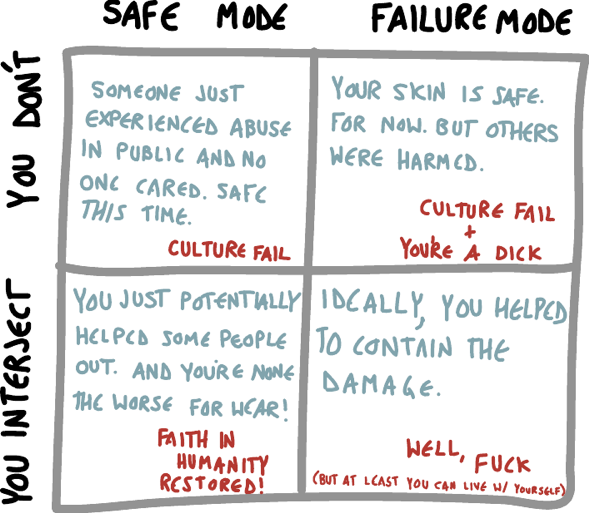
Me, personally, I’m pretty ok with getting into a fist fight so long as I am fairly certain there aren’t any weapons around. While getting hit sucks, the mere willingness to put yourself at that risk deescalates most situations. Think of it like poker, and you’re calling a bluff – but you have to be willing to take the hit if you’re wrong. Here is why I think it’s imperative to take responsibility in these situations, broken down in chart format:

conflict grid

This is important to me because, honestly, sometimes I need backup too. I’m reminded of sitting on the BART, headed to the airport, when two guys came and sat in the seats near me. There was the pretty standard come-ons, accompanied by aggressive body language, clearly trying to box me into the seat. I did my usual progression: first good natured “sorry, not interested, and did you know your approach is kind of awkward?” followed by “not even cute. Piss off.” They even pushed it to the point of dead-on eye lock with “Look. Either persuade me you don’t have balls, or I’m going to remove them.” They got off at the next stop, muttering between themselves. While their actions were appalling, what I found so much more awful were that when I had tried to make eye contact with the other people on the car, of whom there were plenty, no one would. And while I can take care of myself, the thought of someone who is less willing to cause lots of damage (even if losing) seeking help and not getting it makes me feel utterly disgusted.

Our system is incredibly flawed in how we hold perpetrators accountable for their actions. I am not disputing that. But equally (or more) dangerous is a lack of taking bystanders to task. And to that end, I want you to listen to the most recent Brainmeats! podcast on Social Scripts for Abuse, and think about how we can fix this. What role does a community play around bad actors? That community can be social or geographic. As always, it starts with you. Stand up. I hope this has given the beginning structures on which to engage.

Safe space (online and off) isn’t just about policies and retributions, it’s about how we as individuals encourage, expect, and enforce it. It’s not about ego (either it getting bruised if you fail, or bolstered if you don’t), it’s about being able to exist.

Coping Processes

I’ve been struggling with social anxiety a lot lately. I’m aware of my stressors, the main one being the way I’ve been framing my work. It’s gotten to low-level panic attacks for days on end. Yes, I know I work too much. Yes, I know I tend to care far too much about the wrong things. Let me re-state that. I mis-prioritize my actions based on the outcomes I would like (I don’t execute in ways that will further my end goals).

And then the crux of the problem – I am actually an introvert who just happens to be good at people. I feel like the stage tech who gets dragged out on stage to act, and I just want to be in the dark reading cues and flipping switches so other people can bare their souls. The people who like doing that sort of thing. That said, I find people fascinating. I love how individuals build a society out of their communities. But. Every single person I cross paths with, or see on the street, or see the lighted window in a building.. each of them has a life that is just as complex (if not more so) as mine. And most of it will never overlap with me – which is great. But it’s so.. massive. And complicated by all the other lives abutting theirs, the social factors they’re not even aware of, that we’re all monkeys in clothes with language. And then one person comes up to you and asks you where the bathroom is, and it’s like “do you even realize what that means? That we have bathrooms! History and context and memetics! And that so many people used that public restroom before you!” I don’t even care about the washed hands (I mean I do, but not in this context), there’s just so much past-ness (thanks, Dymaxion, for the term) behind that stall door. And should we even be using toilets? And that’s just a tiny portion of everyone’s day that no one really thinks about. And then the person just blinks at you, and you point them in the (supposedly) right direction, and they walk that way. And then someone else comes up to you. Rinse and repeat.

So. That. I’ve started medication that is situation-based, only in my system for so long, to deal with the anxiety. And there’s the possibility of mood-stabilizing drugs, but first I have to set up a double-blind and match a placebo. Which brings us to the point of this entry (you knew we’d get here eventually): processes for coping. But first another tangent!

One of the reasons I’m medicating is because it’s incredibly difficult to keep a routine when on the road, what with switching timezones constantly and staying in other people’s space. Pacing around half-naked and sweaty practicing German after a morning run can only be done in the closest of friends’ living rooms. But the nomadic lifestyle is so incredibly worth it. And even a routine is just a coping mechanism, a way to stave off the anxiety. Something my psych said that made me feel better about the situation was “I don’t think it’s psychosomatic – you would have dealt with it by sheer force of will. There is something going on in your brain you don’t have control over.” Which also freaks me out, but oh well.

Processes help. Routine when you can find it. Meditation is a process. Quantified Self can be a process. I talked to Ed of i3 Detroit (and recent transplant to Boston) about his process. He’s listed out people who are important to him in a column, and dates across the top row. He draws a smiley or frowny face for what sort of topic he called them about, when. He can see how to balance good calls and bad calls, and make sure that he’s been keeping up with folk. I’m going to try this out. The best I can hope to do is once a month – I hate the phone in general, and even this would be a vast improvement over the current complete lack.

What do you do to cope? What processes do you have?

How do you know who is important? My three criteria are that they make me think, they make me laugh, and they aren’t drama. I am blessed that my list of people is so long. That doesn’t mean I’m any good at keeping up with people who I should be indicating my fondness of. I *suck* at keeping up with people. I am very present where I am, which means I’m just not pinging people that aren’t there right then. Which has been a difficult place for me to get to. Apparently humans take some time every day to contact folk who aren’t physically present. I thought about auto-sending emails of affection and check-ins, but that seems fake. What I can do is set alarms for myself, to be sure I do things when I should. That’s more authentic, right?

Also, you should totally check out Ed. He’s awesome. He does things like Penflake, and now works with the Center For Civic Media, my biggest organizational crush right now. Be still my activist techie heart.

He also made a way for people to create easily in the same way.

I wanted to do something interactive for Maker Faire last year. I had been drawing my PenFlakes, and thought it would be cool if people could design their own and print them out. So I created FlakePad, a javascript/HTML5 web app that enforces the basic symmetry of a snowflake, and provides a hexagonal grid to work off of.

Aside from being a great way to get my hands dirty with HTML5, the most interesting part of the app was creating the hexagonal grid. I wound up learning about and utilizing Isometric Cubic Coordinates. These coordinates provide an amazingly simple way to label hexagons on a grid, as well as a relatively simple transformation to and from standard Cartesian Coordinates. The basic trick is to recognize that a hexagonal grid, can be seen as a projection of a 3D arrangement of cubes centered on the plane x+y+z=0 (imagine Q*bert, the old NES game).

Co-opting and Saturation

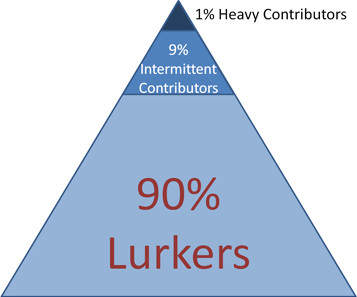
I read this study recently, about the inequality of online contributions. You should go read it as well, and then come back here. It’s easy to digest, and a quick read. You can even just skim it.

The first step to dealing with participation inequality is to recognize that it will always be with us. It’s existed in every online community and multi-user service that has ever been studied.

I wonder if there are studies on off-line communities, and if they show a similar trend. If you know of any, please post to comments.

Imagine if we could push people up this pyramid. What an incredible world we would live in, were more people to be creators, or at least to actively contribute in some way! Or at the least, we would be less fucked. I sincerely believe many of the problems facing humanity could be addressed if more people took an active role in their lives. Blame my socialist upbringing if you like. It’s why I worked (and continue to work) so hard at Jigsaw – creating an entry-level environment for n00bs to get their hands around a soldering iron before facing what can be rather intimidating robotics and the like. I gave a talk at Berlin-Sides in 2010 about hackerspaces being extroverted, and how it was an absolute necessity. Not for every group, but for at least some. We can’t just serve the people who already know, and request, what they want. We can’t just create a new class of elite. We have to welcome, and actively invite, lurkers to become editors; and editors to become creators. (Or do we? I am sad to question this assumption)

So while this pyramid might hold true for online communities, what about communities which simply do most of their interactions online? Makerspaces have become A Thing. Tech conferences are blowing further and further past their capacities (On what feels beyond an expected progression. I would love actual numbers on this if anyone has them). What is causing this? People wanting to have an active role in their lives? Is consumption finally not enough? Or is it just the new shiny?

Insert plug for the totally rockin’ Brainmeats podcast on Co-Option of Subcultures here. (Download mp3)

Regardless of the reason for the shift, one of the strengths of these movements has been that we all KNOW each other. We’re engaging in things that, while sometimes not inherently dangerous themselves, bring upheaval and unrest. And now that things are gaining traction and the public eye, we’re gaining mass like some sort of burgeoning star. How do we encourage the engagement of more people while not diluting the vision of what we are? As Johannes said at HOPE, “isn’t being elite part of being a hacker”? So how do we balance that necessity and functional form of seclusion with a wider vision of the world? How do we infect memetics without turning into homeopathy? Meaning: how do we actually change larger culture as it gobbles us up, while holding onto our ethos? Becoming diluted will not increase our impact.

This was my third DEFCON. Saw old friends, actually went to a few talks, and got into bed before 3a both nights (no lie!). This year was massive – over 10 thousand people. And we talked a lot, in continuation of HOPE, about what to do when your community gets huge. We’ve been way past Dunbar’s number for awhile now, but still broke into manageable group sizes. But now… there’s a worry, just like at Congress… what is “too big”?

Something I’d like to see: specialized, smaller conferences happening in tandem across a city. See the tracks that interest you, speak to the people who share your background. But at night, visit the people you know well and share what you’ve learned. You likely already work closely with friends who share your interests. Now see what patterns exist across interests.
Another thing I’d like to draw on: there are now more medical journal articles coming out than anyone could ever read, for many individual fields, and still have time to work. So what’s started happening is there will be academics who just read a bunch of those papers and pull out the meta aspects of them. Then practicing folk read those meta articles.

A small group of friends and myself hope to try out these methods next year in July. I’ll post about it soonish.

One of my favorite things is to meet someone who is inspired, brilliant, driven.. and realize that we have no overlap. That we aren’t going to be working together. I love that because there are so many things that need to be worked on, and I am but one person. That someone I can grow to trust, and who I respect, is working on one of those myriad aspects gives me a bit more hope for the world. We can continue to break down silos through communication, sharing, and transparency. We can balance that with diving deep into our specialized areas.

When conversing about all this with a dear friend, this was their response:

Profitable problems will always explode with magic-seekers. Computer hacking is now a profitable problem, and participation is accordingly weird.

There will always be too many interesting problems in the world and never enough people connecting to solve those problems. Valuing hacks over hackers helps, as does creating opportunities to gain social status by teaching others. I’m not worried about losing a unified vision because I don’t think there should be one. As for maintaining a community, decentralized networks of curious and creative people scale well. – Kaleen

Tesla Gun

I sat down one evening at Unit 15 in the old Rainier Brewery Building with Rob Flickenger. His projects have always been amazing – the can-tennashrunken quartersbuilding wireless networks for the UN in Africa, and writing the books (literally) on wireless networks. His most recent project pushes him even further into the mad scientist realm. He’s built a Tesla Gun.
robwithgunNOTE TO READERS: This is a dangerous idea. An operator holds this device as it operates. Tesla coils and other high voltage devices can stop your heart. The operator must be ABSOLUTELY SURE that the case has a solid ground to shunt the electricity to earth, and not through you. And while I’m all about taking informed and calculated risks, this is me informing you. Ok. Read on.



When I asked him why he had started on this project, he cited Steven Sanders and Matt Fraction’s Five Fists of Science, a graphic novel in which Tesla and Twain battle the evil forces of Edison and Marconi. “How much more epically awesome can you get than a young Tesla fighting evil with a TESLA GUN?”

While Rob is undoubtedly brilliant, he had to learn a lot to make this project happen. If you made something like this out of duct tape and plastic, it would kill you. But if he wanted that Tesla Gun, he’d have to make a lot of the parts himself. Luckily for Rob, he lives in Seattle, where we have an outstanding group of hacker/makerspaces and incredible people doing crazy things in them. He went and talked to a lot of people. He learned about aluminum casting, 3D printing, working with ceramic slip, and machining — all things he had never had first-hand experience with. He learned even more about high voltage electronics. The end result is a hand-held (if you are veryvery certain it is grounded) spark-gap Tesla Gun that puts out around 100k volts with sparks leaping a meter to DAGGAR*.

teslagun

How and where it was made:

The casing needed to aluminum to withstand the high voltage and look cool. Rob headed over to Hazard Factory to talk with Rusty. They used the foundry there and green casted a NERF gun mold.

The resulting case was machined down with the Hackerbot mill so it would line up correctly and look pretty. He also machined some HDPE stand offs to house the primary coil, so it would be sturdy and resistant to HV. Then he needed a different switch – “no one in their right mind would manufacture what I needed for the consumer market.”

Off to Metrix Create:Space to 3D powder print a mold. They then poured porcelain slip into it, and fired the resulting piece in the kiln. The custom-made porcelain and tungsten switch can withstand 20kv at several hundred amps.

Most of the work was done at Rob’s resident hackerspace, Unit 15 (private). There, he put together his Hockey Puck of Doom. HPoD is a zero voltage sense flyback driver found on Instructables that lets you turn an 18 volt drill battery into 20k volts (the reason this device is more portable than other coils of the same effect). He hand-wound the 1100 turns of #30 copper wire, and laser etched some of the fiddly bits for a more mad-scientist feeling. And my personal favorite: the transformer is from an old TV, which is the best possible use I can think of for old TVs.

Finally, he did a talk at Ada’s Technical Books and at Jigsaw Renaissance to share the joy. The talk at Ada’s was video’d and can be viewed here.
lighting

“Telsa Coils are at the intersection of science and magic. It’s impossible to describe the visceral experience of the luminous discharge of a secondary terminal, from a machine that creates ion streams using 100 year old technology. They make a room smell like a thunderstorm.”

As a closing story, Rob told me about the most exciting thing he had ever electrified – himself. One evening, three Tesla coils were running in the same room at Hackerbot at the same time. He powered his down and noticed it was self-resonating – throwing sparks from secondary without being powered, presumably from being in-tune with the two others. He thought, the current coming off must be small, and wondered if he could draw it out with his finger. Rob was then surprised to pull a 4 foot spark — one of the the others was striking it from another angle. “It was awesome. But not the kind of awesome I like to promote. You want the controlled kind of high voltage project.”

daggarYou can read a whole lot more about the project over on his blog, Hacker Friendly. He’ll be showing it off at the Seattle Mini Maker Faire.

*DAGGAR is a staple of HV projects in Seattle. There is nothing more epic than catching lightning on this cheesily ornate blade.

images by yours truly and Rob Flickenger.

What does education mean to you?

As you all likely know, my intent is always towards education. I don’t mean traditional systems, though that works for some folk quite well (myself included). I mean the simple act of learning. The fulfillment and deepening of curiosity. It means an engagement with the world that can only be temporarily dimmed by complacency. It means the survival and prosperity of individuals, their community, and the superorganism we all compose together. But for me it’s one simple idea:

Education is the best possible fulcrum for social change.


Everyone interacts with it, even if it’s explicitly not to. Everyone agrees our current systems are broken. And through the examination of those systems, we come to understand our cultures, and how we are affected by and effecting those cultures.

I’ve gotten into 50-comment-deep threads on Google Reader before (sadface to my recently departed favorite social forum) about this sort of cultural awareness, so let me explain a bit more.
I can support whatever choices someone is making, even if I don’t fully get it or if it doesn’t seat well with my personal world view. I can only do this, though, if they have examined those choices in light of other cultural knowledge. I respect the Catholics of Seattle I’ve met because they have also understood science, Greek mythology, and what they personally get out of religion. They have educated themselves about many aspects of culture and decided what works best for them.

This is what got me into Transhumanism – that we are at a point in our evolution where through awareness, we can become self-determining. It’s why I have “we are the machine” as my first tattoo – our interactions with each other are what set us going in certain directions. That is ultimate compassion and ambition.

So. This brings us to the most recent Brainmeats podcast. It’s me and Lisha; James Carlson, my mentor and founder of Bucketworks; Beth Kolko, awesome education hacker at University of Washington; Pete Hall, another amazing education hacker, though in Auckland; Dale Dougherty of MAKE and various hands-on education initiatives; and Kushal Chakrabarti of education microloan foundation Vittana. I have the absurd pleasure of calling each of these folk “friend,” some even “dear friend” or “partner in crime.”

Kushal is doing a blogger challenge right now for Vittana. You should check that out, plus the student I just supported, and get in on one or both of these extensions of opportunity. Those of us who are privileged enough to be able to choose between if school works for us or not, and how we will pay for it if we do, have a responsibility to offer those same opportunities. How often can you say $25 changed someone’s life? I lose that in the dryer every month.

This blog post is part of the Vittana “Make a Difference” blogger challenge. The contest invites bloggers from around the world to discuss various ways to make a difference in the world, as well as share stories on who or what has made a difference in their lives.

The winning blog post will be the post that drives the most loans to students in need. Please support this cause (and this blog!) by making a loan in my name: “Willow Brugh.” Be sure to type that in when you reach the checkout page (example screenshot) The more loans you make the more educations get funded and the more recognition and traffic my site gets!

Please support this blog and contest by using this special link to tweet about it (You can edit the tweet before it’s posted, but make sure this link (http://bit.ly/s5beTT)and the hashtag #vittanachallenge is part of the tweet or Vittana won’t know you tweeted about me!)

Brainmeats : Occupy Everything

Brainmeats Episode 1 – Occupy Everything!

Download ogg format or mp3 format.

The inaugural episode of the BrainMeats podcast is devoted to the Occupy movement and what hackers and makers can do to support the protesters on the ground. Willow spoke over Skype to AriEllaMattRuben, and Smári about the history of OWS, the meaning of illegibility within the movement, software tools for protesters, and more. Absolute thanks also to Lisha who came up with the idea of these podcasts (and who will be joining in future episodes), and who also edited and is hosting the audio.

The episode is licensed Creative Commons: Attribution, Share Alike, Non Commercial

Smári writes more about the concept of illegibility within Occupy at http://www.smarimccarthy.com/2011/10/occupied-with-illegibility/

The RSA Animate videos mentioned in the podcast can be viewed here:
The Internet in Society: Empowering and Censoring Citizens
Language as a Window into Human Nature

Also mentioned:

OccupyHack
OccupyDesign
OccupyTogether
Sukey
A mobile tool for viewing what protesters and police are saying and where they are.
Briar
Briar is a secure news and discussion system designed to be used by journalists, activists and civil society groups in authoritarian countries.
The Guardian Project
Creators of Android apps and firmware MODs intended to protect communications and personal data from unjust intrusion and monitoring.
The Free Network Foundation
An organization committed to the tenets of free information, free culture, and free society. They use peer-to-peer technologies to create a global network intended to be immune to censorship and resistant to breakdown.
NoiseTor
A donation-funded Tor exit node project
Vibe
A (non-secure) tool for communicating micro-blog-style for a specific amount of time to people within a specific radius around your present location.
Fluid Nexus security issues

Importance of Security in Communications

If any of you know me personally, you know one of my main investments in the ideals behind GWOB are those of propagating security. Being in Berlin this past week for Chaos Communications Camp was a true joy – European hackers, specifically those from Berlin – tend to have a highly-tuned sense of geek social responsibility. I could go into (at great length) my theories on the historical basis for this, but let’s just dive right in.

At-risk populations using telecommunications systems must be secure in doing so. If a tool is created which further jeopardizes their well-being, kittens die. And so I was filled with joy when people I have the honor of knowing stood up for those at-risk populations and broke something — fast. In fact, they broke it before breakfast. Fluid Nexus is (was) a tool specifically designed for activists to use for off-grid communications. While a noble idea, it completely failed to shield its target user base from security attacks.

Additionally, the ownership of a message is attributable when the client’s database is dumped.  On an Android phone, *any* application with access to the SD card can dump the database in this way, making trojans trivial to implement.  Further, this database column does nothing to benefit the users of the software, putting them at risk for no reason.

pro% sqlite3 ~/.FluidNexus/FluidNexus.db
SQLite version 3.7.4
Enter “.help” for instructions
Enter SQL statements terminated with a “;”
sqlite> select title from messages where mine;
Run
Martians know cryptography!
Things change.
Evidence against me.
sqlite>

The full (incredibly snarky) write-up can be found on pastebin, I highly encourage the read.

That said, it is incredibly important that people continue working on creating and improving tools for situations in which communications break down. It is equally important to request feedback from people who live in this discipline – will your tool use more power than readily available? Is it possible to use with a different native language? Is it secure? It’s better that people who care break things and help to improve them than The Bad GuysTM doing it live. Get started with this Software for Activists overview.

Credit/Mad Props and Mate to Eleanor Saitta (@dymaxion), Meredith Patterson (@maradydd), and Travis Goodspeed (@travisgoodspeed) for the break; Stephan Urbach (@herrurbach) for the overview; Fabienne Serriere (@fbz) and Skytee Haas (@skytee) for the Hacker Hostel (@hackerhostel); and my own self (@willowbl00) for the crepes.