How I think about retrospectives

I believe in self-improving systems, and retrospectives are a core way of reflecting and then changing behavior accordingly. There’s a lot out there on what a retrospective is, formats to use, and other techniques, so I’ll just highlight my facilitation thoughts on them here. This is influenced by the CAST handbook and my own facilitation background.

Must be blame-free / a psychologically safe space

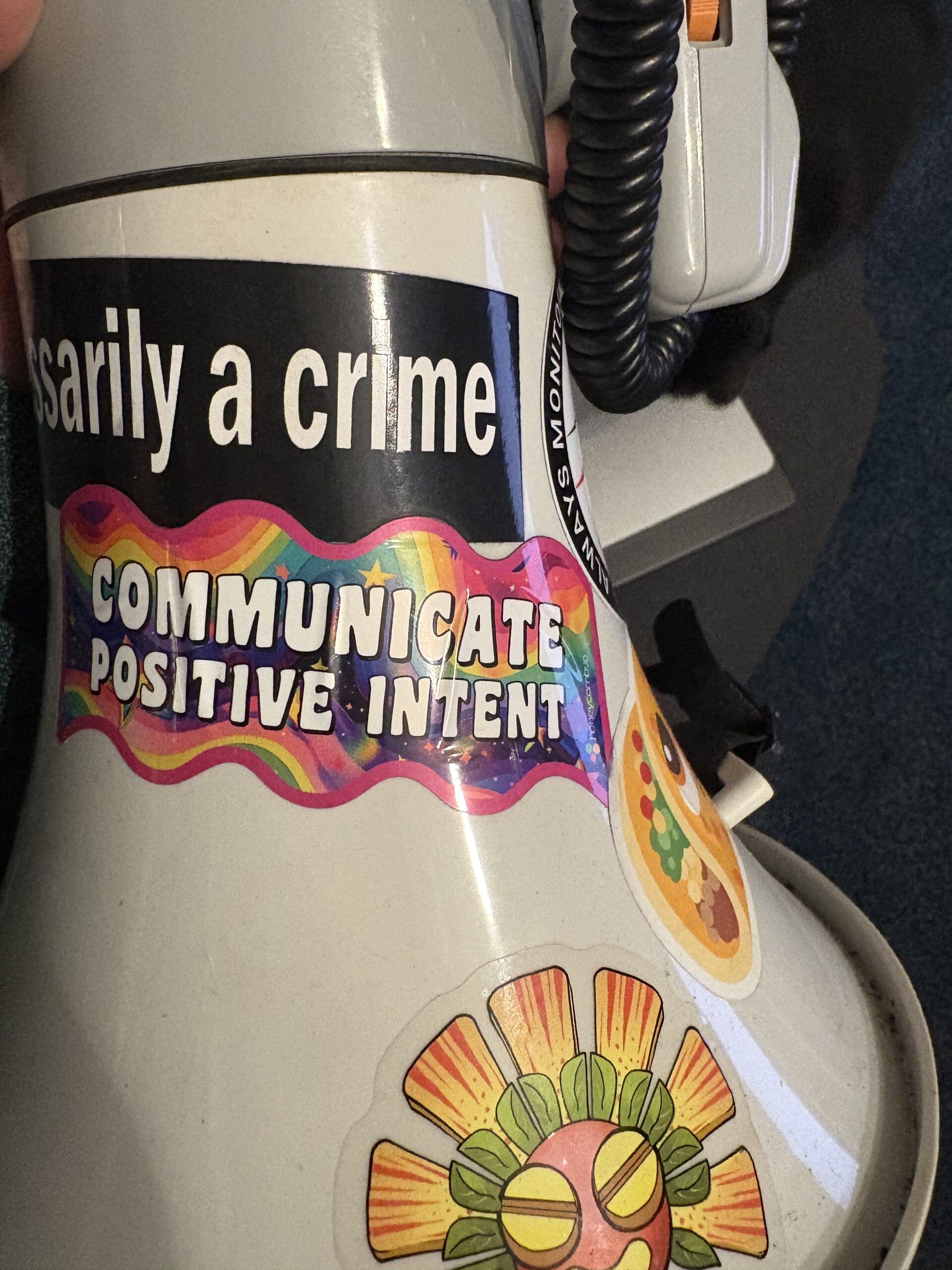
People will not open up and be actually present and interrogative if they don’t feel safe. It is your responsibility when setting up, facilitating, and debriefing to make sure the system is what is being critiqued, not the humans within it. The humans made the best possible choice they could given the circumstances they were in, so let’s change the circumstances in the future. Make this explicit early and often. As Charity says on the sticker on my megaphone, “communicate positive intent.”

A picture of a megaphone focused on a sticker in Lisa Frank obnoxiously bright styling, "communicate positive intent." Additional stickers that are visible are the Priceless Baroot, the edge of a pleading taco emoji, and one that seems to ready "...necessarily a crime."

Must be scoped well

If people don’t know what they’re talking about, they won’t talk about the same thing, and getting to concrete outcomes will become nearly impossible. Focus on a specific project, timeline, or outcome. Communicate this early and often.

Should encourage creative thinking

Whatever format you pick should be mildly novel (not so novel that it disrupts how people approach things, but novel enough to edge them out of their comfort zone). Use a different prompt set or a different tool, but rarely both at the same time. Ask more of people to engage and challenge them into someplace new.

Needs to lead to concrete, actionable tweaks

If you don’t arrive at experiments that will change how you’re behaving, you have wasted everyone’s time. I like to set aside about 1/4 of the time of the retro to listing, refining, and then selecting one or two these experiments. I ask the following questions:

  • What will change if we take this action?
  • What would prevent us from making the change?
  • How will we know if we’re successful or not?
  • When should we check back?
  • What is our next step, and who is responsible for it?

I only pick up 1-3 concrete steps to take after each retro. I track them just like any project, and I report back on them before the next retro to show that the time and vulnerability is worth it.

One goal should be building trust with the team

A core part of the system is team trust, and in improving the system, we should be focused on building that part of it. By being blame free, enacting suggestions, and pushing people to engage more, we build that trust. If something about the retro process is eroding trust, pause and reassess your approach.

Experiments in being anticapitalist

Priceless was founded as an anticapitalist event. I’m not sure how it worked for the original False Profit crew, but for our Priceless Planners crew, and ongoing discussion has been about wealth disparity within the Planner community. The vibe has been that while we question capitalism, many of us are also doing well enough under capitalism that it’s primarily a theoretical discussion with well thought out experiments in how to HOST an event for others that’s anticapitalist. We set out to change that last year by taking on a radical experiment of moving from volunteer-only organizing (we do pay our food vendor, medical staff, and security staff; along with paying artists and musicians to help us host our event) to paying a couple roles. This is how that went, and what comes next.

Continue reading

Scaling organizations from 50 to 150

There’s this thing that some organizational theory nerds (hi) talk about called the “rule of threes.” What it means, basically, is that every time your organization grows by x3, the way the organization operates has to change. While that blog post breaks down the numbers differently, I see one of the main inflection points as being between 50 and 150. One of my dear friends is on the board of a maker space, and they’ve recently started experiencing growing pains at the 120 mark where trust is breaking down and folks aren’t as aligned as they once were. This is a blog post about what I recommended to him based on the stage they’re at.

Institute and N+1 expectation

As the group grows, things start to slip through the cracks, and the accumulation of those things bothers some folks. Institute an N+1 rule. It goes like this:

  • Every time you pick up a piece of trash or wash a dish, do it for one extra.
  • Every time you restock a soda or filament, stock one more than seems necessary.
  • Every time you order for the space, order one more than you think you need.
  • When you’re sitting in a circle, always have one chair open for someone to join the group.

Etc. This helps deal with the slop of having a bunch of people sharing a space.

Build culture

Build a culture of

  • respecting each other, who you serve, and the space you use.
  • gently enforcing boundaries.
  • giving feedback on small things so feedback on big things is easier.
  • “deescalate with everyone but the enemy.” We are in a time of fascism, and infighting is kind of what the Left is known for.

Have a framework for course correction that visible people use, and gently encourage others to do the same.

Reiterate expectations

Set these and other specific expectations in onboarding documentation, with your People/HR team, in your Code of Conduct, and in everyday exchanges. This helps folks remember and course correct for themselves and others without it being personal.

Influence without Control

One of the core skills as a program manager is “influence without control.” I am stellar at this, primarily because of my work in network organizations and working with volunteers. While we had a small team at Geeks Without Bounds, nearly everyone we interacted with was volunteering their time. Same goes for Digital Humanitarian Network. Priceless experimented with hiring and paying two roles this year (I developed the hiring and accountability structures), but otherwise it’s 40 opinionated, badass volunteer planners running the core event with another 150 event volunteers helping in the days of and surrounding the event. And there is zero control over volunteers, there is only influence. So here’s how I do it, as a coordinator, program manager, and manager.

This is less about communicating effectively (maybe I’ll write about that another time), and more about attitude towards people you’re working with.

Continue reading

July Joy : Kids at Priceless

So as I’ve mentioned before, I help out with this medium-sized anticapitalist campout in the woods with lots of music and art. I love it. It also drives me batty.

As one might imagine, a festival that’s been running for 20 years has some Complex Feelings on a few topics. One of those topics is kids. Way back when the crew of friends who threw the event started having one or two grubs emerging, they sat down and had a (really long) discussion. What they arrived at was: Priceless is a festival for adults that Priceless-friendly kids are welcome at. It is up to the adults in their lives to mediate their experience, and no one is to censure themselves or change their behavior just because there are kids present.

Locke in a gnomish pointed straw hat, tiedye shirt, and shorts kneels in front of a circle made of upright sticks in the sand. There are some leaves and a bottle cap in the center of the circle. Floaties and sandals are in the background.

Over the years, the number of kids increased. And the message was a bit lost. A couple years ago, I was on People Team, and multiple people mentioned choosing art or changing their musical acts because of kiddos being present. Others weren’t in the headspace they wanted to be in while there were kids present. So we sat down again for another long conversation about kids at Priceless. And we realized that we were all on board for the original message. Priceless isn’t kid-friendly, but Priceless-friendly kids are welcome. We wrote some new things — refined the child waiver that sets out expectations, and also put together an expectations doc that all attendees can read to level-set.

Estelle and Yulia put together the area called Kidsville this year; and Reed, JoJo (grandma), and I brought Locke to his first Priceless.

We went camping twice this year in anticipation of Priceless — once for one night, and then a follow-up with birthday buddy Liora for two nights. Camping was a smash hit, but we were still nervous to have him at a festival. So much stimulation, so many people, such a bigger area than our usual campground. But we got set up near 3 other families we know well and ended up with a little living room area in addition to the big Kidsville lounge area a short walk away. And Locke LOVED it. I was mostly preoccupied with helping the whole event run, but the rest of the fam swam in the river, and ate pancakes, and dug in the sand.

Willow, Reed, and Locke cuddle on some grass. Willow sits upright in a bikini top with lots of tattoos and signature blue hair. Reed has a pink mohawk and head in Willow's lap. Locke leans against Willow with one leg held up and a smile.

By the end of the event, our reserved kiddo was going up to strangers to ask them to play with him. The noise levels weren’t too much for him! And he did a great job of playing with the other kids. Being in such a high-trust environment was good for all of us. Looking forward to similar experiences in the future.

The secrets we keep

I now know that saying you work at Apple is like saying you work at the government. Which part matters a lot.

I worked in Security, Engineering, and ARchitecture (SEAR) for the last 5 years as an Engineering Project Manager (EPM). I had a key role in helping Contact Key Verification, Blastdoor, Advanced Data Protection, Forgotten Passcode, Legacy Contact, Child Safety, and some hardware improvements ship. I was doing infrastructural work to continually improve security across the keychain, certificates, cryptography, authentication, insight and detection, endpoint security, and sandboxing. I made sure we got our certifications. I helped Red Teams and fuzzing to be effective. Not all at the same time. But 2-4 releases in flight at a time, and 3-6 teams on board at a time.

A lot of what I worked on I can’t talk about. And I will continue to not talk about until they ship. That was the problem.

I thrive on talking to a wide variety of people about whatever they’re passionate about. I invest in my network, and my network loves me back. It is deep and powerful. I love getting groups of folks to discover something collectively that is new to each of them. I love making weird connections between groups to help them be better. Apple works on the pushing-a-pimple-out-of-a-circle innovation route, a choose-the-best-from-set-options route, and I work the novel-graph-connection-to-make-something-new route. And it was slowly crushing my spirit.

At first, the company was big enough that I was still able to make graph connections. But that wore out quickly as we ran into disclosures and folks not being able to talk about what they actually knew and were passionate about. I still did senior-level technical project manager work while not in my lane. I tracked projects, I mentored folks. Things shipped. But I struggled. I wasn’t happy. I didn’t have anything to talk about with my husband or son when I got home from work. Reed, at one point, pretended that I worked a miniature golf course experience production company. When I vented about a coworker (the only part of work I felt comfortable talking about with non-disclosed folks), he’d sagely nod while thinking “ah, hole 3 is really coming together.”

I tried this experiment for 3 years of trying to have non-productive hobbies. You know, cross stitch and stuff. And it just didn’t work for me. I applaud the folks who can turn off, I will fight for our rights to have time to do things that are not governed by capitalism. I read sci-fi in bed for sure, but I didn’t like trying to take up spare hours on weekends not organizing people. I’m like a Border Collie or something. And I want to talk to people about it. I want to be able to make sense of the world by connecting what I know to what other people know. It’s hilarious to me that Apple TV is what Severance is on. I get the “surprise and delight” thing, but ends up I do not like surprises or getting them.

Securing a billion people without them having to care or notice is a pretty compelling argument, so I stuck with it for 5 years. I worked with many incredible, driven people. But for me, the same reason I struggle with role playing tabletop games is the same reason I struggled at Apple — I am my whole self, with all of its facets, all of the time. I can keep a secret (snitches get stitches!), but I can’t keep a whole part of my life secret.

So, I’m looking for work. Here’s my portfolio of things I’ve done. Here’s my resume. And I’m dipping my toe back in with the disaster zine, digital estate planning, security consulting implementation with Myeong at Tiny Gigantic, and facilitation gigs in the meantime. Let me know if you have a me-shaped hole, because trying to do not-me-shaped things sure didn’t work. I’m a work horse, and I’m good, and I also really like sharing.

June Joy : Deciding to throw Priceless!

When one of my dearest friends found out I was planning to move from the Boston Area to the Bay Area, he put me in touch with the planners behind Priceless to give me some extra social safety net and ways to plug in.

Priceless is an anticapitalist campout with about 1150 attendees on the Feather River in Northern California. It’s historically happened July 4th weekend, and has been running for.. 18 years? There was one year it got cancelled due to fires, and a Half Price during Covid, and some other anomalies. It has 3-4 stages with different sorts of music (here’s the sampler set that got me hooked), lots of art, and was (until this year) entirely volunteer run. Our food vendor (paid for in advance) is the only thing that involves money on site for the festival. It’s wonderful. And until this year, it had sold out every year, within a very short period of time.

Continue reading

Approaches to Conflict

We’re already seeing people being disappeared. I think we’ll see more of that, and people fighting back, and a possible escalation of violence between civilian factions, and between civilians and the government. I think things will get kinetic soon. I think it’s important to be deliberate in how we approach the incoming conflict, to not be swept up in it. So I’ve been having conversations with friends and neighbors about what this might look like, and how we want to approach things. This blog post is inspired by those conversations, but I’m not going to name everyone here because that would be bad opsec. These are friends with direct experience with conflict, and/or are deeply researched about it.

So first, to set the tone, there are already groups saying we’re lined up for a genocide against trans folks in the US. People who know how these things go say we’re headed there. We need to be aware of this and fight it, not “wait it out.” It will only get better if we make it better. So this is a post not about theoreticals, this is a post about how I’m approaching something that seems certain at this point. Friends say we’ll probably look like Columbia, and suggest Lederach as a person to read, although I haven’t yet.

I’m balancing two views here, both from people I have direct contact with, and both of which are born of deep experience. One is about how some communities decide to opt out of conflict despite it happening all around them, and the other is about being willing to be in conflict with bullies scaring the bullies away in post-disaster zones. From that, I’ve decided my goal is to not be in conflict, and to be ready to defend myself if that approach doesn’t work. And I know you can’t prepare for peace and war at the same time, but also I’m not setting strategy for a country. The Quakers would disagree with this approach, and point out that nonviolence does not mean passivity, and that putting violence on the table tends to optimize for violence and limit approaches to responding to violence. Regardless of how you choose to engage, hold close to the fact that violence isn’t the norm, and we should work to return to a peaceful baseline. Be loud about violence being abnormal and not acceptable. If you go a nonviolent route, make it clear that fighting, if it’s going to happen, happens outside of your space. The people being violent can do it in their own spaces. 

Most of the ways communities have approached opting out of conflict had to do with being connected with their neighbors and always welcoming more people in (if they adhere to the nonviolence). That’s harder after eviction culture and being hyper individualistic — I will forever beat the drum of bringing unknown neighbors baked goods to try to get to know them. Maybe go talk to your local security forces about how they’re thinking about the incoming conflict and what they see their role as — some have already started making statements about never working with ICE. Further afield, having such far-flung communities means having early warning systems for where the violence WILL start, so stay in touch with those loved ones who live in other places and talk about what the local happenings are. 

When Marshall, author of Opting Out of War, came to talk to a small group of us about his research, he told us about the differences between Sarajevo and Tolisa in Bosnia, and how Sarajevo buttoned down in neighborhoods and fell into local violence, and Tolisa united and welcomed others and avoided much of the violence. An impromptu peace demonstration in Sarajevo was fired upon, killing some protestors, and the movement fell apart and so did the city. Marshall focused on holding a broad circle, anticipation, communication, and relationships with security forces to help stave off conflict. In his book, he also talks about throwing a good party as part of the trends in communities that opt out of conflict. 

In that conversation, we also talked about how we need to only persuade a few percentage points of the population to oust Trump. But that means talking to people who might not be aligned with you politically, and what that might look like. I’d recommend the Better Conflict Bulletin for thinking on how to approach those conversations. I’ve started making bets with people online — define thresholds and timelines and check back it. It forces people to acknowledge risks to their world view, a clear story, and a bid for connection. Offering to build bridges can also be seen as traitorous by either end of the spectrum, and that’s problematic to avoiding armed conflict. 

I’ll still be going to the range with neighbors because shooting is meditative and fun, and because I won’t tolerate people bringing violence to my neighborhood. But I will do so while putting 90% more time and effort into nonviolent approaches, and hoping desperately that path is the one I’m allowed to take.

How are y’all thinking about these things?

Additional reading from Marshall:

  • Erica Chenoweth and Maria Stephan, Why Civil Resistance Works
  • Chenoweth, Civil Resistance: What Everyone Needs to Know
  • William Ury, The Third Side
    • He describes 10 roles for people to play in reducing conflict. It’s an interesting way to think about tapping into people’s strengths and finding the gaps in your organization or your work.
  • Gene Sharp, From Dictatorship to Democracy
  • Sharp, 198 Methods of Nonviolent Action
  • Peter Ackerman, Strategic Nonviolent Conflict
    • Sharp and Ackerman’s organization: The Albert Einstein Institution (https://www.aeinstein.org/). Gene Sharp was instrumental in moving the ideas of nonviolence into secular language from religious. Here in 2025, he’s probably more intellectually influential than King or Gandhi.
  • Srdja Popovic, Blueprint for a Revolution
    • Popovic’s organization: CANVAS (Centre for Applied Nonviolent Action and Strategies) (https://canvasopedia.org/). The publications page has good resources that are also, dare I say it, fun. 
  • Martin Luther King, Jr, Letter From a Birmingham Jail
    • In my opinion, one of the finest strategy documents ever written.

Participating in nonhierarchical organizations

Network/nonhierarchical organizing is my preferred methodology over hierarchy (that was a joke where I put my preferences into a hierarchy). And while I’ve written a fair amount about organizational structures on this blog, I’ve never really talked about what I expect of participants in a network beyond defining governance models. So this is about that. 

Intrinsic Motivation

I learned this term from Debbie Chachra, and I love it. You can learn a whole lot more in this video and in this book, but the basics are this:

  1. Purpose – You gotta know why you want to do something. In networks, this is usually either the thing the network has decided is their collective purpose together, or people joining the network are signing up to the already-stated purpose. Purpose can shift over time, and it’s good to check in on, on occasion, without getting too navel-gazey. 
  2. Scaffolding – You gotta know if you’re on the right track towards your goals within that purpose, and are making progress against that track. In networks, we usually use documentation and skill shares from folks who have already tried it in this or another context. 
  3. Autonomy – With shared purpose guiding you and scaffolding pointing the way, you gotta be able to make decisions for yourself and move without someone else telling you what to do. Because in a network, people (generally) don’t tell each other what to do. There is coordination without control.

Do the work

If you’re present, you should be contributing towards the purpose. This of course includes caring for people doing more directly related work, mentoring, etc. But separate out the philosophical navel-gazing discussion time and people from the work at hand. It’s so much fun to have those philosophical discussions! It’s even important for the purpose of the group and how you communicate that to others. But if you’re not contributing, get out of the way of the people who are and just read their newsletter instead of distracting them. 

Self awareness and integrity

Because no one is telling you what to do, and no one is tracking your work, it is vital that you have enough self awareness to notice if something is going off the rails, or your ability to deliver has changed. You then need to communicate with others about how things are going, even if it’s bad news. Otherwise a competent person who is well resourced quietly working on their own looks the exact same from the outside as someone who is in over their head and can’t deliver. 

Communication

Here, I look for transparency and sharing space. Talking about what your part is in a way that opens up the space for others to weigh in as well is vital. And I’m always a big fan of the rule of N – speak 1/Nth of the time, whether that means taking up more or less space than you’re prone to!

It’s also important here to speak only for yourself. If someone is missing from the room, work to bring them into the room. But speaking for others is paternalistic and you often get it wrong, anyway. The number of productive conversations I’ve seen derailed because someone started concern-trolling about something they barely understood on someone else’s “behalf” is staggering. 

It’s also fun to look at the COINTELPRO guide to disrupting and delaying effective action, and to just avoid doing those things. 

Why I know what I’m talking about

I’ve done a lot of network organizing since I got started in 2009. First organizing hacker and makerspaces to share skills and a 501c3 umbrella for Jigsaw Renaissance and School Factory; then connecting disaster and humanitarian technology groups to each other and responses via Geeks Without Bounds and then UN OCHA’s Digital Humanitarian Network; and now with an art and music campout festival called Priceless. I even considered being an academic for awhile on this topic and how it overlaps with hierarchical orgs at the Center for Civic Media at the MIT Media Lab and the Harvard Berkman-Klein Center for Internet and Technology. Phew.

What I’m doing to prepare

I realized on Friday that all my experience in organizing marginalized frontline populations in times of crisis is really going to come to bear on the upcoming years. This time, we even have some time to prepare, and lots of foundational work has already been happening in our communities by those who haven’t been served by ANY administration that’s been in power.

Find your people

Ideally, you already know some of your neighbors. But maybe you don’t! Capitalism and eviction culture lead to not knowing who’s around you. It means we have less solidarity and less strength against the ruling class. If you don’t already know your neighbors, start getting to know them! Get comfortable knocking on doors with cookies. Be open to who you meet. More and more people are uncomfortable with the status quo, even if they voted differently to you. Remember that the uniting cry of the Zapatists was “¡Ya Basta!” (“enough!”). You may end up with strange allies, but they will be allies nonetheless.

Have a good sense of who you can trust with what. Some folks are excellent at helping people feel welcome, but also don’t have a good gauge of how discrete a new person can be. Some folks are good in a crisis but otherwise aren’t dependable. Etc. There are many things you can trust someone with, have a good sense of who to trust with what.

Be open to new folks showing up, but also be aware that there will be lots of attempts at infiltration as time goes on, especially as you become more known. Each person having a story and a personal contact who can vouch for them goes a long way, but also just behave as if you’re already infiltrated.

Scope your focus

I have chosen to focus on my state and county. If a trans kid from Florida shows up on my porch, Reed and I will talk about housing them. However, I can’t do anything about trans kids in Florida at this point. I can keep giving money to Planned Parenthood in the Midwest and the South, and I can keep giving money to Translifeline, but other than that, I need to hone my focus close to home. Maybe you’ll pick a specific cause to focus on rather than a geographic one. But regardless, pick something that matches your area of influence and stick to it. Else we all go mad and burn out.

I also really liked this article that’s being passed around, that has four areas of focus: protect people, disrupt and disobey, defend civic institutions, and build alternatives. I think it’s good to know which frame folks are using when they’re asking for action. I also think it’s important that all four of these bases be covered (or intentionally left out) when organizing a broader group.

Continue reading